Projectile Motion (VCE SSCE Physics): Revision Notes
📚Revision Notes
Projectile Motion
Introduction
Projectile motion is a fundamental concept in physics that appears frequently in everyday situations, from sports to engineering. Understanding how objects move through the air helps us predict their behaviour and solve practical problems.
A common example of projectile motion can be seen in golf. When golfers select a club, they are choosing the angle at which the ball will be launched. Golf clubs have heads that slope back from the vertical at different angles, and this slope determines both the trajectory and spin of the ball.

Note
The angle of the club head serves two important purposes. First, because the ball launches perpendicular to the club face, a greater slope angle produces a higher but shorter flight path. This is useful when a golfer needs to clear an obstacle such as a bunker whilst ensuring the ball doesn't roll too far past the hole.
Second, the slope angle affects the spin imparted to the ball. Greater slope creates more backspin, which provides lift and makes the ball's trajectory less susceptible to wind interference, resulting in more reliable shots.

What is a projectile?
A projectile is any object that has been launched into the air and subsequently moves freely through space under the influence of gravity alone. For projectiles near Earth's surface, we can treat the gravitational force as constant.
When air resistance is neglected, projectiles follow a parabolic path. This is a crucial point that students often misunderstand: even when a ball is moving upwards, the force acting on it is still directed downwards. The upward motion occurs because the ball possesses upward velocity, not because of an upward force.
Important
A common misconception: When a projectile moves upward, students often think there must be an upward force acting on it. This is incorrect! The upward motion occurs because the object has upward velocity, not because of an upward force. The only force acting is gravity pulling downward throughout the entire flight.
In projectile motion problems, you will typically be given an initial velocity. The question will not concern itself with how the object reached that velocity. For instance, when you throw a ball, you accelerate it whilst it is in contact with your hand. However, the moment the ball leaves your hand, the only force acting on it is the gravitational force pulling it downward. This force remains constant throughout the entire flight.
Fundamental characteristics
Constant gravitational acceleration
All projectiles near Earth's surface experience a constant downward acceleration of due to gravity. This acceleration acts continuously throughout the flight, regardless of the projectile's velocity or direction of motion. Even as the projectile rises, slows down, reaches its peak, and falls back down, the gravitational acceleration remains constant at downward.
Separation of motion components
A fundamental principle in solving projectile motion problems is treating the horizontal and vertical motions as independent of each other. This separation simplifies calculations considerably.
Note
Horizontal motion: When air resistance is ignored, the horizontal component of velocity remains constant throughout the flight. There is no horizontal acceleration because gravity acts only in the vertical direction.
Vertical motion: The vertical component of velocity changes continuously due to the constant downward gravitational acceleration. The projectile decelerates as it rises, momentarily stops at its maximum height (where vertical velocity equals zero), then accelerates downward as it falls.
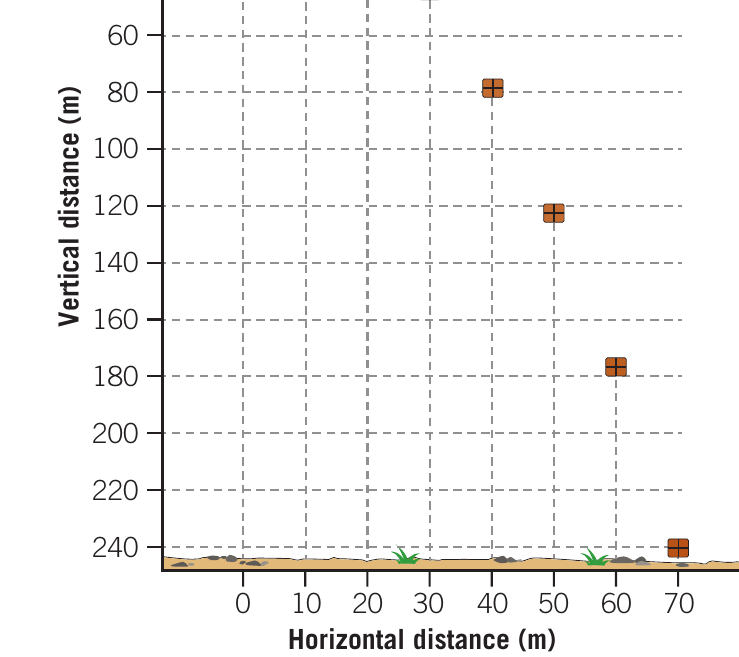
The diagram above illustrates a package dropped from a helicopter travelling horizontally at at a height of . Notice how the horizontal spacing between successive positions remains constant (constant horizontal velocity), whilst the vertical spacing increases (increasing downward velocity).
Solving projectile motion problems
General approach
When tackling projectile motion questions, follow these systematic steps:
Important
Step-by-step approach to projectile motion problems:
-
Draw a clear diagram showing the initial position, velocity (with angle if applicable), and any relevant heights or distances.
-
Choose a positive direction for vertical motion (either up or down) and maintain this convention throughout your calculations.
-
Decompose the initial velocity into horizontal and vertical components using trigonometry:
- Horizontal component:
- Vertical component:
-
Analyse horizontal and vertical motions separately using appropriate equations.
-
Use total flight time to calculate horizontal distance travelled:
-
Remember the vertical acceleration is always downward (or if upward is positive).
-
Calculate final velocity by vector addition of horizontal and vertical components, including direction.
-
Consider air resistance effects qualitatively if required: air resistance opposes motion, reducing both maximum height and horizontal range.
Worked example 1: Projectile launched at an angle
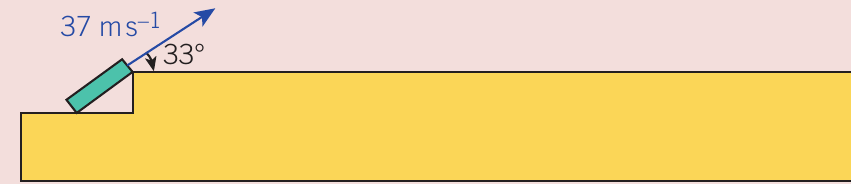
Let's examine a projectile launched from ground level at at an angle of to the horizontal, ignoring air resistance.
Example
Worked Example: Projectile Launched at an Angle from Ground Level
Part (a): Calculate the time of flight
First, we decompose the initial velocity into components:
The projectile reaches its maximum height when the vertical velocity becomes zero. The time to reach maximum height is half the total flight time. Using the equation :
Since the upward journey time equals the downward journey time (for a projectile returning to the same level):
Total flight time
Part (b): Calculate the horizontal distance travelled
With no air resistance, the horizontal velocity remains constant throughout flight. Therefore:
The projectile travels 128 m horizontally before returning to ground level.
Worked example 2: Projectile launched horizontally from a height
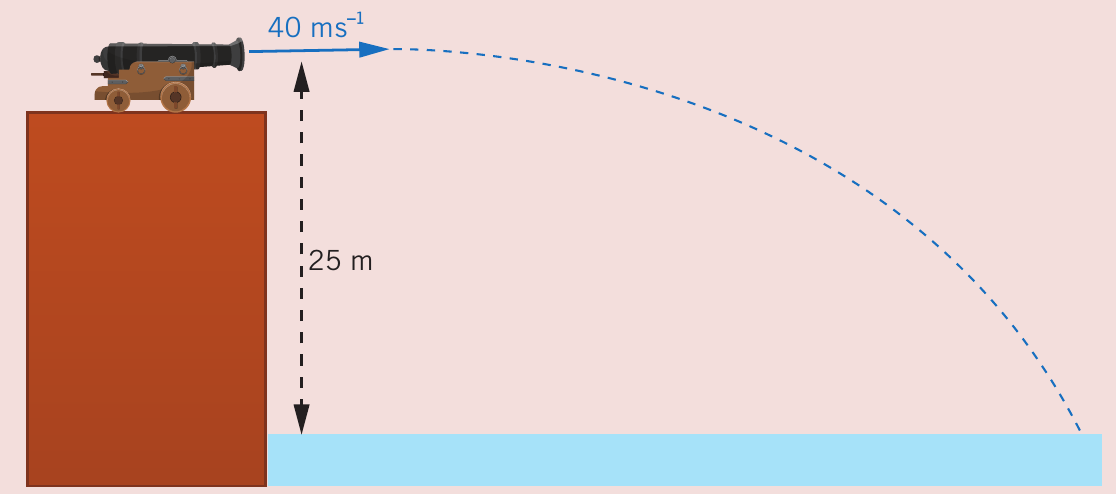
Consider a cannonball launched horizontally at from a cannon positioned above the sea.
Example
Worked Example: Projectile Launched Horizontally from Elevated Position
Part (a): Find the velocity when the cannonball hits the water
When the cannonball strikes the water, its velocity is the vector sum of its constant horizontal velocity and the vertical velocity gained from falling.
First, we calculate the vertical velocity using :
Now we combine the horizontal and vertical components to find the resultant velocity:
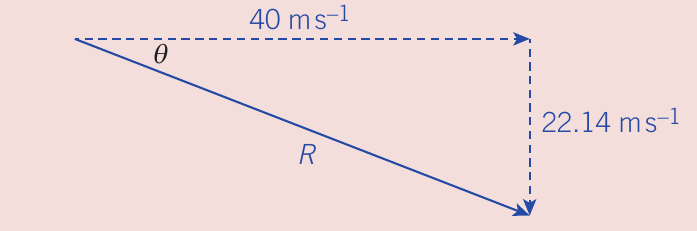
To find the angle below the horizontal:
Therefore, the velocity when the cannonball hits the water is 45.7 m s⁻¹ at 29.0° below the horizontal.
Part (b): Effect of air resistance
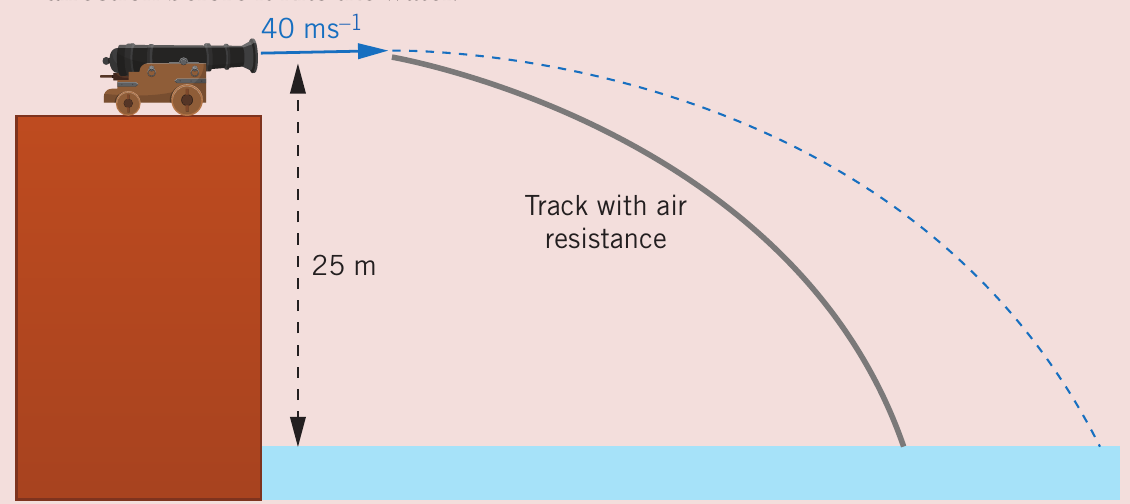
If air resistance is present, it opposes the cannonball's motion throughout its flight. This resistance force slows the projectile, meaning it will not travel as far horizontally before hitting the water. The actual trajectory (solid curve) falls short of the ideal parabolic path (dashed curve).
The force of gravity in projectile motion
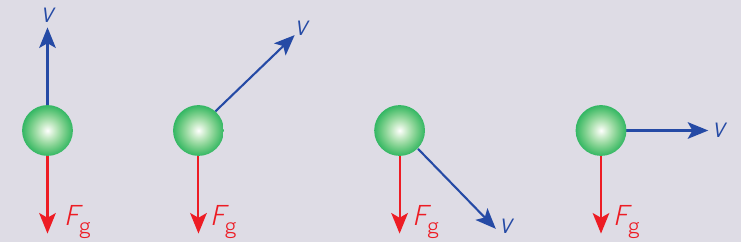
An important concept to understand is that gravitational acceleration acts independently of an object's velocity. Consider four projectiles of equal mass, each with different initial velocities:
Note
Despite their different velocities and directions of motion, all four projectiles experience the same gravitational force acting downward. Consequently, they all have the same downward acceleration of .
This independence means that:
- A projectile moving upward still experiences downward gravitational force
- A projectile moving horizontally still experiences downward gravitational force
- A projectile moving downward experiences the same downward gravitational force
When solving projectile problems, you must always draw a diagram, separate the velocity into horizontal and vertical components, and remember that gravity provides the only force acting on the projectile (when air resistance is negligible). The vertical velocity changes over time due to this constant downward force, but the horizontal velocity remains unchanged.
Extended worked example: Projectile from elevated position at an angle
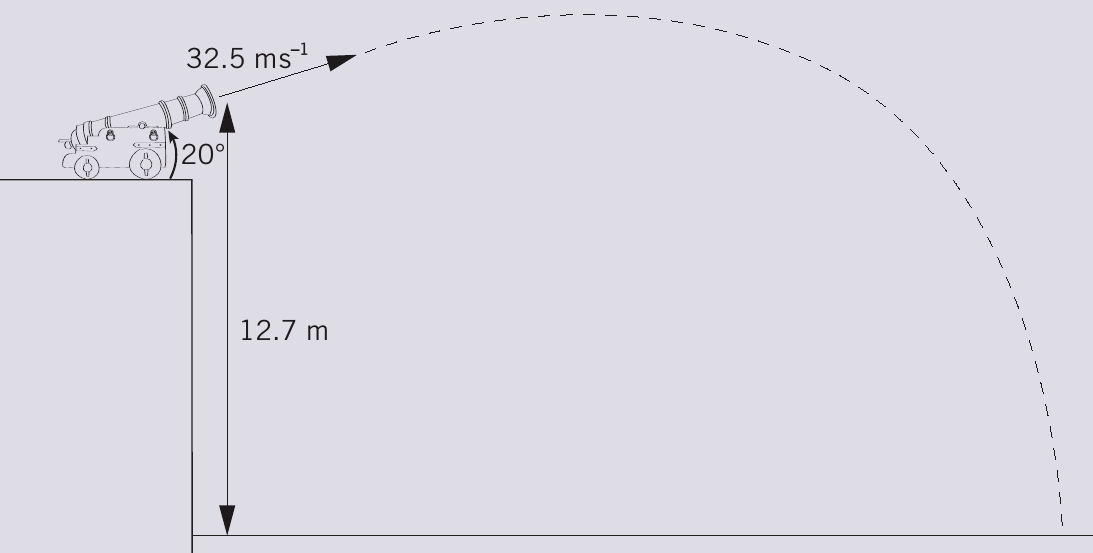
A cannon fires a cannonball with velocity at an angle of above the horizontal from the top of a tall cliff. Find the horizontal distance travelled before the cannonball hits the ground.
Example
Worked Example: Projectile Launched at an Angle from Elevated Position
Solution:
We choose down as the positive direction and will maintain this throughout.
Since horizontal distance equals , we need to find the total flight time.
First, decompose the velocity:
- (upward, so negative in our convention)
The vertical motion can be considered in two stages: rising to maximum height, then falling to the ground.
Stage 1: Time to reach maximum height
At maximum height, vertical velocity is zero:
Finding maximum height above launch point:
Total height above ground:
Stage 2: Time to fall from maximum height to ground
From maximum height (where ), falling :
Since :
Total time
Horizontal distance:
Alternative method:
Instead of treating upward and downward motion separately, we can treat the entire vertical motion as one journey:
-
Find the vertical velocity component just before impact:
-
Use this to find total time:
Both methods yield the same result of 3.10 s, but the alternative method is often more efficient.
Air resistance
In the real world, projectiles do not move through a vacuum. Air resistance, also called drag, acts on all moving objects through the atmosphere. This force always opposes the direction of motion.
Note
Effects of air resistance on projectile motion:
When air resistance is considered:
- The projectile does not reach as high as predicted by ideal calculations
- The horizontal range is reduced
- The trajectory is no longer a perfect parabola
- The path becomes asymmetric (steeper descent than ascent)
For SSCE VCE Physics, you should be able to describe these effects qualitatively. Quantitative calculations with air resistance are beyond the scope of this course, as they involve complex mathematical models.
Remember!
Summary
Key Points to Remember:
-
A projectile experiences constant downward gravitational acceleration of throughout its entire flight, regardless of its velocity direction.
-
Always separate horizontal and vertical motion components – they are independent of each other. Horizontal velocity remains constant (no air resistance), whilst vertical velocity changes due to gravity.
-
The systematic approach is crucial: draw a diagram, choose a positive direction, decompose velocity into components, solve vertical motion for time, then use time to find horizontal distance.
-
At maximum height, the vertical velocity is zero, but the projectile still has horizontal velocity and experiences downward gravitational force.
-
Air resistance opposes motion, reducing both maximum height and horizontal range compared to ideal parabolic trajectories. Projectiles with air resistance do not travel as high or as far.