Active Transport (AQA A-Level Biology): Revision Notes
📚Revision Notes
Active Transport
What is active transport?
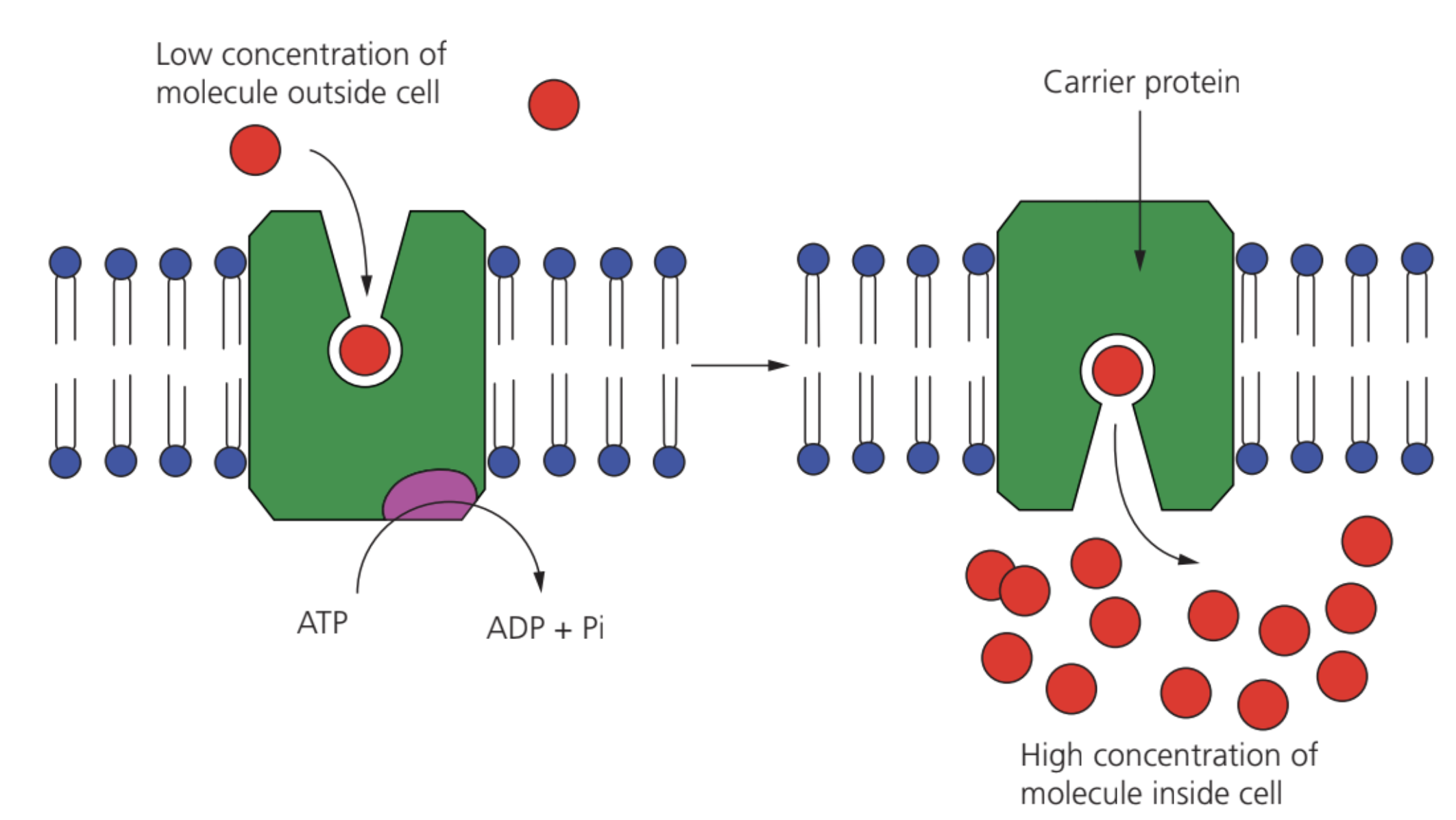
Active transport is the process that moves molecules or ions across cell membranes from areas of low concentration to areas of high concentration. Unlike passive transport processes such as diffusion and osmosis, active transport requires energy in the form of ATP (adenosine triphosphate) and involves specialised carrier proteins.
This process is essential because it allows cells to move substances against their natural concentration gradients, maintaining the specific internal conditions needed for cellular functions.
Note
Active transport is fundamentally different from passive processes because it can work against the natural flow of substances, similar to pumping water uphill rather than letting it flow downhill naturally.
Key features of active transport
Active transport has several distinctive characteristics that set it apart from passive transport:
- Energy requirement: Metabolic energy in the form of ATP is always needed
- Direction: Substances move against their concentration gradient (from low to high concentration)
- Selectivity: The process is highly selective, with specific carrier proteins transporting particular substances
- Protein involvement: Specialised carrier proteins act as molecular 'pumps' spanning the membrane
Important
The key distinction is that active transport moves substances from areas of low concentration to high concentration - this goes against the natural tendency and therefore requires energy input.
How active transport works
The mechanism of active transport follows a specific sequence of steps:
- Binding phase: Carrier proteins span the plasma membrane and bind to the specific molecule or ion to be transported on one side of the membrane
- ATP attachment: Inside the cell or organelle, ATP binds to the carrier protein
- Energy release: ATP splits into ADP (adenosine diphosphate) and a phosphate molecule, releasing energy
- Shape change: The energy from ATP causes the carrier protein to change shape, opening a pathway to the opposite side of the membrane
- Release: The transported molecule or ion is released on the other side of the membrane
- Reset: The phosphate molecule detaches from the protein, causing it to return to its original shape, ready for the next transport cycle
- ATP regeneration: The phosphate molecule recombines with ADP to form ATP during cellular respiration
The chemical equation for ATP breakdown can be represented as:
Types of active transport
Direct active transport
This involves the direct movement of single molecules or ions using ATP. Each transport event requires one ATP molecule to be broken down.
Co-transport
Sometimes called indirect active transport, this process uses the concentration gradient created by direct active transport to move different substances. While co-transport itself doesn't directly use ATP, it depends on gradients established by ATP-powered transport.
Note
Think of co-transport as a "piggyback" system - one substance rides along with another that is being actively transported, taking advantage of the energy gradient that ATP has already created.
Example: The sodium-potassium pump
Example
Worked Example: The Sodium-Potassium Pump in Action
The sodium-potassium pump demonstrates active transport in action. This process simultaneously moves sodium ions out of cells while bringing potassium ions in, both against their respective concentration gradients.
The pump cycle:
- 3 Na⁺ ions bind to the pump from inside the cell
- ATP provides energy to change the pump's shape
- Na⁺ ions are released outside the cell
- 2 K⁺ ions bind from outside the cell
- The pump returns to original shape, releasing K⁺ inside
Overall reaction:
This pump is vital for many physiological processes, including:
- Creating nerve impulses
- Maintaining cell volume
- Establishing electrochemical gradients
The pump actively removes sodium ions from inside the cell whilst actively taking in potassium ions from the surrounding environment, using ATP to power both movements.
Comparison with facilitated diffusion
While both active transport and facilitated diffusion use carrier proteins, they differ in important ways:
| Feature | Active Transport | Facilitated Diffusion |
|---|---|---|
| Energy requirement | Requires ATP | No energy needed |
| Direction | Against concentration gradient | Down concentration gradient |
| Driving force | Metabolic energy | Natural kinetic energy |
Both processes are selective and use specific carrier proteins, but only active transport can work against the natural flow of substances.
Note
The table above highlights the key trade-off: active transport requires energy investment but provides the ability to move substances where the cell needs them, regardless of natural concentration gradients.
Energy considerations
Cells that perform significant amounts of active transport typically contain many mitochondria to provide the ATP needed. This is why tissues with high transport activity, such as kidney cells involved in reabsorption, have abundant mitochondria.
The continuous need for ATP makes active transport an energy-expensive process, but it's essential for maintaining the precise internal conditions that cells require for proper function.
Important
Energy Cost vs. Cellular Function
Active transport consumes a significant portion of a cell's energy budget - in some cells, up to 40% of ATP is used for active transport processes. This high energy cost demonstrates how crucial it is for cellular survival.
Summary
Summary
Key Points to Remember:
- Active transport moves substances against their concentration gradient using ATP energy
- Carrier proteins act as specific molecular pumps spanning the membrane
- The process involves ATP splitting into ADP and phosphate, causing protein shape changes
- Active transport is essential for processes like nerve impulse generation and kidney function
- Cells performing lots of active transport need many mitochondria to supply ATP