Photosynthesis (AQA A-Level Biology): Revision Notes
📚Revision Notes
Overview of Photosynthesis
The importance of photosynthesis
Photosynthesis is the biological process that sustains nearly all life on Earth. Every organism, including humans, depends on this process for survival. The energy we use, whether from the food we consume or from fossil fuels we burn for heating, originally came from sunlight captured through photosynthesis. This process not only provides energy sources but also generates the oxygen we breathe by releasing it from water molecules.
Note
Energy continuously flows through living systems, and photosynthesis represents the primary entry point for solar energy into biological systems. This makes photosynthesis the foundation of virtually all food chains and ecosystems on Earth.
Plants absorb light energy using chlorophyll and convert it into chemical energy stored in organic molecules. These energy-rich compounds fuel the plant's own metabolism through ATP production during respiration. Non-photosynthetic organisms obtain their energy by consuming these plant-produced molecules, then using them to synthesise ATP through their own respiratory processes.
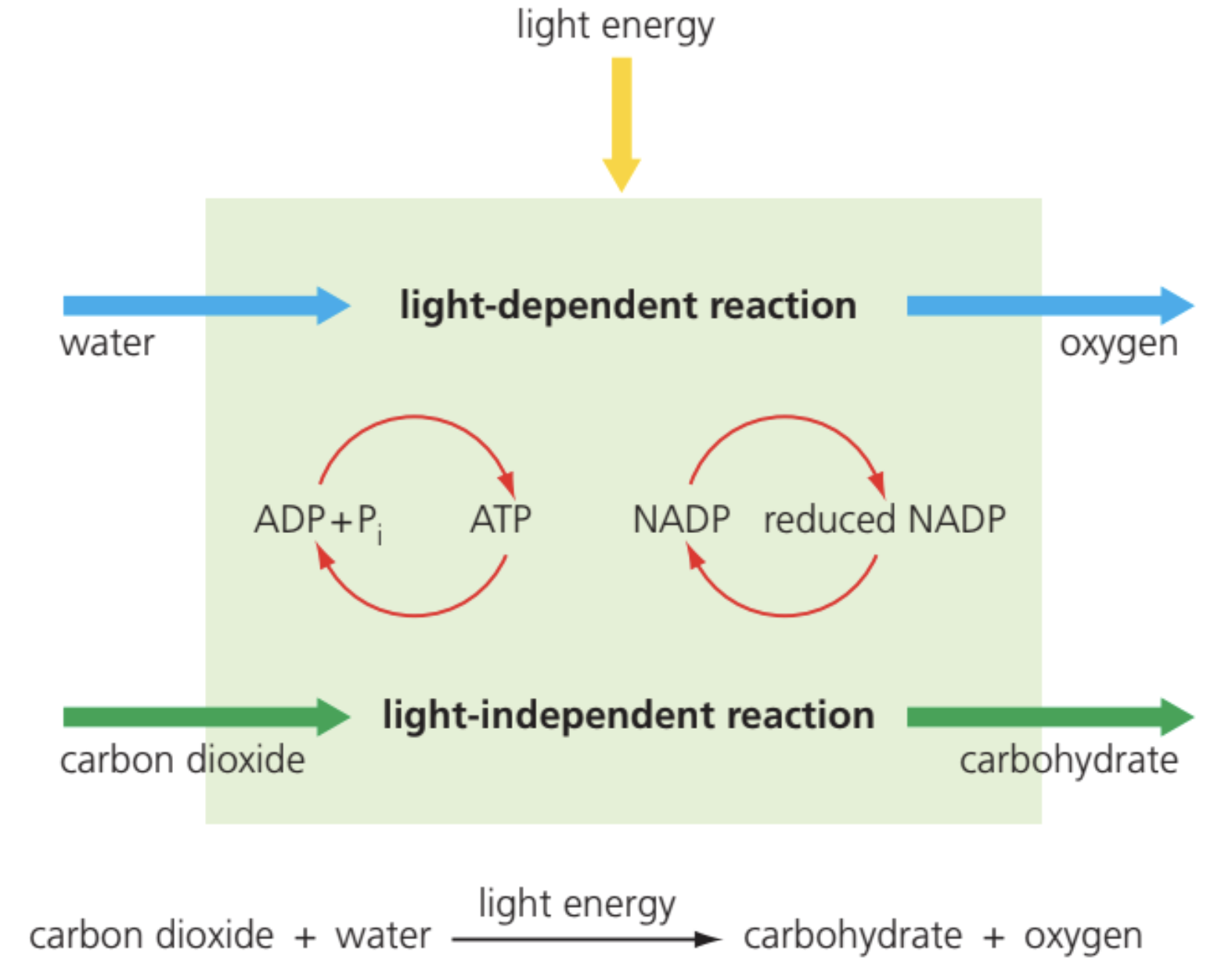
Site of photosynthesis
In eukaryotic plants, the leaf serves as the main photosynthetic organ. Within leaf cells, specialised organelles called chloroplasts house the cellular machinery where photosynthesis occurs.
Structure of the leaf
Plant leaves exhibit numerous adaptations that maximise photosynthetic efficiency by optimising the collection of raw materials (water, carbon dioxide, and light) whilst facilitating the removal of products (oxygen and glucose).
Note
Leaf Adaptations for Photosynthesis
These structural features work together to create an optimal environment for capturing light energy and facilitating gas exchange, making leaves remarkably efficient biological solar collectors.
These structural features include:
- Large surface area to capture maximum sunlight
- Leaf arrangement on plants that minimises overlapping, preventing leaves from shading one another
- Thin structure allowing light penetration, as most light absorption occurs within the first few micrometres of leaf tissue, whilst keeping diffusion distances short for gas exchange
- Transparent cuticle and epidermis that permit light to reach the photosynthetic mesophyll cells beneath
- Elongated upper mesophyll cells densely packed with chloroplasts to collect sunlight efficiently
- Numerous stomata providing gas exchange pathways, ensuring all mesophyll cells remain close to a diffusion route
- Stomata that respond to light intensity changes by opening and closing
- Air spaces throughout the lower mesophyll layer enabling rapid gas movement during the gas exchange phases
- Vascular network of xylem delivering water to leaf cells and phloem transporting sugars away from photosynthetic sites
An outline of photosynthesis
The complete photosynthetic process can be summarised by this balanced equation:
Important
This equation represents a complex metabolic pathway involving numerous intermediate reactions and energy transfer processes. Don't mistake this simple equation for a single-step reaction - photosynthesis actually involves hundreds of individual chemical reactions working in precise coordination.
Photosynthesis consists of three main stages:
- Light energy capture by chloroplast pigments, particularly chlorophyll
- Light-dependent reaction where absorbed light energy becomes stored in chemical bonds. Light striking chlorophyll creates an electron flow that triggers photolysis - the splitting of water molecules into protons, electrons, and oxygen. This stage produces reduced NADP, ATP, and oxygen
- Light-independent reaction where the protons (hydrogen ions) from the previous stage drive the synthesis of sugars and other organic compounds
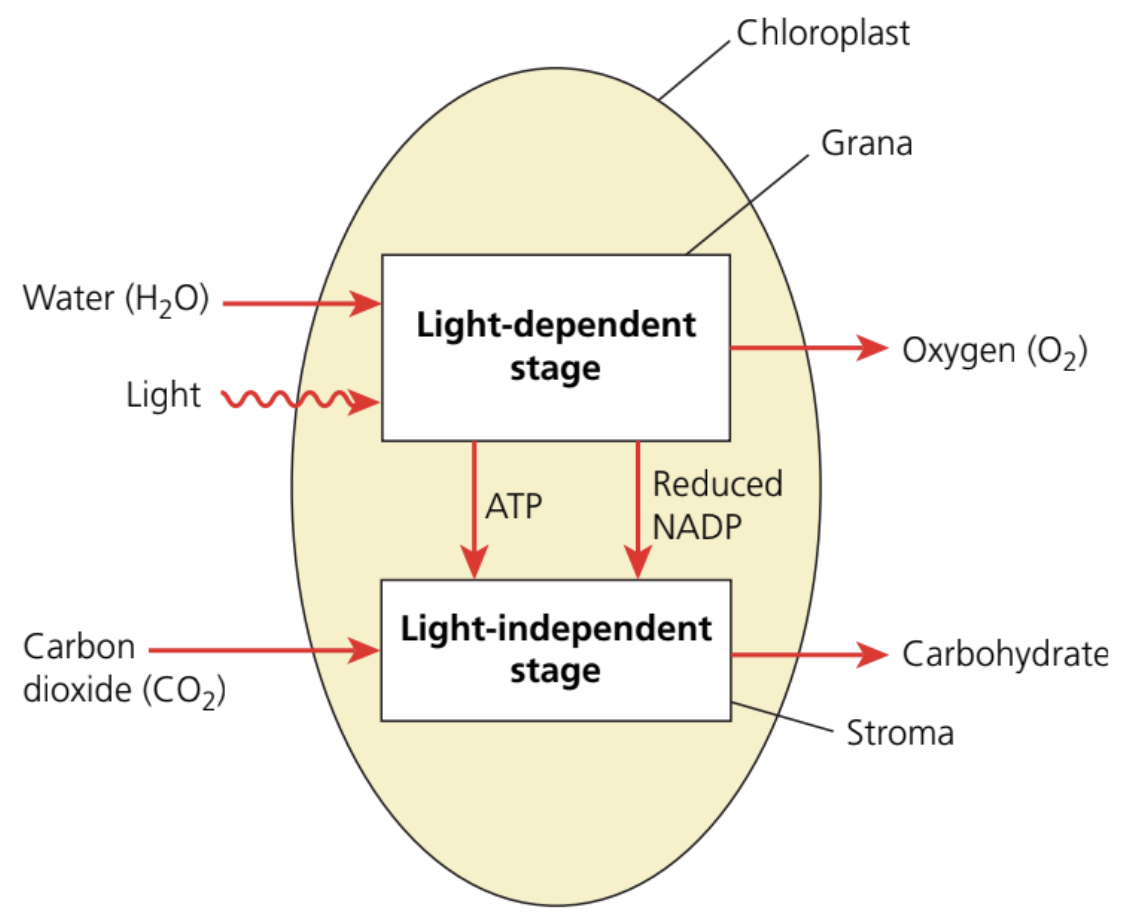
Structure and role of chloroplasts in photosynthesis
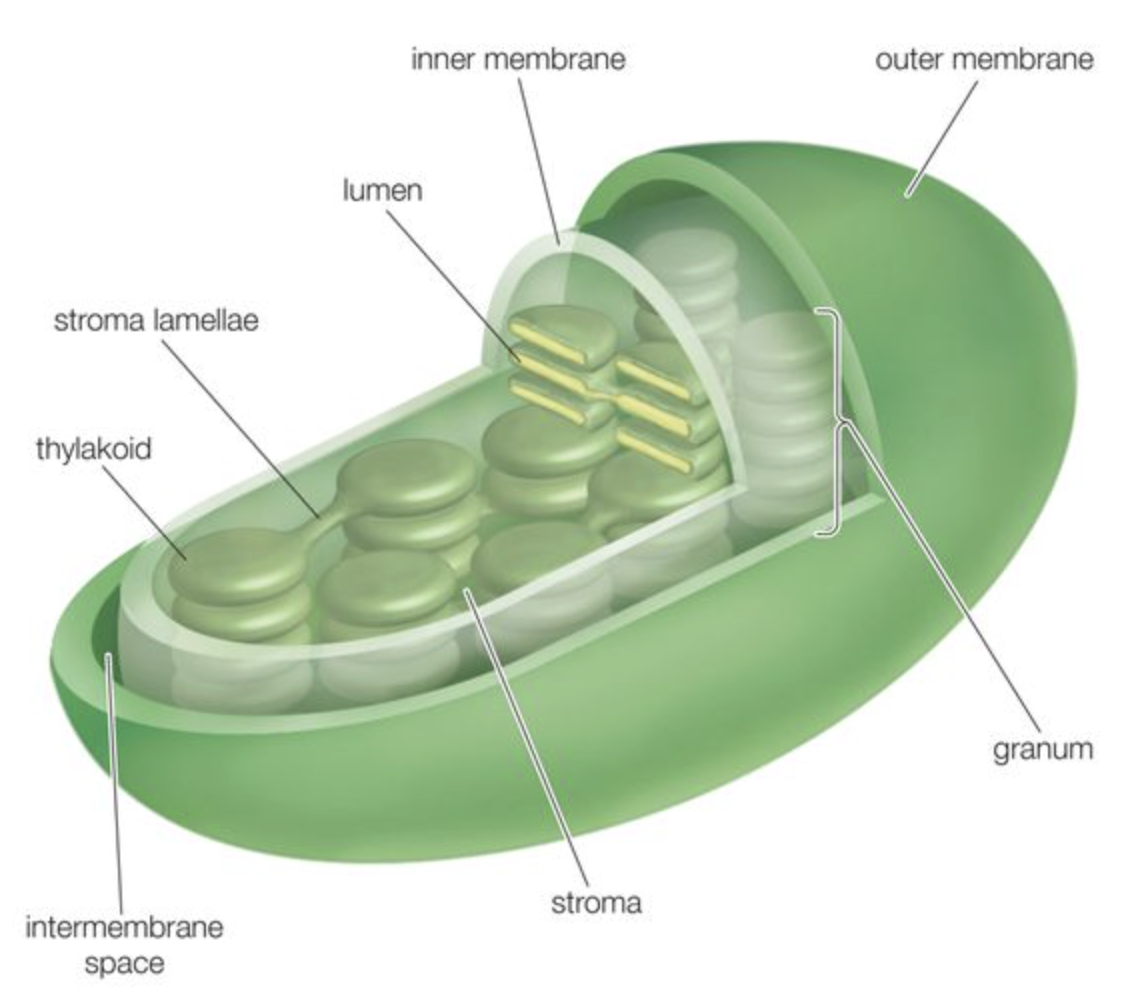
Chloroplasts are the specialised organelles where photosynthesis takes place in eukaryotic plant cells. These disc-shaped structures typically measure 2-10μm in length and 1μm in diameter. A double membrane surrounds each chloroplast, creating two distinct internal regions:
The grana consist of stacks containing up to 100 disc-like structures called thylakoids. The light-dependent stage of photosynthesis occurs within these thylakoids, which contain the photosynthetic pigment chlorophyll. Some thylakoids extend between grana through tubular connections called intergranal lamellae.
The stroma forms a fluid-filled matrix surrounding the grana where the light-independent stage takes place. This region also contains various other structures including starch grains.
Note
Connection to Other Cellular Processes
The structure of chloroplasts links to ATP synthesis in respiration and demonstrates the complex internal organisation found in eukaryotic cell structure. The compartmentalisation allows different stages of photosynthesis to occur in optimal environments.
Remember!
Summary
Key Points to Remember:
- Photosynthesis converts light energy into chemical energy, forming the foundation of most food chains and producing the oxygen we breathe
- The leaf's structure maximises light capture, gas exchange, and transport through features like large surface area, thin profile, and extensive vascular networks
- The overall equation shows six molecules each of carbon dioxide and water producing one glucose molecule and six oxygen molecules
- Photosynthesis occurs in three stages: light capture by chlorophyll, light-dependent reactions in thylakoids, and light-independent reactions in the stroma
- Chloroplasts contain grana (stacks of thylakoids for light reactions) and stroma (fluid matrix for light-independent reactions)