Light-dependent Reaction (AQA A-Level Biology): Revision Notes
📚Revision Notes
Light-dependent Reaction
Overview of the light-dependent reaction
The light-dependent reaction of photosynthesis captures light energy and uses it for two main purposes:
- Adding an inorganic phosphate molecule to ADP, thereby producing ATP
- Splitting water molecules into hydrogen ions (protons) and hydroxide ions through a process called photolysis
Note
This reaction forms the first stage of photosynthesis and provides the energy and reducing power needed for the light-independent stage. Understanding this process is crucial as it sets up all the products needed for the Calvin cycle.
Understanding oxidation and reduction
Before examining the light-dependent reaction in detail, it's important to understand the key concepts of oxidation and reduction:
Important
Oxidation occurs when a substance:
- Gains oxygen
- Loses hydrogen
- Loses electrons (most common definition in biological systems)
Reduction occurs when a substance:
- Loses oxygen
- Gains hydrogen
- Gains electrons (most common definition in biological systems)
These processes always occur together - when one substance is oxidised, another must be reduced. In biological systems, oxidation typically involves energy being released, while reduction involves energy being taken in.
ATP production through photoionisation
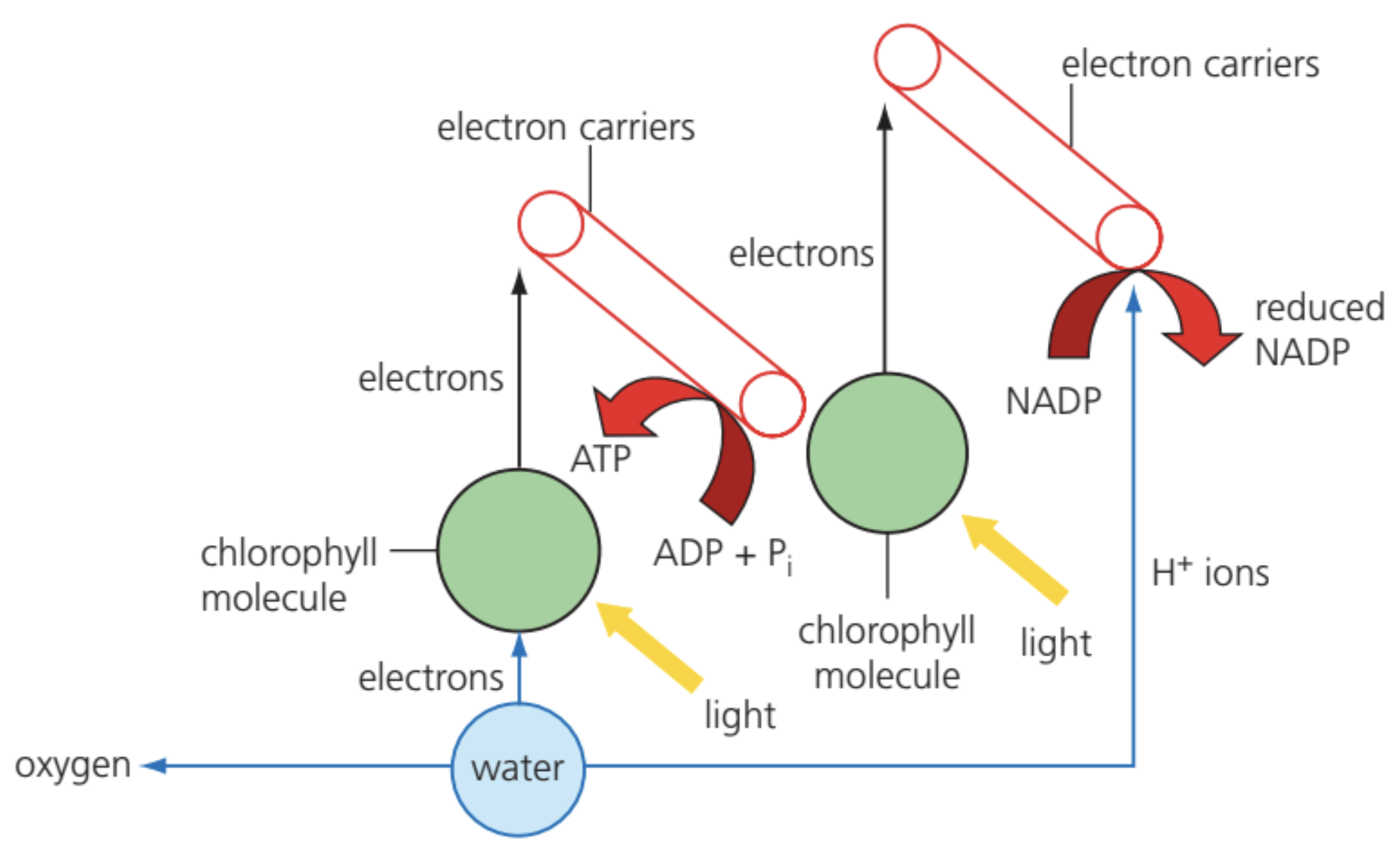
When a chlorophyll molecule absorbs light energy, the energy boosts a pair of electrons within the molecule to a higher energy level. These electrons become so energetic that they leave the chlorophyll molecule completely. This process is called photoionisation.
The departure of electrons leaves the chlorophyll molecule with a positive charge (ionised). The high-energy electrons are captured by a molecule called an electron carrier, which becomes reduced in the process.
The electron transport chain
The electrons pass along a series of electron carriers in what's known as an electron transport chain. This chain is located in the membranes of the thylakoids. Each carrier in the sequence exists at a slightly lower energy level than the previous one, so electrons lose energy at each transfer.
Note
Some of this released energy is used to combine an inorganic phosphate molecule with an ADP molecule, forming ATP. This process demonstrates how light energy is converted into chemical energy.
Chemiosmosis and ATP synthesis
The precise mechanism of ATP production follows the chemiosmotic theory:
Example
Step-by-Step Process: Chemiosmotic ATP Synthesis
-
Thylakoids are enclosed chambers where protons (H⁺ ions) are actively transported from the stroma using energy from the electron transport chain
-
The energy driving this transport comes from electrons released during photolysis of water molecules
-
Photolysis of water also produces additional protons, further increasing their concentration inside the thylakoid space
-
This creates a concentration gradient of protons across the thylakoid membrane - high concentration inside, low concentration in the stroma
-
Protons can only cross the thylakoid membrane through ATP synthase channels, which form stalked granules on the membrane surface
-
As protons flow through these channels, they cause structural changes in the ATP synthase enzyme, which catalyses the combination of ADP with inorganic phosphate to form ATP
Photolysis of water
When light strikes chlorophyll molecules, they lose electrons and need replacement electrons to continue absorbing light energy. These replacement electrons come from water molecules through photolysis.
Example
Chemical Equation: Photolysis of Water
This process:
- Provides electrons to replace those lost by chlorophyll
- Produces protons that contribute to the proton gradient
- Generates oxygen as a by-product, which either diffuses out of the leaf or is used in respiration
NADP reduction
Protons from photolysis move out of the thylakoid space through ATP synthase channels and are taken up by an electron carrier called NADP. When NADP accepts both protons and electrons, it becomes reduced NADP (NADPH).
Note
Reduced NADP is extremely important as it serves as the main product of the light-dependent reaction and provides chemical energy for the light-independent stage of photosynthesis.
Site and adaptations of chloroplasts
The light-dependent reaction occurs in the thylakoids of chloroplasts. Thylakoids are disc-like structures stacked together in groups called grana.
Note
Chloroplast Adaptations for Light-Dependent Reactions:
Chloroplasts are specifically adapted for the light-dependent reaction:
- Thylakoid membranes provide a large surface area for attachment of chlorophyll, electron carriers, and enzymes
- Protein networks in the grana hold chlorophyll molecules in precise arrangements for maximum light absorption
- Granal membranes contain ATP synthase channels and are selectively permeable, allowing establishment of proton gradients
- DNA and ribosomes within chloroplasts enable rapid manufacture of proteins needed for the light-dependent reaction
Summary of products
The light-dependent reaction produces three main products:
- ATP - provides energy for the light-independent stage
- Reduced NADP (NADPH) - provides reducing power for the light-independent stage
- Oxygen - released as a by-product or used in respiration
Links to Calvin cycle reactions in the light-independent stage of photosynthesis.
Remember!
Summary
Key Points to Remember:
- The light-dependent reaction converts light energy into chemical energy (ATP) and reducing power (NADPH)
- Photoionisation of chlorophyll starts the process by releasing high-energy electrons
- Photolysis of water replaces lost electrons and produces protons and oxygen
- Chemiosmosis uses proton gradients to drive ATP synthesis through ATP synthase channels
- The reaction occurs in thylakoids, which are specially adapted structures within chloroplasts