Translation (AQA A-Level Biology): Revision Notes
📚Revision Notes
Translation
Translation is the second stage of protein synthesis, following transcription. During this process, the genetic information carried by codons on messenger RNA (mRNA) is converted into a sequence of amino acids to form a polypeptide.
It takes place on the ribosomes in the cytoplasm. In eukaryotic cells, the mRNA leaves the nucleus through a nuclear pore and attaches to a ribosome. The order of bases on the mRNA determines the order in which amino acids are joined together, producing a specific protein.
Transfer RNA structure and function
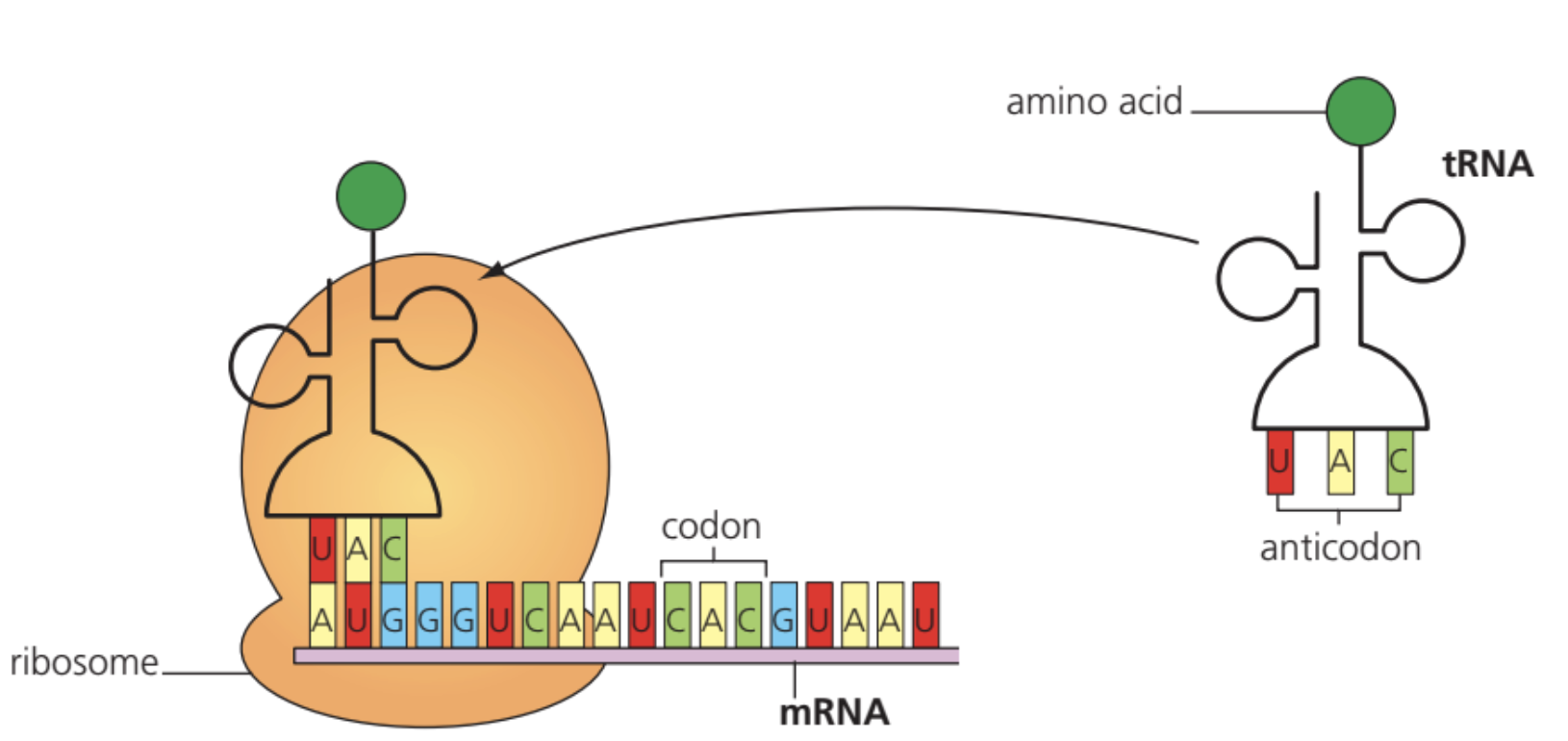
Transfer RNA (tRNA) molecules are essential components of translation. There are approximately 60 different types of tRNA in cells. Each tRNA molecule has two key features:
- A specific anticodon - a three-base sequence that is complementary to a particular codon on mRNA
- An amino acid attachment site - where a specific amino acid binds to the tRNA
Each amino acid has one or more corresponding tRNA molecules. The tRNA's anticodon determines which amino acid it will carry, ensuring the correct amino acid is delivered to match each codon during translation.
Note
The specificity of tRNA molecules is crucial for accurate protein synthesis. Each tRNA can only carry one type of amino acid, and its anticodon ensures it pairs with the correct mRNA codon. This one-to-one correspondence prevents errors in the amino acid sequence of the final protein.
Key terms
- Codon – a sequence of three mRNA bases that codes for a specific amino acid.
- Triplet – a sequence of three DNA bases that codes for a specific amino acid.
- Anticodon – a sequence of three tRNA bases that is complementary to a codon on the mRNA.
- tRNA (transfer RNA) – a small RNA molecule that carries a specific amino acid to the ribosome.
- rRNA (ribosomal RNA) – forms part of the ribosome and helps catalyse the formation of peptide bonds.
The translation process
Translation begins when mRNA exits the nucleus and encounters a ribosome in the cytoplasm. The ribosome consists of two subunits (small and large) that work together to facilitate polypeptide synthesis.
1. Attachment of mRNA to a Ribosome
- Once mRNA leaves the nucleus through a nuclear pore, it binds to a ribosome in the cytoplasm.
- The ribosome attaches to the start codon on the mRNA, which signals where translation is to begin.
- The ribosome moves along the mRNA, reading the base sequence three bases at a time (one codon).
2. Binding of tRNA molecules
- Each transfer RNA (tRNA) molecule carries a specific amino acid and has an anticodon that is complementary to a codon on the mRNA.
- The anticodon–codon base pairing ensures that the correct amino acid is added in the correct sequence.
- As the ribosome reads each codon, the corresponding tRNA molecule binds to it by complementary base pairing.
3. Formation of peptide bonds
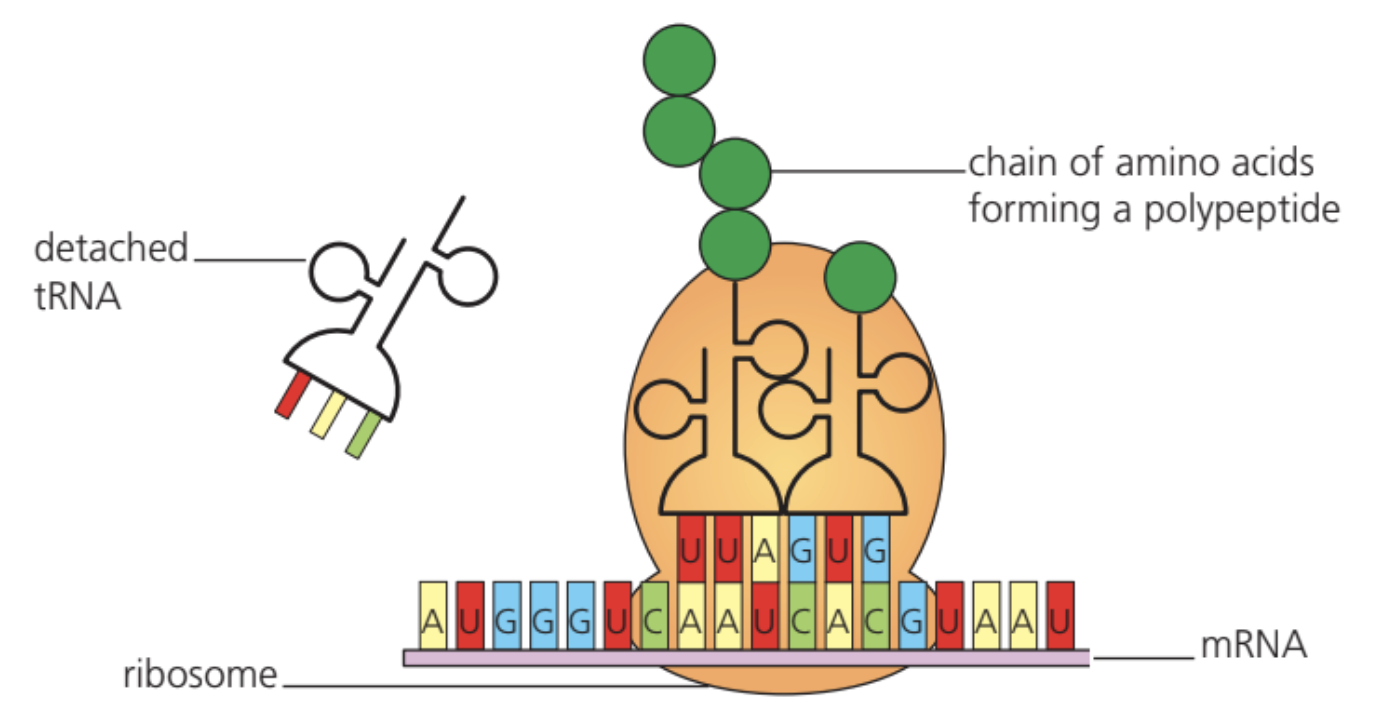
- When two tRNA molecules are positioned in the ribosome, the amino acids they carry are joined by a peptide bond.
- This reaction is catalysed by an enzyme in the ribosome, which is made partly of rRNA (ribosomal RNA).
- The reaction requires energy from ATP, which is hydrolysed to form the bond.
- After the bond forms, the first tRNA molecule is released and can collect another amino acid from the cytoplasm.
4. Movement of the ribosome
- The ribosome moves along the mRNA by one codon (three bases) at a time.
- As it moves, a new tRNA molecule carrying the next amino acid binds to the next codon, while the previous tRNA detaches.
- This sequence continues, and the ribosome catalyses the formation of successive peptide bonds, extending the polypeptide chain.
5. Elongation of the polypeptide chain
- The chain of amino acids (the polypeptide) grows as the ribosome moves along the mRNA, bringing together successive tRNA molecules.
- At any given time, the ribosome holds two tRNA molecules, allowing continuous formation of peptide bonds.
- Each new amino acid is added to the C-terminal end of the growing chain, maintaining the correct sequence determined by the mRNA codons.
6. Termination
- When the ribosome reaches a stop codon on the mRNA, translation ends.
- There are no tRNA molecules with anticodons complementary to the stop codons.
- The completed polypeptide chain is released, and the ribosome detaches from the mRNA.
- The same mRNA molecule may then be used again for further rounds of translation.
Speed and efficiency
Translation occurs rapidly, with up to 15 amino acids being added to the polypeptide chain each second. Multiple ribosomes can work on the same mRNA molecule simultaneously - up to 50 ribosomes can translate one mRNA strand at the same time, allowing many identical polypeptides to be produced quickly.
Note
This simultaneous translation by multiple ribosomes is called a polyribosome or polysome. This mechanism allows cells to rapidly produce large quantities of proteins when they are needed, such as during periods of growth or stress response.
ATP's role in translation
ATP serves two essential functions during translation:
- Amino acid activation: Energy from ATP is required to attach amino acids to their corresponding tRNA molecules
- Peptide bond formation: ATP hydrolysis provides the energy needed to form peptide bonds between adjacent amino acids
Important
Without adequate ATP, translation cannot proceed efficiently. This is why actively growing cells have high energy demands and require constant glucose metabolism to maintain ATP production for protein synthesis.
Protein assembly after translation
Once a polypeptide chain is complete, it must fold into its functional form. This process involves several levels of protein structure:
- Secondary structure: The polypeptide chain coils or folds into patterns such as alpha helices or beta sheets
- Tertiary structure: Further folding creates the three-dimensional shape of a single polypeptide
- Quaternary structure: Multiple polypeptide chains may link together, sometimes with non-protein groups, to form a complete functional protein
Many proteins produced through translation are enzymes that control cellular activities, making translation a process that directly influences cell function and metabolism.
Important
Common Misconception Alert:
Remember that RNA contains uracil (U) instead of thymine. In translation, uracil in RNA pairs with adenine in the complementary sequences.
The sequence of codons on mRNA directly determines the order in which tRNA molecules line up, which in turn determines the sequence of amino acids in the final polypeptide. This demonstrates how genetic information flows from DNA through mRNA to proteins.
Summary
Key Points to Remember:
- Translation converts mRNA codons into amino acid sequences to build polypeptides
- Each tRNA has a specific anticodon and carries a corresponding amino acid
- Ribosomes facilitate translation by bringing together mRNA and tRNA molecules
- ATP provides energy for both amino acid activation and peptide bond formation
- Multiple ribosomes can work on one mRNA simultaneously for efficient protein production
- The process follows the central dogma: DNA → RNA → Protein