Classification (AQA A-Level Biology): Revision Notes
📚Revision Notes
Classification
What is classification?
Classification is the process of organising organisms into manageable groups to improve communication between scientists and reduce confusion. With millions of species both living and extinct, this systematic approach allows biologists to better understand relationships between different life forms.
Note
The sheer scale of biodiversity makes classification essential - scientists estimate there are between 8-100 million species on Earth, with only about 1.5 million formally described so far.
Taxonomy refers to the theory and practice of biological classification. It involves studying groups of organisms and determining their positions within a hierarchical system based on evolutionary relationships.
Types of classification systems
There are two main approaches to biological classification, each serving different purposes:
- Artificial classification
- Phylogenetic classification
Artificial classification
This system divides organisms according to observable differences that are useful at a particular time. Features used may include colour, size, number of legs, or leaf shape. These characteristics are described as analogous characteristics - they serve the same function but do not share the same evolutionary origins.
For example, the wings of butterflies and birds both enable flight, but they evolved independently through different evolutionary pathways. While useful for quick identification, artificial classification does not reflect true evolutionary relationships.
Important
Artificial classification can be misleading because it groups organisms based on superficial similarities rather than evolutionary relationships, potentially placing unrelated species together.
Phylogenetic classification
This more advanced system has three key features:
- It is based on evolutionary relationships between organisms and their ancestors
- It classifies species into groups using shared features derived from common ancestors
- It arranges groups into a hierarchy where smaller groups are contained within larger groups with no overlap
Phylogenetic classification relies on homologous characteristics - features that share similar evolutionary origins regardless of their current function. For instance, the wing of a bird, the arm of a human, and the front leg of a horse all have the same basic bone structure and evolutionary origins, making them homologous.
Note
The key difference between analogous and homologous characteristics is their origin: analogous features evolved separately to serve similar functions, while homologous features share common evolutionary ancestry regardless of their current use.
The three domain system
At the highest level of classification, all life is divided into three domains. A domain represents the highest taxonomic rank in biological classification.
- Bacteria
- Archaea
- Eukarya
Bacteria
Bacteria are single-celled prokaryotes characterised by:
- Absence of membrane-bound organelles (no nucleus or mitochondria)
- Unicellular structure, though cells may form chains or clusters
- Smaller ribosomes (70S) compared to eukaryotic cells
- Cell walls containing murein (but never chitin or cellulose)
- Single loop of naked DNA without histones
Archaea
Archaea are single-celled prokaryotes that were initially classified as bacteria due to their similar appearance. However, they differ from bacteria in several important ways:
- Their genes and protein synthesis processes more closely resemble those of eukaryotes
- Their cell membranes contain fatty acid chains attached to glycerol by ether linkages
- They lack murein in their cell walls
- They possess a more complex form of RNA polymerase
Important
Despite their prokaryotic structure, Archaea are more closely related to Eukaryotes than to Bacteria at the molecular level, which is why they form a separate domain.
Eukarya
Eukarya encompasses organisms composed of one or more eukaryotic cells. Their distinguishing features include:
- Cells containing membrane-bound organelles such as mitochondria and chloroplasts
- Cell membranes with fatty acid chains attached to glycerol by ester linkages
- Not all possess cell walls, but when present, they contain no murein
- Larger ribosomes (80S) than those found in bacteria and archaea
Taxonomic hierarchy
Within the Eukarya domain, organisms are further classified into four kingdoms: Protoctista, Fungi, Plantae, and Animalia. The complete hierarchical system works as follows:
Domain → Kingdom → Phylum → Class → Order → Family → Genus → Species
- Each level represents a taxon (plural: taxa). Within each kingdom, the largest groups are called phyla (singular: phylum).
- Organisms within each phylum share a fundamental body plan that differs significantly from other phyla.
- Each phylum divides into classes, classes into orders, orders into families, families into genera (singular: genus), and genera into species.
Note
As you move down the hierarchy, the differences between organisms become less obvious, but they share increasingly specific characteristics. Think of it like a filing system - the broadest categories at the top become progressively more specific.
Phylogeny and evolutionary relationships
Phylogeny refers to the evolutionary relationships between organisms, derived from the word 'phylum' meaning a group of related organisms. These relationships trace the evolutionary pathways that led to present-day species.
Phylogenetic trees
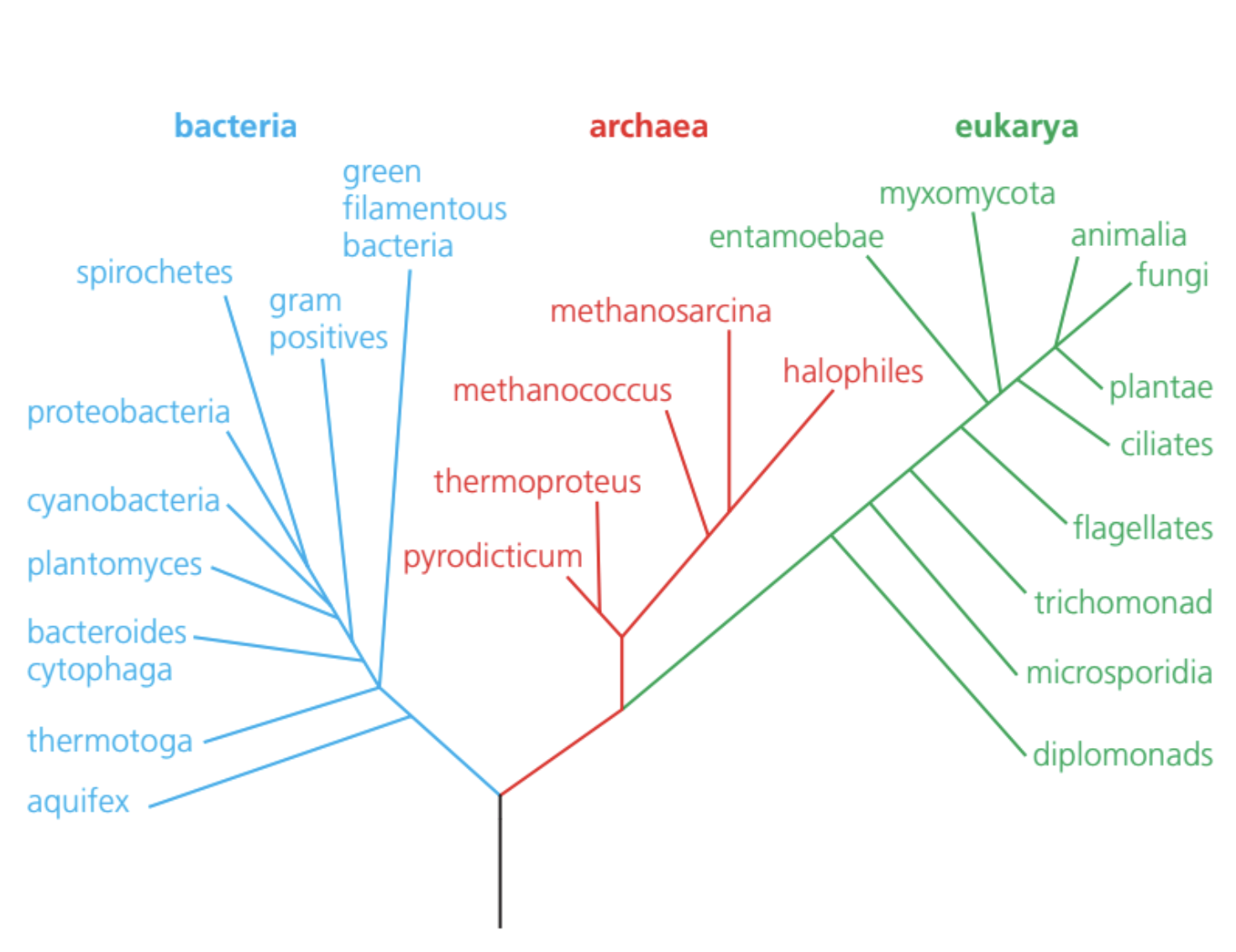
The evolutionary relationships between different species are represented using tree-like diagrams called phylogenetic trees. In these diagrams:
- The oldest species appear at the base of the tree
- More recent species are represented at the ends of branches
- The closer the branches, the more closely related the species
- Branch points represent common ancestors
Note
Phylogenetic trees are like family trees for species - they show how different organisms are related through common ancestors and help us understand the pattern of evolutionary change over time.
These trees help scientists understand how species have diverged from common ancestors over evolutionary time, providing insights into the process of evolution and the relationships between different groups of organisms.
Phylogenetic tree showing the three domains based on molecular similarities:
Summary
Key Points to Remember:
- Classification organises organisms into groups; taxonomy is the study and practice of this organisation
- Artificial classification uses convenient characteristics; phylogenetic classification reflects evolutionary relationships
- The three domains are Bacteria (prokaryotes with murein), Archaea (prokaryotes without murein), and Eukarya (eukaryotes)
- The taxonomic hierarchy follows: Domain → Kingdom → Phylum → Class → Order → Family → Genus → Species
- Phylogenetic trees show evolutionary relationships, with closer branches indicating more closely related species