Blood Vessels (AQA A-Level Biology): Revision Notes
📚Revision Notes
Blood Vessels
Types of blood vessels
The circulatory system contains four main types of blood vessels, each specialised for different functions:
- Arteries transport blood away from the heart towards arterioles
- Arterioles are smaller vessels that regulate blood flow from arteries to capillaries
- Capillaries are microscopic vessels connecting arterioles to veins
- Veins return blood from capillaries back to the heart
Note
Blood flows in one direction through this sequence: Heart → Arteries → Arterioles → Capillaries → Veins → Heart. This unidirectional flow is essential for efficient circulation and is maintained by the heart's pumping action and various structural adaptations.
Basic structure of blood vessels
All blood vessels share the same fundamental layered structure, though the thickness of each layer varies according to function. From outside to inside, these layers include:
- Tough fibrous outer layer - provides structural support and resists pressure changes from internal and external forces
- Muscle layer - contains smooth muscle that can contract to control blood flow
- Elastic layer - stretches and recoils to help maintain blood pressure, particularly important during the cardiac cycle
- Endothelium (lining layer) - smooth inner surface that reduces friction and facilitates diffusion, thin enough to allow exchange of materials
- Lumen - the central space through which blood flows
Important
The relative thickness of each layer determines the vessel's specific function and ability to withstand different pressure conditions. This is a fundamental principle - structure always matches function in blood vessel design.
Artery structure and function
Arteries must transport blood rapidly under high pressure from the heart to body tissues. Their structure reflects these demanding requirements:
The muscle layer is thick compared to other vessels. This allows smaller arteries to constrict and dilate, controlling blood volume and pressure as it moves through the circulatory system.
The elastic layer is relatively thick because maintaining high blood pressure is essential for blood to reach extremities. During systole (heart contraction), the elastic walls stretch to accommodate blood surge. During diastole (heart relaxation), they recoil like elastic bands, maintaining pressure and smoothing pressure fluctuations.
The overall wall thickness is substantial to prevent vessel rupture under high pressure conditions.
No valves are present (except where arteries leave the heart) because constant high pressure from heart contractions prevents backwards flow.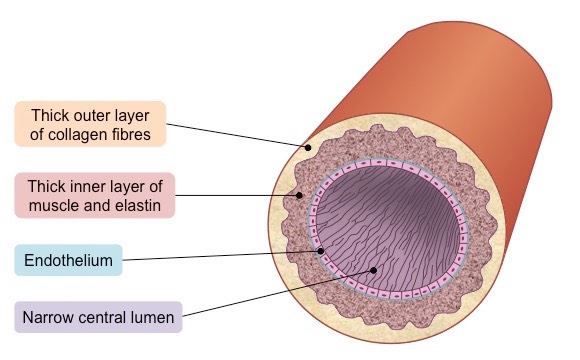
Example
Worked Example: Arterial Pressure Management
During the cardiac cycle:
- Systole phase: Heart contracts → Blood surges into arteries → Elastic walls stretch to accommodate increased volume
- Diastole phase: Heart relaxes → Elastic walls recoil → Maintains pressure and smooth blood flow
This elastic recoil mechanism ensures continuous blood flow even when the heart is not actively pumping.
Arteriole structure and function
Arterioles transport blood at lower pressure than arteries while controlling blood distribution between different tissue regions.
The muscle layer is relatively thicker than in arteries. Contraction of this smooth muscle can constrict the arteriole lumen, restricting blood flow and controlling blood supply to specific capillary networks.
The elastic layer is relatively thinner than in arteries since blood pressure has decreased from arterial levels.
Note
Arterioles are often called the "resistance vessels" because their ability to constrict and dilate allows them to control blood flow to different organs based on metabolic needs. This regulatory function is crucial for maintaining blood pressure and directing blood where it's needed most.
Vein structure and function
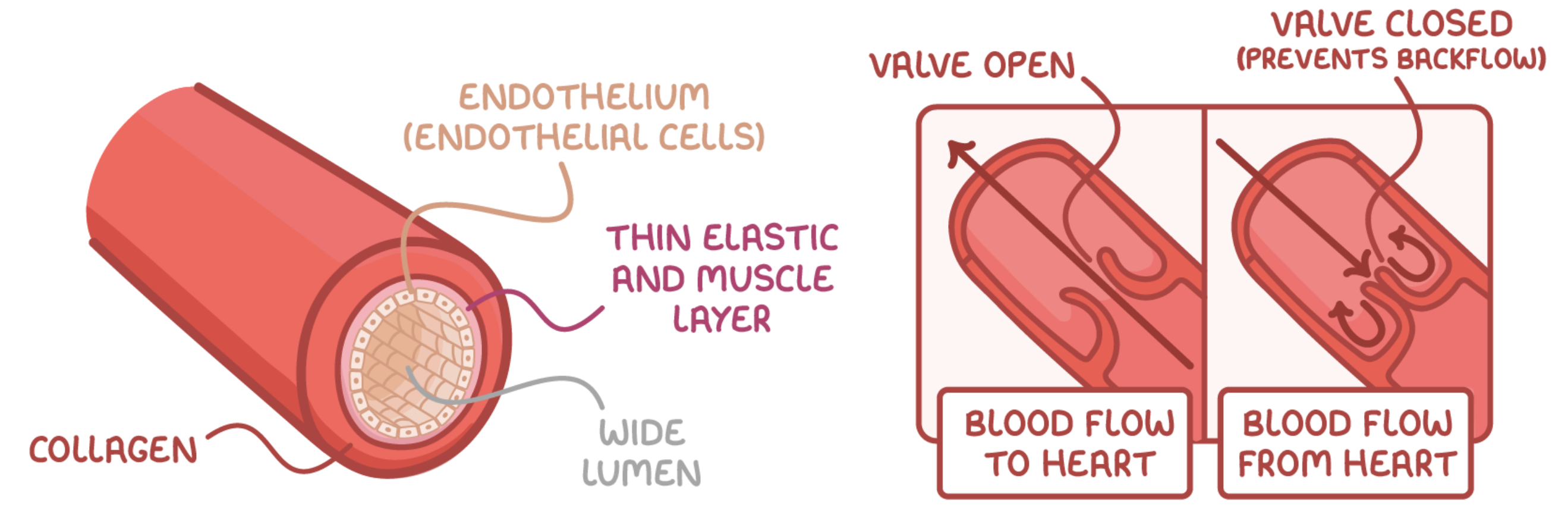
Veins transport blood slowly under low pressure from capillaries back to the heart. Their structure accommodates these different conditions:
The muscle layer is relatively thin compared to arteries because veins transport blood away from tissues rather than controlling flow to them.
The elastic layer is relatively thin compared to arteries since low blood pressure eliminates the risk of vessel rupture and insufficient pressure exists for significant recoil action.
The overall wall thickness is small because low internal pressure creates no bursting risk and allows easy compression when body muscles contract.
Valves occur at intervals throughout to prevent backwards flow. When blood flows towards the heart, valve flaps open easily. When blood attempts to flow away from the heart, increased pressure forces valve flaps closed, directing blood in one direction only.
Important
Common misconception: Many students think veins have thick walls like arteries. Remember that veins operate under low pressure conditions and therefore have thin walls and rely on valves to prevent backflow, not pressure to maintain forwards flow.
Capillary structure and function
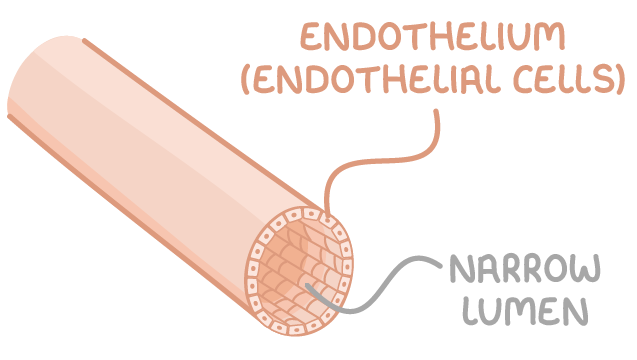
Capillaries exchange metabolic materials including oxygen, carbon dioxide and glucose between blood and body cells. Blood flow is much slower to allow sufficient time for exchange processes.
Walls consist mostly of endothelium, making them extremely thin so diffusion distances remain short. This enables rapid diffusion of materials between blood and cells.
Numerous and highly branched networks provide extensive surface area for exchange processes.
Narrow diameter ensures tissues are permeated effectively, meaning no cell remains far from a capillary and diffusion pathways stay short.
Extremely narrow lumen forces red blood cells to squeeze flat against capillary sides, bringing them closer to cells requiring oxygen while reducing diffusion distance.
Spaces between endothelial cells allow white blood cells to escape and combat infections within tissues.
Note
Capillaries are so narrow (about 7-10 micrometres in diameter) that red blood cells must squeeze through single file. This intimate contact maximises the opportunity for gas exchange and ensures efficient delivery of oxygen to tissues.
Summary
Key Points to Remember:
-
Arteries have thick walls with substantial muscle and elastic layers to handle high pressure blood transport from the heart
-
Veins have thin walls and valves to facilitate low pressure blood return to the heart, preventing backflow
-
Capillaries have extremely thin walls consisting mainly of endothelium to enable rapid diffusion and exchange of materials
-
Tissue fluid forms when hydrostatic pressure forces plasma out of capillaries, creating the immediate cellular environment for exchange processes
-
Structure matches function - each vessel type has wall thickness and features specifically adapted to its pressure conditions and transport role