Mechanisms of Absorption (AQA A-Level Biology): Revision Notes
📚Revision Notes
Mechanisms of Absorption
The small intestine, particularly the ileum, has adapted mechanisms to absorb the products of digestion efficiently. Understanding these processes requires examining both the structural adaptations and the specific pathways different molecules take during absorption.
Structure and adaptations of the ileum
The ileum shows remarkable structural modifications that maximise absorption efficiency. The intestinal wall forms finger-like projections called villi, which dramatically increase the surface area available for nutrient uptake.
Each villus contains a rich network of blood capillaries positioned close to the absorptive surface. This arrangement ensures rapid transport of absorbed molecules away from the absorption site, maintaining concentration gradients that drive continued uptake.
Note
The positioning of blood vessels so close to the absorption surface is crucial - it ensures that absorbed nutrients are quickly transported away, preventing the buildup that would reduce absorption efficiency.
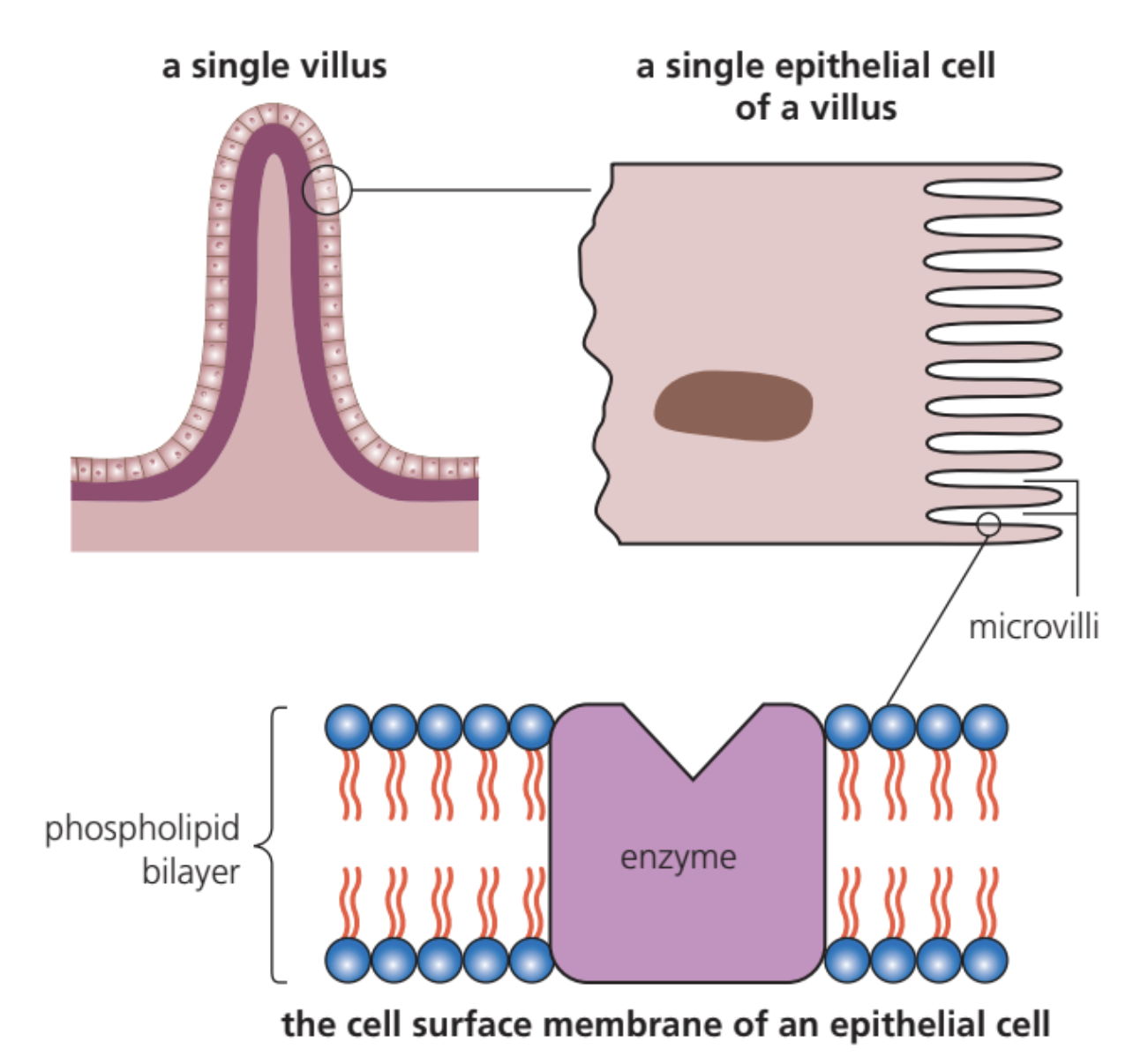
The epithelial cells lining each villus possess even smaller projections called microvilli on their surface membranes. These microscopic structures further multiply the surface area available for absorption.
Several features make villi particularly effective for absorption:
- Increased surface area: The folded structure provides a much larger area for molecular uptake compared to a flat surface
- Thin walls: The minimal distance between the intestinal contents and blood vessels allows rapid diffusion
- Movement capability: Villi contain muscle fibres that enable movement, helping to mix intestinal contents and maintain diffusion gradients
- Rich blood supply: Dense capillary networks ensure efficient transport of absorbed materials
- Lymphatic drainage: Each villus contains a central lacteal (lymphatic capillary) for lipid transport
Important
The combination of villi and microvilli can increase the surface area of the small intestine by up to 600 times compared to a simple tube, making it one of the most efficient absorption systems in nature.
Absorption of amino acids and monosaccharides
Protein digestion yields amino acids, while carbohydrate breakdown produces monosaccharides such as glucose, fructose, and galactose. Both types of molecules use similar absorption mechanisms.
These water-soluble molecules cross the intestinal epithelium through two main processes: diffusion and co-transport. The specific mechanism depends on concentration gradients and the availability of transport proteins in the epithelial cell membranes.
Once inside the epithelial cells, amino acids and monosaccharides pass directly into the blood capillaries within the villi. From there, they enter the general circulation for distribution to body tissues.
Note
Unlike lipids, these water-soluble nutrients can be transported directly in the bloodstream without requiring special packaging mechanisms, making their absorption pathway much more straightforward.
Triglyceride absorption process
Triglycerides require a more complex absorption pathway due to their lipid nature. The process begins when monoglycerides and fatty acids (products of triglyceride digestion) remain associated with bile salts in the intestinal lumen.
Important
Lipid absorption is significantly more complex than water-soluble nutrient absorption because lipids cannot dissolve in the watery environment of blood and lymph, requiring sophisticated transport mechanisms.
Micelle formation and breakdown
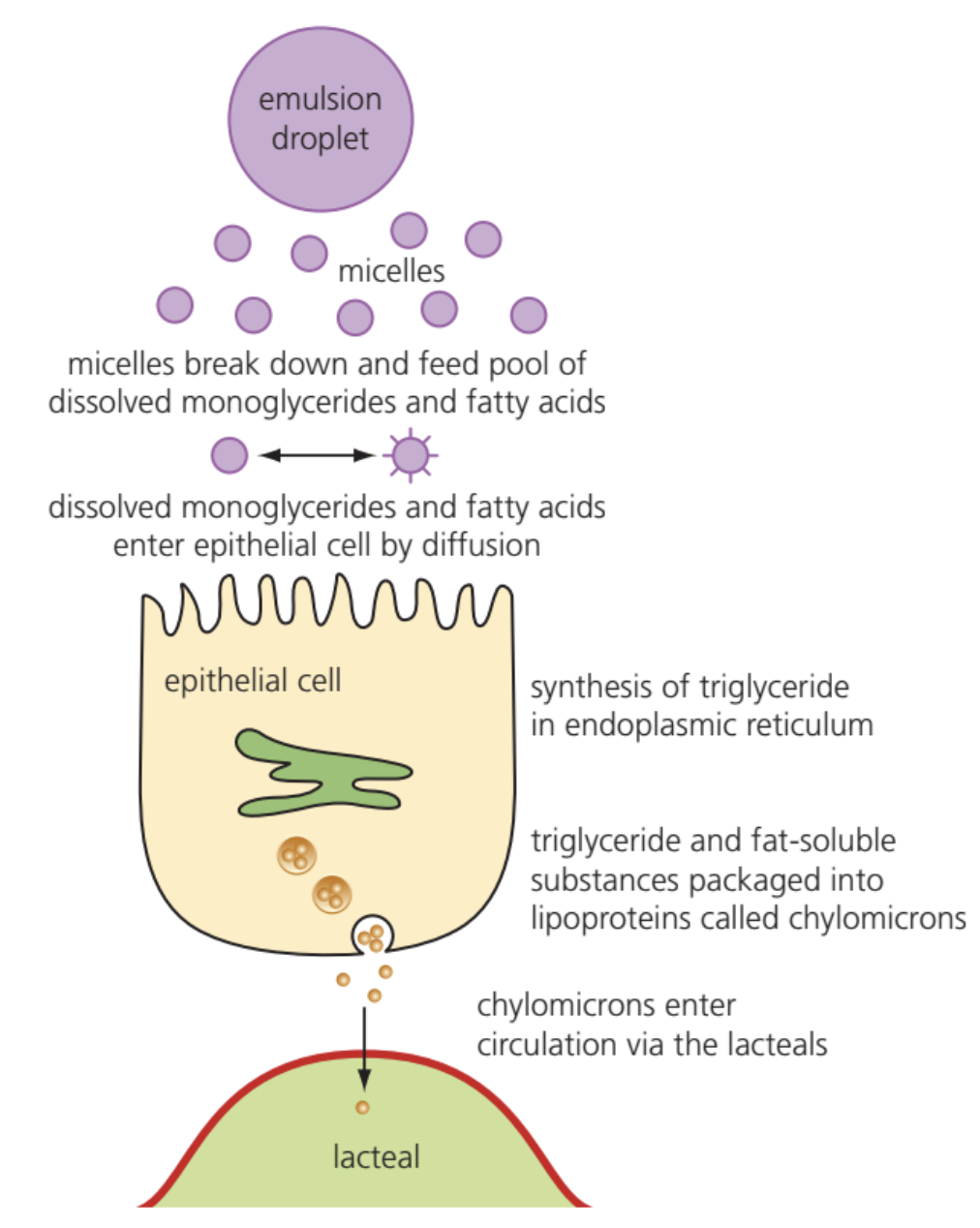
The combination of monoglycerides, fatty acids, and bile salts forms structures called micelles. These tiny particles, approximately 4-7 nm in diameter, move through the intestinal contents until they contact the epithelial cells lining the villi.
At the epithelial cell surface, micelles break down and release their monoglyceride and fatty acid components. Since these molecules are non-polar, they diffuse easily across the cell membrane into the epithelial cells.
Chylomicron formation and transport
Inside the epithelial cells, an intricate reconstruction process begins. Monoglycerides and fatty acids are transported to the endoplasmic reticulum, where they recombine to form triglycerides once again.
These reformed triglycerides then associate with cholesterol and specialised proteins called lipoproteins. This combination creates particles called chylomicrons, which are specifically adapted for lipid transport through body fluids.
Example
Step-by-Step Process: Chylomicron Formation
- Uptake: Monoglycerides and fatty acids enter epithelial cells
- Transport: Molecules move to the endoplasmic reticulum
- Reformation: Monoglycerides and fatty acids recombine into triglycerides
- Assembly: Triglycerides combine with cholesterol and proteins to form chylomicrons
- Packaging: Golgi apparatus packages chylomicrons for export
- Export: Chylomicrons are released by exocytosis into lacteals
The Golgi apparatus packages the chylomicrons for export from the cell. Rather than entering blood capillaries directly, chylomicrons are released from epithelial cells by exocytosis and enter the lacteals - the lymphatic capillaries found at the centre of each villus.
Entry into circulation
Chylomicrons travel through the lymphatic system before eventually entering the bloodstream. Once in blood capillaries, enzymes in the endothelial cells hydrolyse the triglycerides within chylomicrons, allowing the fatty acids to diffuse into surrounding tissues.
Note
Chylomicrons enter the lymphatic system rather than blood capillaries because they are too large to pass through the tight junctions between blood vessel cells. The lymphatic system has more permeable vessels that can accommodate these large particles.
Role of bile salts in fatty acid absorption
Bile salts play a vital role in fatty acid absorption through their unique molecular structure. Each bile salt molecule has one end that dissolves in fat (lipophilic) and another end that dissolves in water (hydrophilic).
This dual nature allows bile salts to arrange themselves around fat droplets, with their lipophilic ends embedded in the fat and their hydrophilic ends facing outward towards the watery intestinal contents. This arrangement prevents fat droplets from combining into larger masses, maintaining them as tiny micelles that can reach the epithelial cells.
Note
Research Evidence on Fatty Acid Absorption
Experimental evidence demonstrates the importance of various factors in fatty acid absorption. Studies show that the presence of bile salts significantly increases absorption rates, while compounds like glycerol and phosphate also enhance the process. The data indicates that iodoacetate, which inhibits cellular respiration, prevents fatty acid absorption, suggesting that active transport mechanisms requiring energy are involved.
Summary
Key Points to Remember:
- The ileum is specially adapted for absorption with villi and microvilli that maximise surface area
- Amino acids and monosaccharides are absorbed by diffusion and co-transport directly into blood capillaries
- Triglyceride absorption involves micelle formation, cellular reconstruction as chylomicrons, and transport via lymphatic vessels
- Bile salts are essential for lipid absorption, acting as emulsifying agents to form micelles
- The absorption process requires energy, as demonstrated by the inhibitory effect of respiratory inhibitors on fatty acid uptake