Exchange (AQA A-Level Biology): Revision Notes
📚Revision Notes
Gas Exchange in Single-celled Organisms & Insects
Gas exchange in single-celled organisms
Single-celled organisms possess a significant advantage for gas exchange due to their small size, which creates a large surface area to volume ratio. This physical characteristic allows efficient gas exchange to occur through simple diffusion across their cell surface.
Note
The surface area to volume ratio is crucial for gas exchange efficiency. As organisms get smaller, their surface area to volume ratio increases dramatically, making simple diffusion across the body surface highly effective for meeting their respiratory needs.
Oxygen enters these organisms by diffusing directly across their body surface, which acts as the gas exchange surface. The cell membrane presents no additional barrier to this process. Similarly, carbon dioxide produced during cellular respiration exits the organism by diffusing outward across the same surface.
Where single-celled organisms are surrounded by a cell wall, this structure does not create any additional resistance to gas diffusion, allowing the exchange process to continue unimpeded.
Important
Single-celled organisms can rely entirely on simple diffusion for gas exchange because their small size ensures that no part of the cell is far from the external environment, eliminating the need for specialised gas exchange systems.
Gas exchange in insects
Terrestrial insects face a fundamental challenge: they must balance efficient gas exchange with water conservation. The conflict arises because increasing surface area for gas exchange also increases the potential for water evaporation.
Important
This represents one of the key evolutionary challenges for terrestrial organisms - the need to exchange gases efficiently while preventing excessive water loss that could lead to dehydration and death.
The tracheal system
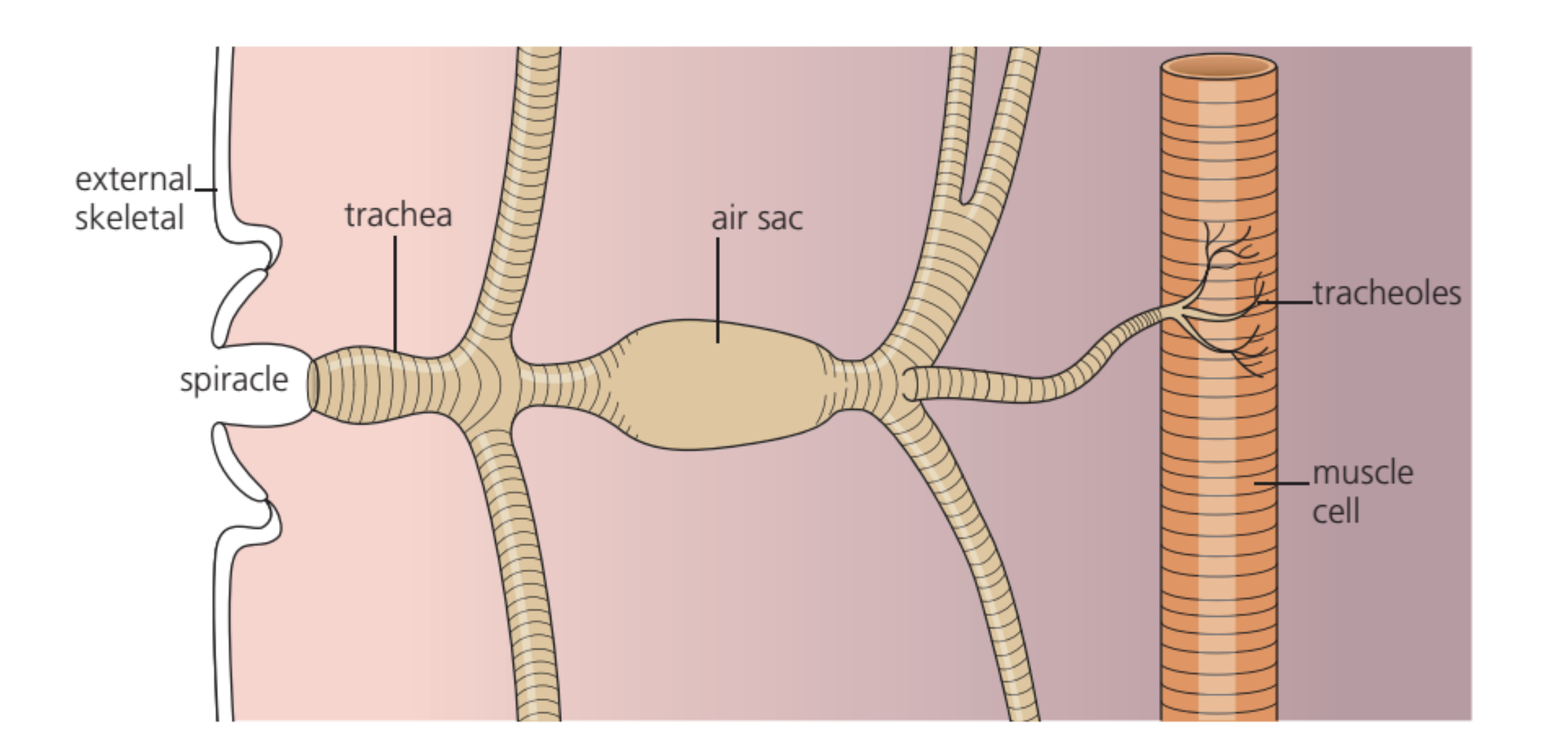
Insects have evolved an internal network of tubes called tracheae to overcome this challenge. These tubes are reinforced with strengthened rings that prevent collapse under pressure. The tracheae branch extensively throughout the insect's body, dividing into progressively smaller tubes called tracheoles.
The tracheoles extend to reach all body tissues, ensuring that atmospheric air containing oxygen is delivered directly to respiring tissues. This creates a very short diffusion pathway from each tracheole to any body cell.
Note
The tracheal system is remarkably efficient because it delivers oxygen-rich air directly to tissues, eliminating the need for a circulatory system to transport dissolved oxygen. This direct delivery system allows for rapid gas exchange even during periods of high metabolic demand.
Mechanisms of gas movement
Respiratory gases move through the tracheal system using three distinct mechanisms:
1. Diffusion gradient method
During cellular respiration, cells consume oxygen, reducing its concentration at the ends of tracheoles. This creates a concentration gradient that drives oxygen diffusion from the atmosphere along the tracheae and tracheoles towards the cells.
Simultaneously, carbon dioxide production during respiration creates the opposite gradient. Carbon dioxide diffuses away from cells, along tracheoles and tracheae, eventually reaching the atmosphere. Since diffusion occurs much faster in air than in water, this method enables rapid gas exchange.
Example
Worked Example: Diffusion Gradient in Action
Step 1: Active muscle cell consumes oxygen, reducing O₂ concentration at tracheole ends
Step 2: Concentration gradient established (high O₂ in atmosphere → low O₂ in tracheole ends)
Step 3: Oxygen diffuses along gradient from spiracles → tracheae → tracheoles → cells
Step 4: CO₂ produced by respiration creates reverse gradient (high CO₂ in cells → low CO₂ in atmosphere)
Step 5: CO₂ diffuses outward along tracheoles → tracheae → spiracles → atmosphere
2. Mass transport mechanism
Insects can actively assist gas movement through muscle contraction. When muscles surrounding the trachea contract, they compress the tubes, forcing air movement in and out. This mechanical ventilation significantly speeds up the exchange of respiratory gases beyond what diffusion alone could achieve.
3. Water-filled tracheole ends
During periods of high metabolic activity, muscle cells may switch to anaerobic respiration, producing lactate as a byproduct. Lactate is soluble in water and reduces the water potential of muscle cells.
This causes water to move from tracheoles into cells by osmosis. As water volume in tracheole ends decreases, air is drawn further into the system. The final part of the diffusion pathway now occurs in the gas phase rather than through liquid, making diffusion significantly more rapid and increasing the overall rate of air movement through the tracheal system. However, this mechanism does lead to increased water loss through evaporation.
Example
Worked Example: Water Movement During High Activity
Step 1: Muscle activity increases, oxygen demand rises
Step 2: Muscle cells switch to anaerobic respiration, producing lactate
Step 3: Lactate accumulates, reducing water potential in muscle cells
Step 4: Water moves from tracheoles into muscle cells by osmosis
Step 5: Air is drawn deeper into now partially-empty tracheoles
Step 6: Gas exchange pathway becomes shorter and occurs in air rather than water
Result: Faster diffusion and increased oxygen delivery to active muscles
Spiracle control
Gas exchange occurs through tiny pores called spiracles located on the insect's body surface. These openings can be opened and closed by valve-like structures.
To minimise water loss, insects typically keep their spiracles closed for much of the time. They open them periodically to allow gas exchange when oxygen levels become depleted or carbon dioxide levels build up excessively.
Note
This control mechanism allows insects to fine-tune the balance between gas exchange and water conservation based on their immediate physiological needs and environmental conditions.
System limitations and advantages
The tracheal system represents an highly effective gas exchange method, but it does have constraints. The system relies primarily on diffusion for gas transport between the environment and cells. For diffusion to remain effective, the diffusion pathway must be short.
Important
This requirement explains why insects are relatively small organisms - as body size increases, diffusion pathways become longer and less efficient. This physical constraint represents the fundamental trade-off in the tracheal system design.
This requirement explains why insects are relatively small organisms - as body size increases, diffusion pathways become longer and less efficient. Despite this size limitation, the tracheal system has not prevented insects from becoming one of the most successful animal groups on Earth.
Summary
Key Points to Remember:
- Single-celled organisms use simple diffusion across their body surface due to their large surface area to volume ratio
- Insects have evolved a tracheal system (tracheae → tracheoles) to deliver air directly to tissues
- Three mechanisms move gases in insects: diffusion gradients, mass transport via muscle contraction, and water movement in tracheole ends
- Spiracles can open and close to balance gas exchange needs with water conservation
- The tracheal system's reliance on short diffusion pathways limits insect body size but remains highly successful