Stereoisomerism (AQA A-Level Chemistry): Revision Notes
📚Revision Notes
3.1.5 Stereoisomerism
Stereoisomerism
Note
Stereoisomerism occurs when compounds have the same structural and displayed formulae but differ in the spatial arrangement of their atoms. Unlike structural isomers, which differ in how atoms are connected, stereoisomers have the same connectivity but occupy different positions in space. The most common form of stereoisomerism is E/Z isomerism (also known as geometric isomerism).
E/Z Isomerism
E/Z isomerism arises due to the restricted rotation around a carbon-carbon double bond ().
- This restricted rotation occurs because of the pi bond formed alongside the sigma bond in a double bond.
- Pi bonds prevent the free rotation that single bonds () allow, "freezing" the groups attached to each carbon in place.
For E/Z isomerism to occur, each carbon of the double bond must be attached to two different groups. The arrangement of these groups around the double bond determines whether the isomer is E or Z.
- Z isomer: The two groups with the highest priority are on the same side of the double bond (think "Zame Zide").
- E isomer: The two groups with the highest priority are on opposite sides of the double bond.
Cahn-Ingold-Prelog (CIP) Priority Rules
For more complex molecules, the E or Z designation is determined by the Cahn-Ingold-Prelog (CIP) priority rules.
These rules rank the groups attached to the carbon atoms based on atomic numbers:
-
Assign a priority to the two atoms directly attached to each carbon of the double bond. The atom with the higher atomic number has higher priority.
-
If the atoms directly attached to the carbon are the same, look at the atoms bonded to these atoms. The group with the atom of higher atomic number further down the chain takes priority. Once the priorities have been assigned:
-
If the higher priority groups are on the same side of the double bond, the isomer is Z.
-
If the higher priority groups are on opposite sides, the isomer is E.
Note
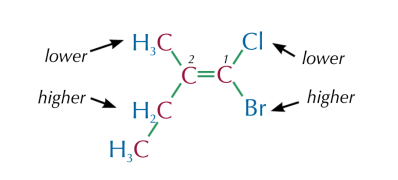
Example: 1-bromo-1-chloro-2-methylbut-1-ene
For this compound, let's assign priorities to determine whether it's an E or Z isomer:
Carbon 1:
Attached to and . Since has a higher atomic number than , takes priority.
Carbon 2:
Attached to two carbons. We compare the groups further down the chain.
The ethyl group () has a higher priority than the methyl group () because the second carbon in the ethyl group has a higher atomic number than the hydrogens attached to the methyl group.
In this case, both high-priority groups ( and the ethyl group) are on the same side of the double bond, so the molecule is Z-1-bromo-1-chloro-2-methylbut-1-ene.
Drawing E and Z Isomers
To draw E and Z isomers, follow these steps:
- Identify the groups attached to the carbon atoms of the double bond.
- Assign priorities using the CIP rules.
- Draw the molecule with the higher priority groups either on the same side (Z) or opposite sides (E) of the double bond.
Note
Summary
Understanding stereoisomerism, particularly E/Z isomerism, is crucial when studying organic molecules. These spatial differences can have significant effects on the physical and chemical properties of compounds, making it essential to identify and differentiate between them accurately.