Oxidation of Alcohols (AQA A-Level Chemistry): Revision Notes
📚Revision Notes
3.5.3 Oxidation of Alcohols
Note
Alcohols can be oxidised to form various organic compounds depending on their classification as primary, secondary, or tertiary alcohols. Understanding the oxidation reactions of alcohols is important in both organic synthesis and chemical analysis. This note will explore the oxidation processes, required conditions, and tests to identify oxidation products.
Types of Alcohols
Alcohols are categorised based on the carbon to which the hydroxyl group () is attached:
- Primary Alcohols (): The carbon with the group is attached to one other carbon or hydrogen atoms.
- Secondary Alcohols (): The carbon with the group is attached to two other carbon atoms.
- Tertiary Alcohols (): The carbon with the group is attached to three other carbon atoms.
Oxidation of Primary Alcohols
Overview
Primary alcohols can undergo partial or complete oxidation:
- Partial Oxidation: Forms an aldehyde.
- Complete Oxidation: Forms a carboxylic acid.
Oxidising Agent
The typical oxidising agent used is acidified potassium dichromate (VI), a mixture of potassium dichromate () and sulfuric acid (). In equations, the oxidising agent can be represented as .
Key Observation:
Colour Change: Orange (dichromate (VI) ions) to green (chromium (III) ions) when oxidation occurs.
Partial Oxidation: Producing Aldehydes
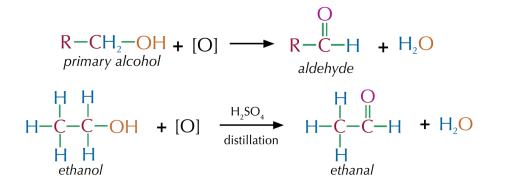
To oxidise a primary alcohol to an aldehyde:
- Add acidified potassium dichromate (VI) to the alcohol.
- Heat the mixture and distil the product as it forms to prevent further oxidation.
Note
Example: Ethanol to Ethanal
Complete Oxidation: Producing Carboxylic Acids
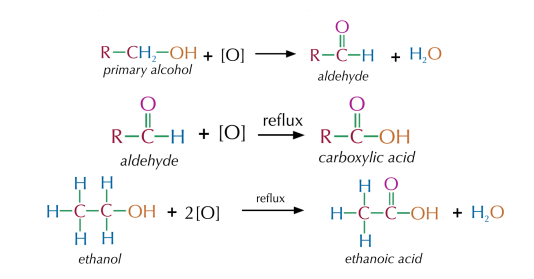
To fully oxidise a primary alcohol:
- Use excess acidified potassium dichromate (VI).
- Heat the mixture under reflux for at least 10 minutes to ensure complete oxidation.
- Distil the final product after the complete reaction.
Note
Example: Ethanol to Ethanoic Acid
Explanation of Distillation and Reflux
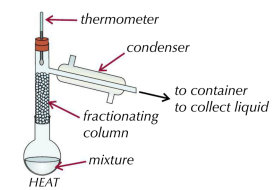
Distillation: Separates products by their boiling points. Aldehydes have lower boiling points than alcohols, allowing them to be distilled off immediately during partial oxidation.
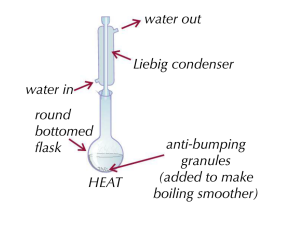
Reflux: Ensures that the reaction mixture is continuously boiled and condensed back into the reaction vessel, preventing volatile compounds like aldehydes from escaping.
Oxidation of Secondary Alcohols
Overview
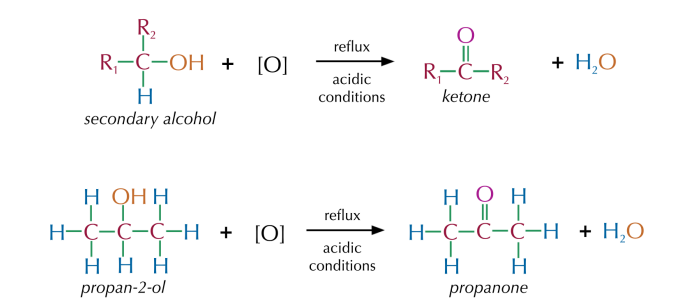
Secondary alcohols are oxidised to ketones, which are stable and do not undergo further oxidation.
Oxidation Process
- Use excess acidified potassium dichromate(VI).
- Heat under reflux to ensure a complete reaction.
Note
Example: Propan-2-ol to Propanone
Properties of Ketones
- Functional Group: Carbonyl group ().
- Naming: Suffix is "-one". For longer chains, the carbon position of the carbonyl group is indicated.
Oxidation of Tertiary Alcohols
Overview
Tertiary alcohols are generally resistant to oxidation due to the lack of hydrogen atoms attached to the carbon with the group. Oxidising tertiary alcohols requires very harsh conditions, such as using hot concentrated nitric acid, which breaks carbon-carbon bonds.
Note: For typical laboratory conditions, tertiary alcohols are considered non-oxidisable.
Distinguishing Aldehydes from Ketones
Chemical tests can differentiate aldehydes from ketones because only aldehydes are easily oxidised.
Fehling's Solution Test
- Procedure: Warm the sample with Fehling's solution.
- Result:
- Aldehydes: Blue solution turns to a red precipitate ().
- Ketones: No change.
Tollens' Reagent Test
- Procedure: Add Tollens' reagent (ammoniacal silver nitrate) and warm.
- Result:
- Aldehydes: Formation of a silver mirror ().
- Ketones: No change.
Note
Summary of Oxidation Reactions
| Alcohol Type | Oxidation Product 1 | Oxidation Product 2 | Reagents and Conditions |
|---|---|---|---|
| Primary | Aldehyde | Carboxylic Acid | Acidified , distil/reflux |
| Secondary | Ketone | N/A | Acidified , reflux |
| Tertiary | N/A | N/A | Not easily oxidised under normal conditions |
By understanding these oxidation processes, you will have a solid grasp of how alcohols behave under different conditions, which is crucial for organic synthesis and chemical analysis. Practice distinguishing between aldehydes and ketones using the chemical tests mentioned, as these are essential skills for exams and laboratory work.