Employment and Unemployment (AQA A-Level Economics): Revision Notes
📚Revision Notes
Employment and Unemployment
The meaning and measurement of unemployment
Understanding employment and unemployment is essential for analysing how well an economy is performing. In the UK, the government has moved away from using the claimant count (the number of people claiming unemployment benefits) as its primary measure of unemployment. Instead, it now relies on the Labour Force Survey (LFS), which provides a more comprehensive picture of the labour market.
When we talk about full employment, it's important to recognise that this doesn't mean every single person in the working population has a job. Rather, full employment describes a situation where everyone who wants to work at the prevailing market wage rate can find employment. In other words, it's when the number of people willing to work at the current real wage equals the number of workers employers want to hire at that same wage rate.
Note
Even this definition requires some qualification. In a dynamic economy where industries are constantly evolving—with some sectors growing whilst others decline—there will always be some level of unemployment present. This leads us to distinguish between different types of unemployment, particularly frictional and structural unemployment.
Important
Exam tip: Make sure you can interpret both claimant count and Labour Force Survey data, as questions may present either measure and ask you to explain the differences between them.
Voluntary and involuntary unemployment
A fundamental distinction in unemployment economics is between voluntary and involuntary unemployment. This classification is particularly important when discussing the causes of unemployment and appropriate policy responses.
Involuntary unemployment occurs when workers are genuinely willing and able to work at the current market wage rate, but cannot find employment because there are no jobs available. This situation arises when there is insufficient demand for labour in the economy. Writing in the 1930s during the Great Depression, the economist John Maynard Keynes argued that deficient aggregate demand was the primary cause of mass unemployment. The unemployed weren't choosing to be without work; rather, they wanted jobs but couldn't find them because aggregate demand for goods and services was too low, which in turn meant firms didn't need to hire workers.
In contrast, voluntary unemployment describes a situation where workers without jobs are unwilling to accept employment at the going wage rate. They may choose instead to receive state benefits rather than seek work. Whilst this might initially sound like laziness, the reality is more nuanced.
Note
The concept of voluntary unemployment can be quite subjective. For example, if someone chooses not to relocate to find employment in order to stay near family, some observers might consider this 'voluntary' whilst others would view it as 'involuntary'. The key point is that in voluntary unemployment, workers are technically available for work but are not accepting jobs at current wage rates.
Types and causes of unemployment
Economists identify four main types of unemployment: frictional, structural, cyclical, and seasonal. Each has distinct causes and requires different policy responses.
Frictional unemployment
Frictional unemployment, also known as transitional unemployment, represents the 'between jobs' unemployment that occurs naturally in a functioning labour market. This type of unemployment is usually short-term and arises when workers are moving from one job to another. The key characteristic is that job vacancies exist somewhere in the economy, but friction in the labour market prevents unemployed workers from immediately filling these positions.
Several factors create this friction in the labour market. Geographical immobility of labour occurs when workers face barriers to moving from one region to another. These barriers include:
- Family ties and local friendships that discourage relocation
- Lack of information about job opportunities in other regions
- High costs of moving house and difficulties of obtaining affordable housing in areas where jobs are available
Occupational immobility of labour arises from difficulties in training for jobs that require different skills. Contributing factors include:
- Restrictive practices that require workers to possess specific qualifications
- Various forms of discrimination in labour markets based on age, gender, or ethnicity
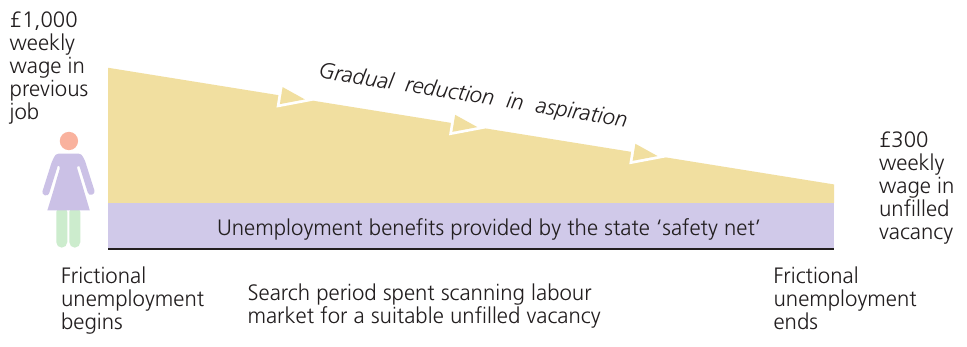
The search theory of unemployment helps explain frictional unemployment as a voluntary search period. When a worker loses a job, they typically have aspirations about the wage they want to earn in their next position. As their job search continues without success, they gradually reduce their wage aspirations until they find a vacancy they're willing to accept. Unemployment benefits act as a safety net during this period, allowing workers time to search for suitable employment rather than having to accept the first available job regardless of how poor the match might be.
Note
Redundant workers who have been made unemployed may take considerable time to find work matching their skills and acceptable wage levels. Similarly, young workers entering the labour market for the first time, including recent university graduates, often experience a period of frictional unemployment whilst they search for appropriate positions.
Imperfect information in the labour market worsens frictional unemployment. When jobless workers are unaware of available vacancies, the matching process between workers and jobs becomes less efficient. Additionally, some unemployed people may be reluctant to actively seek work because they fear that accepting employment will result in higher tax payments and loss of benefits, effectively reducing their net income.
Structural unemployment
Structural unemployment represents a more serious, long-term form of unemployment compared to frictional unemployment. It occurs when industries enter structural decline, unable to compete with changing demand patterns or new products, and when more efficient competitors emerge in other countries. Structural unemployment also results from changing skill requirements as industries evolve their production methods. This type of unemployment is sometimes called technological unemployment when it specifically results from technological change.
Technological unemployment arises from the successful growth of new industries using labour-saving technology. There's an important distinction here between mechanisation and automation. Mechanisation—where workers operate machines—has historically increased overall demand for labour. However, automation—where machines operate other machines—can reduce labour demand significantly. As mechanised industry has grown, employment in those sectors has typically increased. But when automation is introduced, even in expanding industries, it can lead to labour being shed.
Note
Changes in technology can also shift patterns of demand. For instance, in countries with hot climates, solar panels have been replacing electricity generated from coal, leading to structural unemployment when fossil-fuel power stations close down.
The growth of structural unemployment in the service sector has partly resulted from increasing use of information and communication technology (ICT) and automated services. Call centre employment grew significantly in recent years, but some of these centres have relocated overseas to lower-wage countries such as India. Moreover, companies that previously employed call-centre workers increasingly use automated communication software rather than human operators to provide customer services.

The modern economy has seen the rise of zero-hours employment contracts and increased under-employment. Under-employment occurs when people work part-time because they cannot secure full-time employment, or when they want more hours in their current job but cannot get them. Zero-hours contracts, which don't guarantee a minimum number of working hours, have become particularly common in sectors such as accommodation and food services (around 25%) and health and social care (around 20%). Whilst some workers value the flexibility these contracts provide, others experience significant insecurity and unpredictability in their working lives.
Important
Separating structural unemployment from other causes, particularly changes in aggregate demand, can be challenging. Manufacturing output grew in many years between 1993 and 2008, but manufacturing employment fell during this same period. This occurred partly because many activities previously undertaken 'in-house' by manufacturing firms—ranging from cleaning to information technology maintenance—were outsourced to external service-sector providers. This shift demonstrates how deindustrialisation doesn't always reflect genuine structural decline but can instead represent a reclassification of economic activity.
Deindustrialisation—the decline of manufacturing industries alongside coal mining—has been a particularly important cause of structural unemployment in the UK. During the post-Second World War era, structural unemployment was concentrated in regions where nineteenth-century staple industries such as textiles and shipbuilding had suffered decline. However, in the severe recessions of the 1980s and 1990s, and again in the 2008-09 recession, structural unemployment affected almost all UK regions. The decline of manufacturing industries due to international competition has also created structural unemployment in industries and service sectors that depended on the manufacturing base.
Cyclical unemployment
Cyclical unemployment, also known as Keynesian unemployment or demand-deficient unemployment, occurs when there is insufficient aggregate demand in the economy. This typically happens when the economy enters a recession or depression. During the Great Depression of the 1930s, Keynes argued that deficient aggregate demand was the major cause of persistent mass unemployment. Whilst free-market economists generally accept that temporary cyclical unemployment may result from lack of demand during economic downswings, Keynes went further, arguing that the economy could settle into an under-full-employment equilibrium caused by a continuing lack of effective aggregate demand.
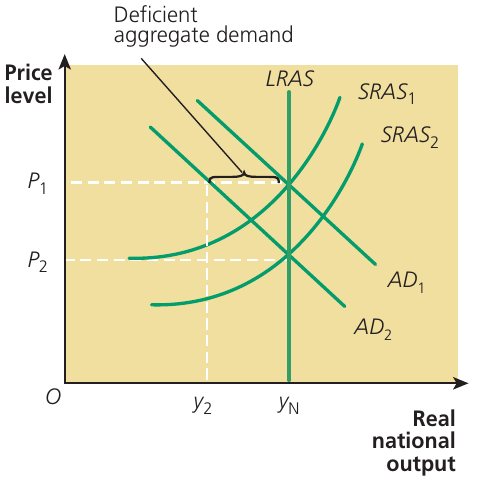
Note
The diagram above illustrates cyclical unemployment using an AD/AS framework. When there is deficient aggregate demand, the AD curve shifts leftward. If prices and wages are 'sticky' (inflexible), this leads to cyclical unemployment persisting. The equilibrium level of national income falls below the economy's potential output at full employment.
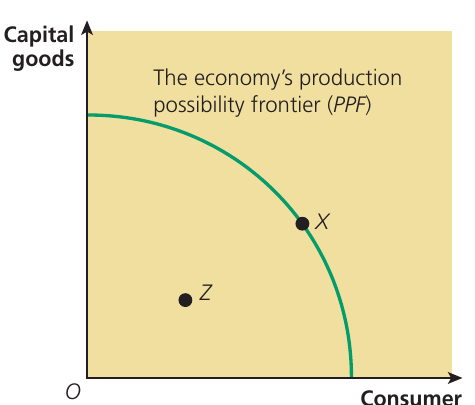
An alternative way to visualise cyclical unemployment is through the production possibility frontier (PPF). All points on the PPF curve represent the economy using all its productive capacity, including labour—meaning there's no demand deficiency and therefore no cyclical unemployment. However, deficient aggregate demand can cause the economy to produce inside its production possibility frontier, such as at point Z in the diagram above. When this occurs, cyclical unemployment exists in the economy.
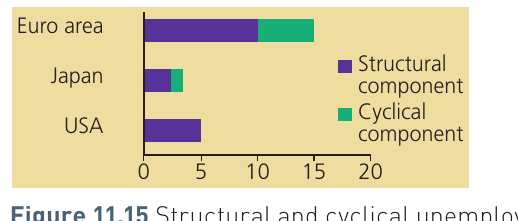
Note
The bar chart above compares the structural and cyclical components of unemployment across different economies. The Euro area shows relatively high levels of both structural and cyclical unemployment. Japan displays much lower levels of both types, whilst the USA shows moderate structural unemployment with minimal cyclical unemployment at the time this data was collected.
In contrast to the Keynesian view, free-market economists reject the notion that cyclical unemployment can persist in the long run. They assume that markets for both goods and labour are competitive. By allowing businesses' costs of production to fall (through wage reductions), market forces shift the SRAS curve, increasing output back towards the economy's normal capacity level. According to this free-market perspective, cyclical unemployment is temporary and self-correcting—provided that markets remain sufficiently competitive and prices and wages are flexible.
Seasonal unemployment
Seasonal unemployment represents a special category of casual unemployment that occurs when workers are temporarily laid off at certain times of the year. This type of unemployment affects industries such as tourism, agriculture, hospitality, and building. When casual unemployment results from regular fluctuations in weather conditions or seasonal demand patterns, economists classify it as seasonal unemployment.
Seasonal unemployment is generally the least significant of the four main types, except naturally for those workers who become seasonally unemployed. In the UK, seasonal unemployment doesn't typically create major economic problems because the seasonal variations are relatively small and predictable.
Demand-side and supply-side factors affecting employment and unemployment
Understanding whether unemployment stems from demand-side or supply-side factors is crucial for determining appropriate government policies. Cyclical (or Keynesian) unemployment results from insufficient aggregate demand—a demand-side problem. Seasonal unemployment is also primarily demand-driven, as it reflects fluctuations in demand for certain goods and services at different times of year.
By contrast, frictional and structural unemployment arise from supply-side factors affecting the economy. These include geographical and occupational immobilities of labour, skills mismatches, and technological changes that make certain types of work obsolete.
Important
The appropriate government policy response depends on correctly diagnosing the underlying cause. Cyclical unemployment can potentially be reduced through using fiscal and monetary policy to stimulate aggregate demand. However, supply-side policies should be employed to address frictional and structural unemployment. These policies aim to improve labour market flexibility, enhance worker mobility, and facilitate retraining and skill development.
Important
Exam tip: When answering questions about unemployment policies, always identify the type of unemployment first, then explain why particular policies would be effective for that specific type.
The real-wage theory of unemployment
Nearly a century ago, large-scale persistent unemployment occurred in the UK, preceding the spread of unemployment worldwide during the Great Depression of the 1930s. Much of the unemployment in 1920s Britain probably resulted from lack of competitiveness and decline of traditional industries such as shipbuilding and textiles. However, free-market economists placed substantial blame for the unemployment on excessively high real wages.
Real wages refer to the purchasing power of the nominal (or money) wage. For instance, real wages fall when inflation rises faster than nominal wages, and real wages rise when the nominal wage rate increases more rapidly than inflation. Understanding real wages is essential for analysing labour market dynamics.
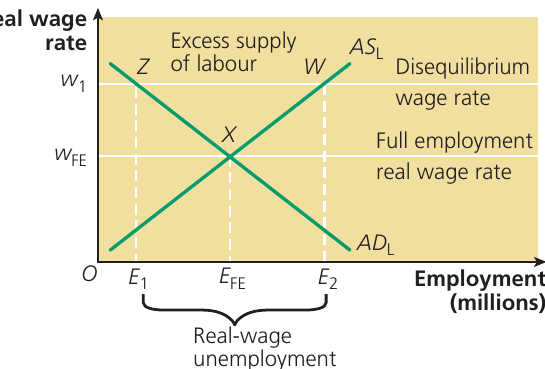
Real-wage unemployment, also called classical unemployment, is a type of disequilibrium unemployment illustrated in the diagram above. Full employment (equilibrium employment) occurs where the aggregate demand for labour equals the aggregate supply of labour—shown at point X, with the full employment real wage rate at . However, if wages become fixed at a higher real rate () rather than at , employers wish to hire only workers, but workers want to supply their labour at this wage rate. There is excess supply of labour in the labour market, equal to the horizontal distance between points Z and W. This represents real-wage unemployment: .
Note
Free-market economists argue that, provided labour markets remain competitive, the resulting real-wage unemployment should be temporary. Competitive forces in the labour market should drive down the real wage rate to , thereby eliminating the excess supply of labour. Full employment would be restored once the number of workers willing to work equals the number of people whom firms wish to hire.
However, labour market rigidity or 'stickiness'—perhaps caused by trade unions—can prevent the real wage rate from falling below . When the market mechanism fails to work properly, excess supply of labour persists, and real-wage unemployment continues. Pre-Keynesian free-market economists blamed trade unions and other causes of labour market imperfection for the mass unemployment between the First and Second World Wars. They believed that responsibility for unemployment lay with workers and their trade unions who, by refusing to accept lower wages, prevented the unemployed from pricing themselves into jobs.
Important
Many Keynesian economists consider real-wage unemployment to be involuntary unemployment, caused by wage stickiness where wages remain at their current level and take time to adjust to changing market conditions—a form of wage inflexibility beyond workers' control. By contrast, free-market economists argue that real-wage unemployment is voluntary unemployment, claiming that workers and their trade unions should be prepared to accept wage reductions.
The natural rate of unemployment
As previously noted, full employment doesn't necessarily mean that every single member of the working population is employed. Rather, it describes a situation where the number of people wishing to work at the going market real wage rate equals the number of workers whom employers wish to hire at this wage rate. Even this definition requires qualification, since in a dynamic economy there is always some frictional and structural unemployment resulting from constant economic change.
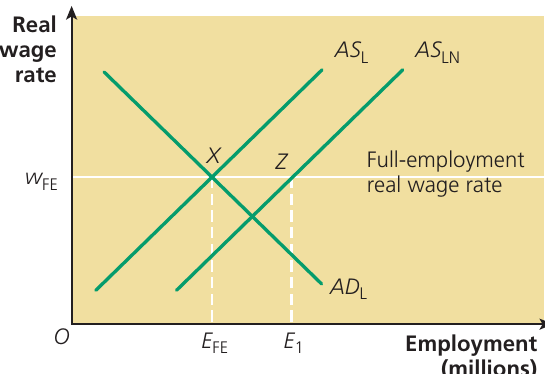
Frictional and structural unemployment together constitute what economists call equilibrium unemployment. Equilibrium unemployment, also known as the natural level of unemployment, exists even when the economy's aggregate labour market is in equilibrium—that is, when the real wage rate equals the market-clearing level where aggregate demand for labour equals aggregate supply of labour.
Note
The natural level of unemployment is illustrated in the diagram above. The distance indicates the number of workers willing to work at the full employment real wage rate , but who for frictional and structural reasons cannot secure jobs. The natural level of unemployment is the unemployment that occurs when the aggregate labour market is in equilibrium, with aggregate demand for labour equalling aggregate supply of labour.
Expressed as a rate of unemployment rather than as a level, this is called the natural rate of unemployment (NRU). The diagram shows equilibrium employment with the equilibrium wage rate at and the market-clearing real wage rate. Full employment occurs when workers are hired. The distance between the aggregate supply curve and the curve represents the amount of frictional and structural unemployment in the economy at the full employment wage rate —namely, the number of workers who are willing and able to work at this wage rate but who, for frictional and structural reasons, cannot secure employment.
The consequences of unemployment
The consequences of unemployment for the economy
Unemployment imposes significant costs on the economy as a whole, primarily through the waste of human capital. When workers remain unemployed, the economy fails to utilise all its productive resources to generate output. This output, if it had been produced, could have enhanced material living standards and economic welfare for the entire population. Instead, the economy produces inside its production possibility frontier, operating below its potential capacity.
Unemployment also reduces an economy's international competitiveness. High unemployment can diminish incentives for firms to invest in cutting-edge technologies that typically improve export competitiveness. The under-investment associated with high unemployment also stems from a reduced need to invest in capital-intensive technologies when abundant unemployed workers are available to hire at low cost. High unemployment means the relative cost of employing labour is low because there's reduced upward pressure on wages. This creates an environment where firms continue using labour-intensive but outdated technologies, particularly when high unemployment accompanies a stagnant economy, low profits, and a climate of business pessimism.
Note
Under-investment can also result from the higher business taxes firms may face to help finance welfare benefits paid to unemployed workers. Whilst Jobseeker's Allowance can only be claimed during the first months of unemployment, in the UK the state continues paying Universal Credit to families without a wage earner, protecting family members—particularly children—from absolute poverty. The government has introduced benefit caps to limit the maximum amount claimable. These caps vary depending on location and family composition, with higher caps in London than elsewhere. The justification for benefit caps is that families living solely on benefits shouldn't receive higher payments than the earnings of people on median incomes.
Economies are particularly severely affected by long-term unemployment. A worker may become increasingly unemployable the longer they remain out of work. Skills and work habits erode over time. Long-term unemployment worsens when employers, who might otherwise hire and retain economically inactive workers, perceive that those with more recent job experience present fewer risks and are more employable. When inactive workers are viewed as unemployable, the economy behaves as if it's on its production possibility frontier, even though many unemployed workers are notionally available for work. An increase in aggregate demand can then trigger inflation rather than growth in output and employment.
Important
Despite the disadvantages of high unemployment for the economy, many free-market economists believe some unemployment is necessary for proper economic functioning. By providing downward pressure on wage rates, unemployment can help reduce inflation. Unemployment also contributes to widening income differentials between better-paid and low-paid workers. Some free-market economists view this positively, believing that pay differences are necessary to promote incentives, which create the supply-side conditions for economic prosperity.
The consequences of unemployment for individuals
Unemployment is obviously damaging for unemployed individuals and their families, largely because of the low incomes and reduced living standards that accompany joblessness. However, the costs extend far beyond simple income loss. Unemployment can destroy hope for the future, causing unemployed people to feel marginalised whilst their self-esteem suffers. Families experience increased health risks, greater stress levels, reduced quality of diet, and heightened risk of marital breakdown and social exclusion resulting from loss of work and income.
Important
Exam tip: Don't confuse the causes of unemployment (such as cyclical, structural, or frictional) with the effects or consequences of unemployment (such as costs to individuals, families, and the economy).
Government policies to reduce unemployment
When governments intervene to reduce unemployment, the appropriate policy depends critically on correctly identifying the underlying cause. If unemployment is incorrectly diagnosed—for example, as resulting from demand deficiency when the true cause is structural—then policies of fiscal or monetary expansion to stimulate aggregate demand will prove ineffective and inappropriate. Indeed, reflating demand in such circumstances would likely create excess demand, raising the price level without producing lasting beneficial effects on employment.
Important
In the long run, the only truly effective way to reduce unemployment is achieving successful economic growth, which increases firms' demand for new employees. However, this proves easier to recommend than to accomplish. Free-market economists believe growth is best facilitated by anti-interventionist supply-side policies and by reducing government intervention in markets. Keynesian economists, by contrast, argue that expansionary fiscal and monetary policy must be employed to reduce demand-deficient or cyclical unemployment, such as that which occurred during and after the 2008-09 recession.
Reducing frictional and structural unemployment
Governments can attempt to reduce frictional unemployment by improving the geographical and occupational mobility of labour, by reducing workers' search periods between jobs, and by introducing supply-side policies.
Improving the geographical mobility of labour
Geographical mobility could be enhanced by making it easier for families to relocate from one region to another. For example, the government could subsidise removal costs. However, the widening disparity in UK house prices between south and north actually reduces geographical labour mobility. Government spending on rented social housing in areas experiencing ongoing labour shortages would perhaps be the most effective method of improving geographical mobility, though for cost and other reasons, this policy is unlikely to be adopted on a scale sufficient to produce significant effects.
Improving the occupational mobility of labour
Governments can improve occupational mobility by providing retraining schemes and enhancing information about available jobs, enabling people to find positions requiring their skillset outside their local area. Government retraining schemes are typically less effective than those operated by private-sector firms.
Note
A market failure exists: employers in trades such as plumbing often prefer avoiding training costs, instead recruiting newly trained workers from the small number of employers who do invest in training their employees. This results in too few workers receiving proper training.
Reducing employment search periods
The introduction of Jobseeker's Allowance (JSA) in 1996, paid to unemployed individuals, aimed to reduce search periods between jobs. The allowance creates an incentive for newly unemployed workers to accept lower wage rates and to accelerate their search for vacancies meeting their (now reduced) aspirations. Various restrictions determine JSA eligibility. For example, those living with a partner who works more than 24 hours per week cannot claim JSA, and those with savings exceeding £16,000 (including their partner's savings) are also ineligible.
Supply-side policies
Supply-side policies, which aim to improve market competitiveness and efficiency, are now used to address frictional and structural unemployment. Historically, deindustrialisation led to large-scale structural unemployment concentrated in regions of decline such as coal fields and areas previously dominated by heavy industry.
Many traditional manufacturing industries and the coal industry have now largely disappeared from the UK, so there's less scope for further structural decline in these activities. The supply-side improvements of the 1980s and 1990s also created conditions enabling service industries to grow and replace manufacturing. Consequently, more workers could transition from declining industries into growing ones. However, recent and current financial services crises demonstrate that service industries such as banking have themselves become vulnerable to structural decline and overseas relocation.
Important
Exam tip: You must appreciate that unemployment has multiple causes, and therefore the appropriate policies to reduce unemployment depend on correctly identifying the cause.
Summary
Remember!
Unemployment can be measured using either the claimant count or the Labour Force Survey (LFS), with the LFS providing a more comprehensive measure.
Four main types of unemployment exist:
- Frictional (short-term, between jobs)
- Structural (long-term, declining industries)
- Cyclical (caused by deficient aggregate demand)
- Seasonal (occurring at certain times of year)
Distinguish between voluntary and involuntary unemployment: involuntary unemployment occurs when workers want jobs but cannot find them due to lack of demand; voluntary unemployment occurs when workers choose not to accept jobs at current wage rates.
The natural rate of unemployment comprises frictional and structural unemployment, and exists even when the labour market is in equilibrium at full employment.
Consequences affect both the economy and individuals: the economy suffers from wasted resources, reduced competitiveness, and under-investment, whilst individuals experience low income, reduced self-esteem, and social exclusion.
Policy responses must match the type of unemployment: demand-side policies (fiscal and monetary expansion) address cyclical unemployment, whilst supply-side policies (improving labour mobility, retraining, reducing market rigidities) tackle frictional and structural unemployment.