Trade and Comparative Advantage (AQA A-Level Economics): Revision Notes
📚Revision Notes
Trade and Comparative Advantage
Why international trade matters
International trade plays a crucial role in modern economies, allowing countries to expand both their production and consumption possibilities beyond what they could achieve in isolation. Without trade, a country's economic activity would be limited to producing only those goods and services for which it has the natural resources and productive capacity.
Note
Consider how a small economy would function without any international trade. A country like Iceland, operating as a closed economy, would face severe limitations. Its production would be restricted to goods and services that could be made using its limited domestic resources. This would likely result in high average production costs, since the small population would prevent economies of scale from being achieved. Similarly, consumers would only have access to domestically produced goods, restricting choice and living standards.
In contrast, when countries engage in international trade, they can specialise in producing goods they are best at making and import everything else. This allows:
- Expanded production possibilities: Countries can access raw materials and intermediate goods from abroad, enabling production of a wider range of final products
- Lower costs: Specialisation allows firms to benefit from economies of scale and longer production runs
- Greater consumer choice: Imports provide access to products that may not be produced domestically
- Higher living standards: The combination of specialisation and trade enables higher levels of economic welfare
The UK economy demonstrates how dependent modern nations are on international trade. The country's relatively narrow resource base means it relies heavily on imports of raw materials, energy, and manufactured goods. Brexit has illustrated the challenges that arise when trade relationships change, as new barriers to trade have made importing and exporting more difficult and costly, even without the imposition of tariffs.
Absolute advantage
To understand the benefits of international specialisation and trade, we first need to examine the concept of absolute advantage.
Absolute advantage exists when a country can produce more of a good using a given amount of resources compared to another country. Put another way, it has an absolute advantage if it can produce the same quantity of output using fewer resources.
Understanding absolute advantage through an example
Let's examine two countries, Atlantis and Pacifica, each with 2 units of resource available. These resources can be used to produce either guns or butter. We'll use these products as they've become traditional in economic examples, though they could represent any two goods (for instance, guns might represent military or capital goods, while butter represents consumer goods).

The table shows that with 1 unit of resource:
- Atlantis can produce either 4 guns or 2 tonnes of butter
- Pacifica can produce either 1 gun or 6 tonnes of butter
From this data, we can clearly see that Atlantis has an absolute advantage in gun production (it produces 4 guns compared to Pacifica's 1). However, Pacifica has an absolute advantage in butter production (it produces 6 tonnes compared to Atlantis's 2 tonnes).
Production without specialisation
If both countries decide to divide their resources equally between the two products, allocating 1 unit of resource to guns and 1 unit to butter, we get the following outcome:
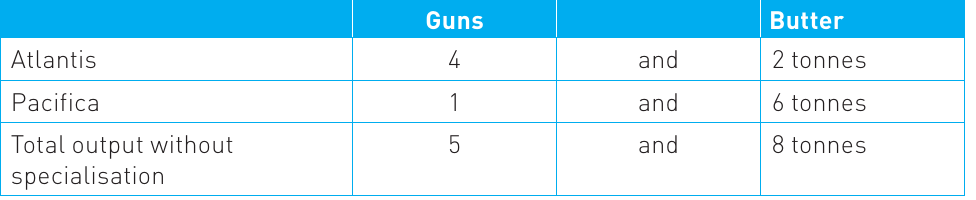
Combined output across both countries totals 5 guns and 8 tonnes of butter. This represents production without specialisation.
Complete specialisation and its benefits
Now let's consider what happens when each country specialises completely in producing the good for which it has an absolute advantage:
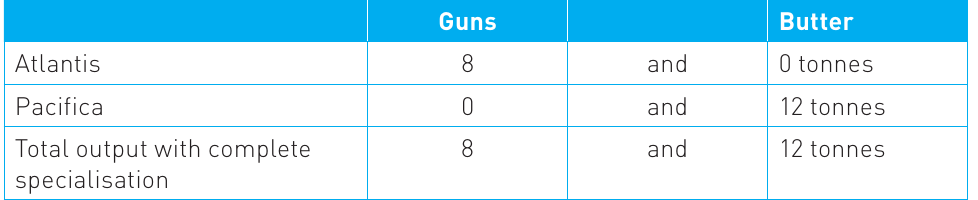
When countries specialise completely:
- Atlantis devotes both units of resource to guns, producing 8 guns
- Pacifica devotes both units of resource to butter, producing 12 tonnes of butter
Total combined output is now 8 guns and 12 tonnes of butter.
The gains from specialisation
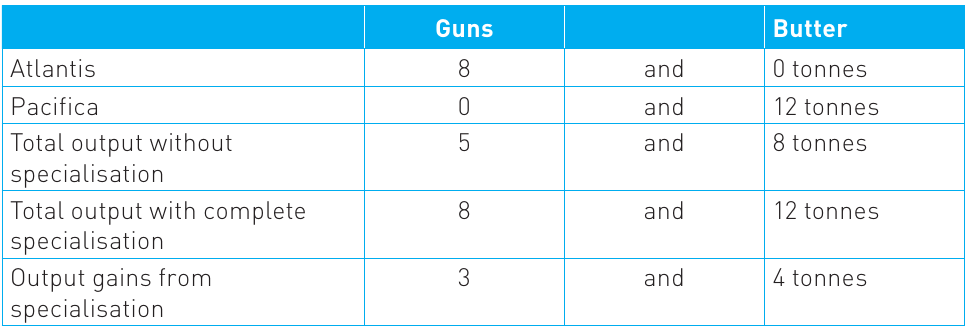
Comparing the two scenarios reveals the output gains from specialisation:
Example
Worked Example: Calculating Gains from Specialisation
Through complete specialisation based on absolute advantage:
- Gun production has increased by 3 guns (from 5 to 8)
- Butter production has increased by 4 tonnes (from 8 to 12 tonnes)
This demonstrates that more of both goods can be produced when countries specialise according to their absolute advantage. This additional output can be consumed, making the population better off.
Important conditions for gains from trade
However, for these output gains to translate into welfare gains from trade, two key conditions must be satisfied:
Important
1. Transport and administration costs must not exceed the gains
The formula for net gains from trade is:
If the costs of physically moving goods between countries and the administrative burden of international trade exceed the production gains, then specialisation would not be worthwhile.
Important
2. The double coincidence of wants must exist
For trade to actually occur between just two countries, each country must want to consume goods produced by the other. The goods being traded must be in demand in the importing country. Each country should export its surplus production (after satisfying domestic demand) to the other country.
For example, if Atlantis's inhabitants were pacifists who refused to purchase guns, and Pacifica's inhabitants were vegans who wouldn't consume butter, then trade would not occur despite the production advantages. Similarly, a good provides utility or welfare to consumers, but a 'bad' yields disutility or negative welfare. Without appropriate demand conditions, the case for specialisation and trade disappears.
Comparative advantage
Absolute advantage provides a straightforward justification for trade, but it doesn't cover all situations. The more subtle and powerful concept is comparative advantage, which explains why trade can be beneficial even when one country has an absolute advantage in producing all goods.
Comparative advantage is measured in terms of opportunity cost. The country with the lowest opportunity cost when producing a good possesses a comparative advantage in that good. In other words, it's the country that gives up least of other production when it increases output of a particular product.
Distinguishing comparative advantage from absolute advantage
Let's modify our earlier example so that Atlantis now has an absolute advantage in producing both goods:

Now:
- Atlantis can produce either 4 guns or 2 tonnes of butter with 1 unit of resource
- Pacifica can produce either 1 gun or 1 tonne of butter with 1 unit of resource
Atlantis is clearly more productive at making both products. It's four times better at gun production and twice as good at butter production. Pacifica has an absolute disadvantage in both goods.
Calculating opportunity cost and identifying comparative advantage
Despite Atlantis being absolutely better at producing both goods, each country still has a comparative advantage in one of them. This is because comparative advantage is about opportunity cost, not absolute productivity.
Example
Worked Example: Calculating Opportunity Costs
Opportunity cost for Atlantis:
- To increase butter output by 1 tonne, Atlantis must give up producing 2 guns
- The opportunity cost of 1 tonne of butter = 2 guns
Opportunity cost for Pacifica:
- To increase butter output by 1 tonne, Pacifica must give up producing 1 gun
- The opportunity cost of 1 tonne of butter = 1 gun
Even though Pacifica is less efficient at producing both goods, it has a comparative advantage in butter production because its opportunity cost (1 gun) is lower than Atlantis's opportunity cost (2 guns).
Conversely, Atlantis has a comparative advantage in gun production (even though it has an absolute advantage in both goods).
Production without specialisation
If each country allocates 1 unit of resource to each product:
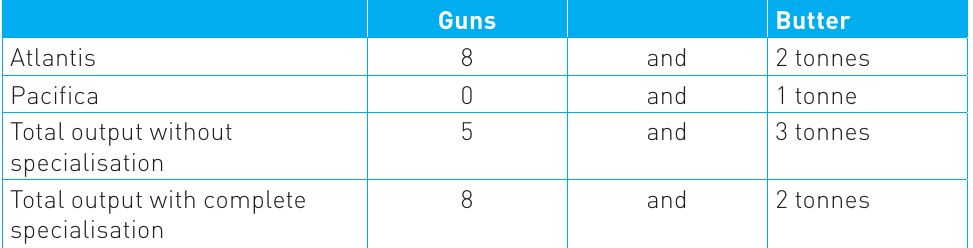
Total combined output is 5 guns and 3 tonnes of butter.
Complete specialisation based on comparative advantage
When Atlantis specialises completely in guns and Pacifica specialises completely in butter:
Total combined output becomes 8 guns and 2 tonnes of butter.
Understanding the outcome
At first glance, this result might seem problematic. Gun production has increased by 3 (from 5 to 8), but butter production has actually fallen by 1 tonne (from 3 to 2 tonnes). When one country has an absolute advantage in both products, complete specialisation based on comparative advantage does not produce a net output gain in both goods.
Note
However, this doesn't mean trade cannot be beneficial. Partial specialisation can still generate net gains. For instance:
If Pacifica specialises completely in butter (producing 2 tonnes), and Atlantis allocates just half a unit of resource to butter production to bring total butter output back to 3 tonnes, then Atlantis can use its remaining 1.5 units of resource to produce 6 guns.
Total production would then be 6 guns and 3 tonnes of butter. Compared to the no-specialisation outcome, this represents more butter produced (same amount) and more guns (6 instead of 5). This demonstrates that specialisation can produce net output gains even when one country is absolutely better at producing all goods.
Key principle
Important
The fundamental insight of comparative advantage is this:
- When one country has an absolute advantage in both goods, its comparative advantage lies in the good where its absolute advantage is greatest
- The other country's comparative advantage lies in the good where its absolute disadvantage is smallest
Worked example
Consider two more countries, Oceania and Eurasia:

Example
Worked Example: Identifying Comparative Advantage
Step 1: Identify absolute advantage
- Oceania has an absolute advantage in both products (produces more of each with 1 unit of resource)
Step 2: Calculate opportunity costs
For Oceania:
- To produce 10 butter requires giving up 20 guns
- Opportunity cost of 1 butter = 2 guns
- Opportunity cost of 1 gun = 0.5 butter
For Eurasia:
- To produce 5 butter requires giving up 15 guns
- Opportunity cost of 1 butter = 3 guns
- Opportunity cost of 1 gun = 0.33 butter
Step 3: Identify comparative advantage
- Oceania has the lower opportunity cost for butter (2 guns versus 3 guns), so has a comparative advantage in butter
- Eurasia has the lower opportunity cost for guns (0.33 butter versus 0.5 butter), so has a comparative advantage in guns
This example reinforces that comparative advantage exists based on opportunity cost, regardless of absolute productivity levels.
Assumptions underlying the principle of comparative advantage
The theory of comparative advantage relies on several important assumptions. Understanding these assumptions is crucial because many arguments for import controls and protectionism rest on showing that these assumptions don't hold in the real world.
Fixed factors of production
Note
The model assumes that each country's endowment of factors of production (capital, labour, land, and entrepreneurship) is fixed and cannot move between countries. While factors can be reallocated between industries within a country, the theory assumes that international trade involves finished goods rather than factors of production or intermediate inputs crossing borders.
In reality, factors of production—particularly capital and labour—have become increasingly mobile internationally, which can complicate the straightforward predictions of the model.
Constant returns to scale
The examples we've used assume constant returns to scale. This means that 1 unit of resource produces 4 guns or 2 tonnes of butter in Atlantis, whether it's the first unit employed or the millionth unit.
However, in the real world:
Note
Increasing returns to scale are common: The more a country specialises in an activity where it initially has an absolute advantage, the more its productive efficiency and advantage may increase. Countries that are 'best' at producing something can become even better through specialisation.
Important
Decreasing returns to scale also occur: If a country over-specialises, efficiency can erode, destroying its initial advantage. In agriculture, for example, excessive specialisation can lead to monoculture (growing a single crop), which causes soil erosion, vulnerability to pests and diseases, and declining future yields.
Stable demand and cost conditions
The model assumes that demand and cost conditions remain relatively stable over time. However, over-specialisation can make countries vulnerable to:
- Sudden changes in demand for their exports
- Changes in the cost and availability of imported raw materials or energy
- New inventions and technical progress that eliminate a country's earlier comparative advantage
Note
The greater the uncertainty about future economic conditions, the weaker the case for countries specialising in a narrow range of products.
Other justifications for specialisation and trade
Beyond the efficiency gains demonstrated by comparative advantage, there are additional benefits:
- Widening production and consumption possibilities: Trade gives countries access to a broader range of goods and services
- Economies of scale: Access to larger international markets allows firms to achieve greater efficiency and lower average costs (as explained in Chapter 4)
- Access to global production platforms: Multinational corporations create global production systems that allow consumers to buy products at lower prices
Competitive advantage versus comparative advantage
It's important not to confuse comparative advantage with competitive advantage, though the concepts are related.
Competitive advantage refers to when a country or firm produces better-quality goods at lower costs and better prices than rivals. It's more similar to absolute advantage than to comparative advantage.
Dynamic factors creating competitive advantage
Competitive advantage can be created through dynamic factors:
- Successful investment over time: Modern, state-of-the-art production capacity developed through sustained investment
- Research and development (R&D): Properly funded and organised research contributes to innovation
- Human capital: Investment in education and training builds a skilled workforce
- Strong institutions: Effective legal, financial, and regulatory systems support business activity
Note
These factors can trigger a virtuous cycle of higher profits, greater investment, better products, increased sales, even higher profits, and so on. Countries and firms that become competitive may continue strengthening their position.
Conversely, those that are not competitive may enter a vicious spiral of decline: inability to compete causes profits to fall, which reduces investment, quality declines, sales are lost to more competitive countries or firms, and profits fall further. This cycle may continue unless a country can regain competitiveness.
Implications for trade policy
Supporters of free trade argue that if free trade exists between countries, market forces create exactly the circumstances needed to foster competitive advantage growth. However, proponents of strategic trade policy argue that, if used carefully, protectionism can better help selected industries develop a competitive advantage against the rest of the world.
The case for import controls and protectionism
While the theory of comparative advantage suggests that free trade maximises global welfare, there are various arguments for using import controls and protectionist policies.
Import controls can take several forms:
- Import quotas: Quantity controls that place a maximum limit on imports of particular goods
- Tariffs or import duties: Taxes on imported goods that raise their price
- Export subsidies: Government payments to domestic firms that reduce the price of exports (and by implication, make imports relatively more expensive)
Basic argument for protectionism
Supporters of free trade believe that import controls prevent countries from specialising in activities where they have a comparative advantage. This reduces global efficiency and welfare.
Summary
Key Points to Remember:
- Absolute advantage exists when a country can produce more of a good than another country using the same amount of resources
- Comparative advantage is determined by opportunity cost—the country with the lowest opportunity cost in producing a good has a comparative advantage in that good
- Countries can benefit from trade even when one country has an absolute advantage in producing all goods, as long as comparative advantages differ
- Specialisation based on comparative advantage increases total world output, but gains from trade also require that transport costs are manageable and demand exists for traded goods
- The theory of comparative advantage rests on assumptions (fixed factors, constant returns to scale, stable conditions) that may not hold perfectly in reality
- Competitive advantage (based on quality and efficiency) differs from comparative advantage and can be developed through investment, R&D, and human capital development