Individual Economic Decision Making (AQA A-Level Economics): Revision Notes
📚Revision Notes
Consumer Behaviour

Introduction
Consumer behaviour examines how individuals make economic decisions when purchasing goods and services. This forms a fundamental part of microeconomics, as understanding consumer choices helps explain market demand and price determination. Traditional economic theory rests on the assumption that consumers act rationally to maximise their welfare or satisfaction. This section explores two key aspects of consumer decision making: utility theory (an established framework explaining consumption choices) and behavioural economics (a newer field providing insights into how people actually make decisions).
Note
Understanding consumer behaviour is essential because it forms the foundation of demand theory. By studying how consumers make choices, economists can predict how markets will respond to changes in prices, income, and other economic factors.
Rational economic decision making and economic incentives
At the heart of traditional demand theory lies the assumption that members of households and consumers act rationally. Rational behaviour means people try to make decisions in their self-interest or to maximise their private benefit. When faced with a choice, people always select what they believe at the time is the best alternative available. This means they reject the second-best or next-best alternative.
For households and the individuals within them, acting rationally means attempting to maximise the welfare, satisfaction, or utility they gain from the goods and services they consume. This is a key assumption that underpins much of traditional economic theory and helps economists predict how consumers will respond to changes in prices, income, or other economic factors.
Important
Key definition: Rational behaviour refers to acting in pursuit of self-interest. For a consumer, this means attempting to maximise the welfare, satisfaction, or utility gained from the goods and services consumed.
Utility theory: total and marginal utility, and diminishing marginal utility
What is utility?
Consumers aim to maximise the welfare or utility they obtain from the goods and services they choose to consume. In economics, utility refers to the satisfaction or economic welfare an individual gains from consuming a good or service. Think of it as the pleasure or fulfilment you experience when you consume something.
Marginal utility is the additional satisfaction or pleasure you gain from consuming one more unit of a good or service. While it may be difficult to compare the utility one person gets from consuming a product with the utility another person receives, we can assign nominal values (arbitrary numbers) to different levels of utility. This allows us to compare how much satisfaction a single individual gets from consuming different goods or different amounts of the same good.
Note
It's important to understand that utility can come from both 'pleasure items' (like chocolate or entertainment) and 'need-fulfilment items' (like medicine or washing-up liquid). Both types of goods provide utility to consumers, although in different ways.
Important
Key definitions:
- Utility: The satisfaction or economic welfare an individual gains from consuming a good or service
- Marginal utility: The additional welfare, satisfaction, or pleasure gained from consuming one extra unit of a good or service
The relationship between total utility and marginal utility
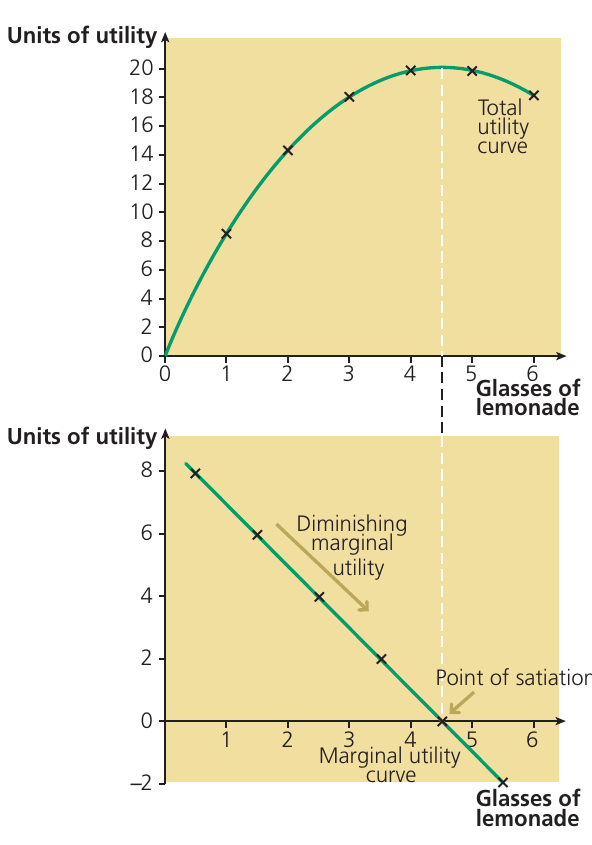
Let's explore the connection between total utility and marginal utility using a practical example. Imagine a thirsty teenager who drinks six glasses of lemonade on a hot sunny afternoon. Each glass consumed provides a certain amount of satisfaction, which we can measure in 'units of utility'. The table below shows how much total utility and marginal utility the teenager derives from each glass.
| Glasses of lemonade | Total utility (units of utility) | Marginal utility (units of utility) |
|---|---|---|
| 0 | 0 | - |
| 1 | 8 | 8 |
| 2 | 14 | 6 |
| 3 | 18 | 4 |
| 4 | 20 | 2 |
| 5 | 20 | 0 |
| 6 | 18 | -2 |
Understanding the distinction between total and marginal utility is crucial. The total utility schedule and the total utility curve show the data cumulatively. For example, when drinking two glasses of lemonade, the thirsty teenager gains 14 'units of utility' in total. After three glasses, total utility rises to 18 'units of utility', and so on.
In contrast, the marginal utility schedule and curve plot the same data as separate observations rather than cumulatively. The last unit consumed is always the marginal unit, and the utility derived from it is the marginal utility. After two drinks, the second glass of lemonade is the marginal unit consumed, yielding a marginal utility of 6 'units of utility'. When three glasses of lemonade are consumed, the third glass becomes the marginal unit, from which the still partially thirsty teenager gains a marginal utility of just 4 'units of utility'.
Note
The diagram above illustrates diminishing marginal utility through both the diminishing rate of increase of the slope of the total utility curve (shown in the upper panel) and the negative or downward slope of the marginal utility curve (shown in the lower panel).
Notice the point of satiation marked on the diagram, which is reached when the fifth glass of lemonade is drunk. At this point, when marginal utility is zero, total utility is maximised. In the context of food and drink, satiation means being 'full up'. Even if lemonade is free to the consumer, it would be irrational for the teenager (who is no longer thirsty) to drink a sixth glass of lemonade. The teenager would experience negative marginal utility (or marginal disutility), which is shown by the downward slope of the total utility curve and by the negative position of the lower section of the marginal utility curve.
Worked example: calculating marginal utility
Example
Worked Example: Calculating Marginal Utility from Total Utility
Scenario: An 8-year-old boy decides to enter a competition to see how many jam doughnuts he can eat in 15 minutes. The table below shows how many he ate and his total utility schedule.
| Jam doughnuts | Total utility (units of utility) | Marginal utility (units of utility) |
|---|---|---|
| 0 | 0 | - |
| 1 | 6 | |
| 2 | 10 | |
| 3 | 12 | |
| 4 | 12 | |
| 5 | 8 | |
| 6 | 3 |
Calculating the marginal utility:
Marginal utility is found by calculating the change in total utility when one more unit is consumed. We subtract the total utility at the previous level from the total utility at the current level.
The completed marginal utility schedule is shown below:
| Jam doughnuts | Total utility (units of utility) | Marginal utility (units of utility) |
|---|---|---|
| 0 | 0 | - |
| 1 | 6 | 6 |
| 2 | 10 | 4 |
| 3 | 12 | 2 |
| 4 | 12 | 0 |
| 5 | 8 | -4 |
| 6 | 3 | -5 |
Notice how marginal utility decreases with each additional doughnut consumed. The first doughnut provides 6 units of utility, the second adds 4 more units, and the third adds just 2 units. By the fourth doughnut, no additional utility is gained (marginal utility = 0). Beyond this point, eating more doughnuts actually reduces total utility, as shown by the negative marginal utility values of -4 and -5 for the fifth and sixth doughnuts.
The hypothesis (or 'law') of diminishing marginal utility
The numerical examples in the tables above, and the graph showing utility curves, illustrate a famous economic hypothesis that some call an economic law: the hypothesis of diminishing marginal utility. This states that for a single consumer, the marginal utility derived from a good or service diminishes for each additional unit consumed.
This simply means that as a person increases consumption of a good (while keeping consumption of other products constant), there is a decline in the marginal utility derived from consuming each additional unit of the good. Think about eating your favourite food: the first portion is usually the most satisfying, the second is still good but less exciting, and by the third or fourth portion, you're getting much less additional satisfaction from each extra serving.
Important
This hypothesis is fundamental to understanding consumer behaviour and helps explain why demand curves slope downward. As the additional satisfaction from consuming more units decreases, consumers are willing to pay less for those additional units.
Key definition: Hypothesis of diminishing marginal utility - For a single consumer, the marginal utility derived from a good or service diminishes for each additional unit consumed.
Adam Smith's diamonds and water paradox
In 1776, the great classical economist Adam Smith wrote about the diamonds and water paradox (also known as the paradox of value) in his famous book The Wealth of Nations. Smith observed:
Nothing is more useful than water: but; scarce any thing can be had in exchange for it. A diamond, on the contrary, has scarce any value in use; but a very great quantity of other goods may frequently be had in exchange for it.
This creates a puzzling question: Why does an economy put a much lower value on something vital like water (sustaining life) compared to something that simply looks good, like diamonds? Smith pointed out that practical things we use every day have a value in use, but often have little or no value in exchange. Conversely, some things that have the greatest value in the market (value in exchange), such as works of art, have little or no practical use other than decoration or ornamentation.
Note
Understanding this paradox requires grasping two important economic concepts: marginal utility and scarcity. Scarcity relates to how little of a good there is compared to what people are demanding. Marginal utility is the additional welfare a person gains from using or purchasing an additional unit of the good.
In most countries, water has a low price but diamonds have a high price. People are willing to pay a higher price for goods with greater marginal utility. Water is not scarce in most of the world, which means people can consume water up to the point where the marginal utility they gain from the last drop consumed is very low. They aren't willing to pay a lot of money for one more drink of water.
Diamonds, by contrast, are scarce. Because of their limited supply, the marginal utility typically gained from adding one more diamond to a person's collection is much higher than for one extra drink of water. However, if someone is dying of thirst, this paradox breaks down. In this situation, the marginal utility gained from another drink of water would be much higher than the additional satisfaction of owning an extra diamond—at least until the thirst was quenched.
Important
This example beautifully illustrates how marginal utility and scarcity work together to determine prices in a market economy. It's not the total usefulness of a good that determines its price, but rather the marginal utility of the last unit consumed combined with how scarce the good is.
Utility maximisation
The assumption of maximising behaviour by economic agents (consumers, workers, firms, and even government) is central to traditional economic theory. Economic agents make decisions about their market plans to maximise a target objective or goal, which is believed to be consistent with the pursuit of self-interest.
In demand theory, the objective that households are assumed to wish to maximise is the utility or satisfaction obtained from the set of goods and services consumed. Consumers aim to get the most satisfaction possible from their spending decisions, given the constraints they face.
Maximisation subject to constraints
If all goods were free, or if households had unlimited income and capacity to consume all goods, a consumer would maximise utility by obtaining all the goods which yield utility, up to the point of satiation. Satiation occurs when no more utility can be gained from consuming extra units of a good. Any further consumption would yield only disutility (negative utility or dissatisfaction).
However, because of the problem of scarcity, consumers face several constraints that restrict the choices they can make in the marketplace:
Limited income
Consumers, even the very rich, do not possess an unlimited income or stock of wealth that can be converted into income with which to purchase all the goods and services that could possibly yield utility. Income spent on one good cannot be spent on some other good or service.
A given set of prices
Very often, consumers cannot by their own actions influence the market prices they have to pay to obtain the goods and services they buy. Given this assumption, consumers are price-takers rather than 'price-makers'.
The budget constraint
Taken together, limited income and the set of prices faced impose a budget constraint on consumers' freedom of action in the marketplace. If we assume that all income is spent and not saved, that there is no borrowing, and that stocks of wealth are not run down, a consumer can only purchase more of one good by giving up consumption of some other good or service. This represents the opportunity cost of consumption.
Limited time available
Even when goods are free, consumer choices must still be made because it is often impossible to consume more than one good at a time, or to store more than a limited number of goods for future consumption. Time itself is a scarce resource that constrains consumption choices.
Note
These constraints mean that consumers must make trade-offs and carefully consider which combination of goods and services will provide them with the maximum utility within their limitations.
Importance of the margin when making choices
Along with assumptions such as rational economic behaviour and opportunity cost, the 'margin' is one of the key concepts in traditional economic theory. Given consistent tastes and preferences, rational consumers choose between available goods and services in such a way as to maximise total utility, welfare, or satisfaction derived from consumption of the goods.
When making consumption decisions, consumers consider the relative prices that must be paid for each of the goods, and the marginal utilities gained from the consumption of the last unit of each good. These marginal utilities determine the combination of goods the consumer must choose in order to maximise total utility.
Important
For a utility-maximising consumer, the optimal point of consumption occurs where marginal utility equals price: . Marginal utility () is the marginal private benefit derived from consuming the last unit of the good, while the good's price () represents its opportunity cost in consumption at the margin.
The margin is equally important in other areas of economic choice. In traditional economic theory, when firms choose how much of a good to produce and sell, they take account of the marginal sales revenue received from selling the last unit of the good, and the marginal cost of producing the last unit. To maximise a desired objective, an economic agent must undertake the activity involved up to the point at which the marginal private benefit received equals the marginal private cost incurred.
Note
The concept of thinking 'at the margin' is fundamental to economic decision making. It means focusing on the additional benefits and costs of consuming, producing, or doing one more unit of something, rather than thinking about total amounts. This marginal thinking helps explain many economic behaviours and is a powerful analytical tool.
Can utility be measured?
On several occasions we have referred to 'units of utility' as a unit of measurement for the happiness, pleasure, satisfaction, or fulfilment of need that an individual derives from consuming a good or service. However, in real life there is no way in which an individual can mathematically work out the utility to be gained from every unit of a good consumed.
Economists have found it impossible to measure directly units of satisfaction, pleasure, or fulfilment through which comparisons can be made across individuals. This presents a significant challenge for utility theory.
Note
To address this problem, the famous economist Paul Samuelson introduced the concept of revealed preference theory. Instead of trying to measure utility directly, this approach works backwards from observing how consumers actually behave to understanding their preferences. Consumers reveal their preferences by choosing certain bundles or combinations of goods at given prices and for given levels of income. By observing these actual choices in the marketplace, economists can infer what consumers prefer without needing to measure utility directly.
This practical approach recognises that while we cannot measure the satisfaction someone gets from a chocolate bar in absolute terms, we can observe whether they choose to buy the chocolate bar or save their money, and from these observations build an understanding of consumer preferences and behaviour.
Remember!
Summary
Key Points to Remember:
-
Rational behaviour means consumers act in self-interest, attempting to maximise the utility or satisfaction they gain from the goods and services they consume.
-
Utility is the satisfaction gained from consumption, while marginal utility is the additional satisfaction from consuming one more unit. Understanding the difference is essential.
-
The hypothesis of diminishing marginal utility states that each additional unit consumed provides progressively less extra satisfaction. This fundamental principle helps explain consumer behaviour and downward-sloping demand curves.
-
The diamonds and water paradox demonstrates that price is determined by scarcity and marginal utility, not by total usefulness. Water is abundant (low marginal utility, low price) while diamonds are scarce (high marginal utility, high price).
-
Utility maximisation is subject to constraints including limited income, given prices, budget constraints, and limited time. These constraints force consumers to make trade-off decisions.
-
Thinking at the margin is crucial in economics. Consumers maximise utility where marginal utility equals price (), focusing on the additional benefit from one more unit rather than total amounts.
-
Utility cannot be measured directly, but revealed preference theory allows economists to infer consumer preferences by observing actual purchasing behaviour in the marketplace.