Externalities in Production and Consumption (AQA A-Level Economics): Revision Notes
📚Revision Notes
Externalities in Production and Consumption
What are externalities?
Externalities occur when there is a difference between private and social costs or benefits. An externality is a special type of public good or public 'bad' that is imposed on third parties who had no choice in receiving or consuming it. The key feature is that externalities are produced and received outside the market, creating another example of market failure.
When we make economic decisions, we typically consider only our own private costs and benefits. However, our actions often affect other people in ways that are not reflected in market prices. These spillover effects on third parties are what we call externalities. For instance, when a factory produces goods, it may also produce pollution that affects the local community. The factory considers its production costs when setting prices, but the health costs imposed on nearby residents are not included in the market price.
Note
Externalities represent a divergence between what is privately optimal and what is socially optimal. This divergence means that free markets, left to themselves, will not achieve the most efficient outcome for society as a whole.
Positive and negative externalities
Externalities can be beneficial or harmful to third parties, leading to two main categories.
Positive externalities (also called external benefits) occur when the consumption or production of a good creates benefits for third parties, where the social benefit exceeds the private benefit. The provider of a positive externality cannot charge a market price to those who enjoy it. For example, a person who creates a beautiful garden visible from the street provides enjoyment to passers-by who benefit without paying. Similarly, someone who maintains a stunning view from their property cannot prevent free-riders from enjoying the sight.
Negative externalities (also called external costs) occur when the consumption or production of a good imposes costs on third parties, where the social cost exceeds the private cost. Those who suffer from negative externalities cannot charge the polluter for the harm they cause. For instance, pollution and noise from economic activities create costs for others who must reluctantly consume these 'bads' without being compensated.
Important
The fundamental problem with externalities is that the people creating them face the wrong incentives. Those generating positive externalities cannot capture all the benefits they create, so they tend to produce too little. Those generating negative externalities do not bear all the costs they impose, so they tend to produce too much.
Externalities and property rights
A property right is the exclusive authority to determine how a resource is used. In modern capitalist economies, the legal system gives property owners the power to exercise their rights in various ways. For example, a house owner has the right to live in the house, to let family members live there rent-free, to rent it to tenants, or to sell it.
However, when externalities are generated, property rights can effectively disappear. Consider the owner of a beautiful house visible from the public highway. While the owner has full property rights over the house itself, they cannot prevent passers-by from enjoying the positive externality of the view. The owner might build a high wall to obstruct the view or even destroy the house, but in most situations, passers-by can free-ride and enjoy the benefits without paying.
Note
This relationship between externalities and property rights is important because it helps explain why markets fail when externalities exist. Without clearly defined and enforceable property rights, market mechanisms cannot function properly to allocate resources efficiently.
The free-rider problem
The free-rider problem occurs when people can benefit from a good without paying for it as a result of non-excludability. Free-riders have no incentive to pay for goods, preferring instead to enjoy them for free. This causes the incentive to provide the good through the market to disappear.
The free-rider problem applies to both public goods and externalities. With pure public goods, producers cannot exclude people who are unwilling to pay from gaining the benefits. Likewise, with positive externalities, providers cannot charge a market price to willing free-riders who enjoy the benefits. For example, the owner of a beautiful view cannot charge passers-by for looking at it.
Similarly, unwilling free-riders who receive or consume negative externalities (such as pollution and noise) cannot charge a price to the polluter for the harm they reluctantly consume. The polluter gets a 'free ride' by not having to pay for the costs imposed on others.
Important
When the free-rider problem becomes severe, a situation arises where not enough people are willing to pay for a good. The incentive to provide the good through the market disappears, leading to a missing market and potential market failure.
Production externalities
Externalities can be generated by firms during production or by households and individuals during consumption. Production externalities are those generated in the course of producing goods for sale in a market.
Negative production externalities
Consider a power station that discharges pollution into the atmosphere while producing electricity. This pollution represents a production externality (or external cost). The pollution is part of the true or real costs of production, but the power station evades these costs by dumping them on others.
The people living in nearby houses and working in the commercial forestry industry suffer from the pollution. They experience health problems, property damage, and reduced quality of life. The price that consumers pay for electricity reflects only the money costs of production, not the real costs which include the external costs of pollution.
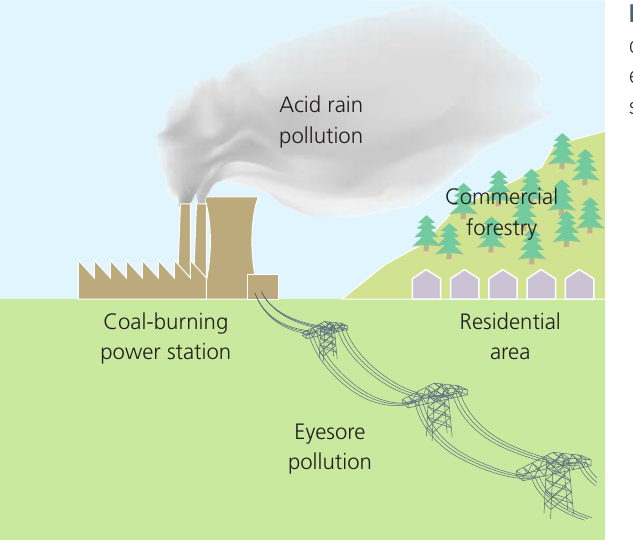
In a market situation, the power station's output of electricity is under-priced. Under-pricing means the allocative function of prices breaks down. This encourages too much consumption of electricity and therefore over-production of both electricity and pollution as a spin-off.
Note
The key problem is that producers consider only their private costs when making production decisions. They ignore the external costs imposed on society. This leads to a misallocation of resources where too much of the good is produced and consumed from society's perspective.
Positive production externalities
Production externalities can also be positive, creating external benefits rather than costs. For example, imagine a power station that discharges warm (but clean) water into an adjacent lake. The warmer temperatures increase fish stocks, benefiting both commercial fishing boats and private anglers.
Unless the power station owns the lake, it cannot charge the fishers for the benefits they receive. The company provides an external benefit that it cannot capture through market prices. This represents a positive production externality.
Another example of a positive production externality is when one farmer benefits from a neighbouring farmer's drainage system. The drainage work improves water management across both properties, but only one farmer bears the cost while both enjoy the benefits.
Note
When positive production externalities exist, goods tend to be under-produced because producers cannot capture all the social benefits their activities create. The market price reflects only the private benefits, not the full social benefits.
Consumption externalities
Consumption externalities are generated by households and individuals when they consume goods or services. Like production externalities, they can be either negative or positive.
Negative consumption externalities
We frequently encounter annoying experiences caused by other people's consumption activities. These are examples of negative consumption externalities. Common examples include:
- Noisy music from a party disturbing neighbours
- Mobile phones ringing in cinemas
- People eating popcorn noisily during a film
- Litter and chewing gum dropped by pedestrians
- Inconsiderate motorists splashing pedestrians
- Loud music played through open windows
In each case, the consumption activity of one person imposes unwanted costs on others. The person creating the externality considers only their own enjoyment (private benefit) and ignores the costs imposed on others (external costs). There are many such examples of similarly annoying externalities that we encounter in daily life.
Important
The fundamental issue is that consumers face the wrong incentives. Because they do not have to pay for the external costs they create, they consume more than the socially optimal amount. From society's perspective, there is too much consumption of goods that generate negative consumption externalities.
Positive consumption externalities
Not all consumption externalities are negative. A good example of a positive consumption externality is the pleasure gained by a passer-by walking past beautiful buildings and household gardens in a residential area. The homeowners maintain their properties for their own enjoyment, but they also create benefits for others who can view them from the street.
It is worth noting that a negative consumption externality suffered by one person may simultaneously be a positive consumption externality for somebody else. For instance, a football fan would gain less pleasure from watching a match if the stadium were empty rather than full of other fans creating atmosphere. The presence of other spectators creates positive externalities for each individual fan.
Similarly, prospective diners walking past empty or nearly empty restaurants may prefer to queue for a table at an already full restaurant. They think the food might be better, but what they also enjoy is the atmosphere generated by other diners. The consumption activities of existing customers create positive externalities for new customers.
Note
When positive consumption externalities exist, goods tend to be under-consumed because individuals consider only their private benefits, not the external benefits they create for others. The market fails to reflect the full social value of consumption.
Summary of different types of externality
The table below summarises the possible types of externality and provides examples of both negative externalities (costs) and positive externalities (benefits):
| Type of externality | Negative externalities | Positive externalities |
|---|---|---|
| Pure production externalities (generated and received in production) | Acid rain pollution discharged by a power station which harms a nearby commercially run forest | A farmer benefiting from drainage undertaken by a neighbouring farmer |
| Pure consumption externalities (generated and received in consumption) | Noisy music at a party disturbing neighbouring households | Households benefiting from the beauty of neighbouring gardens |
Note
Study tip: Make sure you understand the difference between negative and positive externalities, and between production and consumption externalities. You should be able to give examples of all of these categories, as many exam questions will require you to demonstrate this understanding.
How externalities lead to the 'wrong' quantity being produced and consumed
When negative externalities are generated during production, part of the true or real costs of production are not borne by the producer. Instead, these costs are dumped on others. This means that even in competitive markets, if negative production externalities are generated, goods end up being too cheap or under-priced.
The market creates the wrong incentives. When prices under-reflect the true costs of production (which include the cost of negative externalities), too much of the good ends up being produced and consumed. The market has failed to allocate resources efficiently.
The opposite happens when firms generate positive production externalities. Prices end up being too high, leading to the 'wrong' quantity of the good being produced and consumed. The market creates the wrong incentives again, but this time prices over-reflect the true costs of production. Not enough of the good ends up being produced and consumed because producers cannot capture all the social benefits their activities create.
In much the same way, when negative and positive consumption externalities are generated, markets are distorted and the wrong quantity of a good is produced and consumed. With negative consumption externalities, there is over-consumption because consumers ignore the external costs they impose. With positive consumption externalities, there is under-consumption because consumers do not receive compensation for the external benefits they create.
Important
Study tip: Students often fail to understand that externalities are generated and received outside the market. Remember that both public goods and externalities provide examples of missing markets. The market mechanism cannot function properly when externalities exist because the price signal does not reflect all costs and benefits.
Case study: The tragedy of the commons
The concept of the 'tragedy of the commons' helps explain why certain resources become over-exploited when property rights are absent or poorly defined. This idea was developed by ecologist Garrett Hardin in 1968, though the underlying problem has been recognised for centuries.

Hardin described a situation from 18th-century Britain where much farmland was open common land on which farmers could graze as many animals as they wished, for free. As long as animal numbers remained below the carrying capacity of the land, this system worked well. However, it was in each herdsman's self-interest to graze more and more animals. The gains from selling additional animals would benefit the individual farmer, while the costs of over-grazing (deterioration of the common land) would be shared by all herdsmen.
A rational herdsman would conclude that the only sensible course was to add another animal to his herd. But each herdsman would be locked into the same system, compelling him to increase his herd without limit. The result was inevitable: in a world with finite resources, another animal would be added to the grazing land, and then another, and then another. This would be the conclusion reached by each and every rational herdsman sharing the common, leading to ruin for all. This is the tragedy of the commons.
Note
Hardin later used an example from northern Africa to illustrate the tragedy of the commons. Satellite photos showed an irregular dark patch over an area of 390 square miles. Ground-level investigation revealed a fenced area inside which there was plenty of grass. Outside, the ground cover had been devastated.
The explanation was simple: the fenced area was private property, subdivided into sections. Each year, the owners moved their animals to a new section, allowing fallow periods to let the pastures recover. The owners had an incentive to care for their land. But no one owned the barren land outside the fenced-off area. This land, being open to nomads and their herds, exemplified the tragedy of the commons.
The fishing industry and the tragedy of the commons
For decades, environmentalists have argued that pressure on the Earth's natural resources stems from the increasing size of the human population. For some resources like oil, the market mechanism encourages producers to economise and develop new sources of supply.
However, fish may be different. Unless stocks are managed carefully, intensive fishing may lead to collapse and another 'tragedy of the commons'. This happens because people treat fish as one of the Earth's 'free gifts', assuming they can take a limitless amount. For centuries, these apparently free goods had no prices attached to them, so there was nothing restraining their use.
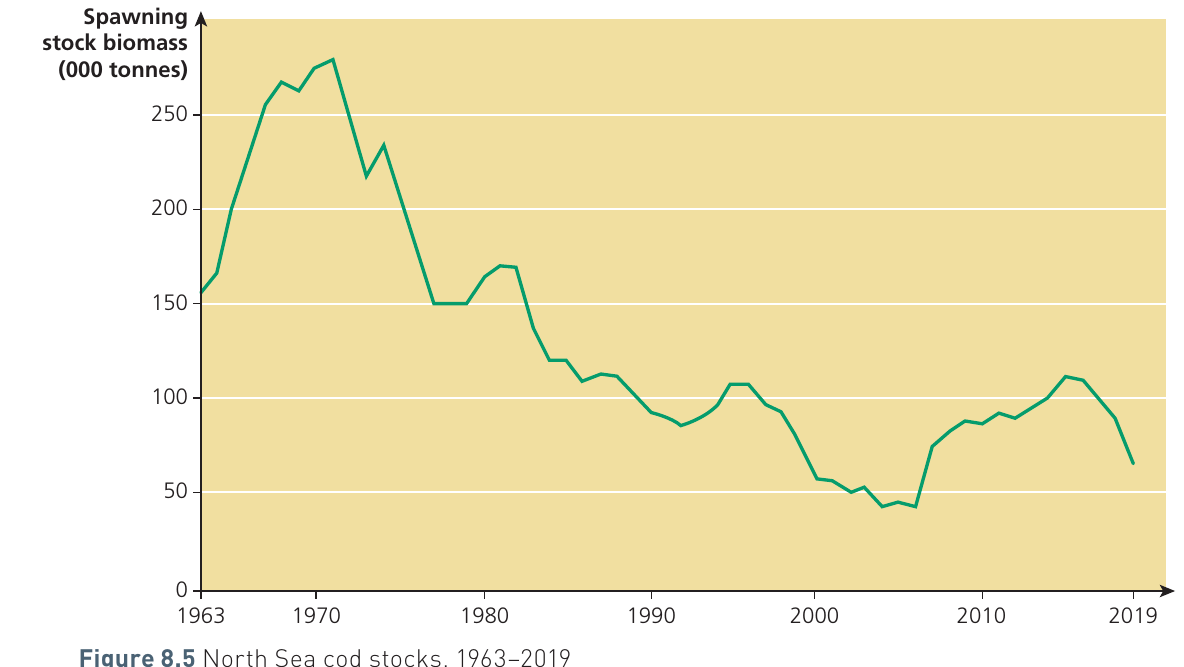
The graph shows that North Sea cod spawning stock biomass fell dramatically from around 270,000 tonnes in the early 1970s to critically low levels of 40-50,000 tonnes in the early 2000s. Although stocks recovered somewhat by 2015, reaching their highest level for 35 years, they fell significantly again after 2016, ending near 65-70,000 tonnes in 2019.
Important
The evidence suggests that overfishing nearly caused the extinction of North Sea cod. On a finite globe, fish stocks can reach limits beyond which they cannot recover. An 'equilibrium shift' can occur where stock numbers stabilise at much lower levels than before. Intensive fishing pressure may eliminate many larger fish, slowing breeding and preventing new breeding stock from developing.
Recent developments suggest additional threats. As sea waters warm due to climate change, some fish species appear to be moving further north to cooler waters where they prefer to spawn. This compounds the problem of overfishing, making recovery even more difficult.
Environmental market failures
Many of the market failures we have discussed result from the discharge of negative externalities into the environment. Environmental externalities often involve pollution of land, sea, rivers and air, as well as externalities associated with road use and congestion.
We have seen how coal-burning power stations discharge sulphur dioxide pollution into the atmosphere, causing acid rain that damages forests and buildings. The diagram also illustrated 'eyesore' pollution caused by unsightly buildings and electricity transmission lines.
Later sections explain how governments can attempt to correct such market failures through various policy interventions, including:
- Taxation to make polluters pay for external costs
- Regulation, including outright bans on certain activities
- Tradeable pollution permits
- Behavioural 'nudges' to encourage better environmental choices
Note
The A-level specification emphasises that exam candidates should appreciate the relevance of the 'tragedy of the commons' concept for understanding environmental market failures. Many environmental problems stem from the absence of clearly defined property rights, allowing individuals and firms to over-exploit shared resources.
Case study: The Great Smog of 1952
Smog is a mixture of smoke and other pollutants combined with fog. It occurs when climatic conditions trap air above cities and industrial areas, preventing dirty air from dispersing. The Clean Air Act of 1956 was passed largely because the London smog of 1952 was the most deadly weather-related catastrophe in the UK for some 150 years.
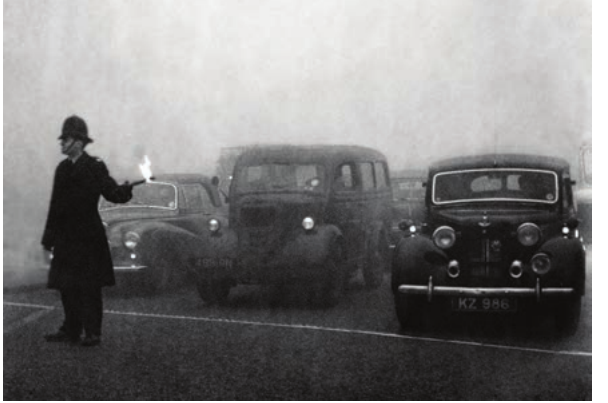
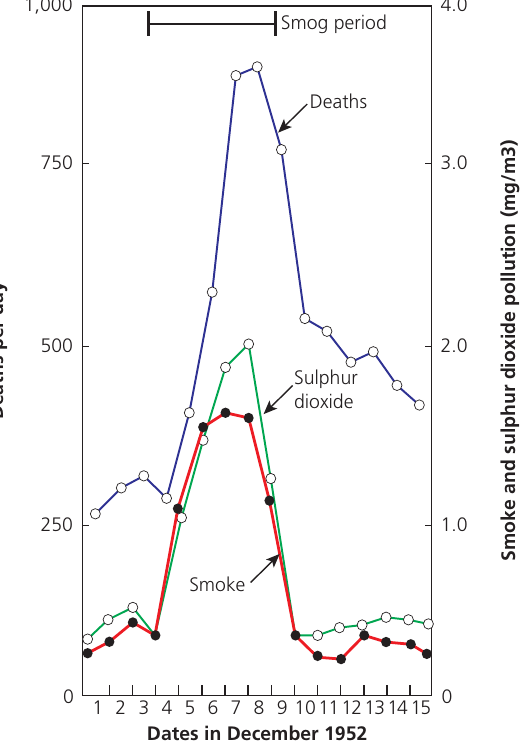
The graph shows the dramatic correlation between pollution levels and deaths during the Great London Smog of December 1952. Between December 1 and 15, daily measurements tracked deaths, sulphur dioxide pollution, and smoke concentration. During the marked 'smog period' around December 7-9, there were dramatic synchronized spikes in all three measurements. Deaths peaked at nearly 1,000 per day, while both sulphur dioxide and smoke concentrations reached approximately 4.0 mg/m³.
Important
At least 4,000 people are estimated to have died from the effects of the London smog, with some estimates suggesting the true toll may have been even higher. The smog was caused primarily by coal-burning in homes and industries, combined with weather conditions that trapped pollutants over the city.
While sulphur dioxide pollution has decreased significantly since then, and soot has largely disappeared from the lower atmosphere, other less visible but still toxic chemicals continue to be emitted. Modern air pollution is particularly caused by motor vehicles powered by petrol and diesel fuel. The most damaging pollutant is nitrous oxide, which is emitted unseen into the atmosphere by human activities including agriculture, fossil fuel combustion, and industrial processes. Nitrous oxide molecules stay in the atmosphere for an average of 120 years before disintegrating, and the warming effect of 1 kilo of nitrous oxide is over 300 times that of 1 kilo of carbon dioxide.
Note
This historical example demonstrates how negative production and consumption externalities can create severe public health crises. It also shows how government intervention (the Clean Air Act) can successfully address environmental market failures, though new challenges continue to emerge.
The concepts of marginal private, external and social costs and benefits
To explain externalities in greater depth, we need to apply marginal analysis. At the heart of microeconomic theory lies the assumption that in a market situation, an economic agent considers only the private costs and benefits resulting from market actions, ignoring any costs and benefits imposed on others.
Private benefit maximisation
For an individual agent, private benefit maximisation occurs when:
This means the individual continues consuming or producing until the additional benefit from the last unit equals the additional cost of that unit. Beyond this point, the costs of additional units would exceed the benefits, making further consumption or production undesirable.
Social benefit maximisation
However, social benefit maximisation, which maximises the public interest or the welfare of the whole community, occurs when:
Traditional economic theory usually assumes that households and firms seek to maximise their private benefit or self-interest, net of costs, and not the wider social interest of the whole community. They ignore the effects of their actions on other people. When externalities are generated, costs and benefits are inevitably imposed on others, so maximising net private benefit no longer coincides with the maximisation of net social benefit.
Calculating social costs and benefits
Social benefit is defined as private benefit plus external benefit:
Likewise, social cost is defined as private cost plus external cost:
Important
These formulas are fundamental to understanding how externalities affect economic decisions and why markets fail when externalities exist.
Example
Worked Example: Calculating social costs and benefits
Consider the costs and benefits of building a new shopping mall:
| Private cost | £10 million |
| External cost | £20 million |
| Private benefit | £8 million |
| External benefit | £25 million |
Calculate the social cost and social benefit:
Social cost is calculated as:
- social cost = private cost + external cost
- social cost = £10 million + £20 million = £30 million
Social benefit is calculated as:
- social benefit = private benefit + external benefit
- social benefit = £8 million + £25 million = £33 million
Decision for society: Since the social benefit (£33 million) exceeds the social cost (£30 million) by £3 million, the shopping mall is worthwhile for society at large.
Decision for the property developer: However, the private cost (£10 million) exceeds the private benefit (£8 million) by £2 million, so it is not worthwhile for the property developer to proceed with the project based on private considerations alone.
This example illustrates why markets fail when externalities exist. Projects that would benefit society may not proceed because private decision-makers do not capture all the social benefits or bear all the social costs.
Using marginal analysis to show how negative production externalities cause market failure
We will now examine how pollution emitted by a fossil-fuel burning power station causes market failure. Initially, we assume that when the coal-burning power station generates electricity, only negative externalities are discharged and there are no positive externalities.
Given this simplification, the marginal private benefit received by the power station from producing electricity, and the marginal social benefit received by the whole community, are the same. These are shown by the downward-sloping demand curve in the diagram. However, because pollution is discharged during production, the marginal social cost of electricity production exceeds the marginal private cost incurred by the power station.
In the diagram, the MSC curve is positioned above the MPC curve. The vertical distance between the two curves shows the marginal external cost (MEC) at each level of electricity production.
The power station maximises private benefit by producing output , where . This is shown at point A in the diagram. However, the socially optimal level of output is , where . This is shown at point B. The privately optimal level of output () is thus greater than the socially optimal level of production ().
Important
To put it another way, market forces over-produce electricity by the amount . The market fails because the power station produces the wrong quantity of the good, namely too much electricity. At the free-market price of , electricity is too cheap. The price would have to rise to to bring about the socially optimal level of consumption.
The shaded area in the diagram illustrates the welfare loss or deadweight loss (DWL) which exists at the free-market output . For units of production from to , the social cost of producing each unit exceeds the benefit society derives from each unit produced. That is, .
Society would be better off if these units ( to ) were not produced and the resources were transferred to the production of other products. When production takes place at the socially optimal output (where ), the deadweight loss is eliminated.
Example
Worked Example: Calculating private, social and external costs
The following table shows the costs incurred when producing different quantities of a chemical:
| Output of chemicals (tonnes per week) | Marginal private cost (£000) | Marginal social cost (£000) | Marginal external costs (£000) |
|---|---|---|---|
| 500 | 100 | 120 | 20 |
| 600 | 130 | 160 | 30 |
| 700 | 160 | 200 | 40 |
The completed table shows how marginal external costs are calculated using the equation:
For example:
- At 500 tonnes: £120,000 = £100,000 + £20,000
- At 600 tonnes: £160,000 = £130,000 + £30,000
- At 700 tonnes: £200,000 = £160,000 + £40,000
This example illustrates how external costs increase as production levels rise, showing that the pollution problem becomes worse at higher output levels.
Using marginal analysis to show how positive production externalities cause market failure
Whereas negative production externalities lead to marginal social costs exceeding marginal private costs, when positive production externalities are generated, the marginal social costs of production lie below the marginal private costs incurred by producers.
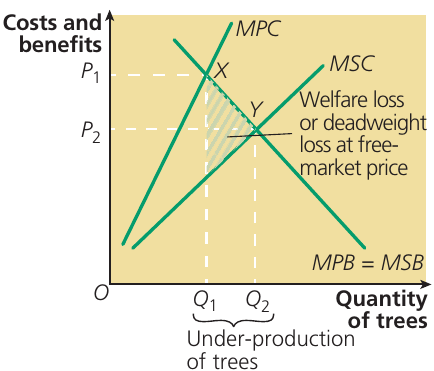
Consider a commercial forestry company that plants trees. The positive production externalities generated by tree planting include improved water retention in the soil and a carbon sink effect, whereby trees absorb greenhouse gases from the atmosphere.
These positive production externalities mean that the MSC curve is positioned below the MPC curve. The vertical distance between the two curves shows a negative marginal external cost (MEC) at each level of tree planting. (A negative marginal external cost is exactly the same as a positive marginal external benefit enjoyed by society as a whole.)
To maximise its private benefit, the commercial forestry plants trees (the free-market level of output). This is shown at point X, where . However, is less than the socially optimal level of output , located at point Y where .
The shaded area illustrates the welfare loss or deadweight loss (DWL) which exists at the free-market output . This loss exists all the way forward to the socially optimum output . When production takes place at the socially optimal output, the DWL is eliminated. This is sometimes referred to as a 'welfare gain'.
Note
There is a net gain in social welfare if trees between and are planted because the MSB is greater than the MSC for each of these trees up to the point at which . The diagram illustrates that when positive production externalities are generated, the market fails because too little of the good is produced and consumed. Under-production and under-consumption are depicted by the distance .
Important
Study tip: Note that in the tree-planting diagram, the 'spillover' benefits generated by production (positive external benefits) are depicted as a 'negative external cost'. The planting of trees reduces the costs imposed on society by pollution, and hence the total cost to society of planting trees is less than the cost to the firm. This is an important point to aid understanding when interpreting positive production externalities in the exam.
Example
Worked Example: The benefits of vaccination
Consider the costs and benefits that a consumer incurs and receives from vaccination:
| Marginal private cost of vaccination (£) | Marginal private benefit from vaccination (£) | Marginal social benefit from vaccination (£) |
|---|---|---|
| 20 | 100 | 1,000 |
(a) What is the marginal external benefit resulting from the vaccination?
Using the equation , the marginal external benefit from the vaccination is £900 (since £1,000 = £100 + £900).
(b) Suppose evidence shows that a small proportion of people who are vaccinated suffer serious side-effects, creating a marginal social cost for society of £800 per vaccination. On the basis of these figures, should the health service recommend that people be vaccinated?
Given the extra information, the marginal social benefit of each vaccination exceeds the marginal social cost by £200 (because marginal social benefit is £1,000 and marginal social cost is £800). On the basis of these figures alone, the health service should recommend that people are vaccinated.
This example shows how vaccination creates positive externalities. When someone is vaccinated, they not only protect themselves (private benefit) but also reduce the risk of spreading disease to others (external benefit). The large difference between private benefit (£100) and social benefit (£1,000) demonstrates the significant positive externalities that vaccination creates for the wider community.
Case study: Road pricing
The issue of road pricing provides an excellent example of how externalities affect resource allocation. Roads combine characteristics of both public goods and sources of negative externalities.
The case for road pricing brings together issues concerning both public goods and negative externalities. Roads are a good example of a quasi-public good, and electronic toll mechanisms can be used to exclude free-riders. Road use also results in negative externalities, and the extent to which negative externalities are produced depends partly on whether the road is congested or uncongested.
During peak periods, increased use of roads by commercial vehicles raises journey times for other road users. This creates negative externalities in the form of increased journey times and frustration. A negative externality is generated when an additional commercial vehicle uses the road, imposing costs on all other road users and pedestrians.
The economic analysis of road pricing
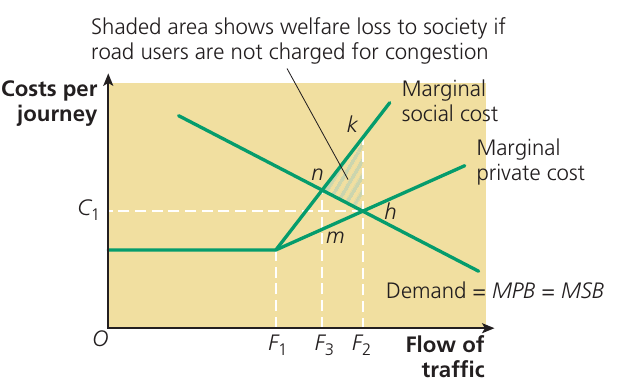
When traffic flow is less than (as shown in the diagram), an extra vehicle on the road does not impose any negative externalities or external costs on other road users. In this situation, road use should be free to encourage allocatively efficient use. For levels of traffic flow between zero and , the marginal social cost of road use equals the marginal private cost borne by vehicles and their owners ().
However, once the road becomes congested (at flows of traffic greater than ), the marginal social cost exceeds the marginal private cost. Each commercial vehicle driven on the road adds to traffic congestion, and all road users suffer from increased journey times and frustration. Beyond , the marginal social cost of motoring is greater than the marginal private cost ().
Note
Without road pricing, road users consider only the private cost of motoring when deciding whether to drive. They ignore the external cost dumped on others. If there is no charge for road use, commercial vehicles are driven up to traffic flow (at point h), where the marginal private benefit of driving equals the marginal private cost ().
At , the marginal external cost of congestion imposed on other road users is shown by the distance (k - h). This represents the welfare loss to society. A misallocation of resources results because commercial vehicles make more journeys than they would if their owners bore the full social cost. The shaded triangle bounded by points n, k and h measures the welfare loss suffered by society at the privately optimal traffic flow, where .
The case for congestion charging
There is a strong economic case for road pricing when roads become congested. Allocative efficiency is improved when motorists are charged a price equal to the marginal external cost imposed on other road users as a result of their journey. The optimal congestion charge would be [n - m], which measures the marginal external cost at the socially optimal level of road use, .
Important
With appropriate congestion charging, commercial vehicle owners or drivers would pay for the congestion they generate. This internalises the externality, making private costs equal to social costs. Journeys that are worth undertaking in the absence of a congestion charge are not worthwhile once the appropriate charge is imposed, leading to a more efficient allocation of road use.
Negative externalities and allocative efficiency
Allocative efficiency is achieved in a perfectly competitive economy when it brings about an outcome in which in all markets that make up the economy. However, allocative efficiency could only occur if several conditions were met, including:
- Competitive markets for all goods and services, including future markets
- No economies of scale
- Markets simultaneously in equilibrium
- No externalities, negative or positive
Since it is impossible for markets throughout the economy to meet all these conditions, allocative efficiency is an abstract rather than a real-life concept. In the context of market failure, we can add a fourth requirement: when there would have to be no externalities.
If we ignore the conditions set out above, profit maximisation in a perfect market occurs at the price at which . In the absence of externalities, this also means that the price equals the marginal social cost (MSC) of production: .
Important
However, when the production of a good causes pollution, external costs are generated, with the result that . This means that when , then . Allocative efficiency requires that price must equal the true marginal cost of production: that is, the marginal social cost and not just the marginal private cost.
In a market situation, profit-maximising firms are assumed only to take account of private costs and benefits. When externalities exist, therefore, the market mechanism fails to achieve an allocatively efficient outcome. Firms evade part of the true cost of production by dumping externalities on third parties. The price that consumers pay for the good reflects only the private cost of production, not the true cost which includes the external cost.
Example
Worked Example: Calculating an allocatively efficient price
Question: The marginal private cost of producing an extra unit of a good is £15 and the marginal external cost resulting from the pollution incurred in the course of production is £3 for each extra unit. Assuming no other externalities in consumption or production, what price should achieve an allocatively efficient level of production and consumption of the good?
Answer: The allocatively efficient level of production and consumption requires that price equals marginal social cost (). Since , for this example the MSC is £18 (£15 + £3). Therefore, a price of £18 is needed to ensure that the level of production and consumption of the good is allocatively efficient.
Note that in this example, since there are no externalities in consumption, the price of the product reflects the marginal social benefit (MSB) derived from the last unit produced and consumed. Hence is equivalent to , which is the condition for allocative efficiency.
Note
Study tip: The specification states that you 'should be able to illustrate the misallocation of resources resulting from externalities in both production and consumption'. The concept of allocative inefficiency is central to understanding market failures. Remember that there is an allocatively inefficient use of resources whenever markets fail to achieve the condition where price equals marginal social cost.
Remember!
Summary
Key Points to Remember:
-
Externalities are spillover effects of production or consumption that affect third parties outside the market, creating a divergence between private and social costs or benefits.
-
Negative externalities lead to over-production and over-consumption because producers and consumers do not bear the full social costs of their actions, whilst positive externalities lead to under-production and under-consumption because producers cannot capture all the social benefits.
-
The free-rider problem occurs when people can benefit without paying, causing market incentives to break down for both public goods and externalities.
-
Social costs and benefits are calculated by adding external costs or benefits to private costs or benefits: and .
-
Allocative efficiency requires that price equals marginal social cost (), but this cannot be achieved when externalities exist because market prices reflect only private costs and benefits, not social costs and benefits.