Merit and Demerit Goods (AQA A-Level Economics): Revision Notes
📚Revision Notes
Merit and Demerit Goods
Merit and demerit goods represent an important type of market failure. Unlike public goods, which cannot be provided efficiently by markets due to their non-excludable and non-rival characteristics, merit and demerit goods can be supplied by markets. However, the free market tends to provide the wrong quantity of these goods, leading to a partial market failure. Understanding these goods requires examining both externalities and information failures.
Note
Merit and demerit goods are unique because they CAN be provided by markets, but markets fail to provide them in the socially optimal quantities. This differs from public goods, which markets cannot provide efficiently at all.
What are merit goods?
A merit good is a good or service for which the benefits to society as a whole are greater than the benefits received by the individual consumer. Value judgements play a crucial role in deciding whether a good should be classified as a merit good.
Merit goods have two key characteristics that distinguish them from other types of goods:
Positive externalities in consumption
When individuals consume merit goods, they create positive externalities that benefit the wider community. These external benefits mean the social benefit exceeds the private benefit enjoyed by the consumer.
Example
Example: Cycling to Work
When someone cycles to work rather than driving, they enjoy personal health benefits. However, the wider community also benefits from:
- Reduced traffic congestion
- Improved air quality
These additional benefits to society represent positive externalities.
Example: Healthcare and Education
When people receive healthcare or education, the benefits extend beyond the individual:
- A healthier population means fewer people catch infectious diseases
- A better-educated workforce contributes to higher productivity and economic growth, benefiting the entire economy
Information failure and merit goods
Information failure occurs when people make decisions that are not in their best interests because they lack relevant information or ignore it. Often, individuals focus on immediate consequences rather than considering the future implications of their choices.
With merit goods, the long-term private benefit of consumption typically exceeds the short-term private benefit. However, when making consumption decisions, individuals often consider only short-term costs and benefits. They may ignore or undervalue the long-term private costs and benefits.
Example
Example: A-Level Students
Consider students starting an A-level course. The teachers may advise them to study consistently from the beginning, embedding their learning gradually over time. However, first-year students frequently think they do not need to work hard initially. As a result, they may find themselves overwhelmed with material to learn in their second year as final exams approach.
Example: Preventative Dental Care
Many people ignore the long-term benefit of regular check-ups. Their decisions are influenced by factors such as the cost of dental visits and the unpleasantness of the experience. Unfortunately, they may later regret this choice when they develop tooth decay or gum disease, reflecting: "If only I had visited the dentist more often when I was younger."
Examples of merit goods
The most widely recognised examples of merit goods are:
- Education at all levels
- Healthcare services including vaccination, preventative dental care, and HIV testing
- Safety equipment such as crash helmets and car seatbelts
- Cultural facilities including museums and public parks
Important
Avoid This Common Mistake!
It is essential to avoid the temptation that many students fall into: defining any good that is "good for you" as a merit good. Most consumer goods benefit the people who buy them, but economists do not classify them all as merit goods.
The classification depends upon value judgements about what society deems beneficial, and what one person views as a merit good, another person may regard as a demerit good (for example, opera).
Under-consumption of merit goods and market failure
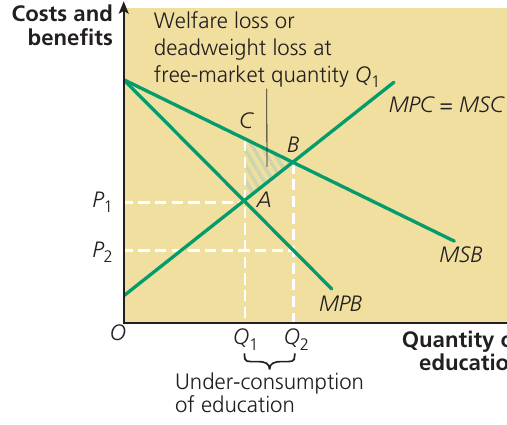
If educational services were provided only through the market at market prices, too few people would benefit from education. The diagram above illustrates this market failure.
Note
Understanding the Diagram:
The privately optimal level of consumption occurs at , where marginal private cost equals marginal private benefit ( at point A).
However, this is below the socially optimal level of consumption, . The socially optimal level of education is found where marginal social cost equals marginal social benefit ( at point B).
According to marginal analysis, free-market provision of merit goods leads to under-consumption.
The marginal social benefit of units of education between and exceeds the marginal social cost of these units. Producing and consuming these additional units would add to society's welfare. The shaded triangle ABC represents the welfare loss or deadweight loss that results from under-consumption in a free market.
Government intervention through subsidies
To correct this market failure, the government can provide a subsidy. A subsidy is a payment made by government or other authority, usually to producers, for each unit of the subsidised good that they produce. Consumers can also receive subsidies, such as free or reduced-price bus passes for children.
Suppose the government reacts by providing a subsidy that reduces the price of education to . At this subsidised price, consumption of education rises to the socially optimal level of . The market failure has now been addressed.
What are demerit goods?
As the name suggests, demerit goods are the opposite of merit goods. A demerit good is one for which the costs to society from consumption exceed the private costs incurred by the consumer. This occurs because consumption by an individual produces negative externalities that harm the wider community.
Just as with merit goods, value judgements are involved in determining whether something should be classified as a demerit good.
Negative externalities in consumption
When people consume demerit goods such as tobacco or alcohol, negative externalities are generated which are unpleasant or harmful for other people. The private cost can be measured by the money spent on purchasing the good, along with any health damage the consumer suffers. However, the social costs of consumption also include the cost of the negative externalities.
These negative externalities include costs imposed on others from:
- Passive smoking
- Road accidents caused by drunk drivers
- The cost of taxes raised to fund the care of victims of tobacco- and alcohol-related diseases
For demerit goods, the benefit the smoker or drinker derives from consumption exceeds the benefit to society. The second key characteristic relates to information failures that affect the consumption decision.
Demerit goods and information failures
When teenagers first develop the habit of smoking, drinking or taking drugs, they may either ignore the long-term private costs they may face later in life, or downplay the significance of these costs. Young people tend to be short-sighted regarding the costs of consuming demerit goods.
Example
Example: Young Adults and Long-Term Consequences
Teenagers and young adults often focus on short-term costs and benefits when deciding how much to consume. They may take account of immediate pleasure but ignore or undervalue the long-term consequences.
A person who started drinking heavily as a teenager may later regret the decision when suffering from an alcohol-related illness. The long-run net benefit of consuming a demerit good is less than the short-run benefit.
Examples of demerit goods
The two most widely recognised examples of demerit goods are:
- Tobacco products including cigarettes
- Alcoholic drinks
Other commonly cited examples include:
- Narcotic drugs such as heroin and crack cocaine
- Pornography
- Prostitution
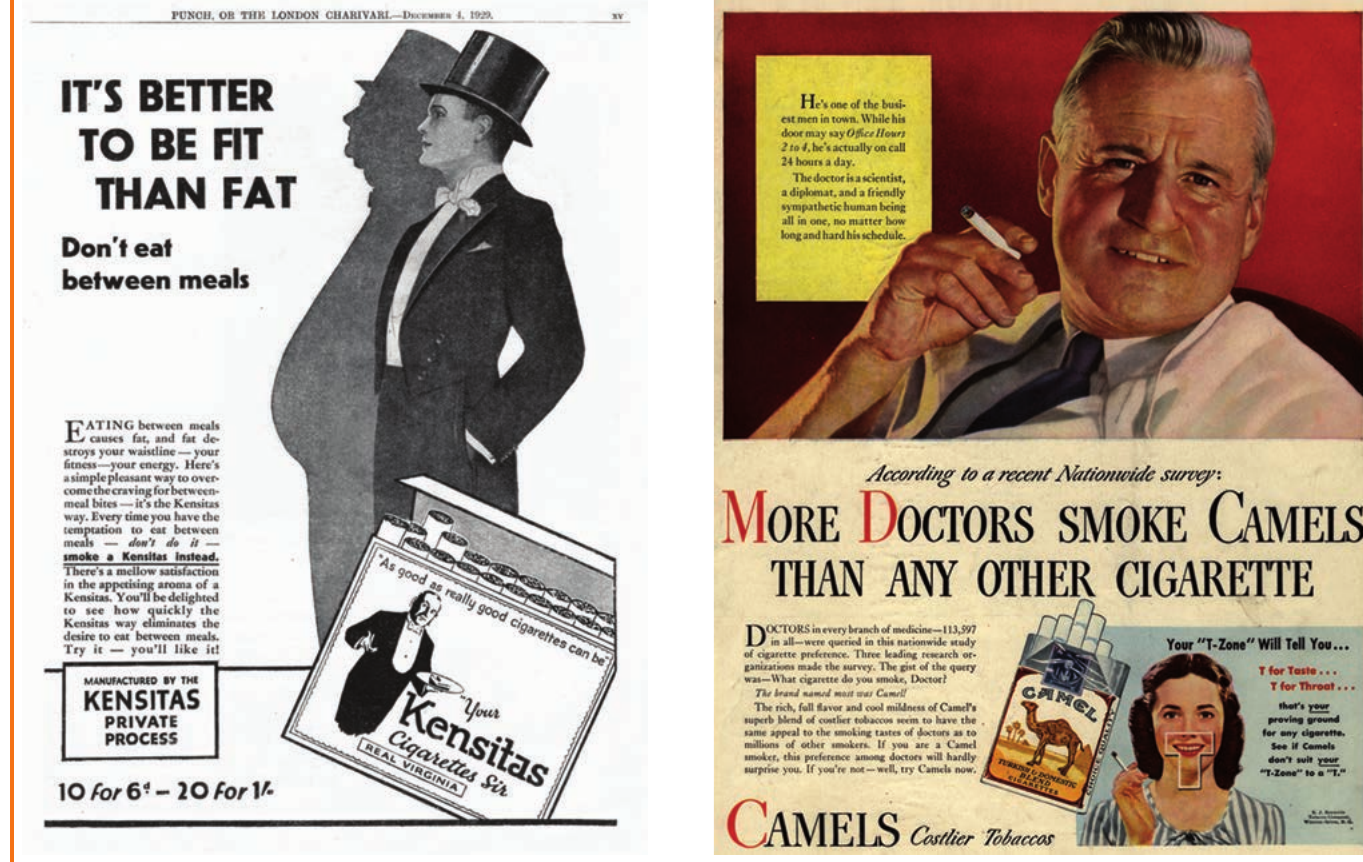
Cigarettes and alcoholic drinks are the best-known examples of demerit goods. In many countries, including the UK, governments either ban tobacco and alcohol advertising or severely regulate what advertisers can show. This represents a significant change from past practices.
Note
Historical Context: Changing Attitudes
Historical cigarette advertisements provide striking examples of how attitudes have changed:
- 1929: Kensitas cigarettes were marketed with the claim "It's better to be fit than fat - Don't eat between meals," promoting cigarettes as an appetite suppressant
- 1946: Camel cigarettes advertised with doctor endorsements, claiming "More doctors smoke Camels than any other cigarette"
By the 1950s, research began to link smoking to cancer. Worldwide, tobacco use now causes more than 7 million deaths per year, and current trends suggest tobacco will cause more than 8 million deaths annually by 2030, largely through the growth of smoking in developing countries. On average, smokers die ten years earlier than non-smokers.
Over-consumption of demerit goods and market failure
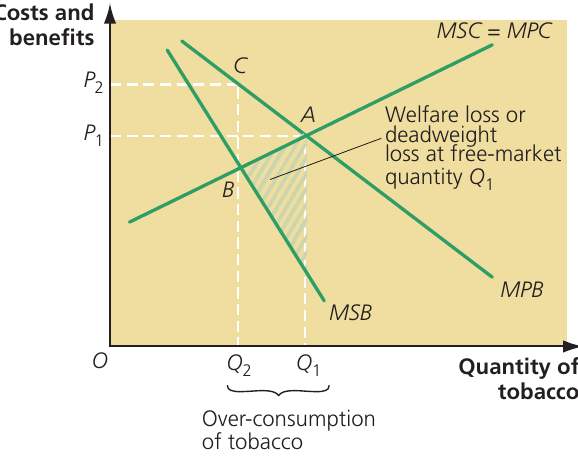
Just as the consumption of merit goods generates positive externalities that benefit the wider community, the consumption of demerit goods leads to negative externalities imposed on others.
In the short term at least, the privately optimal level of consumption is , where . This is greater than the socially optimal level of consumption, , located where . Free-market provision of demerit goods therefore leads to over-consumption, and hence over-production, of tobacco and similar products.
Important
Consumption Externalities vs Production Externalities
The negative externalities in this example are generated when people smoke. For instance, smoke is breathed in by passive smokers who do not enjoy the fumes they inhale. These are consumption externalities rather than production externalities.
As a result, the marginal social benefit (MSB) curve lies below the marginal private benefit (MPB) curve, with the distance between the two curves showing the negative externality.
The shaded area in the diagram represents the welfare loss that occurs at the free-market equilibrium quantity .
Government intervention through taxation
To bring about the socially optimal level of consumption at , an indirect tax equal to the distance between points B and C could be imposed. This would increase the price of tobacco to . The tax needs to be set equal to the marginal external cost (MEC) of consumption at the socially optimal level of consumption ().
Important
Exam Tip
Make sure you practise drawing graphs showing under-consumption of merit goods and over-consumption of demerit goods. These diagrams are fundamental to analysing externalities in production and consumption and are essential for A-level Economics examinations.
Merit and demerit goods and value judgements
The classification of goods as merit goods or demerit goods depends upon value judgements made by those doing the classifying. The table below shows how different goods might be categorised:
| Merit goods | Merit or demerit goods? | Demerit goods |
|---|---|---|
| Education | Contraception | Tobacco |
| Healthcare (e.g. vaccination, preventative dental care, HIV testing) | Abortion | Alcohol |
| Crash helmets | Sterilisation | Narcotic drugs (e.g. heroin, crack cocaine) |
| Car seatbelts | Pornography | |
| Museums and public parks | Prostitution |
Note
The Role of Value Judgements
The left and right columns list goods that most people accept as clear examples of merit goods or demerit goods. However, for goods listed in the middle column, the position is less clear.
Because people hold different values and ethics, contraception and abortion are viewed by some as merit goods, but by others as demerit goods. Whether a good is classified as a merit good, a demerit good, or neither, depends upon the value judgements of the person making the classification.
It is worth noting that under-provision of merit goods and over-provision of demerit goods may result not only from externalities but also from the imperfect information that consumers possess. This can lead to failure to give adequate weight to the long-term consequences of consuming goods such as tobacco.
Do merit and demerit goods actually exist?
Some economists, usually of a pro-free-market persuasion, question whether any goods are truly demerit goods or merit goods. These economists are libertarians who believe that government intervention should be minimal. They argue that individuals are the best judges of what is bad or good for them.
Important
The Libertarian vs Anti-Libertarian Debate
Libertarian View:
- People should be free, within the law, to smoke or drink themselves to death, or to choose whether to have a vaccination
- It is not the state's role to intervene in individual behaviour, except when the pursuit of self-interest harms other people
- For example, the state should prevent motorists from driving on the wrong side of the road
Anti-Libertarian View:
- Over-consumption of demerit goods and under-consumption of merit goods invariably leads to other people being harmed
- Taxation, subsidy and regulation are fully justified as means of altering individual behaviour
Behavioural Economics Approach:
- Individuals should be given as much choice as possible in deciding what is good for them
- However, governments should use appropriate policies to "nudge" people in the direction deemed socially optimal
Merit and demerit goods and information failure
Some economists argue that under-consumption of merit goods and over-consumption of demerit goods stem not primarily from the externalities that consumption generates, but from information failure. Many people become addicted to demerit goods during their teenage years. Because of peer-group pressure and related factors, teenagers are heavily influenced by lifestyle and personal circumstances. At the same time, they may be ignoring, downplaying or being short-sighted about how their addictions may affect them many years ahead.
Individuals consider short-term costs and benefits but ignore or undervalue the long-term private costs and benefits. For most merit goods, the long-term private benefit of consumption exceeds the short-term private benefit. Conversely, for demerit goods, when deciding how much to consume, individuals often take account of only short-term costs and benefits.
Example
Example: Preventative Dentistry
Preventative dentistry provides a good example. Many people ignore the long-term benefit of dental check-ups and decide not to consume the service. Their decisions are influenced by factors such as:
- The price charged by the dentist
- The unpleasantness of the dental experience
Unfortunately, they may later regret this when they suffer from tooth decay or gum disease, saying: "If only I had visited the dentist more often when I was younger."
Note
Synoptic Link
Section 2.2 of Chapter 2 discusses the importance of information for decision making and the effect of asymmetrical information. Information imperfections such as asymmetric information can be a key source of market failure.
Case study: museums as merit goods
Museums perform important cultural functions including conserving, interpreting, researching and displaying heritage. Museums in the UK have a mix of ownership patterns. Over 40% of UK museums are governed by public authorities, with the rest privately owned, mostly on a non-profit basis. Museums cover a wide range of institutions of varying size and reputation, ranging from internationally renowned institutions such as the British Museum to relatively small, locally focused museums.

Note
The Museums Funding Debate
Arguments FOR Government Subsidy:
- Museums generate external benefits - knowledge acquired by a visitor may be passed on to others
- Museums may be regarded as merit goods, generating a better-educated and informed public with cultural pride
- Subsidy would encourage consumption
Arguments AGAINST Government Subsidy:
- May encourage inefficiency, leading to government failure
- May favour well-off visitors who can afford to pay
- Represents a cost to the taxpayer
Remember!
Summary
Key Points to Remember:
-
Merit goods are goods where social benefits exceed private benefits, leading to under-consumption in free markets. They exhibit positive externalities and are affected by information failures.
-
Demerit goods are goods where social costs exceed private costs, leading to over-consumption in free markets. They exhibit negative externalities and are affected by information failures.
-
Value judgements are essential when classifying goods as merit or demerit goods. What one person views as beneficial, another may view as harmful.
-
Government intervention can correct market failures through:
- Subsidies for merit goods (to increase consumption)
- Taxes on demerit goods (to reduce consumption)
-
Information failure contributes significantly to the under-consumption of merit goods and over-consumption of demerit goods, as individuals focus on short-term costs and benefits while ignoring long-term consequences.