Private, Public, and Quasi-Public Goods (AQA A-Level Economics): Revision Notes
📚Revision Notes
Private, Public, and Quasi-Public Goods
Introduction
Understanding the different types of goods in an economy helps us identify when markets work well and when they fail. Goods can be classified according to two key characteristics: whether people can be excluded from consuming them, and whether one person's consumption reduces what's available for others. These characteristics determine whether markets can provide goods efficiently or whether market failure occurs.
Note
Market failure occurs when the free market mechanism fails to allocate resources efficiently. The classification of goods into private, public, and quasi-public helps economists identify which goods are likely to be underprovided by markets and may require government intervention.
Private goods
Most goods and services in the economy are private goods. These goods have two essential features that distinguish them from other types of goods.
Characteristics of private goods
Excludability is the first defining feature of private goods. This means that owners can exercise property rights to prevent others from using or consuming the good. For example, a shopkeeper can stop people from taking items from their shop unless customers pay for them. If someone tries to take goods without paying (shoplifting), the shopkeeper has the legal right to prevent this. Excludability ensures that only those who are willing and able to pay can access and benefit from the good.
Rivalry is the second characteristic of private goods. When one person consumes a private good, the amount available for others decreases. This concept is sometimes called diminishability. Consider a chocolate bar: if you eat it, no one else can eat that same chocolate bar and gain its benefits. Similarly, if you eat a banana, that specific banana is no longer available for anyone else. Each act of consumption directly reduces the quantity available to other potential consumers.
Important
These two characteristics work together to enable private goods to be traded effectively in markets. Because people can be excluded from consuming the goods, suppliers can charge prices. Because consumption is rival in nature, there is a clear incentive for people to pay rather than wait for someone else to purchase the good.
Examples of private goods
Common examples of private goods include:
- Food items (apples, bread, chocolate)
- Clothing
- Cars
- Mobile phones
- Books
- Furniture
Public goods
A public good has characteristics that are the opposite of a private good. Public goods are both non-excludable and non-rival. These characteristics create significant challenges for market provision and commonly lead to market failure.
Characteristics of public goods
Non-excludability means it is impossible or impractical to prevent people from benefiting from the good, even if they haven't paid for it. Once a public good is provided, everyone can access its benefits regardless of whether they have contributed to its cost. This creates what economists call the free-rider problem: people have an incentive to consume the good without paying for it, knowing they cannot be excluded from its benefits.
Non-rivalry means that one person's consumption of the good does not reduce the amount available for others. When you benefit from a public good, this does not diminish the benefits available to other people. For instance, if you receive the benefits of national defence (such as greater peace of mind), this does not reduce the defence protection available to your neighbours or other citizens.
The lighthouse example
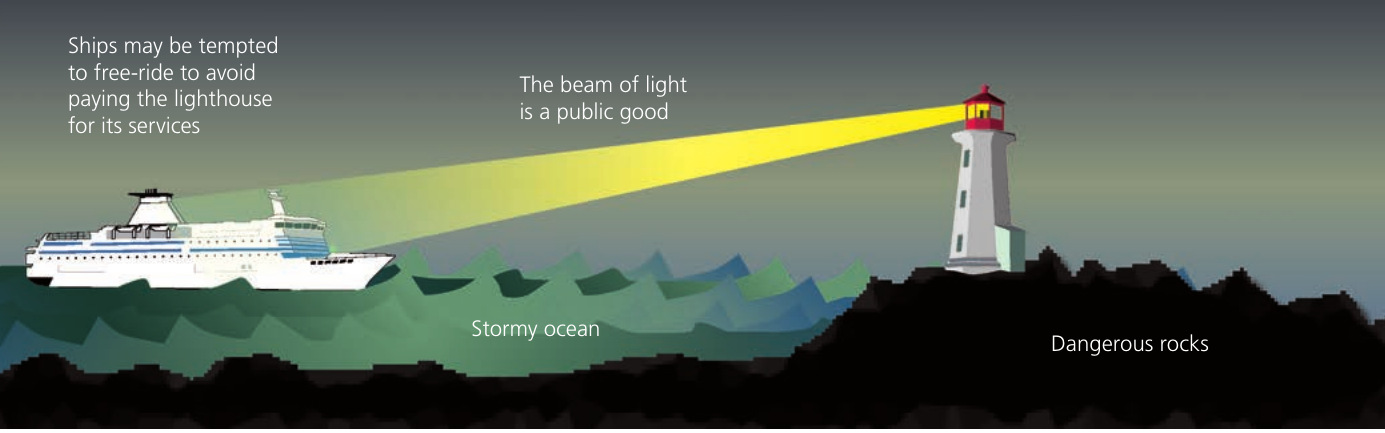
The classic example of a public good is the beam of light provided by a lighthouse. This example effectively illustrates both characteristics of public goods and explains why market failure occurs.
Example
Worked Example: The Lighthouse and Market Failure
Imagine an entrepreneur builds a lighthouse and attempts to charge ships for using the beam of light to navigate safely past dangerous rocks in stormy seas. The entrepreneur tries to bill each ship that passes by and benefits from the lighthouse's beam.
However, the market is likely to fail for several reasons:
Non-rivalry: When one ship uses the lighthouse beam to navigate safely, this does not prevent other ships from simultaneously using the same beam of light. Multiple ships can benefit from the lighthouse at the same time without reducing its usefulness to any individual ship.
Non-excludability: It is impossible to exclude ships that don't pay from benefiting from the beam of light. The lighthouse cannot selectively shine its beam only on ships that have paid. Any ship sailing in the area can see and use the light for navigation.
Free-rider problem: Ships may be tempted to "free-ride" – they can benefit from the lighthouse without paying for its services. If enough ships decide not to pay, the lighthouse operator cannot collect sufficient revenue to cover costs.
Market failure: If too many ships choose to free-ride, profits cannot be generated, and the incentive to provide the service through the market disappears. The market thus fails to provide a service for which there is a clear need.
This creates a missing market – a situation where a good or service that people need is not provided by the market mechanism. When this occurs, there is a case for alternative provision, typically by the government through its public spending programme, or possibly by a charity organisation.
Note
In the UK, lighthouse services are provided by Trinity House, a charity that safeguards shipping and seafarers around the English and Welsh coasts. This demonstrates how non-market mechanisms can step in when markets fail to provide public goods.
Other examples of public goods
Traditional examples of public goods include:
- National defence: Defence is non-rival because one person receiving the benefits of national defence (such as protection and peace of mind) does not reduce the benefits available to others. It is also non-excludable because providing defence for the country means providing it for all residents – you cannot practically defend some citizens while excluding others.
- Police services: Law enforcement creates a safer environment for everyone, and one person's benefit from a safer community does not diminish the safety benefits available to others.
- Street lighting: When streets are illuminated, everyone can benefit from the lighting, and one person's use does not reduce the light available to others.
- Roads: Traditionally considered public goods, though this classification has changed (discussed below).
- Television and radio programmes: Broadcasting signals are non-rival (one person watching or listening doesn't prevent others from doing so) and can be non-excludable (though technology now allows for exclusion through subscription services).
Understanding national defence as a public good
To understand public goods more deeply, consider what would happen if national defence were provided through markets rather than by the government. Suppose a private company, "Nuclear Defence Services Ltd," decided to provide defence services.
The company would need to bill individual households for the defence services received. However, markets can only provide goods when businesses can successfully charge prices for what they supply. The problem is that every household can benefit from the defence services without paying. As long as the defence is provided, all residents benefit regardless of payment.
Important
Why Private Defence Services Would Fail:
- Nuclear Defence Services Ltd cannot provide defence only to households that pay while excluding those who don't pay
- Withdrawing defence from non-payers would mean withdrawing it from everyone
- People face the temptation to free-ride, consuming the benefits without paying
- If enough people free-ride, the company makes a loss and the incentive to provide the service disappears
Assuming most people would agree that defence is necessary (a "good" rather than a "bad"), the market fails because it cannot provide a service for which there is genuine need. This is why national defence is typically provided by governments through public spending, financed by taxation.
Quasi-public goods
Public goods can be categorised into pure public goods and quasi-public goods (also known as non-pure public goods). While pure public goods are fully non-excludable and non-rival, quasi-public goods do not fully meet both of these criteria.
Defining quasi-public goods
A quasi-public good is one that is not fully non-rival and/or where it is possible to exclude people from consuming the product. Most of the traditional examples of public goods are actually quasi-public goods rather than pure public goods.
For instance:
- Street lighting can become congested (rivalry) if too many people use an area
- Roads can exclude people through toll gates or electronic pricing
- Television and radio programmes can exclude non-payers through subscription services and encryption technology
- Lighthouses (though traditionally seen as pure public goods) could potentially exclude ships through electronic identification systems
Converting quasi-public goods into private goods
Methods can be devised to convert quasi-public goods into private goods by introducing exclusion mechanisms. For example:
- Electronic road pricing allows authorities to charge motorists for road use, making roads excludable
- Subscription services make TV and radio programmes excludable
- Toll booths on roads create physical exclusion mechanisms
However, quasi-public goods retain the characteristic of non-rivalry or non-diminishability, meaning there is a case for providing all such goods free of charge to encourage maximum consumption. When there is no capacity constraint, the optimal level of consumption occurs when people can access the goods freely. Of course, capacity constraints do exist – such as the limited ability of roads to carry cars and the limited bandwidth of airwaves – which means there is also a case for charging to manage congestion.
The significance of technological change
Roads provide an excellent example of how a good's classification can change over time due to technological developments.
Until recently, except for motorways with limited access points where toll gates could be installed, charging motorists for using ordinary roads was considered impractical. Roads were therefore regarded as pure public goods.
Note
Technological change has transformed this situation. Government and local authorities can now use electronic pricing systems to charge motorists for road use. These charges can be varied at different times of day to:
- Create incentives for car drivers to shift their travel from peak times to off-peak times
- Manage congestion more effectively
- Reduce pollution by discouraging excessive car use
There is a strong economic case for charging when roads become congested and rivalry occurs. However, when roads are uncongested and largely non-rival, there is less justification for charging. Despite the economic logic, road pricing schemes remain relatively rare.
Important
The scarcity of road pricing schemes probably reflects political considerations rather than economic ones. We generally accept paying different prices at different times for various goods and services (such as cinema tickets or train fares), but the motoring lobby holds significant political power. Politicians often fear they will lose electoral support if they attempt to introduce road pricing schemes, which may explain why such schemes are not more widespread.
London congestion charge case study
In February 2003, the London congestion charge celebrated its 20th anniversary. At the time of its introduction, many economists believed the scheme represented the triumph of economic common sense over narrow self-interest. Economists confidently predicted that many other cities, both in the UK and internationally, would quickly adopt London-style road pricing. However, this prediction proved incorrect.
Note
Case Study: London Congestion Charge
In November 2008, Manchester voters were asked to approve a city-centre congestion charge, and they voted against it. The idea of charging car users to drive around the capital initially met with warnings from motoring groups and newspapers such as the Daily Mail, which claimed the charge would "destroy" the city's commercial heart and cause "total gridlock."
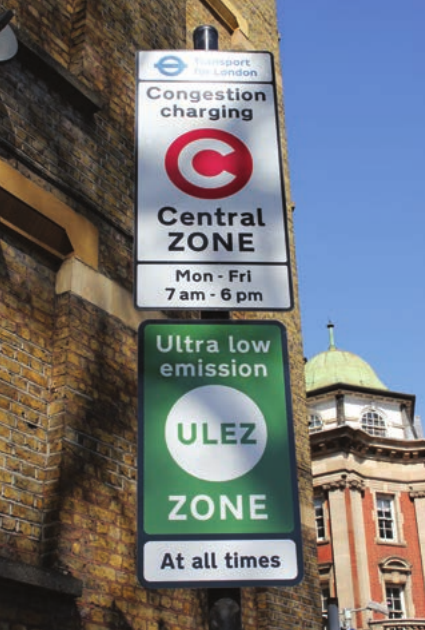
Since its introduction in 2003, the charge (which has risen from 15) has not caused the predicted gridlock. Instead, it has resulted in a slight reduction in traffic levels. While car numbers are down, the number of private hire vehicles (minicabs and Ubers) has increased. Trips by taxi and private hire vehicles as the main mode of journey increased by 9.8% between 2015 and 2016, and by 29.2% since 2000.
Today, more than 18,000 different private hire vehicles enter the congestion charging zone each day, with peaks on Friday and Saturday nights. This has reduced the speed of traffic through the city centre, which has in turn affected the bus network.
The congestion charge has reduced car use but increased the use of taxis and private hire vehicles. The real aim of the London congestion charge is increasingly understood to be reducing air pollution rather than simply reducing traffic congestion. For example, electrically powered cars are exempt from the charge.
This case study demonstrates how quasi-public goods like roads can be converted into excludable goods through technology, and how pricing mechanisms can be used to manage demand and address externalities such as pollution and congestion.
Summary of key concepts
Summary
Private goods characteristics:
- Excludable: People who don't pay can be prevented from consuming the good
- Rival: When one person consumes the good, less is available for others
- Examples: food, clothing, cars, mobile phones
Public goods characteristics:
- Non-excludable: Impossible to prevent people from benefiting, even if they haven't paid
- Non-rival: One person's consumption doesn't reduce availability for others
- Lead to the free-rider problem and market failure
- Examples include national defence, police services, and street lighting
Quasi-public goods characteristics:
- Not fully non-rival and/or exclusion is possible
- Most "public goods" are actually quasi-public goods
- Technology can enable exclusion (electronic road pricing, subscription TV)
- Roads have evolved from being considered pure public goods to quasi-public goods
Market failure and public goods: When markets fail to provide public goods due to the free-rider problem, alternative provision is needed, typically through government spending financed by taxation or through charitable organisations.
Remember!
Summary
Key Points to Remember:
-
Private goods have two key features: they are excludable (you can prevent non-payers from consuming them) and rival (one person's consumption reduces what's available for others).
-
Public goods are the opposite of private goods: they are non-excludable (you cannot prevent people from benefiting) and non-rival (one person's consumption doesn't reduce availability for others). These characteristics lead to the free-rider problem and market failure.
-
The lighthouse example perfectly illustrates the free-rider problem: ships can benefit from the beam of light without paying, making it difficult for private businesses to profit from providing the service, resulting in a missing market.
-
Quasi-public goods are "almost" public goods: they are not fully non-rival or exclusion is possible through technology. Most real-world examples of public goods (such as roads and TV programmes) are actually quasi-public goods.
-
Technological change can transform goods from public to private: electronic pricing systems can make previously non-excludable goods (like roads) excludable, enabling market provision and helping manage congestion and externalities.