Dynamics of Competition and the Contestable Market (AQA A-Level Economics): Revision Notes
📚Revision Notes
Dynamics of Competition and the Contestable Market
Understanding the dynamics of competition
Traditional vs real-world competition
Economists traditionally viewed competition primarily as price competition. In this model, consumers benefit from lower prices and greater choice, while the economy benefits because inefficient, high-cost firms are forced out of the market.
However, real-world markets operate differently. In imperfectly competitive markets, firms compete using multiple strategies beyond just price. Competition drives firms to:
- Improve their products
- Reduce costs
- Enhance service quality
- Differentiate their offerings
- Build strong brand images
- Use attractive packaging and design
- Create fashion and style trends
Note
These forms of non-price competition make firms more dynamically efficient and attractive to customers. They also help innovative and entrepreneurial firms enter markets more easily by competing on quality, innovation, and brand value rather than just price.
The anti-competitive side of competition
Not all competitive behaviour benefits consumers. Some business decisions that appear competitive can actually be anti-competitive in practice. These actions aim to increase the market power of already dominant firms rather than serve consumer interests.
Important
Recognising Anti-competitive Behaviour
Anti-competitive practices often disguise themselves as legitimate competition but actually harm market efficiency and consumer welfare. These actions strengthen dominant firms' market positions without providing real benefits to consumers.
This view connects to the concept of creative destruction (discussed in Chapter 4). This process describes how capitalist economies change over time, becoming more dynamically efficient through the continuous replacement of old firms and methods with new, more innovative ones.
Profit and loss in perfect competition
Perfect competition creates a dynamic process where profits signal market opportunities and losses indicate inefficiency. Understanding how firms respond to different price levels is crucial for grasping market dynamics.
Price levels and firm decisions
When a perfectly competitive firm faces different prices, it must decide how much to produce. The key decision points are:
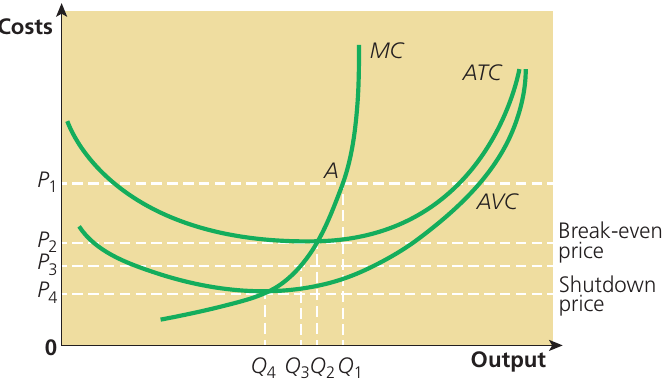
At price P₁ (above break-even):
- Firms can cover all their costs of production
- They earn abnormal profit (profit above normal levels)
- This attracts new firms into the market
- Increased competition eventually pushes prices down
- Abnormal profit disappears in the long run
At the break-even price (P₂):
- This occurs at the minimum point of the Average Total Cost (ATC) curve
- Firms cover all their variable and fixed costs
- Only normal profit is made
- No incentive for new firms to enter or existing firms to leave
- This represents long-run equilibrium
Between P₃ and P₄ (below break-even but above shutdown):
- Price falls below ATC but remains above Average Variable Cost (AVC)
- Firms make losses in the short run
- However, these losses are smaller than if they produced nothing
- The firm covers some of its fixed costs by continuing production
- If the firm produced zero output, it would lose an amount equal to all its fixed costs
Example
Worked Example: The Shutdown Decision
Consider a firm with fixed costs of $10,000 per month and variable costs of $5 per unit. If the market price falls to $7 per unit:
Step 1: Compare price to average variable cost
- Price ($7) > AVC ($5)
- The firm covers its variable costs and contributes $2 per unit toward fixed costs
Step 2: Calculate the benefit of continuing production
- If producing 1,000 units: Revenue = $7,000, Variable costs = $5,000
- Contribution to fixed costs = $2,000
- Loss = $10,000 - $2,000 = $8,000
Step 3: Compare to shutting down
- If shutdown: Loss = $10,000 (all fixed costs)
- By continuing: Loss = $8,000
Conclusion: The firm should continue production because the loss ($8,000) is less than the shutdown loss ($10,000).
At the shutdown price (P₄):
- This occurs at the minimum point of the AVC curve
- Below this price, firms cannot even cover their variable costs
- The firm should shut down immediately
- By producing nothing, the firm reduces its loss to just its fixed costs
The profit-maximisation rule
Note
The Fundamental Decision Rule
Firms maximise profit by producing where MR = MC (Marginal Revenue equals Marginal Cost). At price P₃, the firm produces at point A where this condition is met, even though it makes a loss. This is the output level that minimises the firm's losses in the short run.
How firms compete: the Apple case study
Apple demonstrates how successful firms use non-price competition strategies to dominate markets. The company's approach illustrates the practical application of competitive dynamics.
Innovation and product differentiation
When Apple launched the Macintosh personal computer nearly 40 years ago, most rival computers looked similar, and design received little attention. Apple changed this completely by "thinking different" - creating entirely new products and product categories that didn't exist before.
Apple's innovation strategy includes:
- Creating new markets (MP3 and MP4 players, smartphones, tablets, computers)
- Setting industry standards through pioneering products
- Breaking the traditional mould that competitors follow
- Staying ahead through continuous innovation
Management style and decision-making
Apple's competitive advantage extends to its organisational structure. Unlike rival companies where decisions require approval from multiple committees, Apple operates differently:
- A single executive committee makes all decisions
- This enables rapid, seamless rollout of new products
- The company can launch products "nobody else had thought of almost every other year"
- Speed and flexibility give Apple a significant competitive edge
Design as a competitive weapon
Note
Apple's Design Philosophy
Apple recognises that "great design principles are pervasive in the Apple DNA." This design focus differentiates Apple from competitors who may struggle to match Apple's aesthetic standards.
According to Tim Bajarin of Creative Strategies Inc., unless competitors innovate on their own, Apple will maintain at least a two-year lead. The company's ability to think differently, combined with its management style and design DNA, keeps competitors following rather than leading the market.
Contestable and non-contestable markets
What is a contestable market?
A contestable market is a market structure where the potential for new firms to enter exists. The key feature is not how many firms currently operate in the market, but how easily new firms can enter if profitable opportunities arise.
Important
Key Characteristics of a Perfectly Contestable Market:
- No barriers to entry or exit
- No sunk costs
- Both existing firms and new entrants access the same technology
- New firms can enter and compete on equal terms
The emphasis is on potential competition rather than actual competition.
Traditional vs contestable market theory
Traditional approach (pre-1980s):
Until about 40 years ago, governments focused on:
- The number of firms in the market
- Market concentration ratios (share held by leading firms)
- Increasing regulation of private-sector firms
- Using regulatory powers to counteract large business organisations
- Making monopolies behave more competitively
The traditional approach created a dilemma: how to achieve large-scale productive efficiency whilst avoiding monopoly abuse and consumer exploitation.
Contestable market theory approach:
This theory revolutionised thinking about monopoly power. It argues that monopoly power depends not on the number of firms or concentration ratios, but on how easily new firms can enter the market.
Note
Key Insights from Contestable Market Theory:
- Industrial concentration isn't a problem if barriers to entry and exit are absent
- Actual competition (current competitors) isn't essential
- Potential competition (threat of entry) is sufficient
- The threat of entry keeps existing firms efficient and prevents exploitation
This represents a fundamental shift from counting firms to assessing market accessibility.
Impact on UK monopoly policy
Contestable market theory has significantly influenced UK policy since the 1980s. The theory suggests that traditional regulatory policies may be unnecessary if potential competition exists.
Instead of interfering with pricing and output decisions, government policy should focus on:
- Discovering which industries and markets are potentially contestable
- Minimising barriers to entry and exit
- Ensuring reasonable contestability is possible
Policies to promote contestability include removing:
- Licensing regimes for public transport, television and radio transmissions
- Controls over ownership (such as exclusive public ownership)
- Price controls that act as barriers to entry (previously common in aviation)
The aviation industry example
The removal of price controls in the aviation industry demonstrates contestable market theory in practice. Deregulation increased competition, allowing new entrants like easyJet to challenge established airlines.

This increased contestability led to:
- Lower fares for consumers
- More choice and routes
- Greater efficiency among airlines
- Innovation in service delivery
Sunk costs and hit-and-run competition
Understanding sunk costs
For a market to be perfectly contestable, there must be no barriers to entry or exit and hence no sunk costs.
Important
Defining Sunk Costs
Sunk costs are costs incurred when entering a market that cannot be recovered if the firm decides to leave. These differ from fixed costs, although both are fixed expenses.
The key distinction: sunk costs are irrecoverable, while some fixed costs can be recovered through resale or redeployment.
Examples of sunk costs:
- Machinery with no resale value: If a firm invests in specialised machinery that cannot be sold to another firm or has only disposal costs, this investment becomes a sunk cost
- Advertising expenditure: Money spent establishing the firm in the market cannot be recovered if market entry proves unsuccessful
- Research and development costs: Investment in developing products specific to a market
Examples of fixed costs that are NOT sunk costs:
- Machinery with resale value: If machinery can be sold at a good price to another firm, it isn't a sunk cost because the investment can be recovered
Example
Worked Example: Identifying Sunk Costs
Consider two firms entering the delivery market:
Firm A:
- Purchases generic delivery vans for $100,000
- These vans can be resold for $80,000
- Sunk cost: $20,000 (depreciation loss)
- Recoverable cost: $80,000
Firm B:
- Purchases custom-branded refrigerated vans for $100,000
- Spends $50,000 on brand advertising
- Custom vans can only be sold for $30,000
- Sunk costs: $70,000 (van depreciation) + $50,000 (advertising) = $120,000
- Recoverable cost: $30,000
Conclusion: Firm B faces much higher barriers to exit, making the market less contestable. The higher sunk costs discourage entry because potential competitors face greater risks.
Hit-and-run competition
Hit-and-run competition occurs when a new entrant can temporarily enter a market, earn profits, and then leave quickly when profit opportunities disappear. This is only possible when barriers to exit are low or non-existent.
The process works as follows:
- A new firm spots abnormal profits being made in a market
- The firm enters temporarily
- It shares in the abnormal profit
- When competition eliminates abnormal profits, the firm leaves
- Exit is possible because there are no or low barriers
Note
Why Sunk Costs Matter
Sunk costs discourage hit-and-run competition because they make exit costly. If a firm cannot recover its initial investment, it faces significant losses by leaving the market. This reduces market contestability and allows existing firms to maintain higher prices without fear of temporary competitors.
Impact on monopoly behaviour
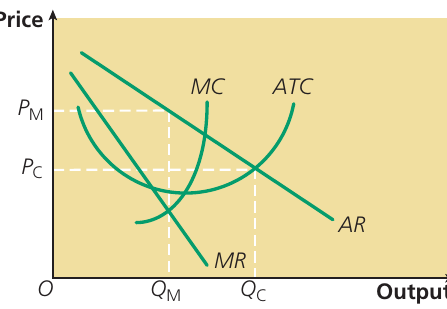
The threat of hit-and-run competition can discipline monopolist behaviour. Figure 5.21 illustrates how a monopolist facing potential competition reacts:
- Without the threat of entry, the monopolist charges price and produces quantity
- With contestability (potential entry threat), the monopolist reduces price to
- This results in only normal profits being made
- The pricing policy becomes similar to limit pricing (pricing to deter entry)
Note
The Power of Potential Competition
This demonstrates that potential competition can be as effective as actual competition in keeping prices low and preventing consumer exploitation. The possibility that new firms might enter creates incentives for existing firms to behave more competitively, even without current competitors.
Summary
Key Points to Remember:
-
Competition involves both price and non-price elements. Non-price competition (innovation, design, branding, service quality) is often more important in real-world markets than simple price competition.
-
In perfect competition, price signals drive market entry and exit. Abnormal profits attract new firms, whilst losses cause firms to leave. The break-even and shutdown prices are critical decision points.
-
Contestable market theory focuses on potential rather than actual competition. The threat of new entrants entering the market can discipline existing firms just as effectively as current competitors.
-
Sunk costs are barriers to contestability. When firms cannot recover their initial investments, they face risks entering markets, reducing contestability and allowing existing firms to maintain higher prices.
-
Hit-and-run competition requires low barriers to exit. This type of competition helps keep markets efficient by allowing temporary entry when profit opportunities arise and easy exit when they disappear.