Discrimination in the Labour Market (AQA A-Level Economics): Revision Notes
📚Revision Notes
Discrimination in the Labour Market
The nature of wage discrimination
In markets where employers have significant control over wage-setting, they can reduce their total wage costs through a practice known as wage discrimination. This occurs when an employer pays different workers different wages for performing identical work. The ability to engage in wage discrimination typically requires the employer to possess some degree of market power, allowing them to influence wages rather than simply accepting the market rate.
To understand how wage discrimination operates, consider a competitive labour market where all workers initially receive the same wage (), which is determined by the intersection of labour supply and demand. In this scenario, the employer's total wage expenditure equals the area represented by rectangle .
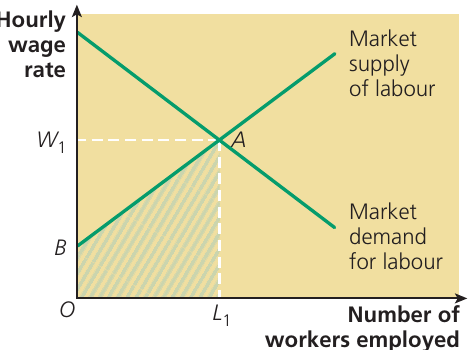
However, when an employer engages in wage discrimination, they pay each worker only the minimum amount that worker is willing to accept, rather than the competitive market wage. This reduces the total wage bill to the shaded area , transferring income from workers to the employer. This practice represents one reason why firms pursue discriminatory wage policies, and why trade unions often resist such arrangements.
Note
Wage discrimination can also manifest when specific groups of workers systematically receive wages below their marginal revenue product (MRP). This situation arises when employers exploit their monopsony power in the labour market, as demonstrated in earlier discussions about market structures.
Understanding the mechanism
For wage discrimination to succeed, employers must be able to identify and separate different groups of workers who supply similar types of labour. This separation becomes possible when workers possess varying levels of knowledge about the labour market and have different abilities to seek alternative employment opportunities.
Important
Workers with limited information about wage rates at other firms, or those who face barriers to changing employers, become vulnerable to discriminatory practices. This information asymmetry is a key factor enabling wage discrimination to persist in labour markets.
Types of wage discrimination
Wage discrimination takes many forms across different labour markets. While we'll examine gender discrimination as a primary example, it's important to recognise that discrimination operates along multiple dimensions. Different groups experience discrimination based on various characteristics including:
- Race and ethnicity
- Religion
- Gender identity
- Sexual orientation
- Disability status
Each type of discrimination shares common economic mechanisms but may have distinct causes and consequences in different market contexts.
Gender discrimination in the labour market
Gender-based wage discrimination remains a significant issue in the UK labour market. Despite equal pay legislation being in place since 1972, women's average pay continues to fall short of men's pay, even when controlling for similar work and qualifications.
The scale of the gender pay gap
Recent data reveals the persistent nature of gender pay inequality. In 2017, the Fawcett Society reported that progress in closing the gender pay gap had stalled, with the gap standing at 14.1% - unchanged from 2015 and 2016. The organisation warned that at the current rate of progress, the gap would not close until 2117, over a century away.
Note
The pay gap shows significant variation across sectors. The private sector exhibited a gender pay gap of 17.1%, though this had decreased by 4.3 percentage points since 2011. In contrast, the public sector maintained a relatively stable gap of just above 14%.
Further analysis revealed substantial differences based on ethnicity, with Pakistani and Bangladeshi women facing a 26% pay gap, and Black African women experiencing a 24% gap.
Important
Research by the Chartered Management Institute in 2017 found an even larger pay gap at management levels, with the gender pay gap at 26.8%. Male managers earned an average of $11,606 more per year than their female counterparts - $3,000 more than previously estimated.
The extent of low pay also disproportionately affects women. Women are 1.8 times more likely than men to earn below the statutory minimum wage, with 221,000 women earning less than this legal threshold compared to 100,000 men.
Reasons for gender pay inequality
Several interconnected factors explain why women earn less than men on average:
Occupational segregation and industry choice: Women tend to work predominantly in lower-paid industries and occupations. Even within specific occupational categories, women often receive lower pay than men. This pattern partly reflects women's under-representation in higher-paid positions within any given occupation, though it also stems from women being paid less for performing identical work.
Discrimination in labour markets: Direct discrimination against women in hiring, promotion, and pay decisions contributes to these pay differences. Women face disproportionate representation in industries characterised by smaller average firm sizes and plant sizes. These smaller organisations typically offer lower wages and fewer promotion opportunities compared to larger firms and industries.
Note
Additionally, such industries are often less unionised, meaning women workers have historically had less collective bargaining power than men. This structural disadvantage reinforces pay inequalities through reduced negotiating power.
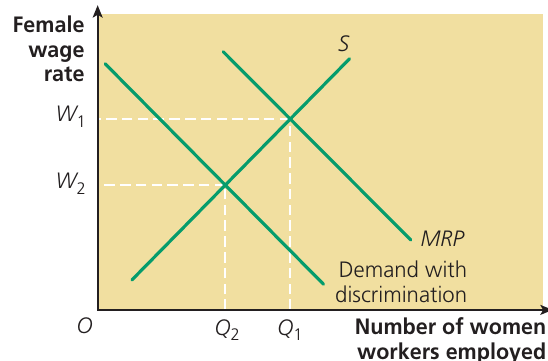
The diagram above illustrates how discrimination affects the labour market for female workers. The demand curve labelled "Demand with discrimination" (represented by the MRP curve) lies to the left of where it would be without discrimination. This results in fewer women being employed ( instead of ) and at lower wages ( instead of ).
Labour force attachment and career interruptions: Women's weaker average attachment to the labour force significantly impacts their pay progression. Both men's and women's pay increases by an average of 3% for each year of work experience. However, when women leave the labour force, typically to care for young children, their potential pay falls by 3% for each year away from employment.
Example
Worked Example: The Cumulative Effect of Career Breaks
This creates a substantial accumulation effect. Consider the following scenario:
Starting Point: A woman and man begin employment with equal potential and pay.
Career Break: The woman leaves the workforce for 8 years to raise a family.
Return to Work: After returning, both work for another 8 years.
Calculation:
- Lost progress during break: behind
- Man's progress during same period: ahead
- Total gap after returning for 8 more years: pay difference
This represents 16 years of pay progression difference - a significant economic penalty for career breaks.
Higher labour turnover costs: Women generally experience higher rates of labour turnover than men, which imposes costs on employers. These include expenses for training replacement workers. This consideration may reduce employers' incentive to invest in training female workers, as they perceive a lower return on this investment. Similarly, some women may have less incentive to invest in their own education and training if they anticipate receiving fewer benefits from these investments over their working lives than their male counterparts.
Effects on labour markets
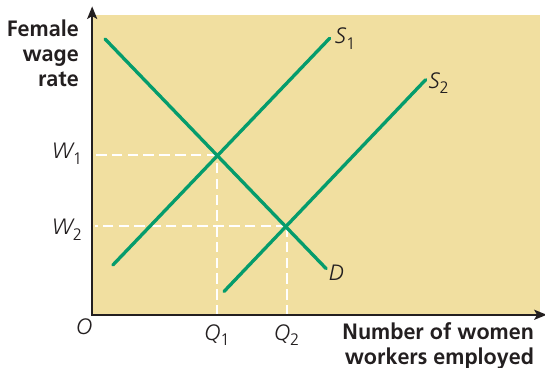
Gender discrimination in one labour market creates ripple effects in other labour markets. As the diagram below demonstrates, when discrimination occurs in one market, it affects the supply of labour to other markets where discrimination is not occurring.
Important
The Spillover Effect
When discrimination takes place in an initial labour market, the supply curve for female workers in non-discriminatory markets shifts outward (from to ). This happens because discrimination in the first market reduces opportunities there, pushing more women to seek employment in alternative markets.
The increased supply in these secondary markets leads to:
- Increased female employment (from to )
- Depressed wages (from to )
This demonstrates how discrimination in one sector can have negative wage effects even in sectors that do not directly discriminate, by altering the overall distribution of labour supply across markets.
Real-world evidence: the glass ceiling
The concept of the "glass ceiling" describes invisible barriers that prevent women from progressing to senior positions despite having the qualifications and capabilities to do so. In 2017, Nicola Brewer, chief executive of the Equality and Human Rights Commission (EHRC), warned that this ceiling had transformed from glass to "reinforced concrete."
Important
Stark Findings from the EHRC
The commission's findings painted a stark picture of women's progress in the workplace:
- At the current rate of progress, it would take nine times longer than the 55 years since equal pay legislation to achieve equality in senior judiciary positions
- The journey from Land's End to John O'Groats (approximately 73 miles) would be covered halfway before equal numbers of women become directors of FTSE 100 companies
- Building the entire Great Wall of China (taking 212 years) would require only slightly more time than the 200 years needed for women to be equally represented in Parliament
The EHRC described progress as moving at "a snail's pace," with young women's aspirations at risk of giving way to frustration. The commission noted that despite women excelling in education and achieving success in higher education, workplaces remain structured in ways that place excessive barriers in their path, resulting in an avoidable loss of talent at senior levels.
Evidence from Parliament reflected this slow progress. The 2017 General Election saw a record 208 female MPs elected, representing 32% of all MPs. While this marked an increase from 191 in the 2015 election and represented the highest proportion in UK electoral history, it still fell well short of the government's 25% female membership target set for 2015.
Note
The commission's report argued that these findings are not simply a "women's issue" but represent symptoms of a broader failure. The report questioned whether old-fashioned and inflexible working patterns prevent the UK from fully utilising the talents of women and other under-represented groups, including disabled people, ethnic minorities, and those with caring responsibilities.
Historical example: Ford car workers and the Equal Pay Act
Example
Historical Case Study: The 1968 Ford Dagenham Strike
The 1968 strike by women workers at Ford's Dagenham car plant provides a powerful historical example of gender-based wage discrimination and the fight for equal pay. This event, documented in the 2010 film "Made in Dagenham" and a 2014 West End musical, played a crucial role in changing UK employment law.
Background: In 1968, the notion of a male "breadwinner" commanding legitimately higher pay than women was widely accepted. However, women sewing machinists at Ford's Dagenham plant challenged this assumption.
The Trigger: These women had their jobs downgraded from Category C (skilled production jobs) to Category B (unskilled production jobs), which also meant they would earn less than men performing work of similar skill level.
The Action: The women went on strike for three weeks. Their action captured the attention of Barbara Castle, then Secretary of State for Employment, and ultimately led to the 1970 Equal Pay Act.
The Outcome: Following the initial strike, the women machinists' pay increased to 8% below men's rate in grade B. However, achieving a grade C rating - reflecting the skilled nature of their work - took until 1984, following a second strike.
The Lesson: This lengthy struggle illustrates the persistent nature of workplace discrimination and the difficulty in achieving genuine equal pay even after landmark legislation.
Exam tips
Summary
Key Points for Exam Success
When analysing wage discrimination in exam questions:
- Distinguish clearly between wage discrimination in labour markets (where firms hire workers) and price discrimination in goods markets (where firms sell output)
- Use diagrams effectively to show how discrimination affects both wages and employment levels
- Consider spillover effects - discrimination in one market affects wages and employment in other markets
- Link theory to practice by connecting theoretical analysis to real-world examples such as gender pay gaps or specific cases like the Ford workers
- Be aware of diversity in discrimination types operating in labour markets (racial, religious, gender, sexuality, disability)
- Take a multi-factor approach when discussing gender discrimination, considering occupational segregation, career breaks, and direct discrimination
Remember!
Summary
Essential Takeaways
-
Wage discrimination occurs when employers pay different workers different rates for performing the same work, or systematically pay certain groups below their marginal revenue product
-
Gender discrimination remains persistent in UK labour markets, with the gender pay gap standing at 14.1% overall and 26.8% for managers as of 2017
-
Multiple factors explain gender pay inequality: occupational segregation, direct discrimination, career breaks due to caring responsibilities, and higher labour turnover
-
Spillover effects mean that discrimination in one labour market reduces wages even in non-discriminatory markets by increasing labour supply there
-
Progress is slow - at current rates, gender pay equality in the UK would not be achieved until 2117, over a century away