Imperfectly Competitive Labour Markets (AQA A-Level Economics): Revision Notes
📚Revision Notes
Imperfectly Competitive Labour Markets
Introduction to imperfectly competitive labour markets
Real-world labour markets rarely operate under conditions of perfect competition. Instead, they exist along a spectrum ranging from nearly perfectly competitive markets at one extreme to monopsonistic labour markets at the opposite extreme. Most labour markets fall somewhere in between these two extremes, displaying varying degrees of imperfect competition.
Note
The spectrum of labour market competition:
- Perfect competition (rare) → workers have many employment choices, no single employer can influence wages
- Imperfect competition (most common) → varying degrees of market power held by employers
- Monopsony (rare) → single employer dominates the market and can set wages
In reality, labour markets are imperfectly competitive due to factors such as different skills and productivities among workers, variations in demand for different types of workers, and the presence of powerful employers or trade unions. These imperfections mean that wage differences persist between workers and between different labour markets, even when workers perform similar tasks or possess comparable skills.
What is a monopsony?
A monopsony is a market structure where there is only one buyer. In the context of labour markets, this means a single employer or firm is the sole purchaser of labour services. The term was first introduced by economist Joan Robinson in her book The Economics of Imperfect Competition (1933) to describe markets with single, powerful buyers.
Pure monopsonies in labour markets are extremely rare. Workers typically have some choice between alternative employers, though this choice may be limited. Examples that come close to pure monopsony include:
- The armed services in a country
- Large dominant employers in specific geographical areas
- Specialist employers requiring unique skills
Monopsony power
More commonly, labour markets exhibit monopsony power rather than pure monopsony. Monopsony power refers to the market power exercised by a buyer of labour services, even when the firm is not the only employer in the market. This occurs when there are dominant employers who can influence wage rates due to their size and importance in the labour market.
Note
Real-World Example: The NHS
The National Health Service (NHS) in the UK provides an excellent illustration of monopsony power. While the NHS possesses considerable monopsony power in the healthcare sector, it is not a pure monopsony because private hospitals also employ healthcare workers. Nevertheless, the NHS's dominant position gives it significant influence over wages and employment conditions for healthcare professionals.
Wage and employment determination in monopsony markets
Understanding how wages and employment levels are determined in monopsonistic labour markets requires examining the relationship between different cost curves.
The marginal cost of labour (MCL)
In a monopsony labour market, the marginal cost of labour (MCL) curve shows the additional cost incurred by the employer when hiring one extra worker. Importantly, this marginal cost includes more than just the wage paid to the additional worker.
Important
Critical Concept: Why MCL Exceeds the Wage Rate
When a monopsony increases employment by one worker, it must typically raise the wage rate to attract that worker from alternative employment or leisure. However, to maintain fairness and prevent worker dissatisfaction, the employer must pay this higher wage rate to all existing workers as well.
Therefore, the marginal cost of hiring an additional worker equals:
- The wage paid to the new worker, plus
- The increase in wages that must be paid to all existing workers
This makes the MCL curve steeper than the labour supply curve.
The average cost of labour (ACL)
The average cost of labour (ACL) is equivalent to the wage rate and represents the labour supply curve facing the monopsony. This curve shows the different wage rates that the monopsony must pay to attract different quantities of labour.
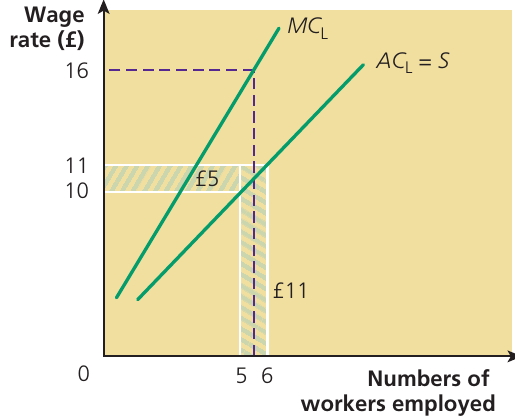
Example
Worked Example: Calculating the Marginal Cost of Labour
Figure 6.8 illustrates a monopsonistic labour market where the MCL curve lies above the ACL (supply) curve. Let's calculate the marginal cost of employing an additional worker:
Initial situation:
- Employment: 5 workers
- Hourly wage rate: £10
- Total wage bill:
Hiring the sixth worker:
- New hourly wage rate required: £11
- Wage for the sixth worker: £11
- Additional cost for existing 5 workers:
Marginal cost of the sixth worker:
This demonstrates why the MCL curve lies above the supply (ACL) curve in monopsony markets.
Equilibrium wage and employment
The equilibrium in a monopsonistic labour market is determined where the firm maximises profit. Like any profit-maximising employer, the monopsony will hire workers up to the point where the marginal revenue product of labour (MRPL) equals the marginal cost of labour (MCL).
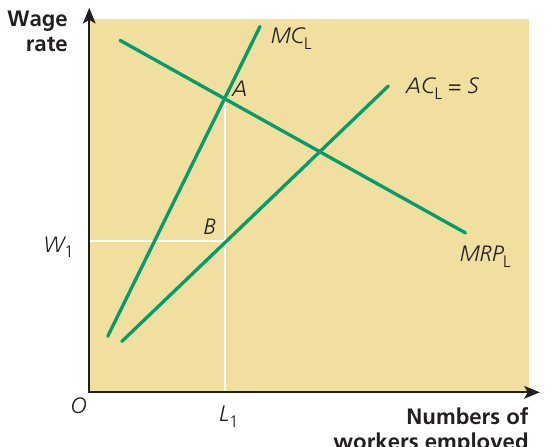
Figure 6.9 demonstrates the determination of both the equilibrium wage rate and the level of employment in a monopsony labour market. The key points are:
- Employment level: Determined at point A, where . This occurs at workers.
- Wage rate: Determined at point B on the supply curve (ACL), below point A. The wage rate is the minimum amount the monopsony needs to pay to attract workers.
Important
The Wage-Setting Power of Monopsony
The crucial insight is that the wage rate () is lower than the marginal revenue product of labour at point A. The monopsony could afford to pay a higher wage (up to the MRPL level), but it has no incentive to do so. Why pay more when is sufficient to attract all the workers the firm wants to hire?
If the monopsony were to pay a wage higher than , it would incur unnecessary production costs and fail to maximise profits when selling its output. Profit maximisation requires employing workers at wage rate .
Comparison with perfect competition
In a perfectly competitive labour market, the wage rate would be determined where labour supply equals labour demand, resulting in both a higher wage and higher employment than in a monopsony market. The monopsony's ability to pay lower wages represents its market power over workers.
Real-world application: recession, recovery and the UK jobs market

The construction equipment manufacturer JCB provides an illuminating example of how labour markets respond to economic changes and how firms with monopsony power behave during different economic conditions.
During the recession (2008): When the UK economy entered recession in 2008 following the financial crisis that began in 2007, JCB faced declining demand for its construction plant and machinery. Many UK companies, including JCB, began laying off workers. Workers who retained their jobs feared further redundancies. To prevent additional job losses, union members at JCB offered to accept lower wages. However, wage reductions proved ineffective in preventing further redundancies. In fact, JCB laid off even more workers as demand for bulldozers and other construction equipment continued to fall.
During the recovery (by 2018): As the UK economy recovered from recession, JCB began creating jobs again. In June 2018, the company announced an investment of more than £50 million in a new British plant, expected to create hundreds of jobs. However, the nature of employment changed. Many workers JCB hires are now agency workers who lack guaranteed continuous employment. Despite this, JCB maintains that most of its full-time employees entered through temporary work arrangements and subsequently proved their worth.
Recent developments: With an improving economy, JCB has invested in its training academy and recently created 100 jobs for teenage apprentices. However, the company is also creating far more jobs by investing in factories in Brazil and India. As a company spokesperson stated, "Growth for JCB anywhere is good for JCB and a significant number of the machines are still made here in the UK and shipped around the world."
Note
Key Insights from the JCB Case Study
This case study demonstrates several important labour market principles:
- Companies that produce capital goods are especially vulnerable to changes in demand for their machinery
- The globalisation process has made labour markets increasingly flexible and international
- Employment patterns have shifted toward more flexible arrangements with less job security
- Economic recovery doesn't always restore the same types of jobs that existed before a recession
Reasons for wage differences in imperfectly competitive labour markets
In imperfectly competitive labour markets, substantial wage differences often exist between different markets and occupations. Five main factors contribute to these wage differences:
1. Disequilibrium trading
Labour markets, like other markets, are subject to constant change. New goods and services emerge, production methods improve through technical progress, and patterns of demand shift continuously. These dynamic conditions mean that labour markets are usually in a state of disequilibrium rather than equilibrium.
Although market forces tend to push wages towards equilibrium levels in competitive labour markets, disparities persist at any given time. These disparities reflect the disequilibrium conditions that currently exist in the market. The continuous nature of economic change means that by the time one set of wage differences begins to disappear, new changes have occurred creating fresh disparities.
2. Imperfect market information
Imperfectly competitive labour markets are characterised by incomplete or inaccurate information available to both workers and employers. This imperfect information takes several forms:
-
Workers' lack of information: Workers may not know the wage rates being offered in other labour markets or even within their own industry. This ignorance prevents them from making fully informed decisions about where to sell their labour services.
-
Employers' lack of information: Similarly, employers may lack complete information about wage rates in other labour markets and sometimes even within their own industries. This information gap affects their wage-setting decisions.
-
Contribution to immobility: Imperfect market information contributes significantly to labour immobility. When workers don't know about better opportunities elsewhere, they are less likely to move between jobs or labour markets.
3. Occupational immobility of labour
Occupational immobility of labour occurs when workers are prevented from moving between different types of jobs, either by natural or artificial barriers.
Note
Natural Barriers to Occupational Mobility
Natural barriers include differences in natural ability that may prevent or restrict movement between certain occupations. Workers who lack particular skills, talents, or physical capabilities cannot easily transition to jobs requiring those attributes.
Artificial or 'man-made' barriers prevent workers from moving between labour markets and include:
-
Professional body membership requirements: Many professions require membership in specific professional bodies (such as accountancy associations), which impose qualification standards and membership criteria that restrict entry.
-
Trade union restrictive practices: Historically, some trade unions operated 'closed shops', which restricted employment to union members only. Non-members found it difficult or impossible to join the union, creating a significant barrier to entry. While such practices are now illegal in the UK, they illustrate how artificial barriers can restrict labour mobility.
4. Geographical immobility of labour
Geographical immobility of labour occurs when factors prevent workers from moving between different geographical areas in search of employment. Several factors contribute to this immobility:
-
Ignorance of job opportunities: Workers may simply not know about job vacancies in other regions.
-
Family and cultural ties: Strong family connections and cultural attachments to an area make workers reluctant to relocate.
-
Financial costs: The expenses associated with moving house or traveling long distances to work can be prohibitive, especially for lower-paid workers.
Important
The Housing Market and Geographical Immobility
Perhaps the most significant cause of geographical immobility in the UK in recent years has been the state of the housing market. During house price booms:
- Low-paid and unemployed workers in regions with lower house prices (typically northern areas of the UK) found it difficult or impossible to move south to fill job vacancies in more prosperous areas like southeast England
- The high prices of owner-occupied housing and limited availability of affordable rental accommodation created major barriers to mobility
- Workers living in their own homes in the southeast became reluctant to apply for jobs elsewhere in the country, fearing they will never be able to afford to return if they sell their homes and move away
5. Discrimination
Various forms of discrimination affect both the demand for and supply of labour in imperfectly competitive markets. Racial, religious, age, and gender discrimination can all contribute to wage differences and employment disparities. These discriminatory practices create artificial differences in labour market outcomes that cannot be explained by differences in productivity or skills alone.
The influence of trade unions in determining wages and levels of employment
A trade union is an association or group of workers who join together to protect and promote their interests. The main function of a trade union is to bargain with employers to improve wages and other conditions of employment, including working hours, health and safety standards, and job security.
The role of trade unions
In economic analysis, we can regard a trade union as a monopoly supplier of labour. The union aims to:
- Keep non-members out of the labour market
- Prevent its members from supplying labour below a certain wage rate (the union wage rate)
Of course, in reality, a trade union may not necessarily achieve the objectives specified above, and even when it does, it may not be able to maintain them over time.
Collective bargaining
In labour markets where trade unions are strong and possess significant bargaining power, wage rates are typically determined through a process known as collective bargaining. This term describes a situation in which unions bargain with employers on behalf of their members, negotiating wages and working conditions collectively rather than individually.
Note
Forms of Collective Bargaining
The collective bargaining process can take different forms:
- Single employer bargaining: Sometimes unions negotiate with a single employer
- Multi-employer bargaining: On other occasions, unions may bargain with several employers simultaneously within a particular labour market
Through the collective bargaining process, unions and employers negotiate the wage rate. Once agreed upon through this process, employers then decide how many workers to employ at the negotiated wage rate.
This represents a significant departure from the purely competitive model where individual workers and employers determine wages through market forces alone.
The presence of strong trade unions with substantial bargaining power can lead to higher wages than would exist in their absence, though this may sometimes result in lower employment levels if employers respond to higher wage costs by reducing their workforce.
Summary
Key Points to Remember:
-
Monopsony refers to a market with a single buyer of labour, though pure monopsonies are rare in practice.
-
Monopsony power is more common and occurs when dominant employers can influence wages even when they're not the only employer.
-
In monopsony markets, wages are lower and employment is lower than in perfectly competitive markets because the employer sets wages where , but pays only the wage shown on the supply curve.
-
The MCL curve lies above the ACL curve in monopsony markets because hiring an extra worker requires raising wages for all existing workers.
-
Five key reasons explain wage differences in imperfectly competitive markets: disequilibrium trading, imperfect information, occupational immobility, geographical immobility, and discrimination.
-
Trade unions act as monopoly suppliers of labour, using collective bargaining to negotiate higher wages and better conditions for their members.