Centres of Mass and Stability (AQA A-Level Further Maths): Revision Notes
📚Revision Notes
Further Topics with Centres of Mass
Centre of mass of a uniform lamina using integration
Definition: A lamina is a thin, flat plate with uniform density. For continuous shapes, we use integration to find the centre of mass rather than treating the object as discrete particles.
Understanding the method
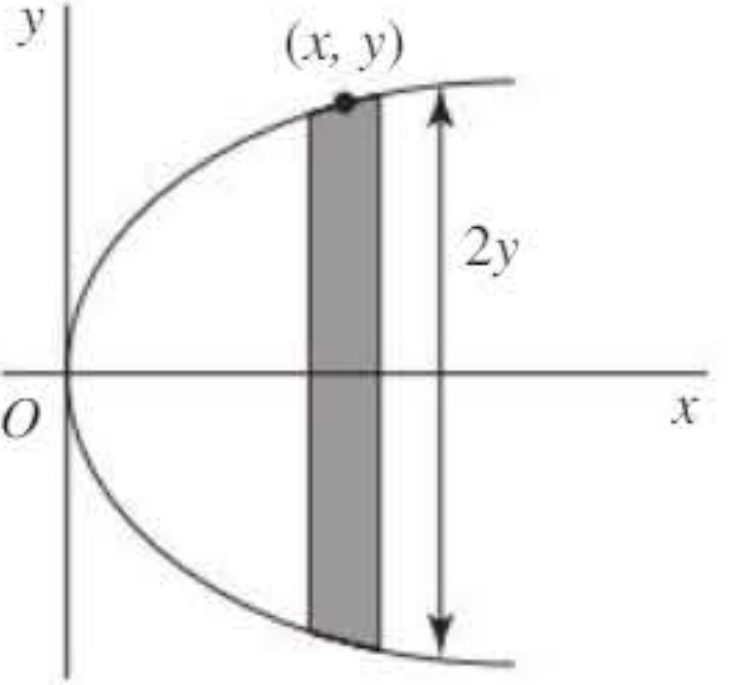
When calculating the centre of mass of a lamina bounded by a curve, we divide the shape into thin vertical strips. Each strip has:
- Width (a small increment in the x-direction)
- Height (determined by the curve equation)
- Mass (where is the area density)
- Centre of mass at
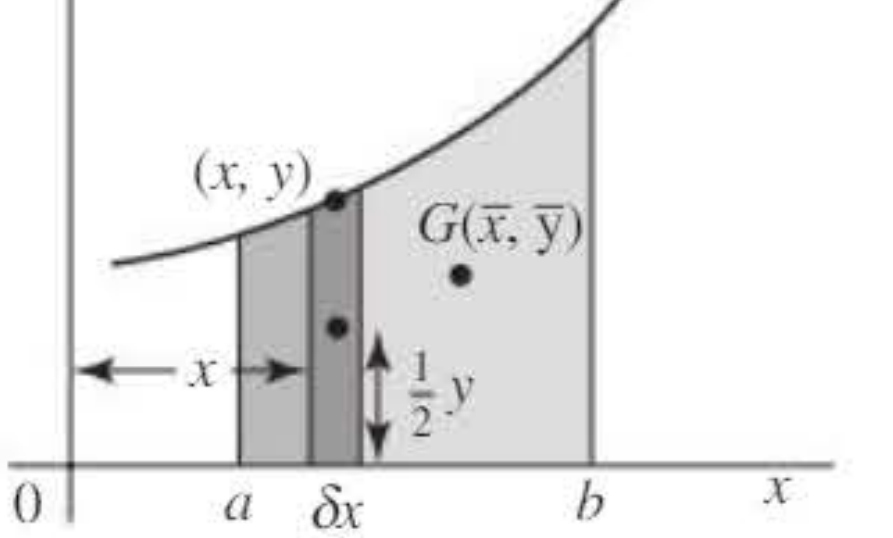
Note
As we make smaller and increase the number of strips, the summation of moments becomes more accurate. In the limit as , these summations become definite integrals. This is the fundamental principle behind using calculus to find centres of mass.
Key formulas for uniform laminae
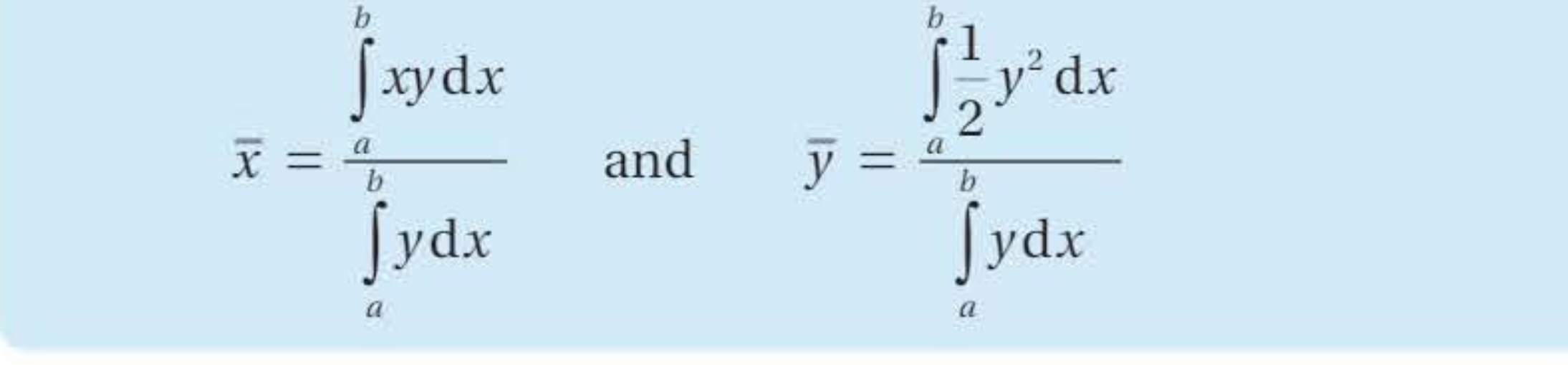
For a uniform lamina bounded by the curve , the x-axis, and the vertical lines and , the centre of mass is given by:
Important
Understanding the formulas:
- The denominator represents the total area of the lamina
- The numerator of uses (x-coordinate times height)
- The numerator of uses (half the square of the height)
- These formulas can be quoted directly from the formula booklet in the exam
Note
Exam tip: You have a choice in the exam - either quote these formulas directly from the formula booklet, or derive them from first principles by taking moments. Both approaches are valid and will earn full marks.
Example
Worked Example 1: Lamina under a hyperbolic curve
Question: Find the centre of mass, , of the lamina formed from the area under the curve for .
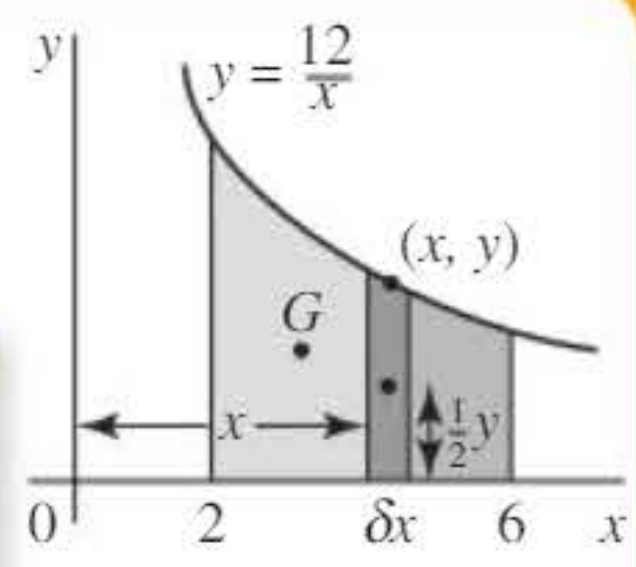
Solution:
Let the area density be and let be at the point .
Step 1: Calculate the total mass .
The total mass equals density times area:
Step 2: Take moments about the y-axis to find .
Therefore:
Step 3: Take moments about the x-axis to find .
Therefore:
Answer: The centre of mass, , is at the point (3.64, 1.82).
Key observation: Notice how cancels out in both calculations. This always happens for uniform laminae, so you can sometimes work without explicitly including .
Centre of mass of a solid of revolution
Understanding the method
When a region is rotated through (or radians) about the x-axis, it creates a three-dimensional solid. To find the centre of mass, we divide the solid into thin circular discs perpendicular to the x-axis.
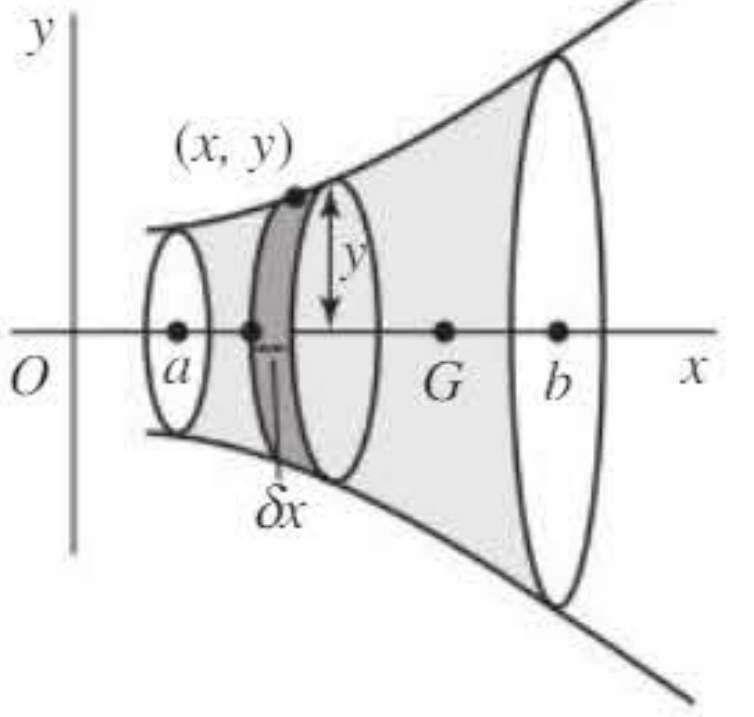
Each disc has:
- Thickness
- Radius (from the curve equation)
- Volume
- Mass (where is the volume density)
- Centre of mass at on the x-axis
Key formulas for solids of revolution
For a uniform solid of revolution formed by rotating the area between the curve , the x-axis, and the lines and through about the x-axis, the centre of mass is given by:
and
Important
Key differences from laminae:
- The denominator is proportional to the total volume
- The formula for uses xy² (not as in the lamina case)
- By symmetry, always (the centre of mass lies on the axis of rotation)
- These formulas are available in the formula booklet
Example
Worked Example 2: Solid of revolution
Question: Find the centre of mass, , of the solid of revolution formed by rotating the area under the curve for through radians about the x-axis. Give an exact answer.
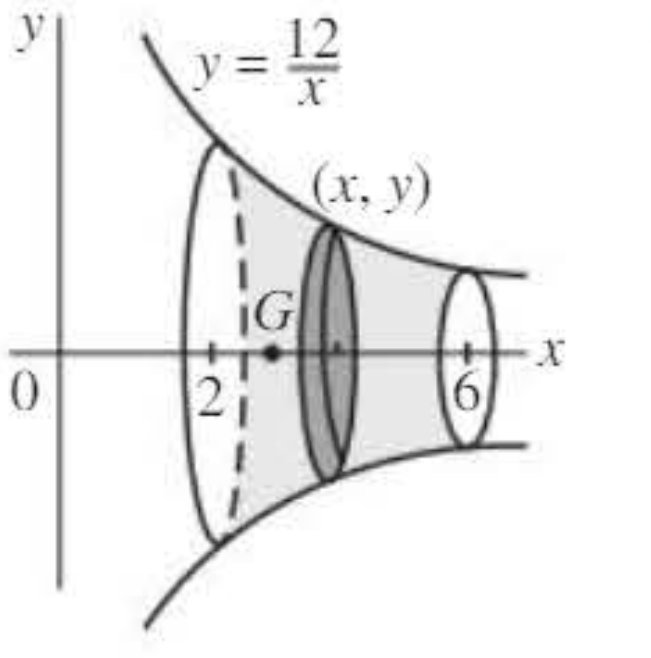
Solution:
Let the volume density be and let be at the point .
Step 1: Calculate the total mass .
Step 2: Take moments about the y-axis to find .
Therefore:
Step 3: Use symmetry to find .
By symmetry about the x-axis, .
Answer: The solid's centre of mass, , is at the point (3ln 3, 0).
Time-saving tip: Always state that by symmetry for solids of revolution around the x-axis. This saves calculation time in the exam.
Special cases
Some laminae have different symmetry properties that affect the calculation method.
Note
If a lamina is symmetrical about the x-axis (not just touching it), the x-axis is not necessarily a boundary. In such cases:
- Vertical strips have length
- You must take moments about the y-axis only
- By symmetry,
This is different from the standard case where the lamina is bounded by the x-axis.
Equilibrium and suspension
Key principle for suspended objects
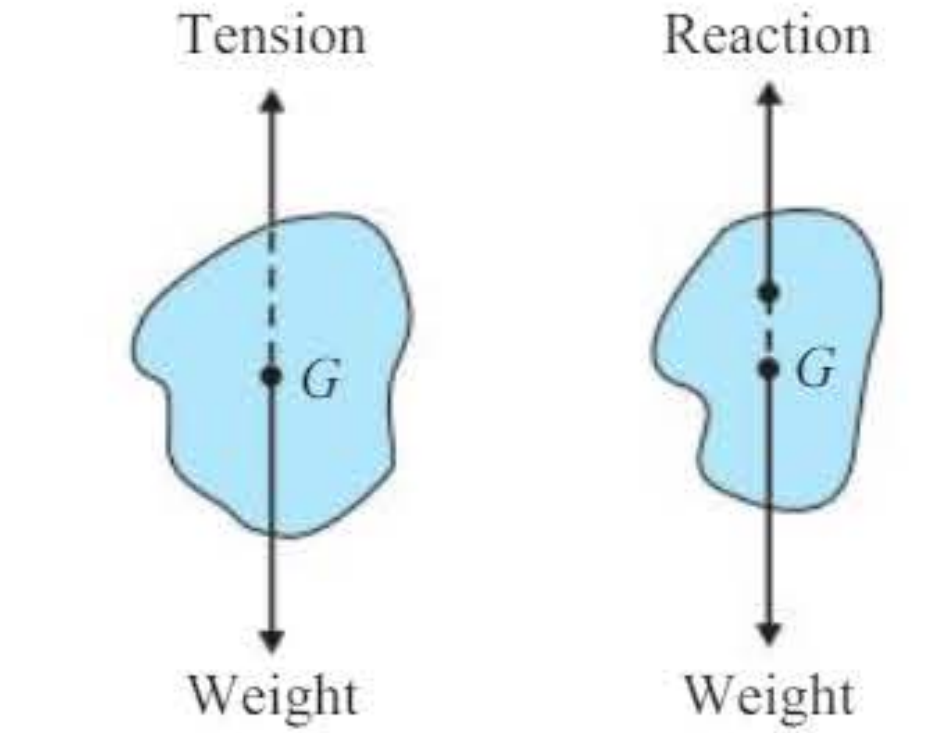
When a lamina or solid is freely suspended (hung) and in equilibrium, only two forces act on it:
- The weight acting downwards at the centre of mass
- Either the tension in the string (if suspended) or the reaction force at the support point (if resting)
Important
Fundamental equilibrium principle:
When a lamina or solid is freely suspended in equilibrium, its centre of mass is vertically below its point of suspension.
If the forces were not in the same vertical line, there would be a couple (turning moment) that would cause the object to rotate until the centre of mass moves directly below the suspension point. This is why objects naturally hang with their centre of mass directly below the support.
Example
Worked Example 3: Suspended semicircular lamina
Question: A uniform semicircular lamina of centre with diameter is suspended from and hangs freely. Calculate the angle that makes with the vertical.
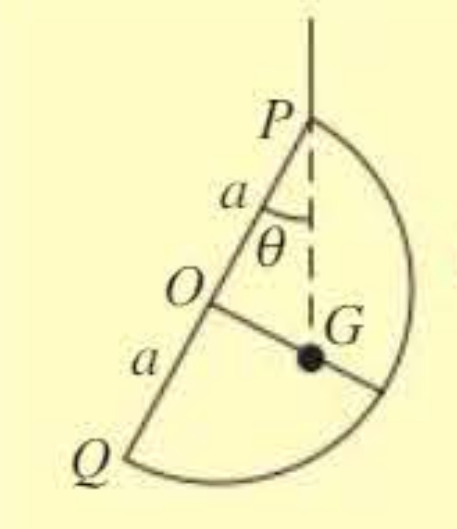
Solution:
Step 1: Draw a diagram with vertical.
This is essential because in equilibrium, the centre of mass must hang vertically below the suspension point .
Step 2: Quote the standard formula for a semicircular lamina.
For a semicircle lamina:
where is the angle of the full arc (in radians).
For a semicircle, radians, so:
Step 3: Calculate the angle.
In triangle :
- (radius)
- is vertical
Therefore:
Answer: The angle of to the vertical is θ = 23.0°.
Important note: The formula for the centre of mass of standard shapes (semicircle, hemisphere, cone, etc.) is given in the formula booklet. Always draw a clear diagram showing the vertical line through the suspension point.
Summary
Key Points to Remember:
-
For a uniform lamina, the centre of mass coordinates are:
-
For a solid of revolution about the x-axis:
-
When dividing into strips:
- Use mass for laminae
- Use mass for solids of revolution
-
For suspended objects in equilibrium: the centre of mass always lies vertically below the point of suspension
-
You can either quote formulas from the formula booklet or derive them from first principles by taking moments—both methods are acceptable in exams