Moments and Couples (AQA A-Level Further Maths): Revision Notes
📚Revision Notes
Moments and Couples
What is a moment?
A moment measures the turning effect that a force produces about a fixed point. When you push a door to open it, you create a moment about the hinges. The size of this turning effect depends on two things: how hard you push (the force) and how far from the hinge you push (the perpendicular distance).
The fixed point about which rotation occurs is called a pivot. A moment is sometimes also called a torque.
Note
Understanding the concept: Think of opening a door - pushing near the edge (far from the hinges) makes it much easier to open than pushing near the hinges. This everyday experience demonstrates how the perpendicular distance affects the moment.
Definition: The moment of a force about a point is given by:
where is the perpendicular distance from the point to the line of action of the force.
The perpendicular distance means the shortest distance measured at right angles (90°) from the pivot point to the line along which the force acts.
Direction of moments
Moments can cause rotation in two directions:
- Anticlockwise moments are taken as positive (+)
- Clockwise moments are taken as negative (−)
Important
Sign Convention: This sign convention is crucial when calculating resultant moments in equilibrium problems. Always state your convention clearly at the start of your solution, and be consistent throughout.
Units of moments
Moments are measured in Newton metres (Nm). Although this is the same unit as work (Joules), moments and work represent different physical quantities. While work can be measured in either Nm or J, moments are always expressed as Nm.
Note
Why not Joules? Even though Nm and Joules have the same dimensions, they represent fundamentally different quantities. Work involves movement along the direction of force, while moments involve turning effects. Using Nm for moments helps maintain this important distinction.
Resultant moments
When several forces act on an object simultaneously, each force produces its own turning effect. The total turning effect is found by adding all the individual moments together.
Key principle: The resultant moment of several forces equals the sum of the moments of the individual forces, taking into account their directions (clockwise or anticlockwise).
To find the resultant moment:
- Calculate the moment of each force about the chosen point
- Assign positive signs to anticlockwise moments and negative signs to clockwise moments
- Add all the moments algebraically
Rotational equilibrium
An object that can rotate about a fixed point is in rotational equilibrium when the total moment acting on it is zero. This means the clockwise moments exactly balance the anticlockwise moments.
Important
Equilibrium condition: If a system of forces is in equilibrium, the resultant moment about any point is zero.
Mathematically: or Clockwise moments = Anticlockwise moments
This principle is powerful because when a system is in equilibrium, you can calculate moments about any convenient point to find unknown forces or distances.
Worked example 1: Rectangular lamina with three forces
Example
Worked Example: Calculating Resultant Moment
Problem: A light rectangular lamina can rotate about point . Find the resultant moment of three forces about : 6 N acting upwards at distance 5 m, 7 N acting horizontally at the top, and 8 N acting downwards at distance 3 m from .
Solution:
Taking anticlockwise as positive:
The resultant moment is 6 Nm anticlockwise.
Note: The 7 N force passes through point , so it produces zero moment about (perpendicular distance = 0).
Couples
Sometimes two forces work together to create a turning effect without causing any overall translation (movement in a straight line). This special arrangement is called a couple.
Definition: A couple comprises two equal and opposite forces which do not act in the same straight line.
Note
Examples of couples in everyday life:
- Unscrewing a bottle top (your hands apply two opposite forces)
- Turning a steering wheel
- Using a screwdriver
- Turning a doorknob
In each case, two equal and opposite forces create a pure turning effect without moving the object in any direction.
Moment of a couple
The moment of a couple has a unique property: it is the same regardless of which point you calculate it about.
Formula: The moment of a couple equals:
where:
- is the magnitude of each force
- is the perpendicular distance between the two forces
Important
This independence from the reference point makes couples particularly useful in mechanics problems. You can choose any convenient point for calculations and get the same answer.
Worked example 2: Cantilever beam equilibrium
Example
Worked Example: Equilibrium of a Cantilever Beam
Problem: A cantilever is formed by clamping a uniform horizontal beam at . The beam is 4 m long, weighs 20 N, and has a load of 15 N hanging vertically at . Find the force and couple that must act at to keep the beam in equilibrium.
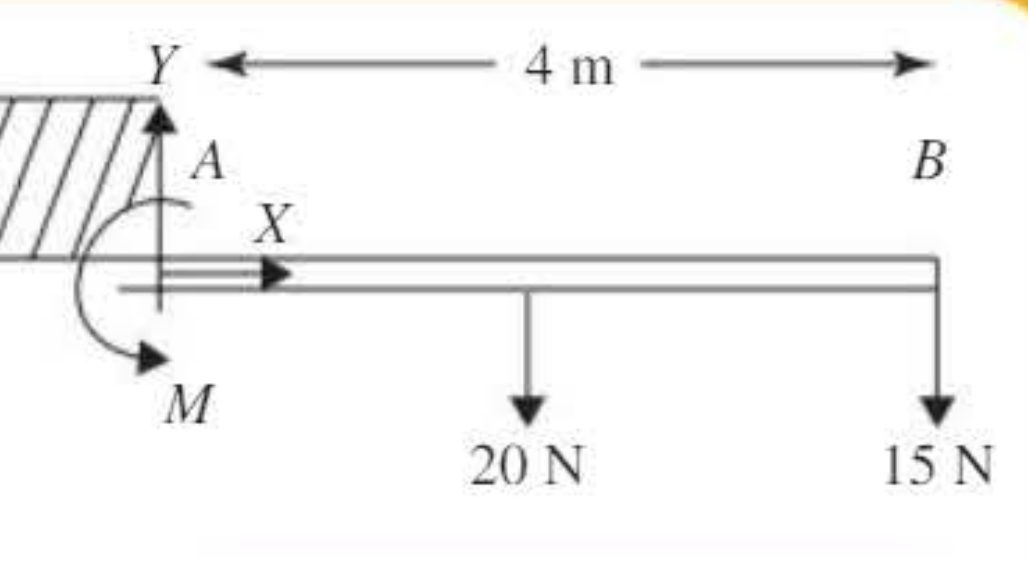
Solution:
Let the force at have components and , and let the couple at have moment .
Step 1: Resolve horizontally
No horizontal forces act, so .
Step 2: Resolve vertically
The upward force must balance the two downward forces.
Step 3: Take moments about A
Taking anticlockwise as positive:
Answer: The force at is 35 N upwards and the couple at is 100 Nm anticlockwise.
Physical interpretation: The components of the force at prevent translation (movement), while the couple prevents rotation. In equilibrium, you need both a balance of forces and a balance of moments.
Calculating moments of forces at angles
When a force acts at an angle (not perpendicular to the beam or rod), you can use one of two methods to calculate its moment.
Method 1: Resolve the force into components
Resolve the force into two perpendicular components, then calculate the moment of each component separately.
For a force at angle :
- Component along the line:
- Component perpendicular to the line:
Method 2: Use perpendicular distance from line of action
Draw the line of action of the force and find the perpendicular distance from the pivot to this line.
where is the perpendicular distance from the pivot to the line of action.
Note
Key insight: Both methods give the same result:
Choose whichever method seems more natural for the problem at hand. Method 1 is often easier when the geometry is simple, while Method 2 can be more elegant when you can easily visualize the perpendicular distance.
Worked example 3: Force at an angle to a rod
Example
Worked Example: Moment of an Angled Force
Problem: A force of 10 N acts at end of a light rod of length , making an angle with the rod. If m and , find the moment of about .
Solution using Method 1:
Resolve into components parallel and perpendicular to :
Solution using Method 2:
Find perpendicular distance from to line of action of :
Both methods confirm the moment is 15 Nm anticlockwise.
Worked example 4: Square lamina in equilibrium
Example
Worked Example: Equilibrium of a Square Lamina
Problem: A light square lamina of side 10 cm can rotate about point . Three forces act on it: acting horizontally at , 2 N acting downwards at , and N acting at 45° at . Find the magnitude of force for the lamina to be in equilibrium.
Solution:
First, find the diagonal length: In , , so cm.
Taking moments about point for equilibrium:
Anticlockwise moments = Clockwise moments
Alternative approach: Set total moment about equal to zero:
Therefore, 12 N.
Exam tip: The reaction at point doesn't appear in the moment equation because moments are taken about . This is a strategic choice that simplifies the calculation. You still need to check force balance separately.
Problem-solving strategy
When solving problems involving moments and couples, follow this systematic approach:
Step 1: Draw a clear diagram showing all forces and distances
Step 2: Choose a convenient point to take moments about (often the pivot or a point where unknown forces act, as these forces will have zero moment about that point)
Step 3: Establish a sign convention (typically anticlockwise = positive)
Step 4: Calculate the moment of each force using
- For forces at angles, choose either component method or perpendicular distance method
- Remember that forces passing through the chosen point have zero moment
Step 5: Apply equilibrium condition: Sum of anticlockwise moments = Sum of clockwise moments
Step 6: Solve for unknown quantities
Step 7: Check your answer makes physical sense
Important
Strategic thinking: The choice of which point to take moments about can make the difference between a simple calculation and a complex one. Always look for points where unknown forces act - this eliminates them from your moment equation.
Exam tips and common pitfalls
Important
Choosing the reference point wisely:
When taking moments, choose a point where unknown forces act. This eliminates those forces from your moment equation, making calculations simpler.
Important
Perpendicular distance is crucial:
Always use the perpendicular (shortest) distance from the point to the line of action of the force. This is the most common error in moment calculations. If in doubt, draw the line of action of the force and measure the perpendicular distance from your reference point to this line.
Note
Sign conventions matter:
Be consistent with your sign convention throughout a problem. State clearly whether you're taking clockwise or anticlockwise as positive at the start of your solution.
Note
Couples are special:
Remember that the moment of a couple is independent of the point chosen. Use this property to simplify problems - you can calculate the moment about any convenient point.
Important
Units check:
Moments are always in Nm, not Joules, even though the dimensions are the same. This distinction is important for clarity and avoiding confusion.
Note
Forces through the pivot:
Any force passing through the pivot point produces zero moment about that point. This is a powerful simplification - choose your pivot wisely to eliminate unknown forces from your calculations.
Remember!
Summary
Key Points to Remember:
-
Moment = Force × Perpendicular distance: The turning effect depends on both how hard you push and where you push from
-
Equilibrium means zero total moment: When clockwise moments equal anticlockwise moments, there's no net rotation
-
Couples are independent: The moment of a couple () has the same value regardless of which point you calculate it about
-
Choose your point strategically: Taking moments about a point where unknown forces act simplifies calculations significantly
-
Two methods for angled forces: You can either resolve into components or use perpendicular distance – both give