Horizontal Circular Motion (AQA A-Level Further Maths): Revision Notes
📚Revision Notes
Horizontal Circular Motion
What is horizontal circular motion?
When an object moves in a circular path within a horizontal plane, the centripetal force acting on it must also be horizontal. This is a key principle that distinguishes horizontal circular motion from other types of circular motion.
Note
The force of gravity acts vertically downward. Since it acts perpendicular to the horizontal plane of motion, gravity does not contribute to the centripetal force in horizontal circular motion. The vertical component of any reaction force balances the weight, whilst the horizontal forces provide the centripetal acceleration.
Essential formulas for horizontal circular motion
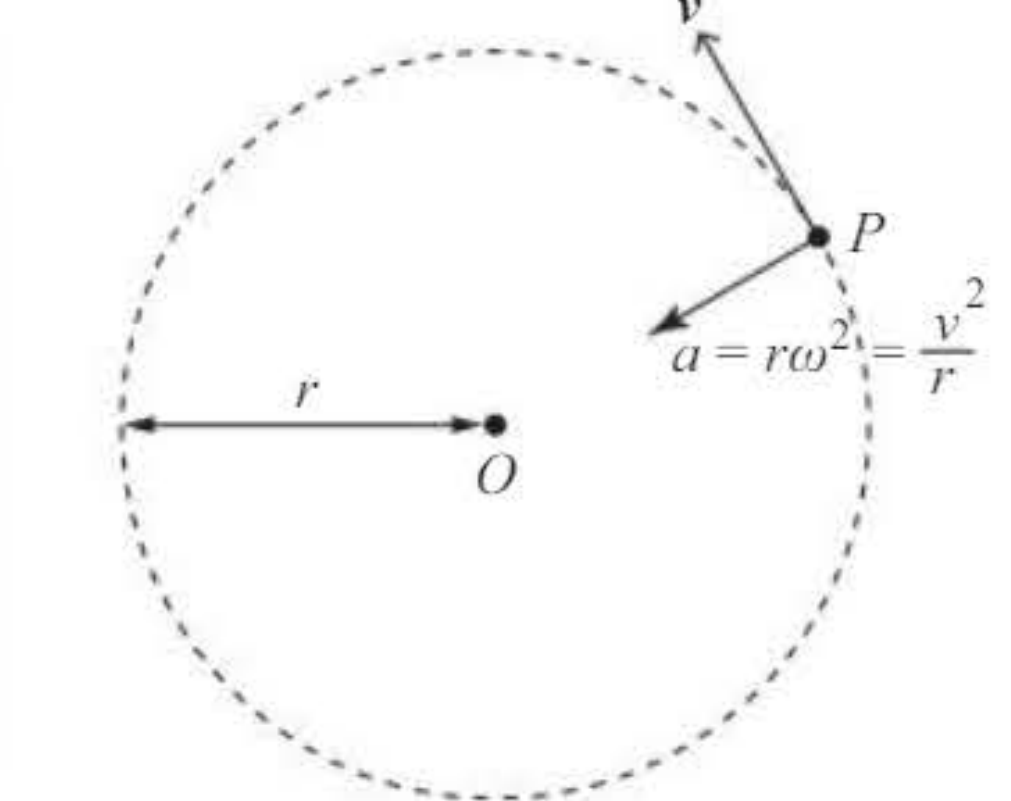
For a body travelling on a circular path of radius with constant angular velocity around a centre point, three fundamental relationships govern the motion:
1. Linear speed: The object moves with a constant speed given by:
This speed is directed along the tangent to the circular path at any point.
2. Centripetal acceleration: The object experiences an acceleration directed towards the centre of:
3. Centripetal force: Using Newton's second law, the force required to maintain circular motion is:
where is the mass of the object.
Note
Key point: These three equations are interconnected. You can use whichever form is most convenient for the given information in a problem. Notice that the centripetal force can be expressed in terms of either angular velocity () or linear velocity ().
Worked example 1: Maximum speed of a car on a bend
Example
Worked Example: Finding Maximum Speed on a Horizontal Bend
Question: Calculate the maximum speed (in km h⁻¹) for a car of mass 900 kg to round a bend of radius 60 m on a level road.
Part (a): Using maximum frictional force
Given: The maximum frictional force between the tyres and road is 1440 N.
Solution:
Let be the maximum speed of the car.
At maximum speed, we need to use the horizontal equation of motion. The friction force provides the centripetal force needed for circular motion:
Substituting the known values:
Rearranging:
Taking the square root:
The normal reaction force from the ground acts vertically and therefore does not contribute to the centripetal force.
Part (b): Using coefficient of friction
Given: The coefficient of friction between the car's tyres and the road is . Take m s⁻².
Solution:
Let the maximum speed of the car be .
Step 1: Resolve vertically
The vertical forces must balance:
Step 2: Write horizontal equation of motion
The horizontal force provides the centripetal acceleration:
Step 3: Apply friction inequality
The frictional force cannot exceed :
Substituting from equations (1) and (2):
Simplifying (mass cancels):
Therefore, the maximum speed without skidding is:
Important
Exam tip: Always write equations for both vertical and horizontal forces separately. Remember that the coefficient of friction is an A Level topic, and you must use the inequality when it's involved. The key insight is that vertical resolution gives you R, which you then use in the friction inequality.
Problem-solving strategy for horizontal circular motion
When solving problems involving motion in a horizontal circle, follow this systematic approach to ensure you capture all the relevant physics:
Note
Three-Step Strategy for Horizontal Circular Motion:
Step 1: Draw a clear diagram
- Show all forces acting on the moving object
- Include the centripetal force direction (towards the centre)
- Mark the radius and any angles clearly
Step 2: Identify centripetal force contributors
- Decide which forces contribute to the centripetal force
- Write an equation for motion towards the centre of the circle
- Remember: vertical forces like gravity don't contribute
Step 3: Write additional equations
- Form any other necessary equations (such as vertical force resolution, Hooke's Law, friction inequalities)
- Solve them simultaneously with your equation of motion
- Check units and reasonableness of your answer
The key to success is being systematic: always resolve forces in both directions, identify what provides the centripetal force, and then combine all your equations to solve.
Worked example 2: Rotating beam with elastic string
Example
Worked Example: Combining Circular Motion with Hooke's Law
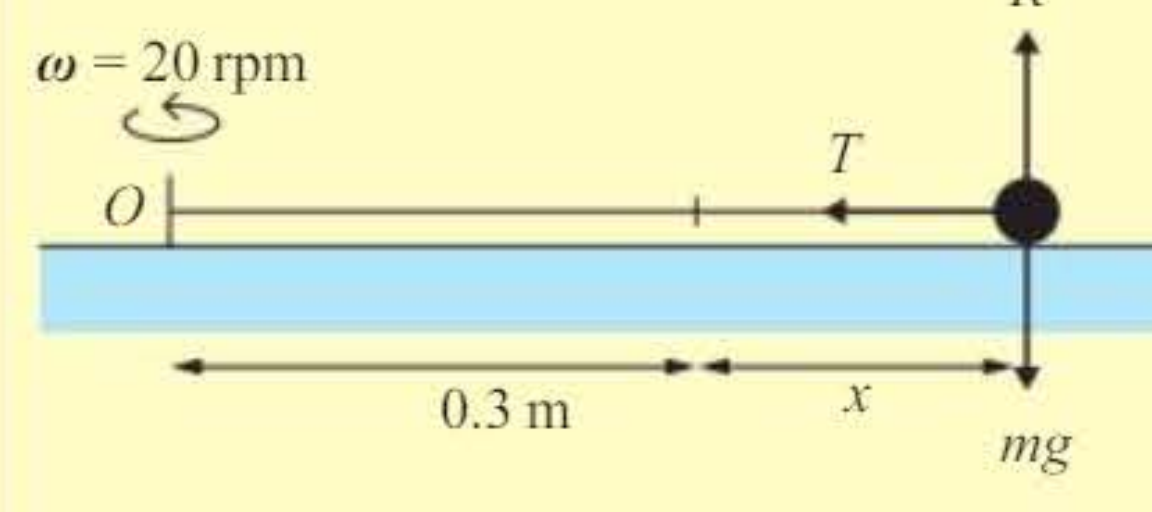
Question: A particle of mass is tied to a fixed point on a smooth horizontal table by an elastic string. The string has natural length 0.3 m and modulus of elasticity . The particle moves at a constant angular speed of 20 rpm about point . Calculate the extension of the string. Take m s⁻².
Solution:
Let the tension in the string be N and let the extension be m.
Step 1: Write equation of motion towards centre
The angular velocity is:
The radius of circular motion is m (natural length plus extension).
Using the centripetal force equation:
Step 2: Apply Hooke's Law
For an elastic string:
Substituting :
Step 3: Solve simultaneously
Equating equations (1) and (2):
Simplifying (mass cancels):
Expanding and rearranging:
The extension is:
The vertical forces (reaction upward and weight downward) balance each other and do not contribute to the horizontal centripetal force. Only the tension in the string provides the centripetal force.
Note
This problem demonstrates the power of combining different areas of mechanics. The tension in the elastic string serves a dual purpose: it provides the centripetal force for circular motion AND it satisfies Hooke's Law for the elastic extension. By setting up both equations and solving simultaneously, we can find the unknown extension.
Remember!
Summary
Key Points to Remember:
-
In horizontal circular motion, the centripetal force is horizontal and gravity does not contribute to it since it acts vertically
-
The three key equations are interconnected:
- (relating linear and angular speed)
- (centripetal acceleration)
- (centripetal force)
-
Always resolve forces in both vertical and horizontal directions separately. Vertical forces balance each other, whilst horizontal forces provide the centripetal force
-
For friction problems, use the inequality where is the coefficient of friction and is the normal reaction force. Remember to find first by resolving vertically
-
When combining circular motion with Hooke's Law, set up equations for both the centripetal force and the elastic force, then solve simultaneously
-
The systematic three-step approach (draw diagram, identify centripetal force, write additional equations) works for all horizontal circular motion problems