Circular Motion 2 (AQA A-Level Further Maths): Revision Notes
📚Revision Notes
The Conical Pendulum
Introduction
A conical pendulum is a system in which a bob moves in a circular path on a horizontal plane while attached to a fixed point above by a string. Unlike an ordinary pendulum that swings back and forth in a vertical plane, the bob in a conical pendulum travels continuously in a horizontal circle at constant speed. As the bob rotates, the string sweeps out the shape of a hollow cone with its apex at the fixed point.
Note
The key difference from an ordinary pendulum is the type of motion: instead of oscillating back and forth in a vertical plane, the conical pendulum maintains continuous circular motion in a horizontal plane. This is why it's called "conical" - the string literally traces out a cone shape in space.
This type of motion combines circular motion principles with force resolution. The bob experiences two main forces: the weight acting vertically downward and the tension in the string acting along the string towards the fixed point. Understanding conical pendulums requires careful analysis of both vertical equilibrium and horizontal circular motion.
Key concepts and geometry
In a conical pendulum system, several geometric and physical parameters are important:
String length (l): The distance from the fixed point to the bob, measured along the string. This remains constant as the string is inextensible.
Angle (θ): The angle the string makes with the vertical. This angle determines the shape of the cone and remains constant during uniform circular motion.
Radius (r): The horizontal distance from the bob to the vertical line through the fixed point. This is the radius of the circular path the bob follows.
Height (h): The vertical distance from the fixed point to the plane of circular motion.
Note
Geometric Relationships
These quantities are related by trigonometry. If the fixed point is O, the centre of the circular path is C (directly below O), and the bob is at P, then:
- The horizontal radius:
- The vertical height:
- Using Pythagoras:
Always draw a clear diagram to identify these relationships before attempting calculations.
Forces in a conical pendulum
Two forces act on the bob:
-
Weight (W = mg): Acts vertically downward with magnitude equal to the mass times gravitational acceleration.
-
Tension (T): Acts along the string towards the fixed point. This force has both vertical and horizontal components when resolved.
The tension can be resolved into:
- Vertical component: (acts upward along the vertical)
- Horizontal component: (acts horizontally towards the centre of the circle)
Important
Force Resolution - Critical Concept
For the bob to maintain circular motion at constant speed, these forces must satisfy two conditions:
- Vertical equilibrium - no acceleration in the vertical direction
- Centripetal force equation - acceleration towards the centre of the circle
Remember: is for the horizontal component (circular motion), and is for the vertical component (equilibrium).
Equations of motion
Vertical equilibrium
Since the bob moves in a horizontal plane, there is no vertical acceleration. The vertical forces must balance:
This equation allows us to find the tension if we know the mass, angle, and gravitational acceleration. Alternatively, it can help us determine the angle if we know the tension.
Horizontal equation of motion
The horizontal component of tension provides the centripetal force needed for circular motion. Applying Newton's second law horizontally towards the centre:
where:
- is the mass of the bob
- is the radius of the circular path
- is the angular speed in radians per second
Since , we can also write:
Simplifying:
Important
Core Equations for Conical Pendulum
The two fundamental equations that govern all conical pendulum problems are:
Every problem will use these equations in some form. Master them, and you master conical pendulums!
Period and angular speed
The period (T) is the time taken for one complete revolution. It relates to angular speed by:
where radians represents one complete revolution.
Worked example 1: Basic conical pendulum
Example
Worked Example: Finding Tension, Angular Speed, and Period
Problem: A conical pendulum has a bob P of mass 2 kg hanging at the lower end of a light, inextensible string of length 2 m. The upper end of the string is fixed to a point O. The bob moves in a horizontal circle with centre C and radius 1.2 m at constant speed. Find the tension in the string, the angular speed of the bob, and the time taken for one revolution.
Solution:
Step 1: Find the vertical height using geometry.
In triangle OPC, we can use Pythagoras' theorem:
Step 2: Resolve forces vertically.
The bob is in vertical equilibrium, so:
where
Therefore:
The tension in the string is 24.5 N.
Step 3: Apply the horizontal equation of motion.
The horizontal component provides centripetal force:
where
The angular speed is 2.47 rad s⁻¹.
Step 4: Calculate the period.
The time taken is 2.5 seconds.
Worked example 2: Particle at string midpoint
Example
Worked Example: Minimum Angular Velocity with String Constraint
Problem: A 0.5 kg mass P is tied to the midpoint of a 2 m string XY, where X is m vertically above Y. The mass P rotates in a horizontal circle so that the string remains taut. Find the least possible angular velocity of P. Take m s⁻².
Solution:
Step 1: Draw a labelled diagram.
The string forms an isosceles triangle XYP. Since X is m above Y and the total string length XY is 2 m, with P at the midpoint, each segment XP and YP has length 1 m.
Using geometry, , so .
Step 2: Write equilibrium equation for vertical forces.
Let T be the tension in segment XP and U be the tension in segment YP.
For vertical equilibrium of P:
Substituting and solving:
... [1]
Step 3: Write horizontal equation of motion.
For P moving in a circle:
where m
... [2]
Step 4: Apply constraint condition.
The string can only go slack between P and Y. For the string to remain taut, .
From equations [1] and [2]:
For :
The least possible angular velocity is 3.4 rad s⁻¹.
Key insight: When a particle is attached to a string at a point other than the end, the tensions on either side may be different. The string going slack provides a constraint that leads to an inequality for the angular speed.
Note
Exam Tip: String Constraint Problems
When a particle is attached to a string at a point other than the end, the tensions on either side may be different. The string going slack provides a constraint that leads to an inequality for the angular speed. Always check which section of the string is most likely to go slack first - this will be the section with the lower tension.
Worked example 3: Two-rod system
Example
Worked Example: Proving a Relationship in a Rod System
Problem: Particle Y is connected to two light rods XY and YZ, both of length l, such that end X pivots about a fixed point. End Z is attached to a ring which slides on a smooth vertical rod XZ. Y and Z have the same mass m. The system rotates so that Y performs horizontal circles with constant speed . Prove that if , then .
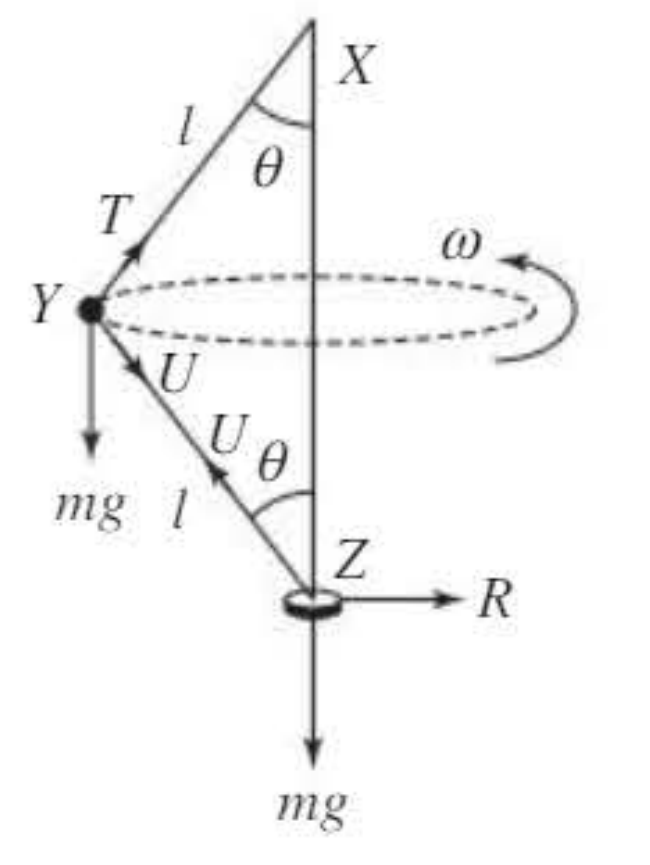
Solution:
Step 1: Identify the forces.
Triangle XYZ is isosceles (since XY = YZ = l). Let T be the force in rod XY and U be the force in rod YZ. The vertical rod XZ exerts a normal reaction R on the ring at Z.
Step 2: Write equation for vertical equilibrium of Z.
Z is in vertical equilibrium: ... [1]
Step 3: Write equation for vertical equilibrium of Y.
Y is also in vertical equilibrium:
Substituting equation [1]: ... [2]
Step 4: Write horizontal equation of motion for Y.
Y moves in a horizontal circle of radius : ... [3]
Step 5: Substitute and simplify.
From equations [1] and [2]:
Factor out :
Divide both sides by :
Rearrange to give:
as required ✓
Problem-solving strategy
When tackling conical pendulum problems, follow this systematic approach:
Step 1: Draw a clear diagram
- Show all forces acting on the moving parts
- Label the fixed point, centre of circle, and bob position
- Mark the angle with the vertical, string length, and radius
- Include tension forces and weight
Step 2: Write equations of motion towards the centre
- Use Newton's second law for the horizontal direction
- The centripetal force equation: or
- Remember that the horizontal component of tension provides this force
Step 3: Write other force equations and solve simultaneously
- Apply vertical equilibrium (no vertical acceleration)
- If multiple strings or rods are present, write separate equations for each object
- Look for constraints (e.g., strings remaining taut, rods staying rigid)
- Solve the system of equations by substitution or elimination
Note
The "VER-HOR" Strategy
Think of conical pendulum problems in two stages:
- VERtical: Write the equilibrium equation (forces balance)
- HORizontal: Write the circular motion equation (centripetal force)
This simple memory aid helps ensure you don't forget either crucial equation.
Common exam traps and tips
Important
Trap 1: Confusing sin and cos
The vertical component uses (because is measured from vertical), while the horizontal component uses . Always check your angle convention.
Memory aid: "sin goes with weight (vertical), cos goes with circular motion (horizontal)" - wait, that's backwards! Actually: cos is vertical, sin is horizontal when measuring from the vertical axis.
Important
Trap 2: Forgetting to use radians
Angular speed must be in radians per second when using in formulas. If given rpm (revolutions per minute), convert: .
Always check the units in your problem statement and convert if necessary!
Important
Trap 3: Incorrect geometry
Use Pythagoras' theorem correctly. If you know the string length and radius, the height is not simply the difference - you must use .
Draw a right-angled triangle to see the relationship clearly before calculating.
Important
Trap 4: String constraints
When strings can go slack, tension cannot be negative. This creates an inequality for the angular speed. The minimum occurs when the tension just reaches zero.
Look out for phrases like "the string remains taut" - this is your cue to set up an inequality!
Note
Exam Tip: Smooth Ring Problems
If a problem involves a smooth ring on a string (rather than a fixed mass), the tensions on either side of the ring must be equal. The ring can slide along the string, so it may not remain at the midpoint during rotation. This is an important distinction from particles tied at fixed points.
Key formulas
| Formula | Description |
|---|---|
| Vertical equilibrium for single mass | |
| Horizontal circular motion equation | |
| Radius in terms of string length and angle | |
| Time for one complete revolution | |
| Linear speed from angular speed | |
| Convert from rpm (n) to rad s⁻¹ |
Remember!
Summary
Key Points to Remember:
-
A conical pendulum traces a cone shape: The bob moves in a horizontal circle while the string sweeps out a vertical cone from the fixed point above.
-
Two key equations govern the motion: Vertical equilibrium () and horizontal circular motion (). Always resolve forces in both directions.
-
Geometry links the parameters: Use Pythagoras' theorem and trigonometry to relate string length, radius, height, and angle. Draw a clear diagram to identify these relationships.
-
Angular speed and period are inversely related: A higher angular speed means a shorter period. Use to convert between them.
-
String constraints create inequalities: When strings can go slack, the tension must remain non-negative, leading to minimum values for angular speed. This is a common exam scenario.