Vertical Circular Motion (AQA A-Level Further Maths): Revision Notes
📚Revision Notes
Vertical Circular Motion
Introduction
When an object moves in a circular path in a vertical plane, we call this vertical circular motion. Unlike horizontal circular motion where speed remains constant, in vertical circular motion both the angular velocity (ω) and tangential velocity (v) vary continuously as the object moves around the circle. This variation occurs because gravity acts on the object throughout its motion, causing it to speed up when moving downwards and slow down when moving upwards.
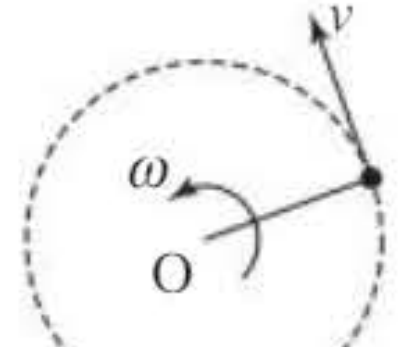
The varying velocity means that the acceleration also changes at different points around the circle, making vertical circular motion more complex than its horizontal counterpart. This type of motion appears in many real situations, such as a ball on a string being swung in a vertical circle, or vehicles travelling around vertical loops.
Note
The key difference between horizontal and vertical circular motion is that in vertical motion, gravity continuously affects the particle's speed, causing both velocity and acceleration to vary throughout the motion.
Acceleration components in vertical circles
When a particle moves in a vertical circle, its acceleration has two distinct components that describe different aspects of the motion.
Radial component
The radial component of acceleration always points towards the centre of the circle. This component is responsible for changing the direction of the velocity vector, keeping the particle moving in a circular path. For a circle of radius with the particle moving at speed , the magnitude of the radial acceleration is:
where represents the angular velocity and is used as shorthand notation for .
This radial acceleration is essential for circular motion and must be produced by a resultant force directed towards the centre. In vertical circular motion, this resultant force comes from a combination of tension (or normal reaction) and the component of weight acting along the radius.
Tangential component
The tangential component of acceleration acts along the tangent to the circle. This component is responsible for changing the speed of the particle. The magnitude of tangential acceleration is:
where is shorthand for .
Important
In most problems involving vertical circular motion, you won't need to use the tangential component explicitly. The energy equation and Newton's second law applied to the radial direction are sufficient to solve the problems you'll encounter.
Energy considerations in vertical circular motion
As a particle moves around a vertical circle under gravity, there is a continuous exchange between gravitational potential energy (GPE) and kinetic energy (KE). Understanding this energy transformation is crucial for solving vertical circular motion problems.
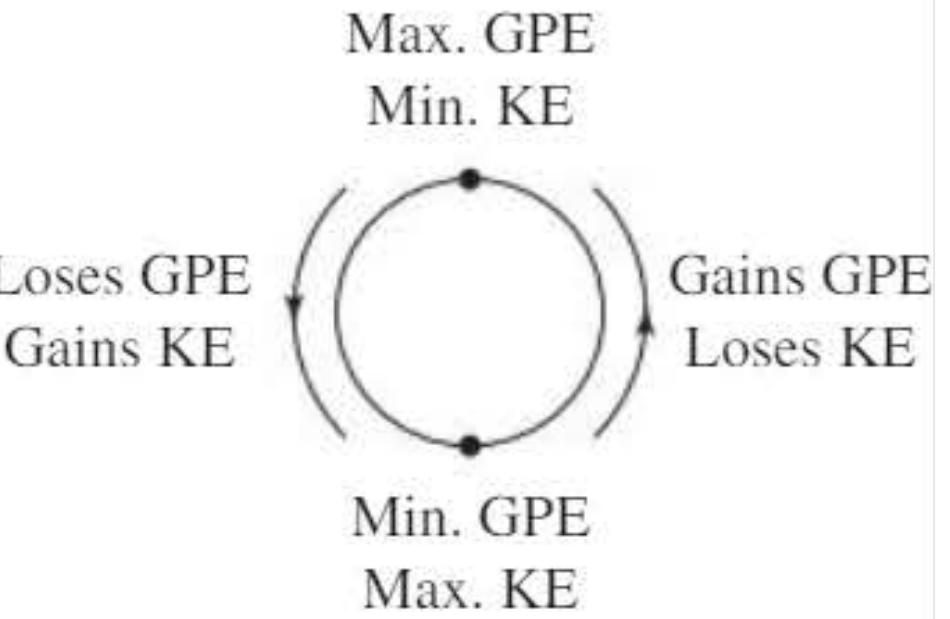
Energy transformations
Consider a particle moving smoothly in a vertical circle. As it travels from the bottom of the circle towards the top:
- It gains GPE as it rises higher
- It loses KE as it slows down
Conversely, as it moves from the top back down towards the bottom:
- It loses GPE as it descends
- It gains KE as it speeds up
At the lowest point of the circle, the particle has minimum GPE and maximum KE. At the highest point, it has maximum GPE and minimum KE.
Note
Energy Cycle in Vertical Circles:
Think of the energy transformation as a continuous cycle: At the bottom, the particle has maximum speed (maximum KE) and minimum height (minimum GPE). As it rises, it trades kinetic energy for potential energy. At the top, it has minimum speed (minimum KE) and maximum height (maximum GPE). Then the cycle reverses as it descends.
The energy equation method
The energy equation is a powerful tool for analysing vertical circular motion. This equation can be stated in two equivalent ways:
- The total mechanical energy remains constant (if there are no external forces doing work)
- The gain in one form of energy equals the loss in the other form
Mathematically, the energy equation can be written as:
or
where is the initial velocity, is the final velocity, and is the change in height.
Important
When to Use the Energy Equation:
The energy equation is particularly useful because it involves velocities and heights but not forces. This makes it the preferred method for finding velocities at different points in the circle. Use energy equations to find speeds, and Newton's second law to find forces like tension or normal reaction.
Newton's second law approach
While the energy equation helps us find velocities, we need Newton's second law when we want to determine forces such as tension in a string or normal reaction from a surface.
For a particle moving in a vertical circle of radius with velocity at any point, the radial component of acceleration is . Applying Newton's second law in the direction towards the centre of the circle:
The resultant force is the combination of:
- The tension (or normal reaction ) acting along the radius
- The component of weight acting along the radius
The sign and magnitude of these forces depend on the position of the particle in the circle.
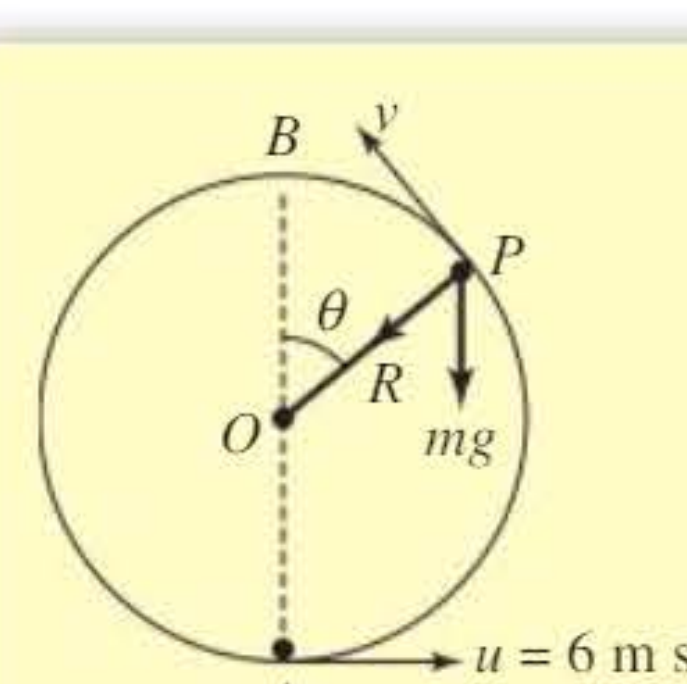
Note
At different positions around the circle, you must carefully identify which forces contribute to the centripetal force. Draw a clear diagram showing all forces and their components to avoid errors.
Complete circles vs incomplete motion
A crucial question in vertical circular motion problems is whether the particle will complete a full circle or only oscillate in the lower part of the circle. The answer depends on whether the particle has sufficient energy.
High-energy particles
Particles with sufficient initial energy can complete full rotations around the circle. To do this, they must reach the highest point with enough velocity to maintain the required centripetal acceleration.
Low-energy particles
Particles with insufficient energy will only oscillate in the lower part of the circle. They rise to a certain maximum height, then fall back down, never completing the full circle.
The critical factor determining which behaviour occurs is whether the particle can satisfy the conditions for remaining in circular motion when it reaches the upper part of the circle. These conditions differ depending on whether the particle is attached to a light rod, a string, or is moving on a surface.
Different types of constraints
The type of connection between the particle and the circular path significantly affects the conditions for motion. Understanding these differences is essential for solving problems correctly.
Important
Key Difference Between Constraints:
- Light rod: Can PUSH and PULL
- String: Can only PULL (never push)
- Surface: Can only PUSH perpendicular to surface (via normal reaction)
This fundamental difference means each constraint requires different conditions for complete circular motion.
Light rod
When a particle is attached to a fixed point by a light rod:
- The rod can push (provide thrust) or pull (provide tension)
- Circular motion breaks when the particle's velocity reaches zero
- At this point, the rod comes to instantaneous rest
- The particle will then oscillate on a circular arc but won't complete the full circle
For a particle on a light rod to complete a full circle, it must reach the topmost point with a speed . Using energy conservation from the lowest point (speed ) to the highest point (speed ):
For a complete circle, , which gives:
Therefore, the minimum speed for a complete circle with a light rod is:
String
When a particle is attached to a fixed point by a string:
- The string can only pull (provide tension), never push
- Circular motion breaks when the tension in the string becomes zero and the string goes slack
- The particle then falls under gravity alone
For circular motion to continue, the tension must remain positive. At the topmost point , applying Newton's second law towards the centre:
For the string to remain taut, , which means:
Using energy conservation from the lowest point to the highest point:
Combining these conditions: and gives:
Therefore, the minimum speed for a complete circle with a string is:
Note
Why Strings Need Higher Speed:
A string requires a higher minimum speed than a light rod ( vs ) because the particle must maintain sufficient speed at the top to keep the string taut. Since the string cannot push, the tension alone must provide the required centripetal force, which demands a higher velocity at the top of the circle.
Surface (inside or outside)
When a particle moves on a circular surface:
- The surface provides a normal reaction force
- The normal reaction can only push perpendicular to the surface, not pull
- Circular motion breaks when the normal reaction becomes zero
- The particle then leaves the surface and follows a parabolic path under gravity
For a particle on the inside of a circular surface, contact is lost when the normal reaction , which typically occurs in the upper half of the circle. For a particle on the outside of a surface, contact is lost when in a similar manner.
Problem-solving strategy
To solve problems involving vertical circular motion effectively, follow this systematic approach:
Step 1: Draw a clear diagram
Start by drawing a clear diagram showing:
- The circular path with centre marked
- The position of the particle
- All forces acting on the particle (weight, tension/reaction)
- The angle or position clearly labelled
- The radius of the circle
Note
A well-drawn diagram is crucial for identifying all forces correctly and setting up the right equations. Take time to label all components clearly, including angles, heights, and force directions.
Step 2: State the condition
Identify what condition applies for the situation described:
- For completing a circle with a rod: velocity at top
- For completing a circle with a string: tension at top (or )
- For losing contact with a surface: normal reaction
Step 3: Write appropriate equations
Depending on what you need to find, use:
- Energy equation to find velocities at different heights
- Newton's 2nd law ( towards centre) to find forces
Often you'll need to use both equations together: first find the velocity using energy, then substitute into the force equation to find the tension or reaction.
Worked examples
Example
Example 1: Finding velocity and tension in a string
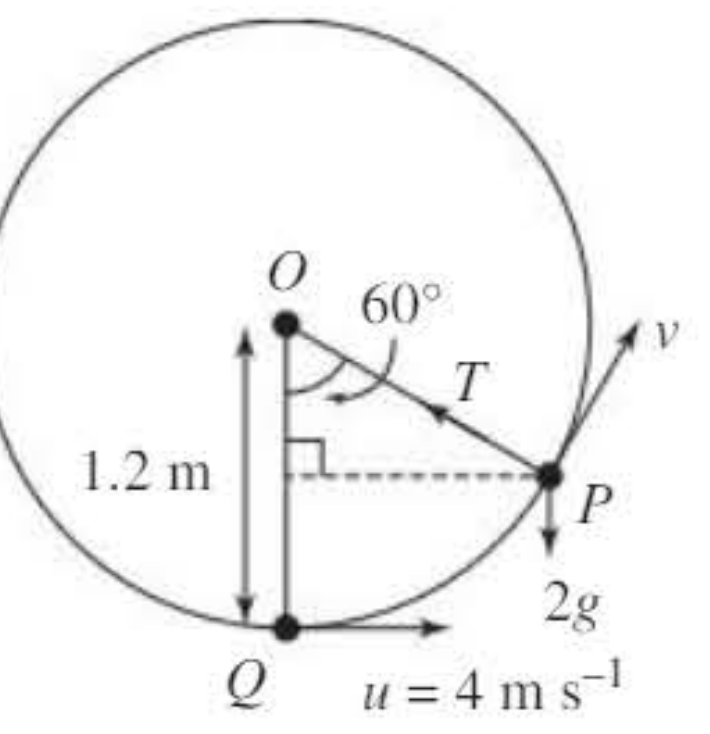
A 2 kg mass is attached to a string of length 1.2 m where is a fixed point. is given a horizontal velocity when hanging vertically below at point . When , find: a) The velocity of b) The tension in the string
Solution:
Part a) Let have velocity when .
First, find the vertical height of above :
Using the energy equation from to :
Part b) Apply the equation of motion along the radius towards :
Key points:
- Finding vertical height as is very common in these problems
- Energy is conserved since there's no friction or external forces
- The resultant force equals mass times acceleration
Example
Example 2: Minimum speed for complete circle with a light rod
A particle of mass at point hangs vertically from a fixed point where is a light rod of length m. is given a horizontal speed at . Find the least value of for to perform a complete circle about .
Solution:
For to complete a circle with a light rod, it must reach the topmost point with a speed .
The rod can push or pull, so the critical condition is simply that the velocity doesn't become zero before reaching the top.
Gain in GPE from to is
Loss of KE from to is
Using the energy equation:
Simplifying:
For a complete circle, , so :
Minimum speed:
Example
Example 3: Minimum speed for complete circle with a string
The light rod in Example 2 is replaced by a string of the same length. Find the new least value of for to perform a complete circle about .
Solution:
With a string, completes a circle if the string is still taut at ; that is, if the tension at .
The energy equation is unchanged: ... [1]
At point (the top), applying Newton's 2nd law towards :
For the string to remain taut, :
... [2]
From equations [1] and [2]:
Minimum speed:
Important: The minimum speed for a string (8.57 m s⁻¹) is greater than for a light rod (7.67 m s⁻¹) because the string cannot push, only pull. The particle must have sufficient speed at the top to create the required centripetal force through tension alone.
Example
Example 4: Particle losing contact with a sphere
A particle of mass is at the lowest point on the inside of a thin, smooth sphere of radius 1.2 m with centre . is projected along the surface from with a velocity . Find when is about to lose contact with the sphere.
Solution:
Let the normal reaction be when the velocity is .
Let where is the topmost point.
The particle loses contact with the surface when , which occurs when is in the upper half of the circle.
Using the energy equation from to :
... [1]
Applying Newton's 2nd law towards :
The particle leaves the circle when :
... [2]
From [1] and [2]:
Therefore,
The particle leaves the sphere when (or equivalently when it has travelled from the lowest point).
Example
Example 5: Particle leaving a sphere and becoming a projectile
A particle of mass 4 kg rests at the topmost point of the surface of a smooth sphere of radius 1.5 m, fixed to a horizontal plane at point . is slightly disturbed from rest and moves down the surface of the sphere before leaving it at . If strikes the plane at , find the distance .
Solution:
Let the normal reaction be and angle be when particle is at .
The particle leaves the sphere when .
Using the energy equation whilst is on the sphere:
... [1]
Applying Newton's 2nd law to the centre :
The particle leaves the sphere when :
... [2]
From [1] and [2]:
So
From equation [2]:
The particle leaves the sphere at a distance m above the plane.
At point , the velocity has components:
- Vertical: (downwards)
- Horizontal:
Now becomes a projectile. Using the equation for vertical motion (taking downwards as positive):
Using the quadratic formula (taking the positive root):
Horizontal distance travelled in this time:
Distance = distance + horizontal distance
Key points:
- State the correct condition for completing a full circle or breaking away from the circle
- Use energy equations for finding velocities
- Use Newton's 2nd law for finding forces
- When the particle leaves the circular path, treat it as projectile motion
Summary
Key Points to Remember:
-
In vertical circular motion, both angular velocity (ω) and tangential velocity (v) vary due to gravity, unlike horizontal circular motion where they remain constant.
-
The radial acceleration is and the resultant force towards the centre equals by Newton's second law.
-
Use the energy equation (KE lost = GPE gained) to find velocities at different heights, and Newton's 2nd law to find forces such as tension or normal reaction.
-
For complete circles: a light rod requires minimum speed , while a string requires the higher minimum speed because strings can only pull, not push.
-
Always draw a clear diagram, state the condition for the motion (such as for losing contact or for a taut string), and write both energy and force equations where appropriate.
-
At the top of the circle: Maximum GPE, Minimum KE
-
At the bottom of the circle: Minimum GPE, Maximum KE