Dimensional Analysis (AQA A-Level Further Maths): Revision Notes
📚Revision Notes
Dimensional Analysis
What is dimensional analysis?
Dimensional analysis is a powerful mathematical technique used in physics to examine the relationships between physical quantities. It involves expressing quantities in terms of fundamental dimensions and using these to check formulas or derive new ones.
This method serves two important purposes:
-
Checking formula validity: You can verify whether a formula is correct by examining if all terms have consistent dimensions. For example, it's not possible to add a term with units in metres to a term with units in kilograms, because the dimensions don't match.
-
Building formulas: When you suspect that certain variables are related, dimensional analysis helps you construct a possible formula connecting them. For instance, if the density of seawater and wave speed might affect wave height, you can use dimensional analysis to find how these quantities relate.
Note
Dimensional analysis is one of the most versatile tools in physics - it can help you check your work, derive relationships, and even predict how physical systems behave without needing the complete underlying equations!
The three basic dimensions
Most physical quantities can be expressed using three fundamental dimensions:
- M represents Mass
- L represents Length
- T represents Time
These dimensions are not the same as units, but units can help you determine dimensions. For example, speed has units of metres per second (m s⁻¹). Since speed equals distance divided by time, its dimensions are Length divided by Time.
Note
Think of dimensions as the "type" of quantity you're working with, while units are the specific "measurement system" you're using. The dimension of length (L) could be measured in metres, feet, kilometres, or any other length unit.
How to write dimensions
You express dimensions using square brackets. For any physical quantity, write its dimensions as:
Example: For speed:
- Speed = distance ÷ time
- Units of speed: m s⁻¹
- Dimensions of speed:
The dimensions can be written as fractions (L/T) or using negative indices (LT⁻¹).
Dimensionless quantities
Some quantities have no dimensions at all. Pure numbers and angles are dimensionless and don't appear in dimensional equations. Examples include:
- The ratio of height to length for a bus
- sin 60°
- Angular measurements in radians
- Speed of rotation in radians per second
- The ratio of circumference to diameter (π)
These quantities are simply numbers without physical dimensions.
Important
Critical Concept: Dimensionless quantities like pure numbers and angles in radians do NOT contribute to dimensional analysis. This is a common source of confusion - when you see a formula with sin θ or a numerical constant like π or ½, these have no dimensions and should be ignored in your dimensional analysis calculations.
Checking dimensional consistency
A formula is dimensionally consistent when all terms that are added or subtracted have the same dimensions. You cannot add metres to kilograms because they represent fundamentally different physical quantities.
Method for checking consistency
To check if a formula is dimensionally consistent:
- Identify each variable in the formula
- Write the dimensions of each variable in terms of M, L, and T
- Calculate the dimensions of each term in the formula
- Verify that all terms on both sides have matching dimensions
If the dimensions match throughout the equation, the formula is dimensionally consistent. However, dimensional consistency alone doesn't guarantee a formula is completely correct - there could still be missing dimensionless numerical constants.
Note
Important distinction: A dimensionally consistent formula is not necessarily the correct formula. Dimensional analysis can confirm that a formula is wrong (if dimensions don't match), but it cannot prove that a formula is completely correct. For example, both and are dimensionally consistent, but only the first is correct!
Example
Worked Example: Kinetic Energy Dimensions
Given that kinetic energy , work out the dimensions of energy.
Solution:
First, identify the dimensions of each variable:
- Mass:
- Velocity is distance per time:
Now calculate the dimensions of kinetic energy:
Therefore, energy has dimensions .
Example
Worked Example: Gravitational Potential Energy
Show that the equation is dimensionally consistent.
Solution:
On the left-hand side:
All forms of energy must have the same dimensions.
On the right-hand side:
- (mass)
- (acceleration)
- (height)
Therefore:
Both sides have the same dimensions , so the equation is dimensionally consistent. ✓
Building formulas using dimensional analysis
When you suspect variables are related but don't know the exact formula, dimensional analysis can help you derive it. You assume the formula takes a certain form with unknown powers (indices), then use dimensional analysis to solve for those powers.
Strategy for deriving formulas
When using dimensional analysis to build formulas:
Step 1: Write the dimensions of all variables in terms of M, L and T
Step 2: Equate powers of M, L and T, then solve to work out the unknown indices
Example
Worked Example: Simple Pendulum Period
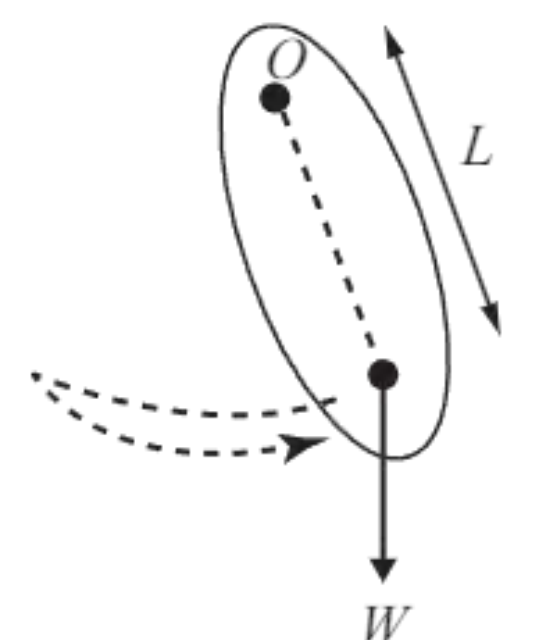
The time period of a simple pendulum may depend on its mass , its length , and the gravitational acceleration .
Find a formula for in terms of , and .
Solution:
Assume the formula takes the form:
where is a dimensionless numerical constant.
The dimensional equation is:
Expanding the right side:
Equate powers of M, L and T:
For dimensional consistency, the powers on both sides must match:
- Power of M:
- Power of L:
- Power of T:
Solving these equations:
- From the T equation: , so
- From the L equation: , so
- We already have:
The formula is:
Since (any number to the power zero equals 1), this simplifies to:
This result shows that the pendulum's period depends on its length and gravity, but not on its mass - a surprising and important result in physics!
Note
Remarkable Discovery: The fact that a pendulum's period doesn't depend on its mass is one of the most counterintuitive results in classical mechanics. This means a heavy pendulum and a light pendulum of the same length will swing with exactly the same period - Galileo famously discovered this by observing chandeliers swinging in a cathedral!
Exam tips and common pitfalls
Important
Watch out for these common mistakes:
-
Confusing units with dimensions - Remember that metres, kilograms and seconds are units, whilst M, L and T are dimensions. Units are specific measurements; dimensions are fundamental categories.
-
Forgetting dimensionless quantities - Pure numbers, angles in radians, and ratios don't contribute to dimensional analysis. Don't try to assign them dimensions.
-
Not checking each term separately - In equations with multiple terms (like ), verify that each individual term has the correct dimensions before comparing.
-
Missing the square bracket notation - Always write , not just . The brackets indicate you're referring to dimensions, not the quantity itself.
Exam technique:
- For checking consistency: Write out the dimensions of every term step-by-step and compare them clearly
- For building formulas: Set up the general form with unknown powers first, then create a clear system of equations to solve
- Show all working: Marks are awarded for method even if your final answer isn't perfect
- State your conclusion: After checking dimensions, explicitly state whether the equation is dimensionally consistent or not
Summary
Key Points to Remember:
-
Dimensional analysis uses three fundamental dimensions: Mass (M), Length (L), and Time (T) to represent all physical quantities.
-
Square bracket notation is essential: Write to express dimensions, for example for velocity.
-
Dimensional consistency is key: All terms that are added or subtracted in a valid formula must have identical dimensions.
-
Two main applications: Use dimensional analysis to check if formulas are valid, or to derive formulas when you know which variables should be related.
-
Follow the two-step strategy: First write all dimensions in terms of M, L and T; then equate powers of each dimension and solve for unknown indices.