Conservation of Momentum (AQA A-Level Further Maths): Revision Notes
📚Revision Notes
Conservation of Momentum
Momentum and impulse
Momentum is a measure of the quantity of motion possessed by a moving object. When an object of mass moves with velocity , its momentum is calculated as:
Note
Both force and velocity are vector quantities, which means momentum and impulse are also vectors. They have both magnitude and direction.
Impulse represents the effect of a force acting over time. When a constant force acts on an object for time , the impulse delivered is:
Important
Key insight: Impulse equals the change in momentum. This gives us the fundamental relationship:
where is the initial velocity and is the final velocity.
Units
Both momentum and impulse are measured in newton seconds (N s). This follows from the relationship between force (newtons) and time (seconds).
Relationship with Newton's laws
Newton's second law
Newton's second law states that force equals mass times acceleration: .
When velocity changes from to over time , acceleration is given by:
Substituting into Newton's second law:
Rearranging gives us:
This shows that impulse equals change in momentum.
Newton's third law in collisions
When two bodies collide, Newton's third law tells us that the force exerted by body A on body B is equal and opposite to the force exerted by body B on body A.
Consider bodies and with masses and colliding directly. If the force on is , then the force on is (equal magnitude, opposite direction).
During the collision:
- For body :
- For body :
Therefore:
Rearranging:
This shows that total initial momentum equals total final momentum.
The principle of conservation of linear momentum
Important
The principle of conservation of linear momentum states that when no external forces are present, the total momentum of a system of particles remains unchanged by collisions between them.
Mathematically:
For two bodies:
When does conservation apply?
Momentum is conserved only when no external forces act on the system. Internal forces (forces between the colliding bodies) do not affect the total momentum.
Note
Exam tip: Always check and state that "there are no external forces" before applying conservation of momentum.
Types of collisions
Direct collisions
A direct collision occurs when bodies collide along their common line of travel. If the bodies are moving towards each other, the collision is head-on.
Most problems in this topic involve direct collisions, where all motion occurs in a straight line. This is why the term linear is used - it indicates motion is considered as acting in a straight line.
Coalescence
When two particles coalesce, they combine into a single particle after collision. The two bodies stick together and move with a common velocity.
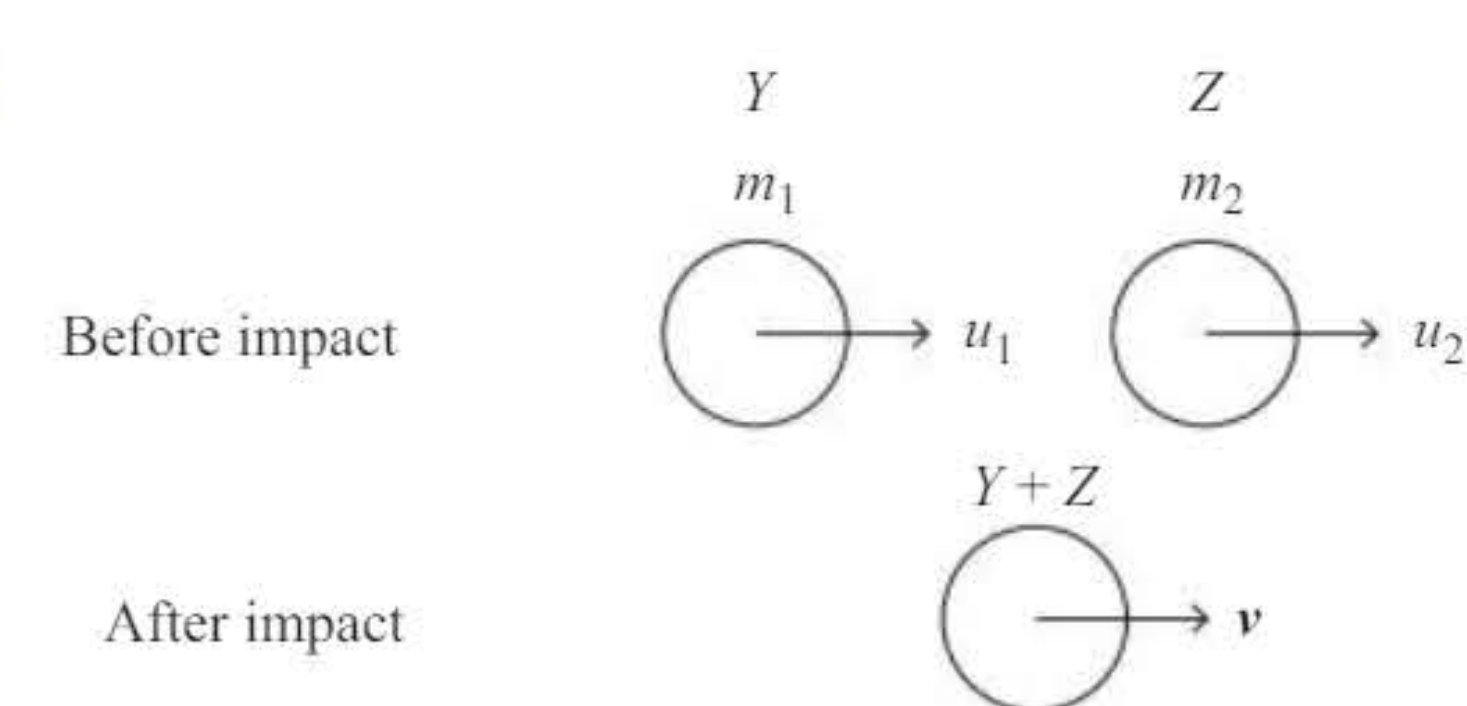
Note
For a coalescence problem:
where is the final velocity of the combined mass.
Problem-solving strategy
Important
To solve collision problems involving conservation of momentum:
-
Draw and label a diagram showing the situation before and after the collision. Include masses and velocities clearly.
-
Check that there are no external forces involved, so that momentum is conserved. State this explicitly.
-
Write momentum equations, ensuring correct signs for velocities. Choose a positive direction and stick to it consistently.
-
Solve the equations for the unknown quantities.
Exam tip: Be careful with signs. Choose one direction as positive at the start and use negative values for velocities in the opposite direction.
Worked examples
Example
Worked Example 1: Direct collision with body at rest
Problem: A body of mass 1 kg moving with velocity collides directly with another body of mass 2 kg moving towards with velocity . After the collision, is at rest. Find the final velocity of .
Solution:
Choose the direction of 's initial motion as positive.
Initial velocities: , (opposite direction)
Final velocities: (unknown), (at rest)
There are no external forces, so momentum is conserved.
Total initial momentum:
Total final momentum:
The momentum equation is:
Solving:
The final velocity is in the opposite direction to that shown on the diagram.
Example
Worked Example 2: Coalescence with vector components
Problem: A particle of mass 1 kg with velocity collides and coalesces with a particle of mass 4 kg and velocity . They move off together with a common velocity . Calculate the speed and the angle makes with the -direction.
Solution:
The combined mass after impact is:
There are no external forces, so momentum is conserved.
The momentum equation is:
Expanding:
Final velocity:
Speed:
Angle with positive -direction:
Note: Use Pythagoras and trigonometry to calculate the speed and angle when working with vector components.
Example
Worked Example 3: Skateboard problem
Problem: A child of mass 30 kg travels in a horizontal straight line on a skateboard of mass 5 kg with a velocity of . The child jumps off the skateboard with an initial horizontal backwards velocity of while the skateboard continues forwards. All motion is in the same straight line. Calculate the final velocity, , of the skateboard.
Solution:
Total mass initially:
Total initial momentum:
After the child jumps, taking the forward direction as positive:
- Child's velocity: (backwards)
- Skateboard's velocity: (forwards, unknown)
Total final momentum:
There are no external forces, so momentum is conserved.
The momentum equation is:
Solving:
The final velocity of the skateboard is in the forward direction.
Example
Worked Example 4: Sequential collisions
Problem: Three particles , and , with masses 1 kg, 4 kg and 12 kg respectively, are positioned in a straight line. Particles and are at rest and particle is moving towards with a speed of .
After and collide, particle rebounds backwards and moves towards with twice the speed of .
After and collide, they move in opposite directions with the same speed.
Show that there are no more collisions between the particles, assuming no other forces act on them.
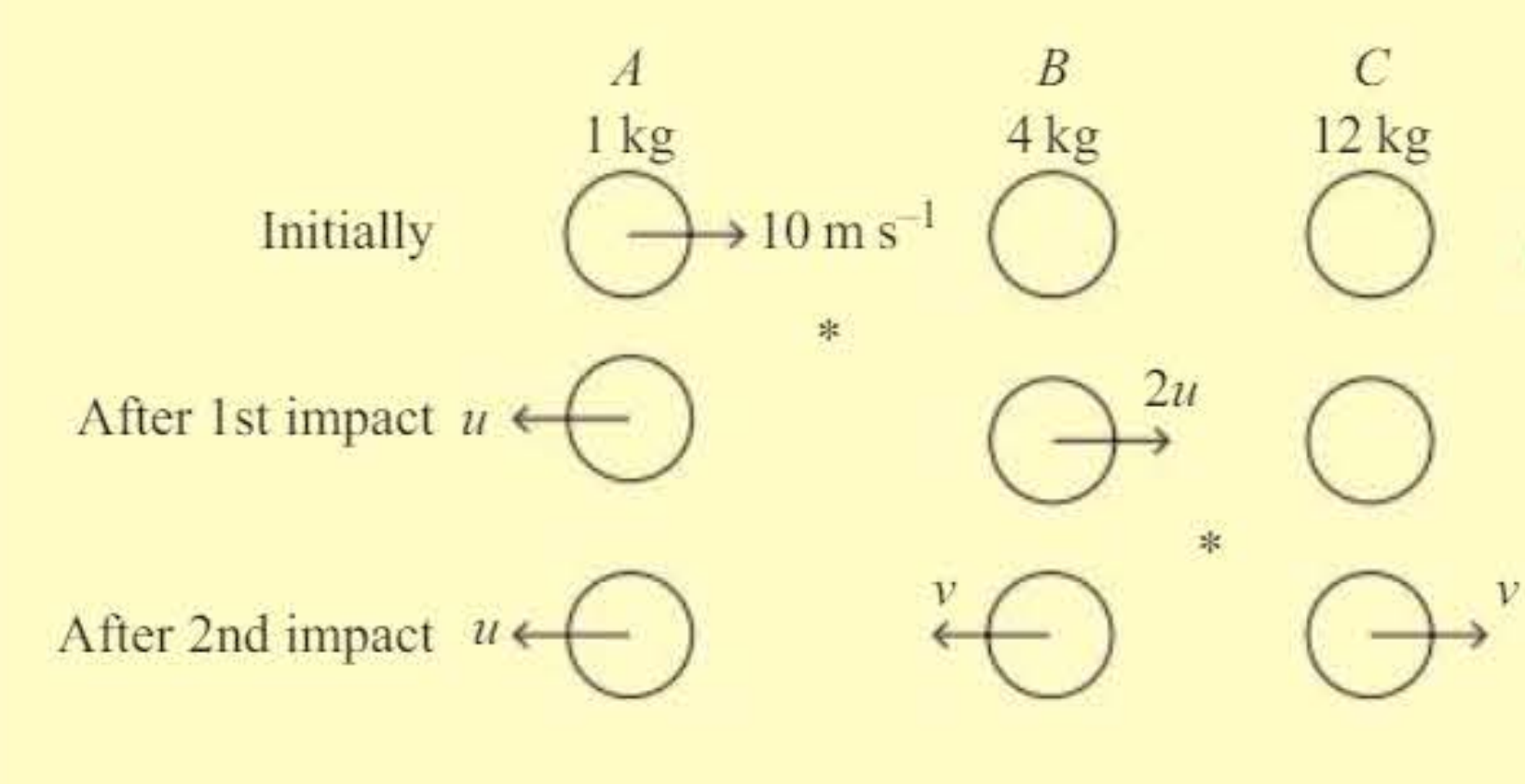
Solution:
Let rebound with speed (backwards) after the first collision. Then moves with speed (forwards).
First collision (A strikes B):
Taking the forward direction (towards ) as positive:
Initial momentum:
Final momentum:
There are no external forces, so momentum is conserved:
Therefore:
After the first collision:
- moves at backwards
- moves at forwards
Second collision (B strikes C):
Let and move with speeds after the collision (in opposite directions).
Initial momentum:
Final momentum (taking moving backwards as negative, forwards as positive):
Conserving momentum:
Therefore:
After both collisions:
- moves at backwards (towards the left)
- moves at backwards (towards the left, same direction as )
- moves at forwards (towards the right, opposite to and )
Since and are moving in the same direction with the same speed, and in the opposite direction to , there are no further collisions. Hence, there are no more collisions between the particles.
Summary
Key Points to Remember:
-
Momentum is the product of mass and velocity: , measured in newton seconds (N s).
-
Conservation of momentum applies only when no external forces act on the system. Always check and state this condition.
-
Impulse equals change in momentum: . This connects force, time and motion.
-
For direct collisions, write the conservation equation carefully: . Pay close attention to signs based on your chosen positive direction.
-
Always draw clear before-and-after diagrams showing masses, velocities and directions. This helps avoid sign errors and makes the problem easier to solve.