Coastal Geomorphological Processes (AQA A-Level Geography): Revision Notes
📚Revision Notes
Coastal Geomorphological Processes
What are coastal geomorphological processes?
Coastal systems evolve gradually over time, moving toward a state of dynamic equilibrium. A variety of processes work together to alter the features of coastal landscapes. These processes are powered by energy inputs that continuously reshape coastline characteristics.
Note
When these processes work together at the coast, they create distinctive landforms found nowhere else, making coastal environments unique from inland landscapes.
The coast is shaped by two distinct groups of processes:
- Marine processes: operate directly on the coastline and are driven by the sea
- Sub-aerial processes: occur on land but significantly influence coastal shape and form
Coastal sediment budget
The sediment budget determines whether a coastline is building up or wearing away. It represents the balance between sediment being added to and removed from a coastal area.
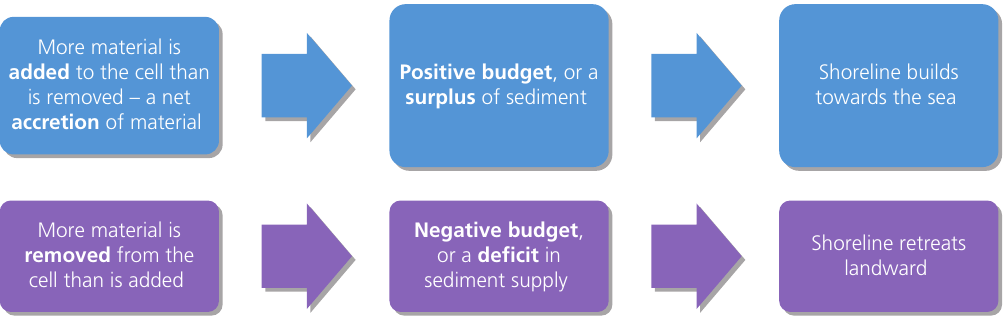
Positive budget (surplus)
When more material is added to the coast than is removed, a net accretion of sediment occurs. This creates a positive budget, or surplus, which causes:
- The shoreline to build towards the sea
- Coastal features to grow and expand
- Beach levels to increase
Negative budget (deficit)
When more material is removed from the coast than is added, a deficit in sediment supply develops. This creates a negative budget, which results in:
- The shoreline retreating landward
- Coastal erosion
- Loss of beach material
Example
Example: Calculating a Sediment Budget
For a coastal cell to have a positive budget:
- Sediment inputs = per year (from rivers and cliff erosion)
- Sediment outputs = per year (removed by longshore drift)
- Net balance = per year
This positive balance of leads to accretion and seaward shoreline growth.
Understanding sediment budgets
Erosion processes determine the extent of sediment loss by removing material from coastal areas. When the coastline loses more sediment than it gains, retreat occurs.
Sediment budgets help us trace where coastal materials come from (sources) and where they are stored (sinks). To calculate the budget for a coastal cell, we must:
- Identify all sediment sources and sinks
- Estimate the amount of material added each year
- Estimate the amount of material removed each year
Note
Calculating these budgets is extremely challenging. Most attempts rely on complex computer models and estimates rather than precise measurements, as tracking every grain of sediment movement along a coastline is practically impossible.
Types of coastal processes
Important
Marine processes operate upon a coastline and are connected with the sea, such as waves, tides and longshore drift.
Marine processes include:
- Wave action
- Tidal movements
- Longshore drift
- Marine erosion
Important
Sub-aerial processes include processes that gradually deteriorate the coastline and reduce the strength of underlying rocks, allowing sudden movements or further erosion to occur more easily. Material is broken down in situ (in its original position). These affect the shape of the coastline and include weathering, mass movement and run-off.
Components of geomorphological processes
Weathering
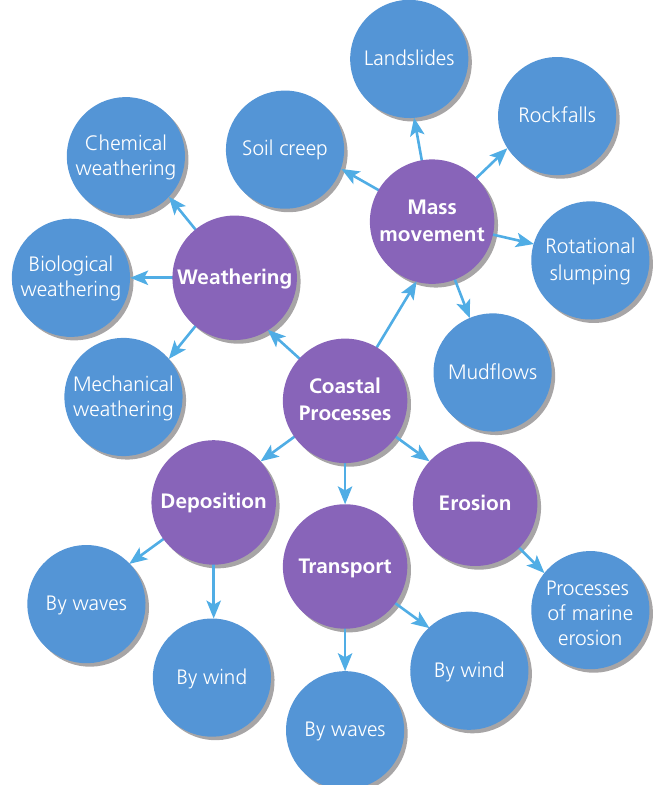
Weathering involves the breakdown of rock and sediment. Three main types operate at the coast:
- Chemical weathering: rocks decompose through chemical reactions with water, acids or oxygen
- Biological weathering: organisms such as plant roots, burrowing animals or bacteria break down rock materials
- Mechanical weathering: physical forces such as freeze-thaw action, salt crystallisation or thermal expansion fracture rocks
Note
Weathering types can be remembered as "CBM":
- Chemical
- Biological
- Mechanical
All three types often work together at the coast, with chemical weathering being particularly effective in areas with high rainfall and salt spray.
Mass movement
Mass movement describes the downslope movement of material under gravity. Five key types affect coastlines:
- Landslides: rapid movement of rock and soil down a slope
- Rockfalls: individual rocks or rock fragments falling freely from a cliff face
- Soil creep: very slow, gradual downslope movement of soil particles
- Rotational slumping: material slides downward along a curved slip plane, rotating as it moves
- Mudflows: rapid flow of water-saturated soil and debris
Important
Common Mistake to Avoid:
Students often confuse mass movement with erosion. Remember: mass movement is the downslope movement driven by gravity, while erosion involves the removal and transport of material by agents like waves or wind. Mass movement weakens the coastline, making it more susceptible to erosion.
Coastal processes
Three interconnected processes continuously reshape the coast:
Erosion
- Processes of marine erosion remove material from the coastline
- Waves carry tremendous energy that breaks down coastal features
Transport
- Material is moved along the coast by waves
- Wind can also transport sediment, particularly on beaches and dunes
Deposition
- Sediment is deposited by waves when energy decreases
- Wind deposition creates dune systems in coastal areas
Note
These three processes—erosion, transport, and deposition—work as an interconnected system. Material removed by erosion doesn't disappear; it's transported elsewhere and eventually deposited, forming new coastal features. This cycle maintains the dynamic equilibrium of coastal systems.
Marine erosion processes
Waves often break on a coastline with considerable energy. Research has estimated that waves breaking against the foot of a cliff can generate energy of tonnes .
This substantial wave energy erodes coastlines through several mechanisms. When these processes work together at the coast, they create distinctive landforms found nowhere else.
Note
The enormous energy of tonnes per square metre is equivalent to the weight of several large vehicles crashing into every square metre of cliff face with each wave. This explains why marine erosion is such a powerful force in shaping coastlines, capable of dramatically transforming coastal landscapes over time.
Summary
Key Points to Remember:
- Coastal sediment budgets determine whether shorelines advance seaward (positive budget) or retreat landward (negative budget)
- Two main process groups shape coasts: marine processes (connected to the sea) and sub-aerial processes (operating on land but affecting the coast)
- Weathering breaks down materials through chemical, biological and mechanical means, whilst mass movement transports material downslope
- Marine processes include erosion, transport and deposition powered by waves, tides and currents
- Wave energy reaching tonnes makes marine erosion a powerful force in shaping coastlines
- Coastal systems move toward dynamic equilibrium through the interaction of all these processes