Currents (AQA A-Level Geography): Revision Notes
📚Revision Notes
Currents
What are currents?
A current is the continuous or periodic movement of surface water in seas and oceans. Currents play a vital role in coastal systems by moving water and sediment along coastlines. Understanding currents helps us predict coastal erosion, sediment transport, and even navigation hazards.
There are three main types of currents you need to know about:
Types of currents
Longshore currents (littoral drift)
Longshore currents develop when waves approach the coastline at an angle rather than straight on. This angled approach creates a current that flows parallel to the shore.
How they work:
- Waves hit the beach at an angle
- The swash pushes water and sediment up the beach at this angle
- The backwash pulls material straight back down the beach (due to gravity)
- This zigzag pattern creates a net movement of water and sediment along the coast
Note
The zigzag movement of sediment along the beach - up at an angle with the swash, and straight down with the backwash - is what creates the continuous transport of material along the coastline. This process can move thousands of cubic meters of sediment annually.
Importance:
- Transports large amounts of sediment along the coastline
- Moves material through the surf zone
- Key process in coastal sediment budgets
Important
Longshore currents (also called littoral drift) occur where waves approach the shore at an angle. The swash and backwash pattern transports material along the coast in the direction of the prevailing wind and waves.
Rip currents
Rip currents are powerful, narrow channels of water that flow away from the shoreline, moving out to sea.
How they form:
- Incoming waves push water up against the coastline
- This water becomes accumulated along the shore
- The current initially flows parallel to the coast
- Eventually, it breaks through the breaker zone, flowing rapidly out to sea
- Often forms at headlands or where the coast changes direction
Dangers:
- Extremely hazardous to swimmers and small boats
- Can pull people away from shore very quickly
- Moving at high speed away from the beach
Important
Safety Warning: If caught in a rip current, never swim directly against it back to shore. Instead, swim parallel to the beach until you're out of the current, then swim back to shore at an angle. Rip currents are responsible for numerous coastal drownings each year.
Upwelling
Upwelling occurs when cold water from deep in the ocean rises towards the surface.
How it works:
- Cold water is denser than warm surface water
- The rising cold water displaces the warmer surface water
- Creates nutrient-rich cold ocean currents
- Forms an important part of global ocean circulation patterns
Significance:
- Brings nutrients from the ocean floor to the surface
- Supports marine ecosystems
- Influences global climate patterns
Note
Upwelling zones are among the most productive areas in the ocean. The nutrients brought up from depth support massive populations of phytoplankton, which form the base of the marine food chain. This is why many of the world's richest fishing grounds are located in upwelling zones.
Tides
Tides are the periodic rise and fall of sea level caused by the gravitational pull of the Sun and Moon. Although both celestial bodies influence tides, the Moon has the greatest effect because it is much closer to Earth.
How tides work
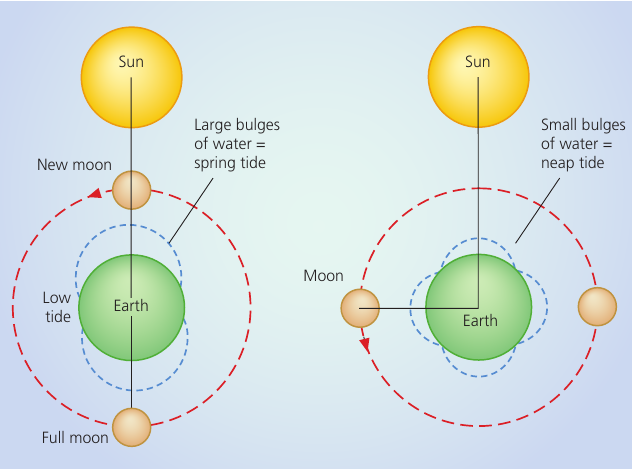
The Moon's gravity attracts water towards it, creating a high tide on the side of Earth facing the Moon. Simultaneously, a corresponding bulge of water forms on the opposite side of Earth. Between these two bulges, sea level is at its lowest, creating low tides.
Spring tides
Spring tides produce the highest tidal range (the largest difference between high and low tide).
When they occur:
- Twice per lunar month
- During the new moon and full moon phases
- When the Sun, Moon, and Earth are aligned in a straight line
Characteristics:
- The gravitational forces of the Sun and Moon work together
- Create the largest water bulges
- Produce the strongest tide-raising force
- Result in the highest high tides and lowest low tides
Note
The term "spring" tide has nothing to do with the season. It comes from the concept of the tide "springing forth" or rising higher than normal. Spring tides occur year-round, twice each month, regardless of the season.
Neap tides
Neap tides produce the lowest tidal range.
When they occur:
- Twice per lunar month
- When the Moon is at a quarter phase
- The Moon and Sun are positioned at 90° (perpendicular) to each other in relation to Earth
Characteristics:
- The gravitational forces partially cancel each other out
- Create smaller water bulges
- High and low tides are between 10 to 30 per cent lower than average
- Less extreme differences between high and low tide
Tidal range and coastal processes
Important
Tidal range is the difference in height between high tide and low tide. This measurement is not fixed and varies according to the tide cycles described above.
The tidal range significantly influences coastal development and processes:
Effects of tidal range:
- Determines the upper and lower limits of erosion and deposition
- Controls how long the littoral zone is exposed to sub-aerial weathering each day
- Affects the width of the coastal zone experiencing wave action
Example
Regional Tidal Range Comparison:
Mediterranean Sea: Low tidal ranges restrict wave action to a narrow coastal zone, typically only a few meters wide. This creates distinct erosion features concentrated in a small vertical area.
British Isles: High tidal ranges (often exceeding 10 meters in some locations like the Bristol Channel) create wide zones of wave attack. This leads to the formation of extensive wave-cut platforms that can extend hundreds of meters from the cliff base.
Additional factors:
- Local seabed topography affects tidal patterns
- Quantity of land masses in the area influences tidal behaviour
- The spinning of the Earth (Coriolis force) modifies tidal patterns
Summary
Key Points to Remember:
- Currents are water movements that transport both water and sediment along coastlines.
- Longshore currents move parallel to the shore when waves approach at an angle, creating littoral drift.
- Rip currents are dangerous currents flowing away from the shore that pose risks to swimmers.
- Spring tides occur twice monthly when the Sun, Moon, and Earth align, creating the highest tidal ranges.
- Neap tides occur at quarter moons when the Sun and Moon are perpendicular, producing the lowest tidal ranges.
- Tidal range influences coastal processes by determining the zone exposed to wave action and weathering.