Estuarine Mudflats and Salt Marsh Environments (AQA A-Level Geography): Revision Notes
📚Revision Notes
Estuarine Mudflats and Salt Marsh Environments
What are mudflats?
Mudflats are distinctive coastal landforms that develop only in very specific conditions. These low-lying areas are composed of fine sediments - primarily silt and clay - and have a unique relationship with the tides. The most important factor in mudflat formation is that they require sheltered shorelines where powerful wave action cannot disturb sediment deposition.
The key locations where mudflats develop include:
- Estuaries, where rivers meet the sea
- Behind spits, where wave energy is reduced
- Other low-energy coastal environments protected from strong waves
These features have a dynamic relationship with the tides. At high tide, mudflats are completely submerged underwater. However, at low tide, the inter-tidal area becomes exposed, revealing expansive flats of fine sediment. This regular cycle of submergence and exposure is crucial to understanding how mudflats function as coastal environments.
Note
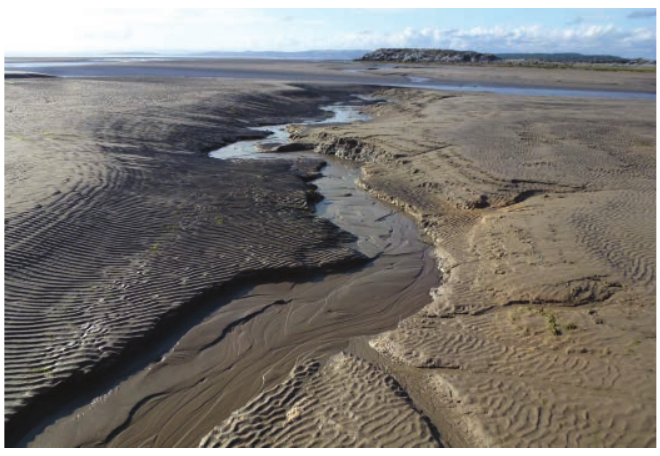
Mudflats can extend over remarkably large areas, sometimes covering many tens of square kilometres. Their surfaces are generally smooth, though they show clear evidence of tidal action through carved channels and distinctive ripple patterns created by flowing water.
How mudflats form
The formation of mudflats relies on a specific set of conditions found in estuarine environments. Understanding this process requires examining what happens when river water meets the sea.
Rivers transport fine sediments - silts and clays - as part of their load as they flow towards the coast. When rivers flow slowly as they enter estuaries, they lack the energy to carry all their sediment, and deposition begins. Simultaneously, saltwater from slow-moving tidal and sea currents also brings large amounts of fine sediments into the estuary. With each tidal cycle, seawater flows into the river mouth at high tide, then flows back out at low tide.
The mixing of these two water bodies triggers a crucial process called flocculation.
Important
Flocculation is the process where individual clay particles aggregate together to form larger, heavier particles that can sink to the bed. When freshwater sediments meet saltwater, the chemical properties cause fine clay particles to clump together, creating particles heavy enough to settle on the estuary floor.
As flocculation continues with each tidal cycle, sediment accumulates in the process of deposition. Over time, this builds up the mudflat surface. The deposition occurs in areas where water flow is slowest, allowing even the slightly heavier flocculated particles to settle.
At low tide, when water is left only in permanent channels, the smooth surface of exposed mud reveals its history. The flowing water carves into the mud or shapes its surface, creating the distinctive patterns visible across mudflats. These features provide clear evidence of tidal action and the direction of water flow.
Development of salt marshes
Mudflats are not permanent, unchanging features. Over extended periods, they can transform into a completely different coastal ecosystem: salt marshes. This transition occurs gradually as conditions change and vegetation becomes established.
Salt marshes develop in much the same way as sand dunes form on beaches - through a slow process of ecosystem change and maturation. The transformation from bare mudflat to vegetated salt marsh can take many years, sometimes decades or even longer, depending on local conditions.
Note
The process is driven by vegetation colonisation, which in turn affects sediment deposition and surface elevation. Each stage of plant development creates conditions that enable the next stage to occur, demonstrating a classic example of ecological succession.
Salt marsh structure and zonation
Salt marshes display a characteristic structure with distinct zones, each defined by its relationship to tidal levels and the vegetation it supports. Understanding this zonation is essential to comprehending how salt marshes function as ecosystems.
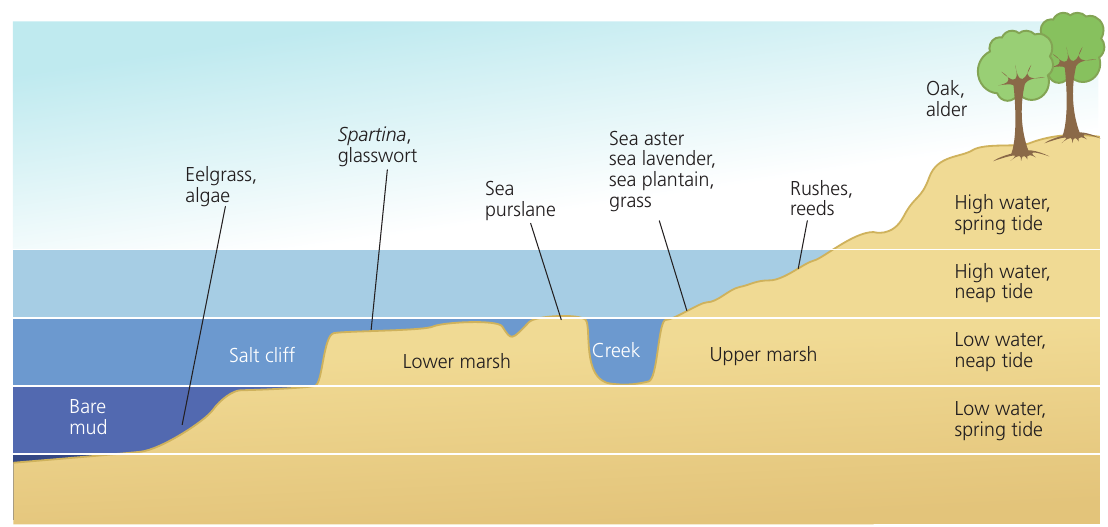
The structure progresses from the lowest areas, which are submerged most frequently, to the highest areas, which are rarely covered by seawater:
Bare mud zone: The lowest area, submerged during both spring and neap high tides. This represents the transition between mudflat and salt marsh, with minimal vegetation.
Salt cliff: A small but distinct step in elevation where the marsh begins to rise above the mudflat level. Marine species like eelgrass and algae begin to appear here, along with salt-tolerant species like sea purslane.
Lower marsh: This zone is covered by seawater during high water at both spring tides (the highest tides) and neap tides (the lowest high tides). It contains creeks where tidal water flows in and out. Vegetation here includes specialised plants like Spartina (cord grass), glasswort, and sea purslane that can tolerate frequent submergence in saltwater.
Upper marsh: Located at a higher elevation, this zone is covered only during high water at spring tides - the very highest tides that occur fortnightly. The vegetation here includes sea aster, sea lavender, sea plantain, and various grasses that tolerate occasional saltwater flooding but require less salt tolerance than lower marsh species.
Transitional wetland zone: At the highest levels, only reached during the most extreme high tides, rushes and reeds dominate. These plants indicate the transition towards terrestrial conditions.
Terrestrial zone: The highest ground, rarely if ever flooded by seawater. Trees such as oak and alder can grow here, marking the boundary between the salt marsh ecosystem and terrestrial ecosystems.
Note
This zonation pattern reflects the fundamental principle that different plant species have different tolerances to saltwater and submergence. Those in lower zones must cope with daily saltwater flooding, whilst those in upper zones face only occasional exposure to saline conditions.
Vegetation succession: the halosere
The development of vegetation on mudflats follows a recognisable pattern of succession known as a halosere - a succession sequence in environments with salty conditions. This process involves several distinct stages, with each stage creating conditions that allow the next stage to develop.
Important
A halosere is a plant succession that develops in saline (salty) environments, tolerant of salt conditions and periodic submergence by seawater.
Stage 1: Initial colonisation
The process begins when low-lying vegetation, such as eelgrass and algae, starts to grow on the mudflats. These initial plants are significant because they slow down the water currents flowing across the mudflat surface. Slower currents mean more sediment settles out of the water, leading to increased and more uneven deposition of fine particles. This creates the foundation for further vegetation development.
Stage 2: Pioneer species establishment
Pioneer plants begin to colonise areas where initial sediment accumulation has occurred. These remarkable plants, called halophytes, can tolerate both the high salt content of seawater and periodic submergence during high tides. Examples include salt marsh grass (Spartina) and glasswort.
Important
Halophytes are pioneer plant species that can tolerate salt and periodic submergence by the sea, making them essential colonisers of mudflats.
Spartina is particularly important because it has two root systems. It develops a fine mat of surface roots that bind the mud together and long, deep roots that can secure up to two metres of deposited sediment. This dual root system enables the plant to trap significantly more mud than other species, causing it to become the dominant vegetation on tidal flats throughout the British Isles.
Stage 3: Dense vegetation development
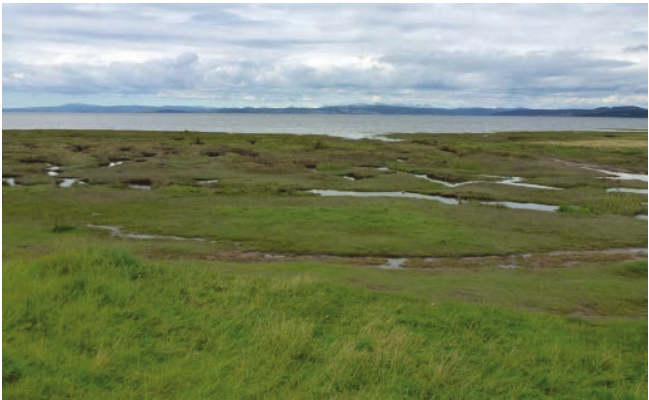
As pioneer species continue to trap sediment, the pioneers gradually develop closer vegetation cover across the mudflat. They create increasingly favourable conditions for other salt-tolerant plants such as sea aster and marsh grass. These later colonisers join the pioneers, forming a diverse plant community.
Over time, a dense mat of vegetation develops, reaching up to 15 centimetres in height. This thick vegetation cover further slows tidal currents, and the combined effect of many plants trapping sediment means that even more mud and silt accumulates on the surface. Gradually, the elevation of the marsh increases.
Stage 4: Organic matter accumulation
Dead organic matter from the plants begins to build up on the marsh surface. This material grows in height by between 1 and 25 millimetres per year - a slow but steady process. The accumulation of both sediment and organic matter continues to raise the marsh surface.
Stage 5: Creek system development
As mud levels rise across the marsh, the increasing elevation changes the drainage patterns. Complex creek systems develop that channel the tides as water flows in and out. These creeks deepen as the marsh surface rises around them, becoming a defining feature of mature salt marshes. The creeks ensure that the marsh remains connected to tidal waters.
Note
Hollows may also form where seawater becomes trapped and evaporates, leaving areas where the salinity becomes too high for plants to survive. These form salt pans - bare patches within the vegetated marsh.
Stage 6: Upper marsh establishment
The final stages see the establishment of vegetation that requires less frequent saltwater exposure. Rushes and reeds colonise the higher parts of the marsh, eventually followed by trees such as alder, ash, and oak in the highest zones. These terrestrial species can only survive in areas that are now rarely covered by the sea.
At this mature stage, the land is rarely covered by seawater, marking the completion of the succession from bare mudflat to established salt marsh ecosystem.
Case study: Morecambe Bay, northwest England
Example
Case Study: Morecambe Bay
Morecambe Bay in northwest England provides an excellent example of extensive mudflat and salt marsh environments. This sheltered bay contains four river estuaries, creating ideal conditions for mudflat development.
The mudflats and sandflats in Morecambe Bay form the largest single continuous area of this habitat type in the entire United Kingdom. The scale is remarkable, demonstrating how extensive these features can become when conditions are favourable.
These environments are important not just nationally but globally. Sizeable examples of similar mudflat systems exist in the United States, particularly the extensive mudflats in Cape Cod and Plymouth Bays off the coast of Massachusetts. However, Morecambe Bay remains one of the most significant examples in Europe and continues to demonstrate the active processes of mudflat formation and salt marsh succession.
Key terminology
Important
Mudflats - Low-lying areas of silt and clay that develop on sheltered shorelines, submerged at high tide and exposed at low tide.
Flocculation - The process where individual clay particles aggregate together to form larger, heavier particles that sink to the bed.
Salt marsh - A coastal ecosystem that develops from mudflats, characterised by salt-tolerant vegetation and distinct zonation related to tidal levels.
Halosere - A plant succession in environments with salty conditions, developing from pioneer species to mature vegetation communities.
Halophytes - Pioneer plant species that tolerate salt and periodic submergence by seawater, enabling them to colonise mudflats.
Remember!
Summary
Key Points to Remember:
- Mudflats form only in sheltered, low-energy environments like estuaries where wave action cannot disturb fine sediment deposition
- Flocculation is the key process - when freshwater sediments meet saltwater, clay particles clump together and sink, building up mudflats over time
- Salt marshes develop from mudflats through vegetation succession (halosere), progressing from bare mud through pioneer halophytes to mature marsh vegetation
- Zonation in salt marshes reflects different tidal levels - lower zones flood daily whilst upper zones flood only during spring tides, with each zone supporting different plant communities
- Morecambe Bay contains the UK's largest continuous mudflat system, demonstrating how extensive these features can become in favourable conditions