Soft Engineering (AQA A-Level Geography): Revision Notes
📚Revision Notes
Soft engineering
What is soft engineering?
Soft engineering is an approach to coastal defence that works with natural systems rather than against them. It uses features like beaches, sand dunes and salt marshes, which naturally absorb and adapt to wave and tidal energy. The key principle is to manage and maintain these natural systems without fundamentally changing their structure.
Important
Soft engineering uses natural coastal systems for defence, manipulating and maintaining features like beaches, dunes and salt marshes to absorb wave energy, whilst preserving their fundamental structures.
This approach contrasts with hard engineering, which uses artificial structures. The Sefton Coast (stretching across Merseyside and Lancashire) provides an excellent example of how different soft engineering strategies can be combined to protect a coastline.
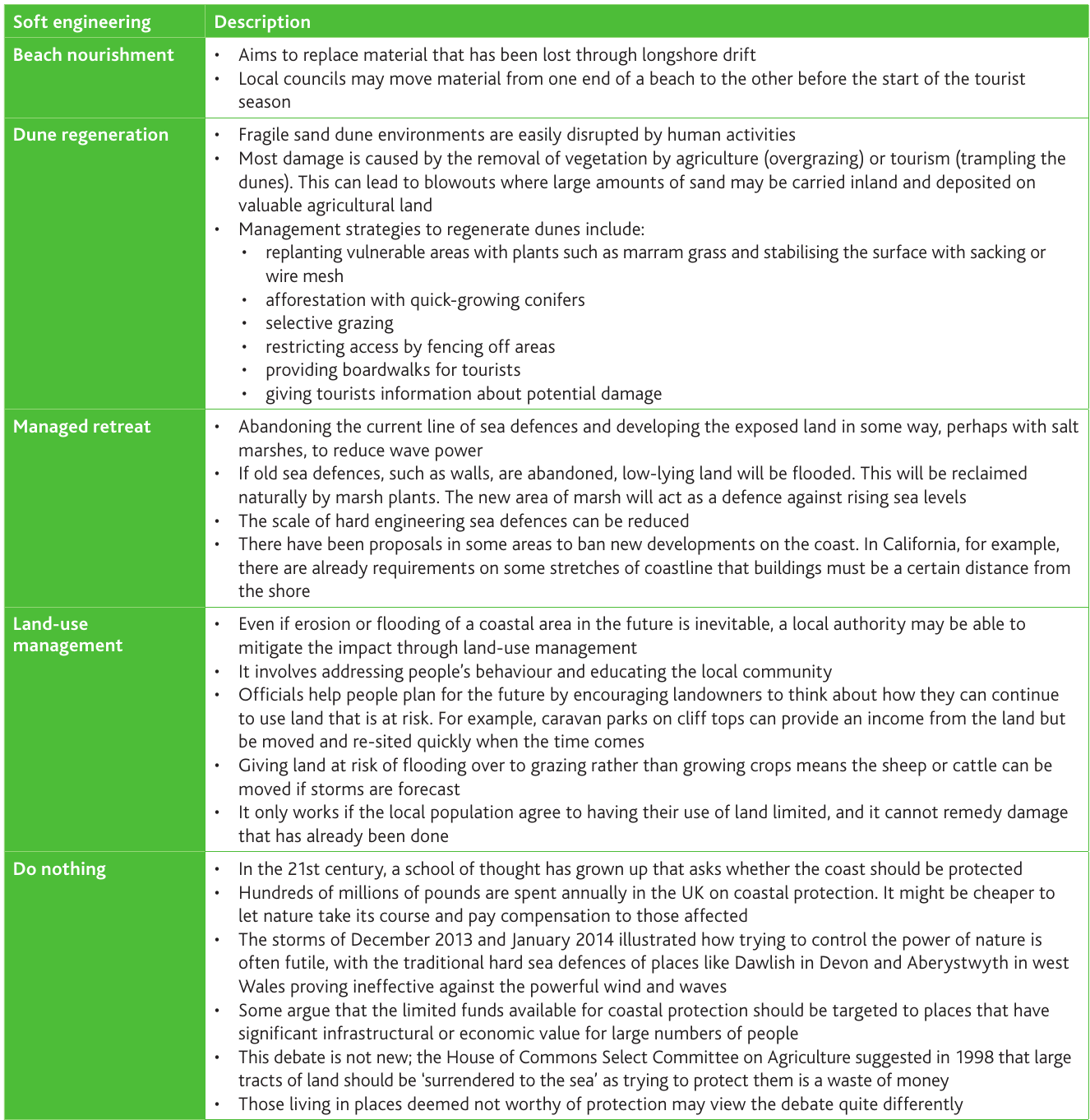
Main soft engineering approaches
Beach nourishment
Beach nourishment focuses on replacing sediment that has been lost through longshore drift. This is the natural process where waves transport material along the coast.
Key features of beach nourishment:
- Local councils often move sand or shingle from one end of a beach to another
- Material is typically redistributed before the tourist season begins
- Maintains beach width without building new structures
- Relatively low cost compared to hard engineering
- Needs regular maintenance as natural processes continue
Note
Beach nourishment offers a cost-effective alternative to hard engineering structures, as it works with natural processes rather than attempting to stop them entirely. The main challenge is that it requires ongoing maintenance since longshore drift continues to move material along the coast.
Dune regeneration
Sand dunes are fragile coastal environments that can be easily damaged by human activity. Most damage occurs when vegetation is removed, either through:
- Overgrazing by livestock (agriculture)
- Trampling by tourists and recreational users
When vegetation is lost, sand becomes unstable. This can cause blowouts where large amounts of sand are carried inland, potentially covering valuable agricultural land.
Management strategies for dune regeneration include:
- Replanting vegetation: Marram grass is particularly effective as it has deep roots that stabilise the sand. Areas can be protected with sacking or wire mesh whilst plants establish
- Afforestation: Planting quick-growing conifers provides additional stability
- Selective grazing: Controlling livestock numbers to prevent overgrazing
- Access restrictions: Fencing off vulnerable areas to prevent trampling
- Boardwalks for tourists: Providing designated pathways to protect wider dune areas
- Education programmes: Informing visitors about potential damage to encourage responsible behaviour
Important
The success of dune regeneration depends heavily on protecting vegetation during the establishment phase. Marram grass is crucial because its deep root system can stabilise large areas of sand, but it takes time to become established and is vulnerable to trampling during early growth.
Managed retreat
Managed retreat involves a deliberate decision to abandon existing sea defences and allow the land behind them to flood naturally. This strategy recognises that in some locations, the cost of maintaining defences outweighs the benefits.
Note
How managed retreat works:
Old sea defences (such as sea walls) are left to deteriorate or deliberately breached. Low-lying land naturally floods and develops into salt marsh. The new marsh areas act as natural buffers, absorbing wave energy and reducing the power of storm surges. This approach significantly reduces the cost of maintaining hard engineering structures.
Some areas have introduced planning restrictions to support managed retreat. For example, in California, regulations require that buildings on certain stretches of coastline must be constructed a minimum distance from the shore, anticipating future coastal erosion.
Land-use management
Even when erosion or flooding is inevitable, local authorities can reduce the impact through careful land-use planning. This approach focuses on changing how people use at-risk coastal areas.
Key aspects include:
- Community education: Addressing people's behaviour and helping them understand coastal risks
- Future planning support: Officials encourage landowners to consider how they might need to adapt their land use
- Flexible land use: For example, caravan parks on cliff tops can be relocated quickly if erosion threatens, whereas permanent buildings cannot
- Agricultural adaptation: Giving land at risk of flooding to grazing (sheep or cattle) rather than growing crops means livestock can be moved when storms are forecast
Important
Limitations of land-use management:
- Only effective if the local community agrees to limit their land use
- Cannot reverse damage that has already occurred
- Requires ongoing cooperation and enforcement
This approach depends on voluntary cooperation and long-term planning, which can be challenging when communities are reluctant to accept restrictions on how they use their land.
Do nothing
The 'do nothing' approach has become an important debate in 21st-century coastal management. It questions whether all coastlines should be protected, given the enormous costs involved.
The debate centres on several key points:
Hundreds of millions of pounds are spent annually on coastal protection in the UK. Some argue it would be more cost-effective to allow nature to take its course and compensate those affected by erosion or flooding.
Note
The storms of December 2013 and January 2014 demonstrated the limitations of trying to control natural forces. Traditional hard sea defences at locations like Dawlish (Devon) and Aberystwyth (west Wales) proved ineffective against powerful wind and waves, raising questions about the value of expensive coastal protection schemes.
Arguments for selective protection:
- Limited funds should target places with significant infrastructure or economic value
- Protection makes sense where large populations would be affected
- Areas with critical transport links or utilities need defending
Arguments against extensive protection:
- The House of Commons Select Committee on Agriculture suggested in 1998 that trying to protect large areas of coastline is a waste of money
- Some areas could be 'surrendered to the sea' more cost-effectively
- However, people living in places deemed 'not worthy of protection' may view this debate very differently
Important
The 'do nothing' debate raises difficult ethical questions: should coastal protection focus only on high-value areas, or does every coastal community deserve defence regardless of economic considerations? This remains one of the most controversial aspects of modern coastal management policy.
Remember!
Summary
Key Points to Remember:
- Soft engineering works with natural systems (beaches, dunes, marshes) rather than building artificial structures
- Beach nourishment replaces material lost through longshore drift, often by moving sand along the beach
- Dune regeneration protects fragile environments through replanting (especially marram grass), access control and tourist education
- Managed retreat deliberately abandons defences to create natural salt marshes that absorb wave energy
- Land-use management focuses on changing behaviour and planning ahead, but requires community cooperation
- The 'do nothing' approach raises important questions about cost-effectiveness - should protection target only high-value areas, or does every community deserve defence?
- The Sefton Coast demonstrates how multiple soft engineering strategies can work together effectively