Sustainable Flood and Erosion Management (AQA A-Level Geography): Revision Notes
📚Revision Notes
Sustainable Flood and Erosion Management
Introduction to sustainable coastal management
Since the 1990s, approaches to managing coastal flood risk and coastal erosion have shifted significantly towards sustainability. This change recognises that short-term solutions often create long-term problems. Both UK Government policies and international frameworks now focus on creating integrated, sustainable approaches that balance environmental protection with human needs.
Note
The shift towards sustainability in the 1990s marked a fundamental change in thinking. Previous approaches often focused on immediate protection without considering long-term consequences or impacts on adjacent coastlines.
The British Isles face considerable challenges from coastal flooding and erosion. To address these challenges effectively, policies have been developed that plan decades into the future and consider the coastal environment as an interconnected system rather than isolated stretches of shoreline.
Shoreline management plans
What are shoreline management plans?
The movement of coastal sediment around the British Isles occurs mainly within distinct sediment cells. These cells rarely align with local authority boundaries, which created problems when different councils managed their coastlines independently. To solve this issue, an integrated planning system called Shoreline Management Plans (SMPs) was introduced in 1995.
Important
Shoreline Management Plans (SMPs) are strategic documents that identify the most sustainable approach to managing flood and coastal erosion risks along specific stretches of coastline. They coordinate planning across administrative boundaries and sediment cells.
There are 22 SMPs covering the entire coastline of England and Wales, each corresponding to sediment cells and sub-cells. This ensures that coastal processes are managed as natural systems rather than political divisions.
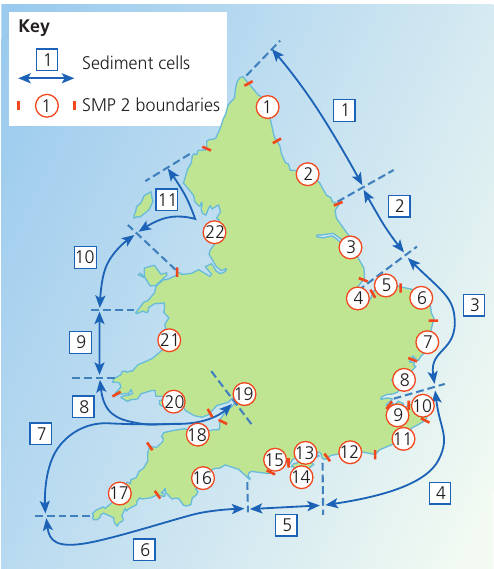
Planning timeframes
SMPs are designed to plan for three distinct time periods:
- Short term: 0-20 years
- Medium term: 20-50 years
- Long term: 50-100 years
This long-term perspective ensures that decisions made today don't create unsustainable problems for future generations. The plans are regularly reviewed and updated. In the 2010s, a second generation of plans (SMP2s) were produced, setting new targets and objectives based on updated information.
Key features and objectives of SMPs
SMPs serve multiple important functions for coastal management:
Risk assessment and planning
- They provide comprehensive assessments of the risks associated with how the coast is evolving
- They create frameworks for addressing risks to people, the built environment, historic sites and natural ecosystems
- They ensure risks are addressed in sustainable ways that don't simply transfer problems elsewhere or to future generations
Policy and long-term strategy
- They set the policy agenda for coastal defence management planning
- They promote management policies designed for the twenty-first century and beyond
- They incorporate 'route maps' that allow decision makers to adapt short and medium-term plans whilst maintaining long-term sustainability
Note
SMPs function as 'live' working documents. This means they're continually reviewed and updated in response to new information, changing conditions and evolving understanding of coastal processes. This adaptive approach is key to their success.
Environmental and technical standards
- They aim to be technically sustainable, environmentally acceptable and economically viable
- They ensure management plans comply with international and national nature conservation and biodiversity legislation
- They provide a foundation for future research and development of new coastal management strategies
Management units and coastal options
Important
A management unit is a stretch of coastline covered by a specific plan. Each management unit requires decisions about how it will be managed.
For each management unit, there are four possible approaches to coastal management. These represent fundamentally different philosophies about how to respond to coastal change.
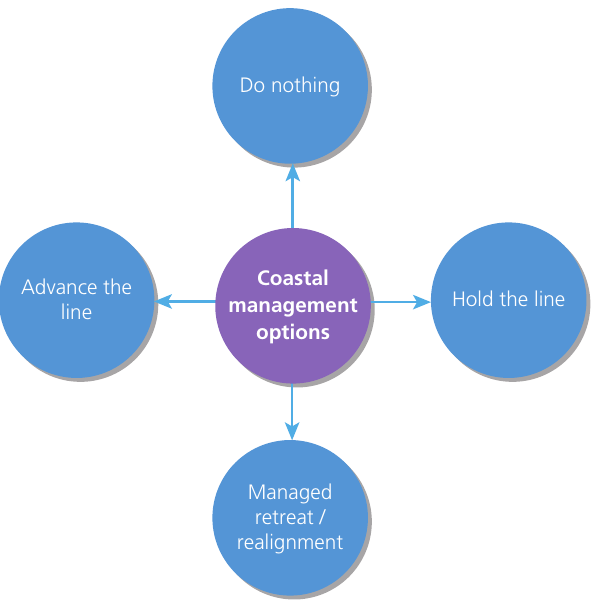
The four options are:
-
Do nothing - Allow natural coastal processes to occur without intervention. This may be appropriate for undeveloped areas or where intervention would be unsustainable.
-
Hold the line - Maintain the current coastline position by building or maintaining coastal defences. This protects existing development but can be expensive and may affect adjacent areas.
-
Advance the line - Build new defences seaward of the existing coastline. This is rare and very expensive, but may be justified for areas of exceptional value.
-
Managed retreat (or realignment) - Allow the coastline to move inland in a controlled way. This works with natural processes and can create valuable habitats, but requires land to be abandoned.
The choice between these options depends on multiple factors including economic value of the area, environmental importance, technical feasibility and sustainability over different time periods.
Integrated coastal zone management
Origins and development of ICZM
The term Integrated Coastal Zone Management (ICZM) originated from the UN Earth Summit held in Rio de Janeiro in 1992. This landmark conference recognised that coastal areas worldwide faced similar challenges and needed coordinated approaches. Following the summit, guidelines for ICZM were published in documents known as Agenda 21.
In subsequent decades, different organisations responsible for coastal governance developed their own policies and approaches for integrated coastal management. The European Commission has been particularly active in promoting ICZM across European coastal nations.
Why ICZM is necessary
Coastal zones are amongst the most ecologically productive areas on Earth. The natural assets of coastlines have made them extremely popular for human activities including settlements, tourist destinations, business centres and ports. Around 200 million people live near Europe's coastline alone.
However, this concentration of people and economic activity creates enormous pressure on the coastal environment, leading to:
- Biodiversity loss - Destruction of habitats and species
- Habitat destruction - Development removing natural coastal features
- Pollution - From industry, sewage and agriculture
- Conflicts between stakeholders - Different groups competing for space and resources
- Overcrowding - Too many activities in limited coastal space
- Excessive exploitation of natural resources - Unsustainable use of fish stocks, minerals and other resources
Note
These impacts are particularly serious in coastal zones because coasts are among the areas most vulnerable to climate change and natural hazards. Coastal areas face specific risks from flooding, erosion, sea level rise and extreme weather events, and the lives of people in many coastal communities are already changing due to these impacts.
The old 'sectoral approach' and its problems
Previously, coastal management often followed a sectoral approach. Under this system, local authorities made decisions for their stretch of coastline, and different agencies and interest groups managed their particular environment, cause or social group independently.
The European Commission identified that this created serious problems:
- Decisions made by different organisations undermined each other
- Resources were used inefficiently
- Sustainability objectives failed to be met
- Stakeholder interests were not coordinated
ICZM was developed specifically to overcome these fragmented approaches.
Key aims of ICZM
Important
Integrated coastal zone management aims for the coordinated application of different policies affecting the coastal zone. It covers activities including nature protection, aquaculture, fisheries, agriculture, industry, offshore wind energy, shipping, tourism, infrastructure development, and climate change mitigation and adaptation. ICZM contributes to sustainable development by using an ecosystem-based approach that respects the limits of natural resources and ecosystems.
The ecosystem-based approach is central to ICZM. Rather than maximising short-term economic benefits, this approach recognises that long-term human well-being depends on maintaining healthy ecosystems. For many coastal communities, the condition of the natural environment is crucial for economic prosperity, so protecting ecosystems is essential for sustainable development for generations to come.
ICZM aims to coordinate policies affecting multiple activities in coastal zones:
- Nature conservation and protection
- Aquaculture (farming marine organisms such as lobster farms)
- Fishing
- Agriculture
- Industry
- Offshore wind energy
- Shipping
- Tourism
- Infrastructure development
- Climate change mitigation and adaptation
By coordinating all these activities, ICZM seeks to reduce conflicts, use resources more efficiently and ensure that environmental limits are respected.
The ICZM management cycle
Important
Integrated coastal management covers the full cycle of information collection, planning, decision-making, management and monitoring of implementation. Involving all stakeholders across different sectors is essential to ensure broad support for management strategies.
When conducted properly, ICZM operates as a continuous cycle where each stage generates feedback that informs the following stage.
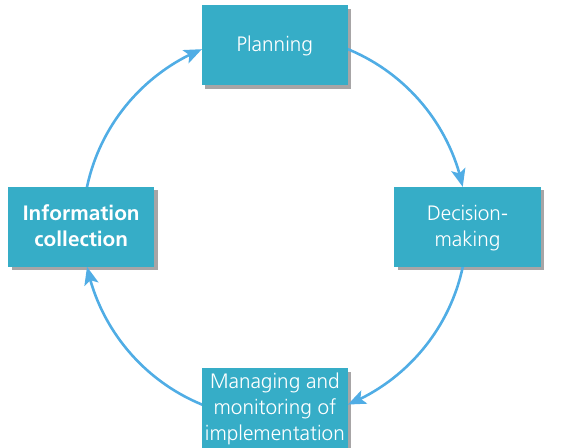
The four stages of the ICZM cycle are:
-
Information collection - Gathering data about coastal processes, ecosystems, human activities and stakeholder needs
-
Planning - Using collected information to develop strategies and policies
-
Decision-making - Choosing between different options and approaches
-
Managing and monitoring of implementation - Putting decisions into practice and tracking their effectiveness
The cycle then returns to information collection, as monitoring reveals new data that may require adjustments to plans and decisions. This adaptive approach allows management to evolve as understanding improves and conditions change.
Maritime spatial planning
Since 2013, the European Commission has developed an additional framework called Maritime Spatial Planning (MSP), building on ICZM principles. MSP adopts sophisticated land-use planning techniques, powerful GIS (Geographic Information Systems) and geo-spatial mapping methods.
Important
Maritime Spatial Planning (MSP) manages competing uses of maritime space including renewable energy equipment, aquaculture and other activities. MSP works across borders and sectors to ensure human activities at sea take place in an efficient, safe and sustainable way.
Competition for maritime space has intensified as new activities develop in coastal waters. Offshore wind farms, aquaculture facilities, shipping lanes, fishing areas, marine protected areas and other uses all require space. Without coordination, conflicts arise and waters are managed incoherently.
The advantages of MSP include:
- Reduced conflicts between stakeholders
- Encouragement of investment (by providing certainty about where activities can occur)
- Increased cross-border cooperation between nations
- Better protection of the environment
MSP represents the latest evolution in coastal management thinking, applying the principles of integration and sustainability to the marine environment as well as the coastline itself.
Remember!
Summary
Key Points to Remember:
-
Shoreline Management Plans (SMPs) provide integrated coastal management for 22 areas across England and Wales, planning for short (0-20), medium (20-50) and long term (50-100 years) using four management options: do nothing, hold the line, advance the line, or managed retreat.
-
SMPs work with natural systems by aligning with sediment cells rather than administrative boundaries, ensuring sustainable management based on how the coast actually functions.
-
Integrated Coastal Zone Management (ICZM) coordinates multiple policies and activities affecting coastal zones to avoid conflicts and achieve sustainable development through an ecosystem-based approach.
-
The ICZM cycle creates continuous improvement through information collection → planning → decision-making → managing and monitoring, with feedback informing future decisions.
-
Stakeholder involvement is essential for both SMPs and ICZM to work effectively, ensuring broad support and balancing different needs across nature conservation, economic activities and community well-being.