Waves (AQA A-Level Geography): Revision Notes
📚Revision Notes
Waves
Introduction to waves
Waves are the primary force that shapes our coastlines. They are created and driven by wind blowing across the ocean surface. Understanding how waves work is essential to understanding coastal processes and landform development.
Waves are formed through the transfer of energy from wind to water. When wind blows across the sea surface, it creates what is known as frictional drag. This friction transfers energy to the water, generating waves. The strength and characteristics of waves depend on several factors:
- Wind strength: Stronger winds create more powerful waves
- Duration: How long the wind blows for affects wave energy
- Fetch: The distance of open water over which wind blows uninterrupted by major land obstacles
Important
Fetch refers to the distance of open water over which wind blows without being blocked by land. A longer fetch allows more energy transfer from wind to water, creating larger and more powerful waves.
Wave characteristics and terminology
To understand waves properly, you need to know the key terms that describe their features.
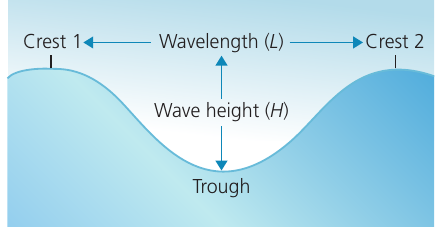
Wave height (amplitude)
This is the vertical distance between the crest (highest point) of a wave and the neighbouring trough (lowest point). Wave height determines how much energy a wave carries.
Note
The greater the wave height, the more energy the wave possesses and the greater its potential to erode or transport sediment.
Wavelength
This is the horizontal distance between successive wave crests. It's measured from one crest to the next crest. Wavelength can vary considerably depending on wave type.
Wave period
This is the time it takes for one complete wave to travel the distance of one wavelength. Alternatively, it's the time between one crest and the following crest passing a fixed point. Wave period is measured in seconds or minutes.
How waves move and break
As waves travel towards the shore, they undergo significant changes due to interaction with the seabed.
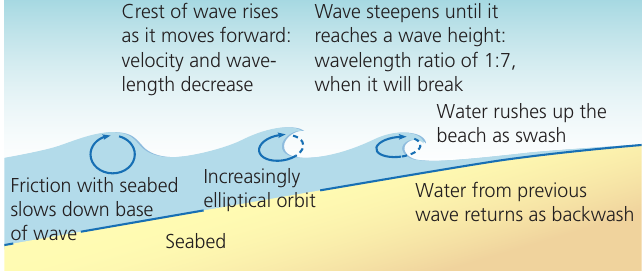
Wave behaviour in shallow water
When waves approach the coast and enter shallow water, friction develops between the wave base and the seabed. This friction causes several important changes:
- The base of the wave slows down due to drag with the seabed
- The crest of the wave continues moving forward at a faster speed
- Wave velocity and wavelength both decrease
- The water particles move in increasingly elliptical (oval-shaped) orbits rather than circular ones
Note
The transition from deep to shallow water fundamentally changes wave behaviour. In deep water, water particles move in circular orbits, but as the wave enters shallow water and experiences friction, these orbits become progressively more elliptical until they become almost horizontal at the seabed.
Wave breaking
As the wave continues into shallower water, it becomes progressively steeper. When the wave reaches a critical steepness ratio of approximately 1:7 (wave height to wavelength), it becomes unstable. At this point, the wave crest plunges forward and the wave 'breaks' onto the shore.
Swash and backwash
Once a wave breaks, the water rushes up the beach slope. This movement is called swash.
Important
Swash is the rush of water up the beach after a wave breaks. It carries sediment and energy up the beach slope.
After reaching its maximum point up the beach, gravity pulls the water back down towards the sea. This return flow is called backwash.
Important
Backwash is the action of water receding back down the beach towards the sea. It carries sediment and energy back down the slope.
The balance between swash and backwash determines whether a beach gains or loses sediment.
Types of waves
Waves can be classified into two main types based on their characteristics and effects: constructive waves and destructive waves.
Constructive waves
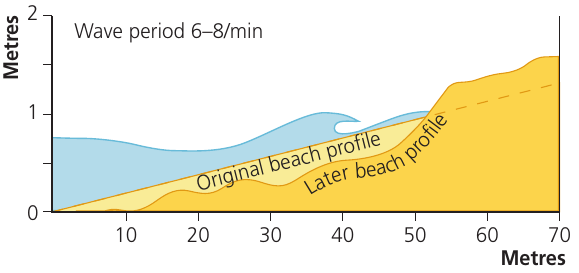
Important
Constructive waves are waves with a low wave height but with a long wavelength and low frequency of around 6-8 waves per minute. Their swash tends to be more powerful than their backwash, and as a consequence, beach material is built up.
Constructive waves have several distinctive features:
- Low wave height but long wavelength (often up to 100 metres)
- Low frequency, typically 6-8 waves per minute
- Gentle approach to the beach
- Wave front steepens only slowly as it approaches shore
- Strong swash that carries material up the beach
- Weak backwash that lacks sufficient force to remove sediment
Effects on the beach
Because the swash is stronger than the backwash, constructive waves transport more material up the beach than they remove. This leads to:
- Net deposition of sediment
- Building up of beach material
- Formation of gently sloping beach profiles
- Creation of berms (ridges of deposited material on the upper beach)
Note
The beach profile becomes steeper over time as material accumulates. Constructive waves are associated with calmer weather conditions and result in the gradual building of beaches through the dominance of swash over backwash.
Destructive waves
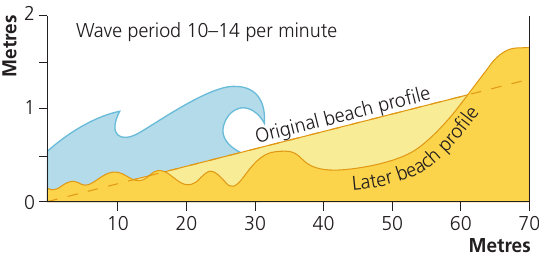
Important
Destructive waves are waves with a high wave height with a steep form and high frequency (10-14 waves per minute). Their backwash is generally stronger than their swash, so more sediment is removed than is added.
Destructive waves have contrasting characteristics to constructive waves:
- High wave height with a steep form
- High frequency, typically 10-14 waves per minute
- Rapid steepening as they approach the beach
- Plunge down when breaking, creating a powerful impact
- Weak swash with little forward movement of water
- Strong backwash that pulls material down the beach
Effects on the beach
The powerful backwash removes more material than the swash deposits, resulting in:
- Net erosion of beach sediment
- Lowering of the beach profile
- Steeper beach profiles
- Formation of a storm beach (a large ridge of shingle at the rear of the beach)
- Material being pulled back down and deposited offshore
Note
Destructive waves are commonly associated with stormy weather and are highly erosive. The dominance of backwash over swash means that sediment is continually transported down the beach and offshore, leading to beach erosion.
The cycle of wave activity
Most beaches experience an alternating cycle of constructive and destructive waves. Constructive waves gradually build up the beach, creating a steeper profile. However, as the beach steepens, it becomes more vulnerable to destructive waves. When stormy conditions bring destructive waves, they erode the beach, moving material back towards the sea and reducing the beach angle. This encourages a return to constructive wave activity.
Note
This pattern is an example of negative feedback - a process that works to maintain dynamic equilibrium (a state of balance). However, this equilibrium is often difficult to maintain because factors such as wind strength and direction constantly change.
Wave refraction
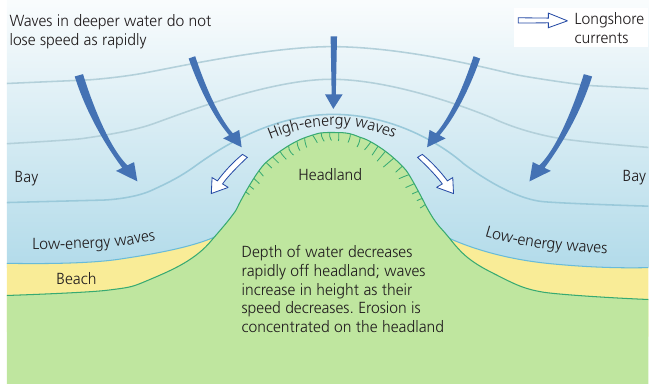
Wave refraction is a crucial process that affects how wave energy is distributed along irregular coastlines.
The refraction process
When waves approach a coastline that has an irregular shape (such as headlands and bays), they don't arrive uniformly. Here's what happens:
In deeper water (away from the coast):
- Waves maintain their speed and direction
- Wave fronts are relatively straight and parallel to each other
As waves approach irregular coastline:
- The part of the wave approaching shallow water (near a headland) experiences friction with the seabed first
- This section slows down while the rest of the wave in deeper water continues at normal speed
- The wave 'bends' or refracts to become more parallel to the coastline
- Wave height and steepness increase in shallower areas
Effects on headlands and bays
Wave refraction has important consequences for coastal erosion and deposition:
At headlands:
- Waves converge and concentrate their energy
- Wave height increases significantly
- High-energy waves cause intense erosion
- Headlands experience the greatest rates of erosion
In bays:
- Waves diverge and energy is spread out
- Low-energy waves result
- Deposition of sediment occurs
- Beaches tend to build up in bay areas
Example
Worked Example: Energy Distribution at a Headland
Consider a wave front approaching a headland:
- In deep water: Wave has uniform energy across its entire front
- As it approaches: The sections near the headland slow down due to shallow water friction
- Result: The wave front bends around the headland, concentrating energy on the headland's sides
- Outcome: Concentrated wave energy leads to erosion rates 2-3 times higher at headlands compared to adjacent bays
Longshore currents
As waves pile up against a headland, they may create a slight local rise in sea level. This can generate a longshore current that flows away from the headland towards adjacent bays. This current transports some of the eroded material from the headland, contributing to sediment deposition in the bays and helping to build up beaches.
Summary
Key Points to Remember:
-
Waves are the primary agent of coastal change, formed by wind energy transfer to water across a fetch.
-
Wave characteristics matter: constructive waves (low height, long wavelength, 6-8/min) build beaches through strong swash, while destructive waves (high height, steep form, 10-14/min) erode beaches through powerful backwash.
-
Wave breaking occurs when waves enter shallow water, friction slows the base, and the wave becomes too steep (1:7 ratio), causing it to plunge forward.
-
Wave refraction concentrates energy: waves bend around irregular coastlines, focusing high energy on headlands (causing erosion) while low-energy waves in bays encourage deposition.
-
Beaches alternate between constructive and destructive phases, creating a dynamic equilibrium that constantly adjusts to changing conditions.