Biodiversity (AQA A-Level Geography): Revision Notes
📚Revision Notes
Biodiversity
What is biodiversity?
Protecting biodiversity isn't only the responsibility of governments and international organisations. The private sector and every individual person has a role to play in changing harmful attitudes and ending destructive behaviours.
Important
Biodiversity (short for biological diversity) describes the entire variety of life on Earth. It includes the diversity of all living organisms (from humans to micro-organisms), the diversity of habitats where they live, and the genetic variation between individuals within each species.
All these elements form part of the global ecosystem - Earth's complete collection of living organisms and their environment. Ecosystems provide the foundation for life support systems, including food provision, clean air and water, climate regulation, disease control and many other services. Biodiversity underpins healthy ecosystems.
Measuring biodiversity
Why is measurement challenging?
From the broad definition above, it becomes clear that no single measurement can fully represent biodiversity. This is because measuring biodiversity involves two key components:
- The number of entities (for example, the number of individual organisms, the number of species, or the number of different habitats)
- The degree of difference (dissimilarity) between those entities
Measurements are commonly used to provide evidence for conservation needs or for general planning purposes. Often indicator species are used to assess biodiversity.
Note
Indicator species are organisms used to assess the health of ecosystems. For example, stoneflies are found in clean, fast-moving streams with gravel or stone bottoms. The presence of stonefly nymphs indicates highly oxygenated (healthy) water. Similarly, mussels serve as indicators for measuring the health of coastal environments worldwide.
This method can be very useful, but it introduces an element of how we value different components of biodiversity. For example, we are more likely to use the abundance of birds or butterflies on a farm as a measure of biodiversity than the richness of microbes in the soil.
Species richness
Important
Species richness refers to the number of different species present in an area. It tells us how many different species exist but does not provide information about the frequency or abundance of individuals within each species.
Advantages of species richness:
- It has proven to be measurable in practice - it is a doable measure
- Extensive information already exists on patterns in species richness, which has been made available in scientific literature, allowing comparisons over time
- Species richness serves as a proxy measure for many other types of variation in biodiversity. Generally, greater numbers of species indicate more genetic diversity (through a greater diversity of genes in populations), more species diversity, and greater ecological diversity
- It is commonly viewed as the unit of practical management and is most easily applied to legislation and political debate. For a wide range of people, variation in biodiversity is pictured as variation in species richness
Disadvantages of species richness:
- There is a lack of agreement about what actually constitutes a species. For example, it is not an adequate method for defining single-cell organisms
- Some assemblages of organisms may be very closely related (for example, two species of rat), whilst others are highly diverse (for example, a species of rat and a species of snail)
Living Planet Index (LPI)
A more recently developed measure of biodiversity is the Living Planet Index (LPI). The LPI measures trends in thousands of vertebrate species populations and provides information on changes in the abundance of the world's vertebrates. It can quickly convey information about which habitats or ecosystems have species that are declining most rapidly. This information can be used to define the impact humans are having on the planet and for guiding actions to address biodiversity loss.
Global trends in biodiversity
Historical perspective
Over Earth's geological history, global biodiversity has gradually increased from when life began around 550 million years ago. During that time, there have been five episodes of mass extinctions (for example, the end of the dinosaurs approximately 65 million years ago).
Important
Some modern scientists believe that we are now living through another period of mass extinction - caused by human activity.
Current decline statistics
Population sizes of animal species measured by the LPI have declined overall by 60 per cent between 1970 and 2014. This decline has continued rapidly since then.
Biodiversity is declining in both temperate and tropical regions, but the decline is greater in the tropics - particularly in South America (with a fall of 89 per cent). Key statistics include:
- The tropical LPI showed a 56 per cent reduction in 3,811 populations of 1,638 species from 1970 to 2010
- The 6,569 populations of 1,606 species in the temperate LPI declined by 36 per cent over the same period
- Latin America shows the most dramatic decline of 83 per cent
The LPI for freshwater species shows an average decline of 83 per cent. The main threats to freshwater species are habitat loss and fragmentation, pollution and invasive species. Changes to water levels and freshwater system connectivity - for example, through irrigation and hydropower dams - have a major impact on freshwater habitats.
Marine species declined by more than half between 1975 and 2015. The period from 1970 through to the mid-1980s experienced the steepest decline, after which there was some stability, before another period of decline. The steepest declines can be seen in the tropics and the Southern Ocean - species in decline include marine turtles, many sharks and large migratory seabirds like the wandering albatross.
Threats to biodiversity
Exploitation through hunting and fishing, and habitat degradation and loss are the main causes of decline. Climate change is the next most common primary threat, and is likely to put more pressure on populations in the future.
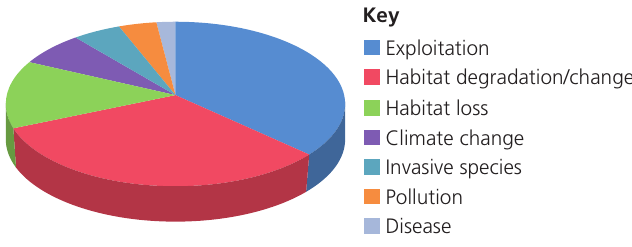
According to the Intergovernmental Science-Policy Platform on Biodiversity and Ecosystem Services (IPBES), since 1900, the average abundance of native land-based species has declined by at least 20 per cent. This trend shows no sign of slowing down. The loss of habitat for human land use - particularly for agriculture, urban development and energy production - continues to be a major threat, made worse by hunting.
Important
Many species have completely disappeared from areas dominated by human influences. Even in protected areas, native species are often out-competed or consumed by organisms introduced from elsewhere. Extinction is a natural process, but it is occurring at an unnaturally rapid rate as a consequence of human activities. Already we have caused the extinction of 5-20 per cent of species in many groups of organisms, and current rates of extinction are estimated to be 100-1,000 times greater than pre-human rates.
Human contributions to biodiversity change
Human activities contribute to changing biodiversity through multiple interconnected pathways:
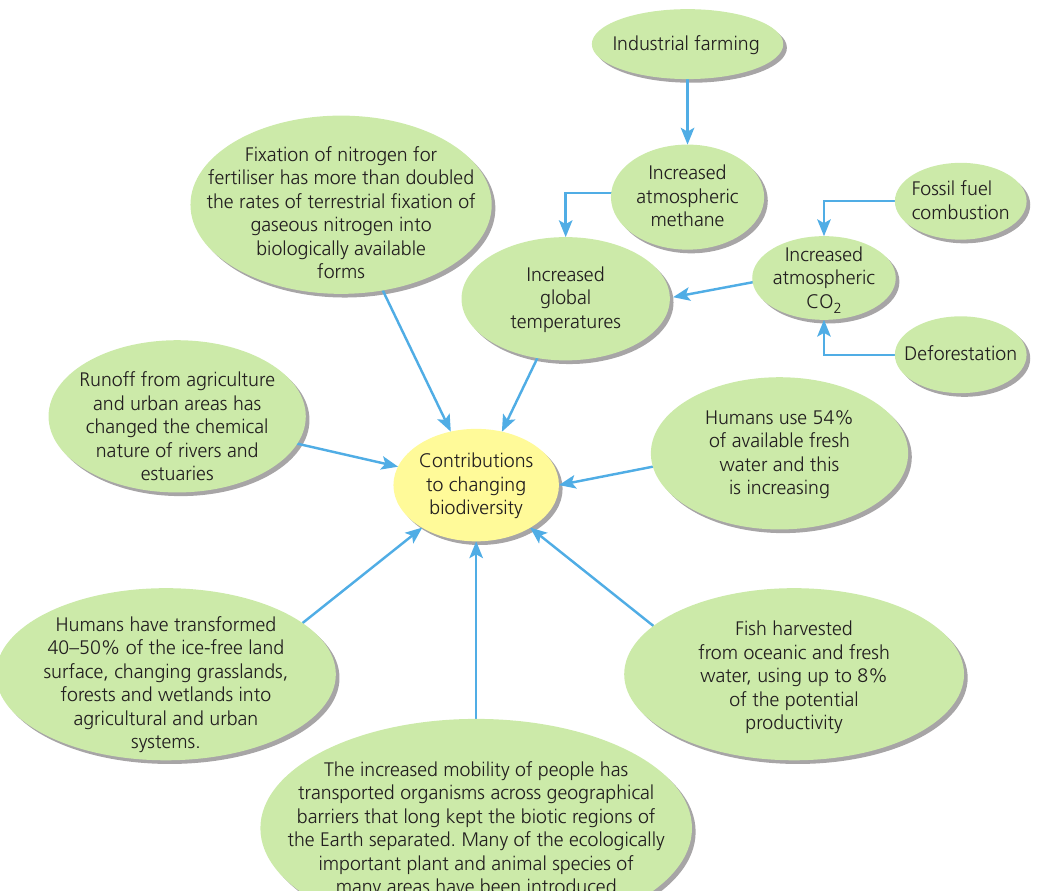
The diagram illustrates how various human activities create cascading effects on biodiversity:
- Industrial farming increases atmospheric methane and involves nitrogen fixation for fertilisers, which has more than doubled terrestrial fixation rates of gaseous nitrogen into biologically available forms
- Fossil fuel combustion and deforestation increase atmospheric CO₂, leading to increased global temperatures
- Agricultural runoff from urban areas changes the chemical nature of rivers and estuaries
- Land transformation: Humans have transformed 40-50 per cent of the ice-free land surface, changing grasslands, forests and wetlands into agricultural and urban systems
- Water consumption: Humans use 54 per cent of available freshwater, and this is increasing
- Fishing: Fish are harvested from oceanic and freshwater systems, using up to 8 per cent of the potential productivity
- Species transportation: The increased mobility of people has transported organisms across geographical barriers that long kept the biotic regions of Earth separated. Many ecologically important plant and animal species have been introduced to new areas in historic time
Case study: Blanket bog habitat in the UK
What are blanket bogs?
One of the most extensive semi-natural habitats in the UK is blanket bog. It ranges from Dartmoor in the south to Shetland in the north. It is a globally restricted peatland habitat confined to cool, wet, typically oceanic climates. Blanket bogs comprise generally upland peat bogs that are fed by rainfall alone.
Peat is an accumulation of dead organic material, mainly plant remains, that is unable to break down because of the wet, acidic and cold conditions in which it is found. These peat bogs take thousands of years to form and support mosses, insects, rare birds and even carnivorous plants. Peat depth is very variable, with an average of 0.5-3 metres being fairly typical.
Note
Because peat is essentially semi-decomposed plant matter, it represents a huge carbon store. More carbon is stored in UK peat than in all the forests in Britain and France combined. When these habitats are healthy, and peat is actively forming, they are building up carbon, so they have an important role to play in helping to combat climate change.
Kinder Scout, Derbyshire
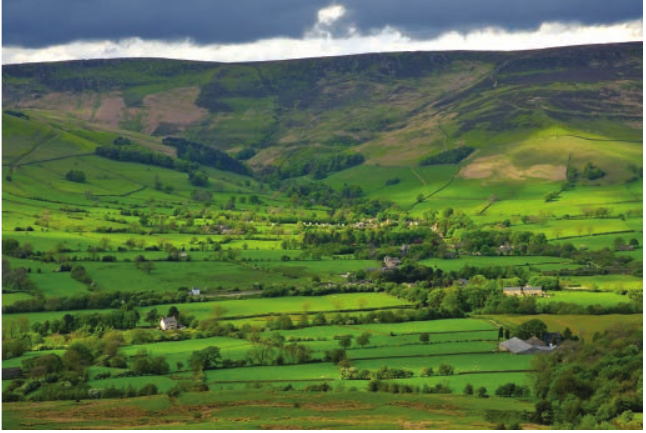
One area of blanket bog is Kinder Scout, Derbyshire. Kinder Scout is an area of moorland and National Nature Reserve in the Dark Peak of the Derbyshire Peak District in England. Part of the moor, at 636 metres above sea level, is the highest point in the Peak District. The 7,000-year-old blanket peat bog sits on top of a plateau, formed from horizontal layers of an impermeable sandstone called Millstone Grit. The land is owned and managed by the National Trust.
Remember!
Summary
Key Points to Remember:
-
Biodiversity encompasses three levels: species diversity, habitat diversity, and genetic diversity within species. All three components are essential for healthy ecosystems.
-
Species richness is a useful but imperfect measure - it's practical and widely used, but doesn't capture the full complexity of biodiversity or provide information about population sizes.
-
Global biodiversity is declining at an alarming rate - animal populations have fallen by 60% since 1970, with tropical regions and freshwater habitats experiencing the steepest declines (83% in Latin America and freshwater systems).
-
Exploitation and habitat loss are the primary threats to biodiversity, followed by climate change, invasive species, pollution and disease. Human activities are causing extinction rates 100-1,000 times higher than pre-human levels.
-
UK blanket bogs are globally important habitats that store more carbon than Britain and France's forests combined, demonstrating how biodiversity conservation connects directly to climate change mitigation.