Climatic Climax, Sub-climax and Plagioclimax (AQA A-Level Geography): Revision Notes
📚Revision Notes
Climatic Climax, Sub-climax and Plagioclimax
Understanding climatic climax
At the end of ecological succession, an ecosystem theoretically reaches its final, stable stage. This is known as the climatic climax community.
Important
Climatic climax community
Climatic climax is the final stage in succession. It represents a stable community of plants and animals that has reached a state of balance (equilibrium) within a particular area. The climate of the region determines which species dominate this community.
In this stable state:
- The community is in equilibrium with its environment
- Species composition remains relatively constant over time
- The dominant plant species are determined by the prevailing climate
The UK example
The British Isles sits within a temperate deciduous forest biome. Therefore, the natural climatic climax community for most of England and Wales would be broad-leaved deciduous forest dominated by oak and ash trees.
Note
Most ecologists recognise that achieving a true climatic climax requires exceptionally long timeframes. In reality, natural disruptions and environmental changes happen so frequently that reaching this stable endpoint is unlikely. Despite this limitation, the concept remains useful as a theoretical framework for understanding ecosystem development.
Local variations
At a local scale, the situation becomes more complex. Where local factors such as soil type, drainage patterns, or topography differ from regional norms, different communities develop:
- Heather moorland in upland areas
- Coniferous forest where soil conditions favour needle-leaved trees
- Marshland in poorly drained lowland areas
- Alpine communities in montane (mountain) environments
These local climax communities reflect how soil, drainage, and relief factors can override the broader climatic influence.
Human impact on primary forest
Human activity over thousands of years has removed almost all of the UK's original primary forest. These ancient forests have been replaced by:
- Agricultural land
- Plantations
- Areas of secondary growth (forests that have regrown after clearance)
Sub-climax communities
At any point during succession, an arresting factor can halt the ecosystem's development. When this happens, the result is a sub-climax community.
Important
Sub-climax
A sub-climax is a community where succession has been stopped before reaching the climatic climax. The ecosystem becomes 'stuck' at an earlier stage because an arresting factor prevents further development.
The arresting factor can:
- Occur suddenly (like a landslide) or gradually (like slow drainage changes)
- Have a permanent effect or be temporary
- Be natural or human-caused
When succession is halted, the climatic climax is not reached. Instead, the ecosystem stabilises at an earlier stage.
Types of arresting factors
Four main types of arresting factors can create sub-climax communities:
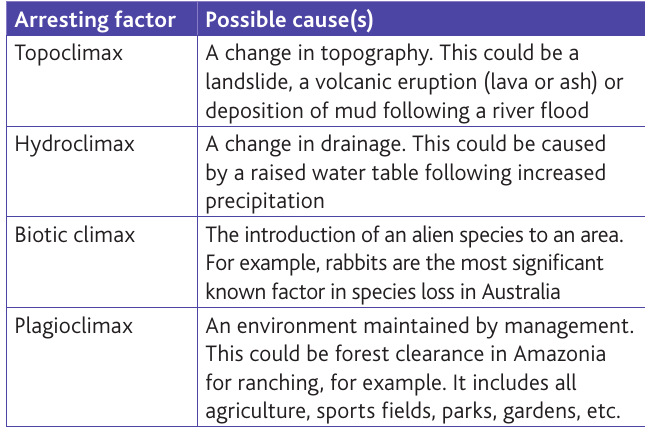
Topoclimax
A topoclimax occurs when topographical changes disrupt succession. Examples include:
- Landslides that strip away vegetation and soil
- Volcanic eruptions depositing lava or ash
- River floods depositing thick layers of mud
Note
These events can reset succession or create conditions that prevent the climatic climax from developing. The physical landscape itself becomes the primary factor controlling ecosystem development.
Hydroclimax
A hydroclimax results from changes in water availability. This might involve:
- Changes in drainage patterns
- Fluctuations in the water table (the level of groundwater)
- Altered precipitation patterns (increased or decreased rainfall)
Example
Worked Example: Hydroclimax Development
Consider an area that was previously suitable for forest growth:
Step 1: Increased precipitation raises the water table
- Groundwater levels rise closer to the surface
Step 2: Soil becomes waterlogged
- Tree roots cannot access sufficient oxygen
- Existing trees die or fail to regenerate
Step 3: Wetland community establishes
- Water-tolerant species (reeds, sedges) colonise
- The ecosystem stabilises as a wetland rather than progressing to forest
This demonstrates how water availability can permanently arrest succession at an earlier stage.
Biotic climax
A biotic climax occurs when alien (non-native) species are introduced to an area. These invasive species can:
- Outcompete native species
- Alter the habitat
- Prevent the native climatic climax from developing
Important
A significant example is the introduction of rabbits to Australia. Rabbits have become the most important known factor in species loss in Australia, demonstrating how a single alien species can dramatically alter ecosystem development.
Plagioclimax communities
Plagioclimax is a specific type of sub-climax that deserves special attention. It represents communities that are created and maintained by human activity.
Important
Plagioclimax
A plagioclimax is an ecosystem maintained by planned or unplanned human activity. Succession has either been halted before reaching climatic climax, or the ecosystem has been deflected toward a different community composition entirely.
Human activities creating plagioclimax
Plagioclimax communities result from various human actions:
- Cutting down existing vegetation for agriculture or development
- Burning vegetation (for example, to clear forest land)
- Planting trees or crops instead of allowing natural vegetation
- Grazing by domesticated animals (such as goats in Mediterranean regions)
- Draining wetland for agriculture or construction
Examples of plagioclimax
Common plagioclimax communities include:
- Forest clearance in Amazonia for ranching or agriculture
- Agricultural fields and croplands
- Sports fields and golf courses
- Parks and gardens
- Managed grasslands for livestock
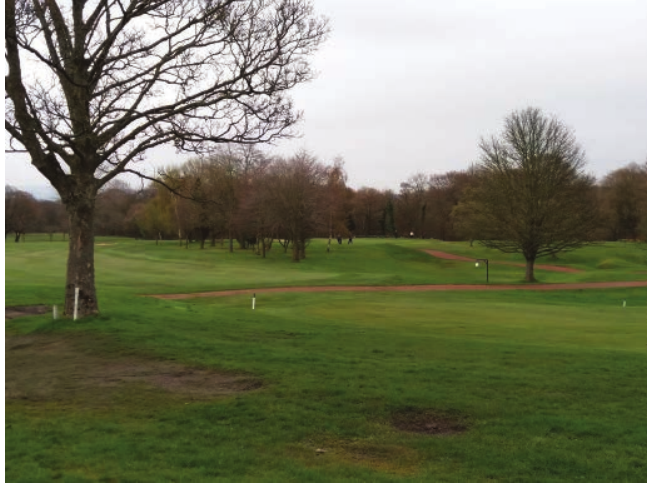
Note
Golf courses are classic examples of plagioclimax. They require constant human management through mowing, watering, fertilising, and pest control to maintain their appearance. Without this continuous intervention, natural succession would gradually transform the manicured grass into scrubland and eventually woodland.
Duration and reversibility
The key characteristic of plagioclimax is that it persists only as long as human management continues. If human activity stops:
- Succession will resume its natural progression
- The ecosystem will move toward the climatic climax
- This happens unless there has been a permanent change to environmental conditions
Example
Worked Example: Plagioclimax Reversibility
Consider an abandoned golf course:
Scenario A - Reversible plagioclimax:
- Golf course is abandoned
- Soil structure remains intact
- Natural seed sources nearby
- Result: Secondary succession resumes, progressing through grassland → scrub → woodland stages toward climatic climax
Scenario B - Irreversible change:
- Golf course built on drained wetland
- Drainage systems permanently altered water table
- Soil chemistry changed by fertilisers
- Result: Succession follows a different path, unable to return to original wetland climax
Relationships between succession types
The diagram below shows how different types of succession and climax communities relate to each other:
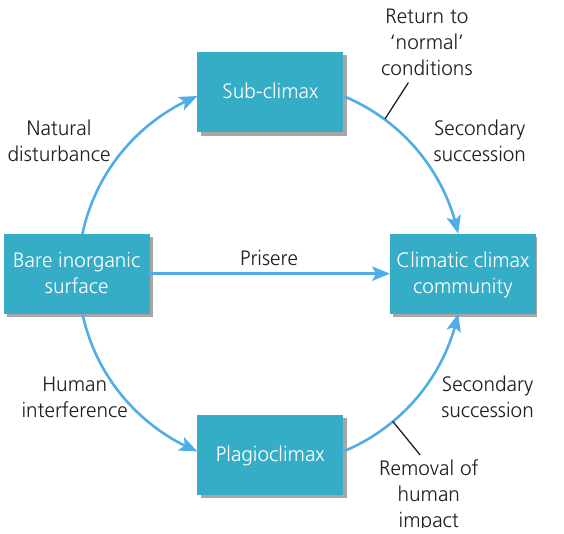
Starting from a bare inorganic surface:
- Primary succession (prisere) leads toward the climatic climax community
- Natural disturbance can create a sub-climax, from which succession can return to 'normal' conditions through secondary succession
- Human interference creates a plagioclimax
- Removing human impact allows secondary succession to resume toward the climatic climax
- However, if environmental conditions have permanently changed, the ecosystem may not return to the original climatic climax path
Note
This diagram illustrates that:
- Multiple pathways exist in ecosystem development
- Disturbances can temporarily or permanently alter succession
- Human management creates a distinct category of arrested development
- Recovery is possible if conditions allow
Summary
Key Points to Remember:
-
Climatic climax is the theoretical endpoint of succession—a stable community in equilibrium with its environment. In the UK, this would be temperate deciduous forest dominated by oak and ash, but it's rarely achieved due to frequent disturbances.
-
Sub-climax occurs when an arresting factor halts succession before reaching the climatic climax. Four types exist: topoclimax (topography changes), hydroclimax (drainage changes), biotic climax (alien species), and plagioclimax (human activity).
-
Plagioclimax is specifically created by human management such as agriculture, sports fields, and forest clearance. It persists only whilst human activity continues.
-
Arresting factors can be natural or human-caused, sudden or gradual, and temporary or permanent. They prevent ecosystems from reaching their climatic climax.
-
If human management ceases and environmental conditions haven't permanently changed, secondary succession can resume, allowing the ecosystem to progress toward its natural climatic climax.