Human Exploitation of the Global Environment (AQA A-Level Geography): Revision Notes
📚Revision Notes
Human exploitation of the global environment
Introduction: The scale of human impact
Human activities have dramatically reshaped our planet over the past 60 years. Understanding these changes is essential to grasp how ecosystems worldwide face increasing pressure.
Between 1960 and 2020, the world's population more than doubled, rising from 3 billion to nearly 7.7 billion people. This growth represents an increase of over 150%. Projections suggest the global population will reach 10 billion by 2050. Whilst low-income countries have experienced most of this population growth historically, patterns are now shifting. Some high-income nations like the USA continue to see significant population increases, whilst certain developing countries such as China, Thailand, North Korea and South Korea now have very low growth rates.
Note
The rate of economic expansion has actually outpaced population growth. This means that the environmental impact per person has increased dramatically, as both population numbers and per capita consumption have risen simultaneously.
Economic activity has expanded even more rapidly than population. According to World Bank data, global economic output increased by over 800% between 1960 and 2020, despite a downturn in 2006. This tremendous growth has quadrupled average income per person during this period.
Rising incomes fundamentally alter consumption patterns, with major implications for ecosystems:
- As people become wealthier, they spend proportionally less income on food
- Consumption of goods and services increases overall
- Dietary composition shifts away from starchy staples (rice, wheat, potatoes) towards fat, meat, fish, fruits and vegetables
These consumption changes create wide-ranging potential effects on ecosystems worldwide.
Impact of science and technology on ecosystems
Agricultural productivity increases
Scientific and technological advances have most dramatically impacted ecosystems through food production. Over the past 40 years, agricultural output has increased substantially, but this growth has come primarily from improved yields per hectare rather than expanding the area under cultivation.
The yield increases have been remarkable:
- Wheat yields rose over 200%
- Rice yields increased over 100%
- Maize yields grew nearly 160%
These improvements occurred in the 40-year period leading to 2015.
Note
These dramatic yield increases were achieved through a combination of factors including improved crop varieties, better irrigation systems, increased use of fertilisers and pesticides, and more efficient farming practices. However, these gains have not come without environmental costs.
Unintended environmental consequences
However, these productivity gains have created significant environmental problems:
Important
Eutrophication is a process affecting freshwater and coastal marine ecosystems caused by excessive application of inorganic fertilisers. This leads to nutrient enrichment of water bodies. (Full details on page 246)
Hypoxia in coastal marine ecosystems similarly results from excessive fertiliser application, creating oxygen-depleted zones where marine life struggles to survive.
Impact on marine ecosystems
Advances in fishing technologies have contributed significantly to the depletion of marine fish stocks. Modern fishing equipment allows vessels to catch fish more efficiently than ever before, but this has led to overfishing and the collapse of many fish populations worldwide.
Direct drivers of ecosystem change
Two main factors directly drive changes in terrestrial ecosystems:
Land-use change
The conversion of natural vegetation to agricultural land represents the most significant direct impact on terrestrial ecosystems. Currently, approximately 11% of Earth's land surface is used for crop production. However, roughly 36% of the planet's land is estimated to be suitable for growing crops, suggesting potential for further expansion.
Note
The difference between land currently used for crops (11%) and land suitable for crops (36%) highlights both the potential for agricultural expansion and the threat this poses to remaining natural ecosystems. This expansion pressure is one of the key drivers of habitat loss worldwide.
New technologies
Modern technologies have significantly increased the exploitation of both farmland and timber stocks. Mechanisation, improved crop varieties, and intensive management practices have allowed humans to extract more resources from existing land whilst also making previously unsuitable areas viable for exploitation.
Global-scale environmental impacts
Deforestation and forest degradation
Forests worldwide face severe pressure from human activities. Deforestation and forest degradation currently affect almost 10% of the world's remaining forests, resulting in an annual loss of 7.6 million hectares.
This loss is particularly concerning in tropical rainforests. For example, 17% of the Amazon rainforest has been lost in just 50 years. Data on the status of boreal forests (northern forests in cold climates) is limited, but the available evidence suggests these losses may also be significant.
Important
The loss of tropical rainforests is especially critical because these ecosystems contain the highest biodiversity on Earth. The Amazon alone is home to approximately 10% of all species on the planet, making its degradation a global conservation priority.
Beyond tropical regions, approximately 10% of the world's arid lands are considered degraded, with the majority of these areas located in Asia.
Freshwater ecosystem impacts
Freshwater ecosystems have been affected by multiple human pressures:
- Water abstraction reduces river flows and lowers water tables
- Invasive species introduction represents one of the major causes of species extinction in freshwater systems
- Pollution, particularly high levels of fertiliser runoff
Important
Invasive species are non-native organisms introduced to an ecosystem where they can outcompete native species, often causing significant ecological damage.
Example
Case Study: American Signal Crayfish in Britain
After the American signal crayfish was introduced to Britain, it drastically reduced the population of the native white-clawed crayfish by more than 50%. This demonstrates how a single invasive species can devastate native populations.
The now-endangered white-clawed crayfish serves as a stark example of the consequences of introducing non-native species to freshwater ecosystems. The American signal crayfish outcompetes the native species for food and habitat, and also carries a disease (crayfish plague) that is fatal to the white-clawed crayfish.
Local ecosystems: Ponds
What are ponds?
A pond represents a distinctive type of local ecosystem found throughout the UK. The Department for Environment, Food and Rural Affairs (Defra) defined ponds in their Biodiversity Action Plan (BAP) as follows:
Important
Biodiversity Action Plan (BAP) classification: Ponds are small, permanent or seasonal water bodies up to two hectares in size.
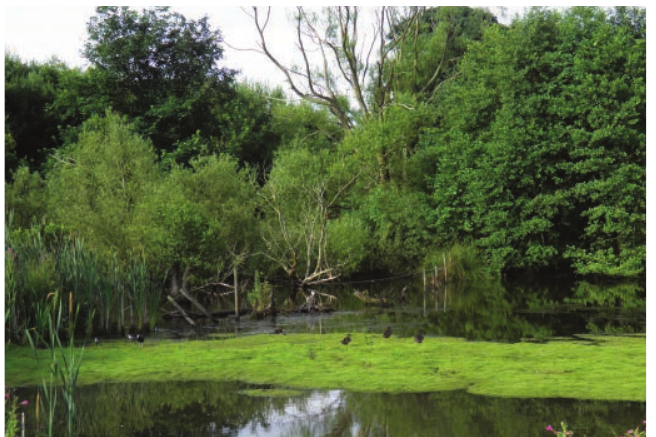
Ponds form in depressions where water collects. They are typically quiet environments with shallow depth, distinguishing them from larger, deeper lakes.
Key characteristics
The shallow depth of ponds creates unique ecological conditions:
- Sunlight can penetrate to the bottom
- This light availability allows plants to grow throughout the water column
- Some pond plants (flora) grow entirely underwater
- Others grow partially on the surface
- Marginal plants such as reeds and bulrushes grow along the pond edges
Note
This variety of growing conditions supports diverse plant communities, which in turn provide habitat for numerous animal species, making ponds important centres of biodiversity despite their small size. Ponds often support more species per unit area than rivers or lakes, making them disproportionately valuable for conservation.
Summary
Key Points to Remember:
-
Global population has more than doubled since 1960 (3 billion to 7.7 billion), with projection of 10 billion by 2050, whilst economic activity increased by over 800%.
-
Agricultural productivity gains (wheat yields up 200%, rice 100%, maize 160%) have come mainly from improved yields rather than land expansion, but have caused environmental problems like eutrophication and hypoxia.
-
Deforestation affects 10% of remaining forests with 7.6 million hectares lost annually; tropical rainforests like the Amazon have lost 17% in 50 years.
-
Freshwater ecosystems face threats from water abstraction, invasive species (such as American signal crayfish reducing native populations by 50%), and pollution from fertiliser runoff.
-
Ponds (defined as water bodies up to 2 hectares) are important local ecosystems with shallow depths that allow sunlight penetration, supporting diverse plant communities including underwater flora, surface plants, and marginal vegetation.