Marine Ecosystems: Coral Reefs (AQA A-Level Geography): Revision Notes
📚Revision Notes
Marine Ecosystems: Coral Reefs
Introduction to marine ecosystems
Marine ecosystems represent the planet's most extensive ecosystem type, with oceans and seas covering approximately 70% of Earth's surface. This vast aquatic environment encompasses numerous smaller ecosystems, including:
- Rocky shores and coastlines
- Salt marshes and estuaries
- Submarine canyons
- Hydrothermal vents
- Deep ocean basins
- Seamounts
- Coral reefs
Note
Among these diverse marine environments, coral reef ecosystems are particularly significant due to their extraordinary biodiversity and the critical ecosystem services they provide to both marine life and human communities.
What are coral reefs?
Coral reefs are underwater structures made of calcium carbonate (limestone) that is extracted from seawater by colonies of coral polyps and coralline algae.
The visible reef structure consists of living coral polyps building upon foundations of dead coral skeletons. Over time, successive generations create layers of limestone, gradually forming massive reef structures. For example, Australia's Great Barrier Reef stretches 2,000 km and took approximately 5 million years to develop.
Types of coral reefs
Corals can be divided into two broad categories based on their environmental requirements and locations.
Deep-sea cold-water coral reefs
These reefs represent a relatively recent scientific discovery, found primarily around Europe's margins. Key characteristics include:
Location and environment:
- Situated in deeper, nutrient-rich waters at high latitudes
- Found where strong ocean currents accelerate water movement and prevent sediment accumulation
- Located along northwest European continental margins, within Scandinavian fjords, and in some Mediterranean areas
Species and growth:
- Dominated by colonial stony corals such as Lophelia pertusa and Madrepora oculata
- Grow very slowly at rates of 5-25 mm per year
- Despite slow growth, they form extensive reef structures over time
- The largest discovered cold-water reef sits off Norway's Røst Island, measuring 40 km long and 2-3 km wide
Note
Cold vs. Warm Water Growth Rates
The stark difference in growth rates between cold-water (5-25 mm/year) and tropical coral reefs (1-100 cm/year) reflects the influence of temperature and symbiotic relationships on coral metabolism and reef-building capacity.
Tropical coral reefs
Tropical reefs are the most well-known and biodiverse coral ecosystems. They occur between 30° north and 30° south of the Equator, where surface water temperatures remain above 16°C year-round.
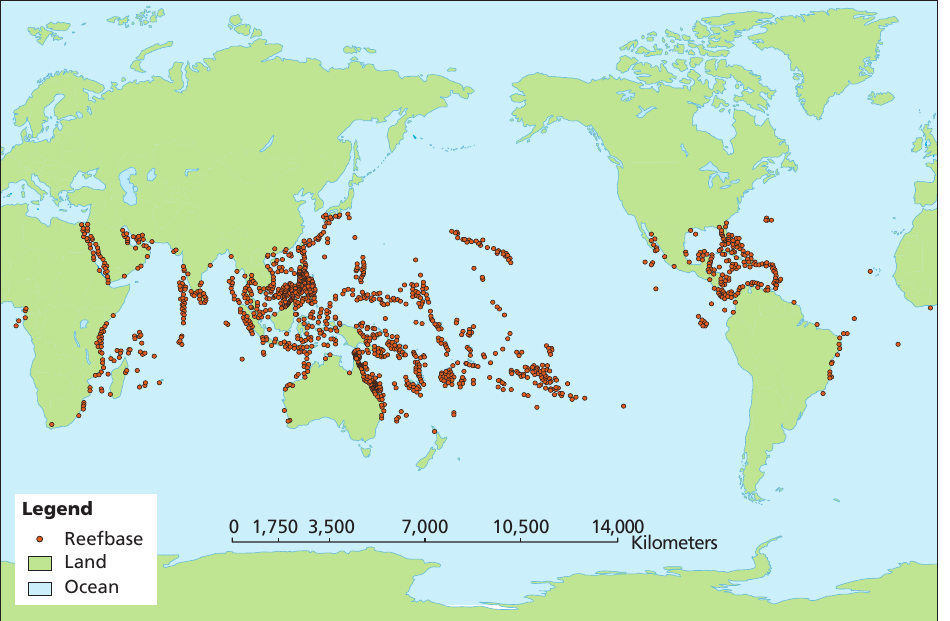
Scale and distribution:
- Total global coverage of approximately 284,300 km²
- Concentrated in the Indo-Pacific region, Caribbean Sea, and around tropical islands
- Can grow upwards at rates of 1-100 cm per year
- Form the largest and oldest living structures on Earth
The structure of tropical coral reefs
Coral composition and foundation
Tropical coral reefs have a distinctive layered structure. The underlying foundation comprises dead coral skeletons accumulated over thousands or millions of years. Living coral polyps colonise the top of this structure, continuously secreting new limestone to build the reef higher and wider.
The coral-algae partnership
Tropical coral polyps host tiny symbiotic algae called zooxanthellae that live inside their tissues. This mutually beneficial relationship works as follows:
What the algae receive:
- Protection and shelter within the coral polyp
- Nutrients from plankton captured by the coral
What the coral receives:
- Food in the form of nutrients produced through photosynthesis by the algae
- The algae also provide the coral's vibrant colours
Important
Photosynthesis Requirements
This photosynthetic relationship explains why tropical corals require:
- Shallow water - to allow adequate sunlight penetration
- Clear water - sediment blocks sunlight needed for photosynthesis
- Distance from river mouths - to avoid excessive sedimentation and pollution
Understanding these requirements is crucial for coral reef conservation and predicting where reefs can successfully develop.
Coral bleaching
Coral bleaching occurs when corals become stressed (typically from elevated water temperatures) and expel their symbiotic algae. This exposes the white calcium carbonate skeleton beneath, giving the coral a 'bleached' appearance.
Bleached corals are not immediately dead but are severely weakened and more vulnerable to disease and death if stress continues.
Categories of tropical coral reefs
Tropical reefs develop into three main structural types:
Fringing reefs
- Grow directly outward from the shoreline
- No area of open water (lagoon) separates the reef from land
- The most common reef type
- Particularly vulnerable to pollution and sedimentation from terrestrial sources because they lack a protective lagoon buffer between land and reef
Barrier reefs
- Form extensive linear complexes running parallel to the coastline
- Separated from the shore by a lagoon of varying depth
- The lagoon provides a wide band of water between land and reef
Atolls
- Roughly circular or oval reef systems
- Surround a central lagoon
- Typically form around volcanic islands that have subsided over time
Note
Remembering Reef Types: FBA
An easy way to remember the three types of tropical reefs is FBA:
- Fringing reefs (attached to shore)
- Barrier reefs (parallel with lagoon)
- Atolls (circular around lagoon)
Case study: Belize Barrier Reef Reserve System
Example
Case Study: The Belize Barrier Reef Reserve System
The Belize Barrier Reef Reserve System demonstrates the incredible biodiversity and scale of tropical reef ecosystems.
Size and significance:
- Extends 300 kilometres along the Central American coast
- Second largest reef system globally
- Designated a UNESCO World Heritage Site
- Total complex covers 960 km²
Structure:
- Includes the main barrier reef formation
- Contains three atolls
- Features approximately 450 sand and mangrove cayes (small, low-elevation sandy islands)
Biodiversity:
- 70 species of hard corals identified
- 36 species of soft corals
- Over 500 species of fish and invertebrates documented
- Scientists estimate that only about 10% of the reef's total species have been discovered so far
Unique characteristics: The diverse array of reef types within one interconnected system distinguishes the Belize reef from other reef systems worldwide. The combination of barrier reef, atolls, and numerous cayes creates varied habitats supporting exceptional biodiversity.
Threats to coral reef ecosystems
Coral reefs face numerous pressures that place them under significant stress:
- Pollution from coastal development and agricultural runoff
- Sedimentation from rivers and coastal erosion, which smothers corals and blocks sunlight
- Rising water temperatures linked to climate change, causing widespread coral bleaching
- Ocean acidification reducing the availability of calcium carbonate needed for reef building
- Overfishing and destructive fishing practices
- Physical damage from boats, anchors, and tourism
Important
Why Coral Sensitivity Matters
Coral reefs are particularly sensitive to pollution and sedimentation because:
- Sediment blocks the sunlight that zooxanthellae need for photosynthesis
- Pollutants can directly harm coral polyps and disrupt the symbiotic relationship
- River discharge often carries both sediment and pollutants, explaining why reefs avoid river mouths
This sensitivity makes fringing reefs especially vulnerable due to their proximity to land-based pollution sources.
Ecosystem management and resilience
The way we manage ecosystems, including coral reefs, has profound consequences for both environmental and human well-being.
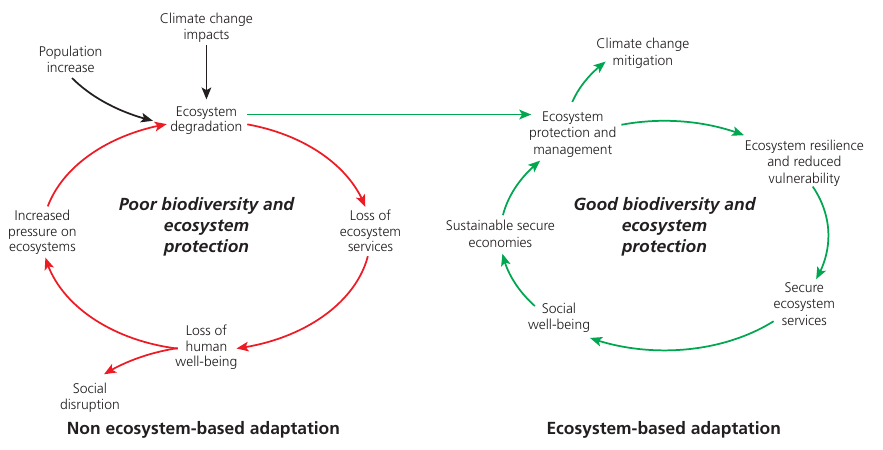
The diagram illustrates two contrasting pathways:
Non ecosystem-based adaptation (negative feedback loop)
Poor biodiversity and ecosystem protection creates a destructive cycle:
- Ecosystem degradation occurs
- Loss of ecosystem services follows
- Human well-being declines
- Social disruption increases
- Greater pressure placed on already degraded ecosystems
- Further population increase and climate change impacts worsen the cycle
Ecosystem-based adaptation (positive feedback loop)
Good biodiversity and ecosystem protection creates a beneficial cycle:
- Ecosystem protection and restoration occurs
- Ecosystem resilience builds, reducing vulnerability
- Secure ecosystem services maintained
- Social well-being improves
- Sustainable economies develop
- Climate change mitigation enhanced
- Positive cycle continues supporting both ecosystems and communities
Note
The Power of Positive Feedback
This demonstrates that protecting coral reef ecosystems doesn't just benefit marine life—it supports human communities through maintained ecosystem services, sustainable livelihoods, and enhanced resilience to climate change. Effective ecosystem management creates self-reinforcing positive outcomes for both nature and people.
Remember!
Summary
Key Points to Remember:
- Marine ecosystems cover approximately 70% of Earth's surface, making them the planet's largest ecosystem type
- Two main coral groups exist: deep-sea cold-water reefs (growing slowly at 5-25 mm/year in high latitude waters) and tropical reefs (growing faster at 1-100 cm/year between 30°N-30°S where temperatures exceed 16°C)
- Coral reefs are built from calcium carbonate secreted by coral polyps and coralline algae, creating layers of limestone on dead coral skeletons
- The symbiotic relationship between coral polyps and zooxanthellae algae is essential—algae provide nutrients through photosynthesis while receiving shelter and captured plankton from the coral
- Tropical reefs require shallow, clear water for photosynthesis, explaining why they avoid river mouths and areas with high sedimentation
- Three main tropical reef types are fringing reefs (attached to shore), barrier reefs (parallel to shore with intervening lagoon), and atolls (circular reefs around central lagoons)
- Coral bleaching occurs when stressed corals expel their symbiotic algae, exposing white skeletons—this is often triggered by elevated water temperatures
- Good ecosystem management creates positive feedback loops that enhance resilience, maintain services, and support both environmental and human well-being