Mineral Nutrient Cycling (AQA A-Level Geography): Revision Notes
📚Revision Notes
Mineral Nutrient Cycling
What are nutrients?
Nutrients are the chemical elements and compounds that organisms need to grow and function properly. Without the right nutrients, plants cannot produce new cells and therefore cannot grow. This makes nutrient availability crucial for all life in an ecosystem.
Note
The processes of energy flow and nutrient cycling work together in ecosystems. The speed at which nutrients cycle through the system affects how quickly energy can be trapped and used by living organisms. Unlike energy, which flows through an ecosystem in one direction, nutrients cycle repeatedly through the system.
The three nutrient stores
In any ecosystem, nutrients are held in three main compartments or stores. Understanding these stores helps us see how nutrients move through the system.
Biomass
Biomass refers to all the living plant and animal matter in an ecosystem. This includes everything from trees and grasses to insects, birds and mammals. Nutrients stored in biomass are locked up in living tissue.
Litter
Litter is the dead organic matter that sits on top of the soil surface. This includes:
- Fallen leaves
- Dead plant stems
- Animal waste
- Dead animals
Although this material is dead, it still contains valuable nutrients that haven't yet been released back into the soil.
Soil
Soil is a mixture of weathered rock fragments, air, water and decomposed organic matter. It forms at the Earth's surface and provides the foundation for plant growth. The soil store contains nutrients in various forms that plants can potentially absorb through their roots.
How nutrients move between stores
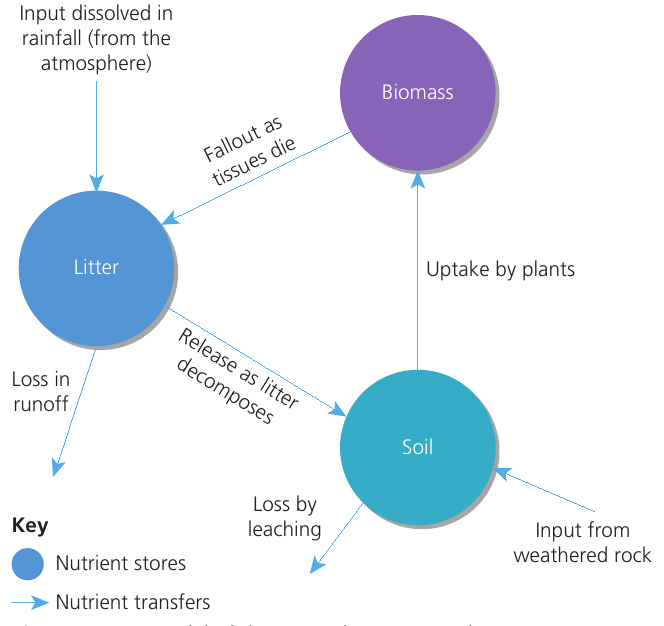
Nutrients constantly transfer between the three stores through various processes. These transfers create a cycle that keeps the ecosystem functioning.
Inputs to the system
Nutrients enter the ecosystem from two main sources:
- Atmospheric input: Rain brings dissolved nutrients from the atmosphere into the litter layer
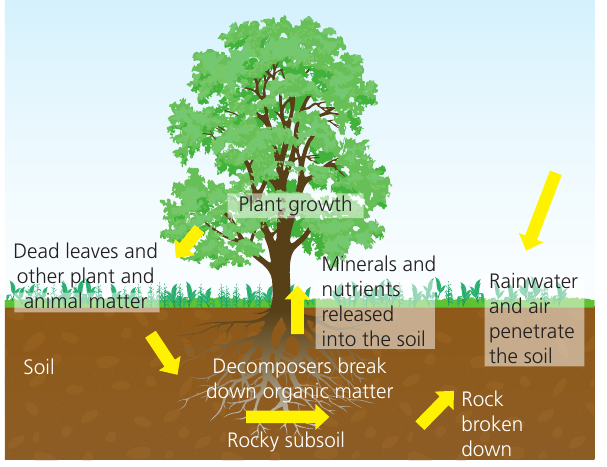
- Weathering: Rock beneath the soil slowly breaks down, releasing minerals that become available to plants
Transfers between stores
Important
Understanding how nutrients transfer between stores is essential for understanding ecosystem function. Each transfer process plays a critical role in maintaining the nutrient cycle.
Several key processes move nutrients around the ecosystem:
-
Plant uptake: Plants absorb nutrients from the soil through their roots and incorporate them into their tissues (transferring from soil to biomass)
-
Fallout: When plants shed leaves or die, their tissue falls to the ground (transferring from biomass to litter)
-
Decomposition: Organisms called decomposers (such as bacteria, fungi and invertebrates) break down dead organic matter in the litter, releasing nutrients into the soil (transferring from litter to soil)
Outputs from the system
Nutrients can also leave the ecosystem:
-
Leaching: Water moving down through the soil dissolves nutrients and carries them deeper, potentially taking them beyond the reach of plant roots
-
Runoff: Surface water can wash nutrients away from the ecosystem entirely
Visualising nutrient cycles: Gersmehl diagrams
Ecologists use a special type of diagram called a Gersmehl diagram to represent nutrient cycles visually. This model makes it easier to compare different ecosystems.
Note
Reading Gersmehl Diagrams:
In a Gersmehl diagram:
- Circles represent the three nutrient stores (biomass, litter and soil)
- The size of each circle shows the amount of nutrients stored in that compartment - larger circles mean more nutrients
- Arrows show the transfers of nutrients between stores
- The thickness of the arrows indicates the rate of nutrient flow - thicker arrows mean nutrients are moving more quickly
This visual approach allows you to quickly see which store holds most nutrients and which transfer processes are most important in a particular ecosystem.
Summary
Key Points to Remember:
- Nutrients are essential chemical elements and compounds that organisms need to grow and function
- Three nutrient stores exist in ecosystems: biomass (living matter), litter (dead organic matter on the surface) and soil (weathered rock mixed with decomposed material)
- Nutrients cycle between stores through processes including plant uptake, fallout, decomposition, weathering, leaching and runoff
- Inputs come from rainfall and rock weathering, while outputs occur through leaching and runoff
- Gersmehl diagrams use circle size to show nutrient store amounts and arrow thickness to show transfer rates