Ablation and Accumulation (AQA A-Level Geography): Revision Notes
📚Revision Notes
Ablation and accumulation
Understanding glacier mass balance
Glaciers are dynamic systems where ice is constantly being added and removed. To understand how glaciers behave, we need to examine the balance between ice gain and ice loss. This balance determines whether a glacier will grow, shrink, or remain stable over time.
The zone of accumulation
The accumulation zone is found in the upper part of a glacier. In this area, the amount of snow and ice added each year exceeds the amount lost through melting and other processes. This means there is a net gain of mass annually.
Note
Key characteristics of the accumulation zone:
- Located in the upper elevations of the glacier
- Receives significant snowfall inputs
- Lower temperatures reduce melting
- Ice and snow accumulate year after year
- The accumulated ice eventually begins to flow downhill under its own weight
The zone of ablation
The ablation zone is located in the lower part of a glacier. Here, the opposite process occurs – more ice is lost through melting than is gained through snowfall. This results in a net loss of mass each year.
Note
Key characteristics of the ablation zone:
- Found at lower elevations where temperatures are warmer
- Ice loss occurs through several processes including melting, sublimation, and calving
- Receives less snowfall than upper areas
- Despite losing mass, this zone continues to receive ice flowing down from the accumulation zone above
The equilibrium line
Important
The equilibrium line is the boundary between the accumulation zone and ablation zone. At this line, the amount of ice gained exactly balances the amount lost over the course of a year. This line is crucial for understanding glacier health and behaviour.
The equilibrium line is not fixed in position. It can shift up or down the glacier in response to changing climate conditions. Its position provides valuable information about the glacier's overall mass balance.
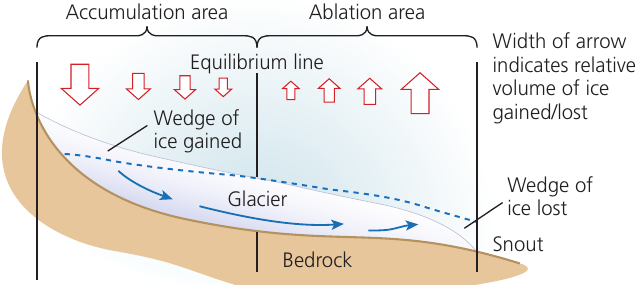
The diagram above illustrates how a glacier is divided into these zones. Notice how the width of the arrows indicates the relative volume of ice being gained or lost. Ice continuously flows downslope from the accumulation zone through the equilibrium line and into the ablation zone, eventually reaching the glacier snout (terminus).
Glacier budget and net balance
Each year, scientists can calculate a glacier's net balance. This is worked out by comparing the total accumulation against the total ablation over a 12-month period.
Important
The net balance is the difference between total accumulation and total ablation during one year. A positive net balance means the glacier is gaining mass overall. A negative net balance means the glacier is losing mass overall.
Seasonal patterns in temperate glaciers
Temperate glaciers, found in alpine regions, show distinct seasonal patterns in their mass balance:
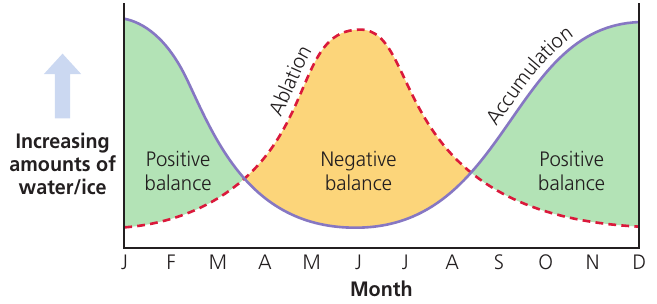
- Winter (positive balance): Accumulation exceeds ablation as snowfall is high and temperatures are too cold for significant melting
- Summer (negative balance): Ablation exceeds accumulation as warmer temperatures cause rapid melting whilst snowfall decreases
Note
The graph demonstrates how accumulation and ablation vary throughout the year. During winter months (roughly October to March), the glacier gains mass. During summer months (roughly May to September), the glacier loses mass. If the winter gains and summer losses cancel each other out, the glacier remains in equilibrium with its snout staying in roughly the same position. However, ice continues to flow downslope from the accumulation zone into the ablation zone throughout the year.
Glacial advance
When conditions favour ice accumulation, glaciers can grow and extend down their valleys.
Important
Glacial advance occurs when the rate of accumulation exceeds the rate of ablation. This causes the glacier snout to move further down the valley.
It is crucial to understand that even though the snout advances down the valley, ice within the glacier continues to flow downslope from the upper parts. The advancing snout position simply means ice is arriving faster than it can melt away.
Glacial retreat
When melting increases or snowfall decreases, glaciers begin to shrink.
Important
Glacial retreat occurs when the rate of ablation exceeds the rate of accumulation. This causes the glacier to shrink in size, and the position of the snout moves up the valley.
A common misconception is that during glacial retreat, the ice flows backwards up the valley. This is not correct. Ice always continues to flow downslope due to gravity. However, it is melting at the snout faster than new ice can arrive, causing the snout's position to move progressively higher up the valley.
Historical patterns of ice advance and retreat
Glaciers respond to both short-term and long-term changes in climate. During the Quaternary period, glaciers across the world advanced and retreated many times in response to major climatic shifts.
Evidence from the landscape
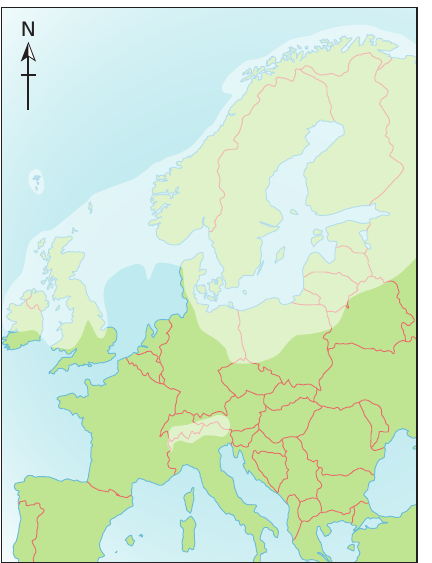
Today's landscape provides clear evidence of past glacial activity. Although Europe currently has limited glacier coverage, this was vastly different in the past.
Note
The map shows that 22,000 years ago (during the last glacial maximum), ice coverage in Europe was far more extensive. At present, glaciers cover approximately 6,000 km² in Europe. However, 22,000 years BP (before present), ice coverage was much more extensive, with vast ice sheets covering Scandinavia and the British Isles.
Individual glaciers respond to long-term climate changes by advancing or retreating. However, they also react to more localised or short-term variations in climate conditions. The pattern of change can be complex, with different glaciers responding at different rates.
Case study: Mer de Glace, France
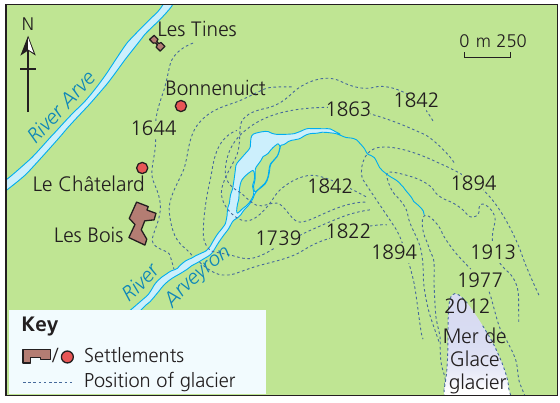
The Mer de Glace in the French Alps provides an excellent example of glacial retreat over several centuries. Detailed records exist showing the changing position of this glacier's snout.
Note
Key observations from the Mer de Glace retreat:
- In 1644, the glacier extended much further down the valley
- By 1739, noticeable retreat had occurred
- Throughout the 19th century (1822, 1842, 1863, 1894), continued retreat is evident
- The 20th and early 21st centuries (1913, 1977, 2012) show dramatic further retreat
- The glacier has retreated several kilometres over this 368-year period
- The settlements shown on the map (Les Tines, Bonnenuict, Le Châtelard, Les Bois) help illustrate the scale of retreat
This pattern of retreat observed at Mer de Glace is typical of most glaciers worldwide. The majority of glaciers globally currently have negative annual net balances, meaning their snouts have retreated in recent decades.
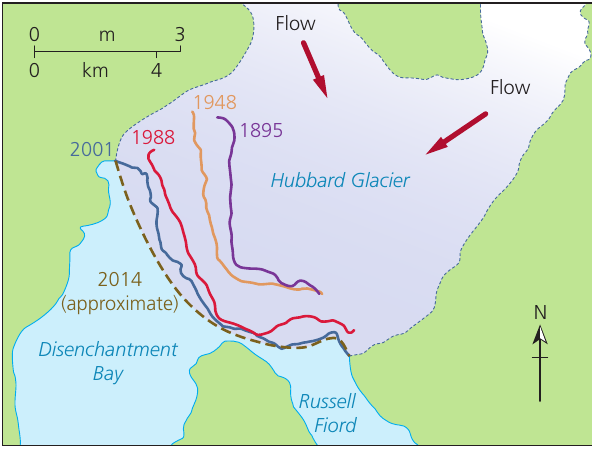
Case study: Hubbard Glacier, Alaska
Whilst most glaciers are retreating, some notable exceptions exist. The Hubbard Glacier in Alaska provides an interesting contrast to the Mer de Glace.
Note
The Hubbard Glacier's unusual advance pattern:
- Records from 1895 show the glacier in a more retreated position
- By 1948, the glacier had advanced significantly
- Further advance occurred by 1988
- The glacier continued advancing through 2001
- By 2014, the glacier had advanced even further, extending into Disenchantment Bay
- The flow arrows indicate the direction of ice movement towards Russell Fiord and Disenchantment Bay
This glacier, along with some others in the Himalayas and Alaska, has a positive annual net balance. This means accumulation exceeds ablation, causing the snout to advance. These exceptions demonstrate that local conditions (such as increased snowfall, cooler temperatures, or topographic factors) can override broader global warming trends in specific locations.
Remember!
Summary
Key Points to Remember:
-
The accumulation zone is where ice gain exceeds ice loss (upper glacier), whilst the ablation zone is where ice loss exceeds ice gain (lower glacier).
-
The equilibrium line marks the boundary between these zones where gains and losses are perfectly balanced.
-
Net balance = total accumulation minus total ablation over one year. This determines whether a glacier grows or shrinks.
-
During glacial advance, the snout moves down-valley because accumulation exceeds ablation. During glacial retreat, the snout position moves up-valley because ablation exceeds accumulation.
-
Ice always flows downslope regardless of whether the glacier is advancing or retreating – the difference is in the balance between the rate of ice arrival and the rate of melting at the snout.
-
Most glaciers worldwide are currently retreating due to climate change, though some exceptions like Hubbard Glacier in Alaska continue to advance due to local conditions.