Changing Impact of Human Activity (AQA A-Level Geography): Revision Notes
📚Revision Notes
Changing Impact of Human Activity
Introduction to human activity in cold environments
Cold environments have experienced increasing human activity over time, with different regions developing distinct patterns of economic exploitation. The level and type of human impact varies considerably depending on factors such as accessibility, available resources, and environmental conditions.
Economic activities in cold regions
Cold environments around the world support diverse economic activities, ranging from resource extraction to tourism and scientific research. The nature of these activities depends largely on each region's characteristics and accessibility.
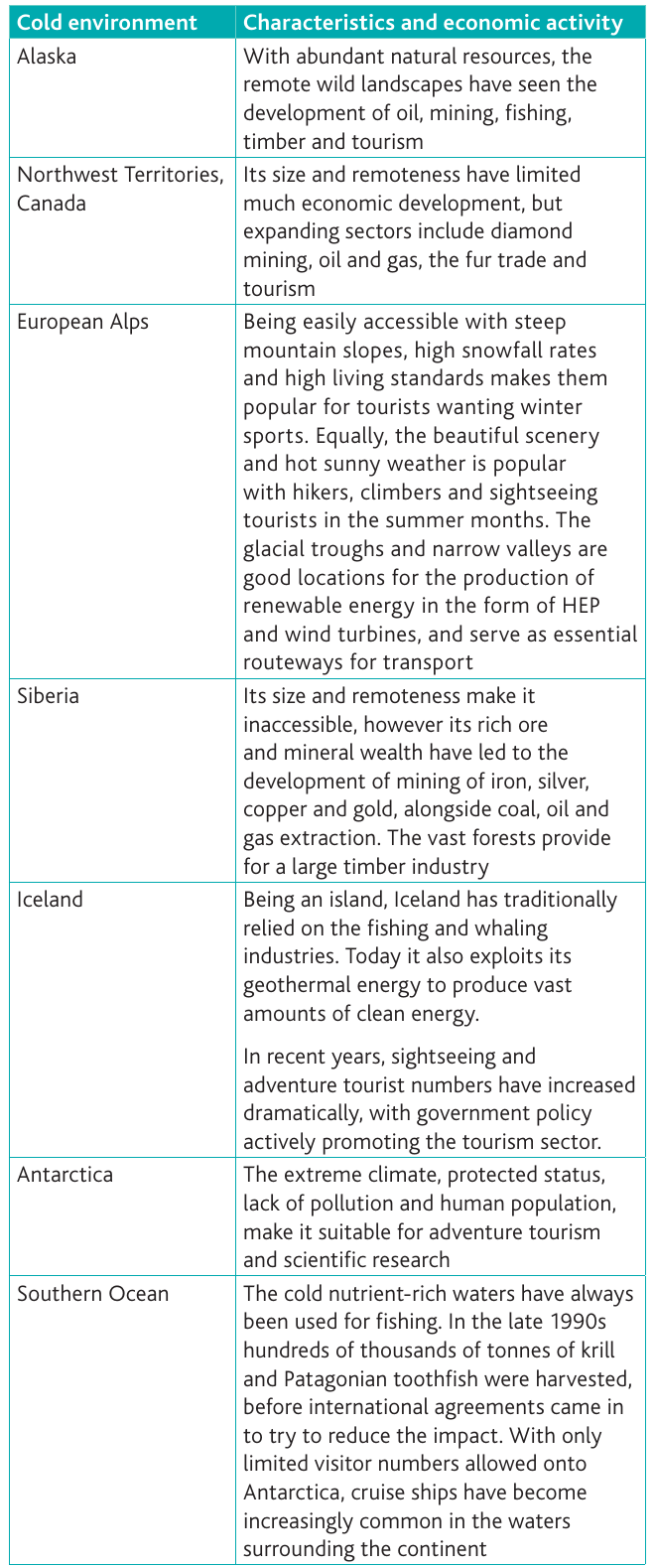
The table above shows how different cold regions have developed economically:
- Resource-rich remote areas (Alaska, Northwest Territories, Siberia) focus on extractive industries like oil, gas, mining, and forestry
- Accessible mountainous regions (European Alps) have developed tourism and renewable energy industries
- Island locations (Iceland) combine traditional fishing with modern geothermal energy production
- Extreme environments (Antarctica, Southern Ocean) are primarily used for scientific research, with regulated tourism and past fishing activity
Note
The diversity of economic activities in cold environments reflects both the unique resources available in each region and the practical challenges of accessibility. Remote regions with abundant natural resources tend toward extractive industries, while more accessible areas have developed tourism and renewable energy sectors.
Historical development of human activity
Early indigenous populations
In North America, indigenous Inuit populations were small relative to the large areas they inhabited. Their low population density meant they placed little pressure on the environment, which remained relatively undisturbed. These communities lived sustainably, moving seasonally with the reindeer and managing their environment in ways that could be sustained long-term.
In northern Europe, the Sami people followed similar patterns. They moved seasonally with reindeer herds, and as long as they kept population densities low, they understood their environment could support them sustainably.
Note
Indigenous peoples in cold environments developed lifestyles that worked in harmony with their surroundings. Their low population densities and seasonal movement patterns meant the natural environment could recover between periods of use, preventing long-term degradation.
European exploitation begins
From the seventeenth century onwards, resources in tundra areas started to be exploited by outsiders. Major economic activities developed, including:
- Sealing and whaling operations
- Fur trapping and trading
- Mining, particularly for gold
Mining operations led to the establishment of permanent settlements, whilst other activities remained temporary or seasonal. These activities brought significantly larger numbers of people into regions that had previously been sparsely populated.
Twentieth century large-scale exploitation
During the twentieth century, exploitation of tundra regions intensified dramatically. This large-scale development had profound impacts on both the lifestyle of indigenous peoples and the physical environment itself. Industrial activities expanded rapidly, bringing new infrastructure, permanent settlements, and intensive resource extraction.
Important
The shift from small-scale indigenous use to large-scale industrial exploitation in the twentieth century marked a turning point for cold environments. The dramatic increase in human activity and permanent infrastructure fundamentally altered both indigenous lifestyles and the physical landscape in ways that continue to affect these regions today.
Impacts on fragile cold environments
Thermokarst formation
Many negative human impacts in tundra environments occur when people establish permanent settlements and build infrastructure. Serious problems arise when vegetation is cleared from the ground surface.
Clearing vegetation removes the insulating layer, which causes the active layer to deepen during summer months. Minor disturbances, such as vehicle tracks, can significantly increase melting. The vegetation in these environments is very slow to re-establish itself once damaged.
Important
Thermokarst Definition
Thermokarst is a landscape of topographic depressions characterised by extensive areas of irregular, hummocky ground interspersed with waterlogged hollows.
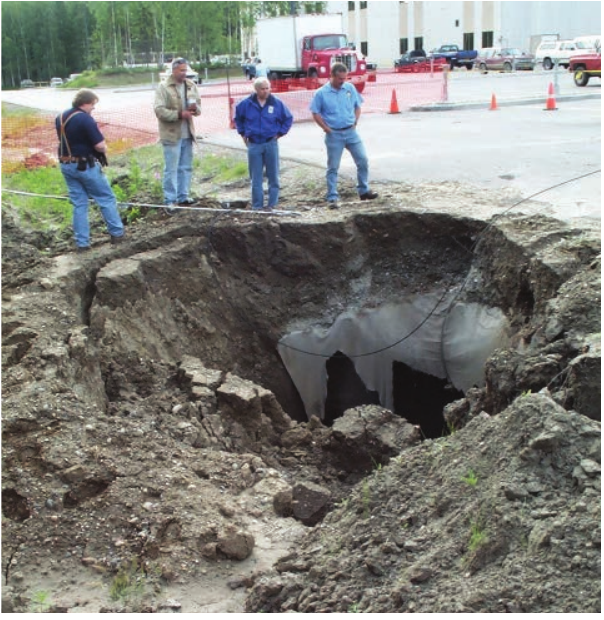
Buildings accelerate ground ice thawing by transferring heat into the ground below. When ground ice thaws, it leads to the development of unnatural thermokarst landscapes. The damage caused by this ground subsidence can be seen in:
- Tilted and fractured older buildings
- Damaged roads and railways
- Damaged airfield runways
Example
How Thermokarst Forms: Step-by-Step Process
Step 1: Vegetation is removed for construction or by vehicle tracks ↓ Step 2: Ground loses its natural insulation layer ↓ Step 3: Active layer deepens during summer months ↓ Step 4: Ground ice beneath begins to thaw ↓ Step 5: Ground subsides as ice melts, creating thermokarst ↓ Result: Infrastructure damage including tilted buildings, cracked roads, and damaged runways
Range of human impacts on the physical environment
Beyond thermokarst formation, human activity affects cold environments in several ways. Each type of activity creates distinct environmental pressures that combine to threaten these fragile ecosystems.
-
Hunting: Over-exploitation of wildlife populations has occurred in many cold regions, reducing biodiversity and disrupting ecosystem balance
-
Transport: Transportation brings risks of oil spillages, particularly in sensitive areas like Alaska where oil and gas extraction dominates the economy. Road vehicles also cause direct damage to the ground surface, creating tracks that accelerate melting
-
Tourism: Visitors remove vegetation and leave litter and waste that does not easily degrade in cold conditions. Well-publicised campaigns have highlighted issues such as the huge amounts of rubbish and human waste left by climbers on Mount Everest every season
-
General air pollution: All cold regions are affected by air pollution transported from other areas, demonstrating how these remote environments cannot escape global impacts
-
Research activities: Even in Antarctica, where human population on the landmass is limited, the presence of researchers and their activities (including transport and waste management) has some environmental impact
Note
While each of these impacts may seem localized to specific areas, they contribute to the global effects of climate change, which is melting the snow and ice in cold environments worldwide. The cumulative effect of human activities in cold regions extends far beyond their immediate geographic boundaries.
Management approaches to cold environments
The development versus conservation debate
Some experts suggest that it is actually the limited development in many cold environments that gives them potential for sustainable development in the future. The Arctic tundra and Antarctica represent common perceptions of wild and natural places. Their remoteness and extreme physical processes keep them largely inaccessible to mass tourism and intensive economic development.
Conservationists argue that wilderness areas have intrinsic value and possess outstanding qualities worth conserving for the future. These areas have aesthetic value for people seeking spiritual refreshment and contemplation.
Scientific importance of wilderness areas
Scientifically, wilderness areas are vital because:
- There is a need to maintain the gene pool of wild organisms to ensure genetic variety is preserved
- Animal communities can be studied in their natural environment without human interference
- Wilderness provides a natural laboratory for scientific study of ecosystems
- Pure natural systems are needed as a baseline against which managed or mismanaged systems can be compared
Note
The Value of Wilderness Conservation
Wilderness areas in cold environments serve multiple important purposes. Beyond their aesthetic and spiritual value, they function as essential scientific resources. Maintaining genetic diversity, providing undisturbed research sites, and offering baseline ecosystems for comparison are all critical functions that justify conservation efforts, even in the face of development pressures.
Development pressures
Despite their value, wilderness regions often contain exploitable resources. Pressure to develop these resources comes from national and transnational groups that require both energy sources and raw materials to support industrial growth.
Balancing developmental pressures against the need to conserve the essential values of wilderness is increasingly difficult to manage. Sustainable development has an important role to play in resolving this tension, but there is considerable disagreement about how it can be successfully applied in many wilderness environments.
Wilderness protection legislation
In 1964, the Wilderness Act in the USA designated a number of wilderness areas for protection. The largest number of designated wilderness areas in any US state is in Alaska, which developed its own wilderness legislation through the National Interest Lands Conservation Act in 1980.
These legislative frameworks aim to protect wilderness characteristics whilst allowing some controlled access and use.
Note
The United States has been a pioneer in wilderness protection legislation. Alaska, with its vast expanses of undeveloped land, has particularly benefited from this legal framework, maintaining some of the largest protected wilderness areas in the world.
Managing Antarctica at present
The entire continent of Antarctica is now designated as a 'reserve devoted to peace and science' by international agreement. This protected status reflects recognition of Antarctica's unique environmental and scientific value, limiting activities primarily to scientific research with some regulated tourism.
The management of Antarctica represents an attempt to preserve one of Earth's last true wilderness areas from the impacts that have affected cold environments elsewhere.
Summary
Summary
Key Points to Remember:
-
Human impact on cold environments has increased dramatically from small indigenous populations to large-scale industrial exploitation, particularly since the seventeenth century
-
Thermokarst forms when vegetation is removed, reducing insulation and causing the active layer to deepen, leading to ground subsidence that damages infrastructure
-
Human activities in cold environments include hunting, transport, tourism, pollution, and research - all contributing to local and global environmental change
-
Wilderness areas have both aesthetic and scientific value, including maintaining genetic diversity, providing natural laboratories, and serving as baseline ecosystems for comparison
-
Management of cold environments involves balancing development pressures with conservation needs, supported by legislation such as the USA Wilderness Act (1964) and protection of Antarctica as a reserve for peace and science