Cold Environments as Human Habitats (AQA A-Level Geography): Revision Notes
📚Revision Notes
Cold Environments as Human Habitats
Introduction
Even though cold environments are harsh and unwelcoming, millions of people successfully live and work in these regions. More than 4 million people reside within the Arctic Circle, with varying proportions of indigenous and non-indigenous populations across different territories. The way people occupy these environments has changed significantly over time, from traditional sustainable practices to modern industrial development.
Note
The occupation of cold environments has transformed dramatically over the centuries. While indigenous peoples lived sustainably for millennia with minimal environmental impact, modern development has brought both opportunities and challenges to these fragile regions.
Population distribution in cold environments
The Arctic regions show considerable variation in population size and composition. Different territories have different balances between indigenous peoples who have lived there for millennia and newer non-indigenous populations who have arrived more recently.
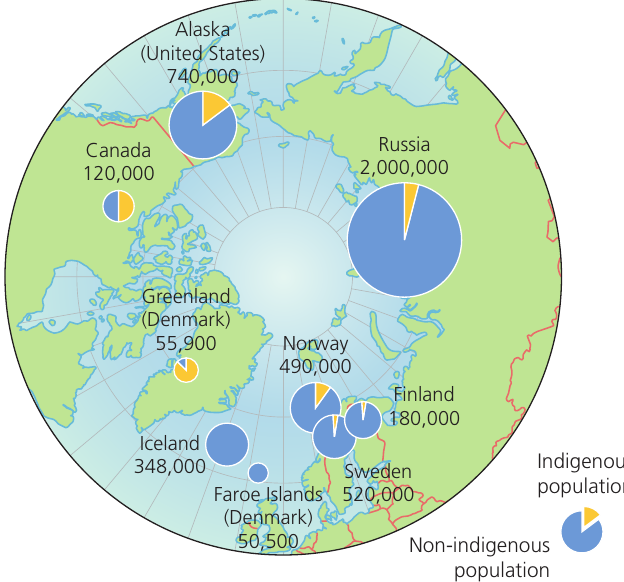
Population sizes vary dramatically across the Arctic:
- Russia has the largest Arctic population at 2,000,000 people
- Alaska (United States) has 740,000 people
- Norway has 390,000 Arctic residents
- Finland has 180,000 people in Arctic regions
- Greenland (Denmark) has 55,900 people
- Faroe Islands (Denmark) has the smallest population at 50,500
The proportion of indigenous peoples also varies considerably. Some regions like Greenland have majority indigenous populations, whilst others like Russia and Norway have much smaller indigenous proportions. These differences reflect the history of development and settlement in each region.
Opportunities and risks in cold environments
Physical challenges
Cold environments create unique difficulties for human occupation and development. The harsh physical conditions that people must cope with include:
- Very low temperatures throughout much of the year
- Short summers which limit the growing season for crops
- Low precipitation making water availability a concern
- Thin, stony and poorly developed soils that restrict agriculture
- Permafrost which creates engineering challenges
- Surface thaw in summer leading to waterlogging and potential flooding
- Long periods of snow cover affecting transport and access
- Blizzards which can be dangerous and disruptive
Important
The combination of permafrost, low temperatures, and short growing seasons creates a triple challenge for any form of human development in cold environments. These conditions not only limit traditional agriculture but also require specialized engineering solutions for construction and infrastructure.
Human and economic challenges
Beyond the physical environment, people living in cold regions face additional obstacles:
- A shortage of labour and skills because population density remains low
- Increasing unpredictability of climate events, such as late winter freezes or early spring melts
- Remoteness and lack of accessibility to services
- Limited permanent jobs and restricted educational opportunities beyond secondary level
- Absence of modern conveniences commonly found in urban areas
- A feeling of economic or political neglect from national governments
- External impacts on natural resources, including climate change, commercial fishing and resource exploitation
Traditional human adaptations
Indigenous peoples and sustainable living
Many indigenous communities have successfully adapted to cold environments over thousands of years. Their traditional way of life demonstrates important principles of sustainability.
Important
Sustainable living
Indigenous peoples traditionally had a sustainable way of life, characterised by low population densities, taking only the resources they needed from the natural environment, and having social structures and cultural systems that actively promoted environmental protection.
Traditional economic activities in tundra regions included:
- Hunting and fishing for food
- Caribou and reindeer herding
- Fur trading
- Hunter-gathering practices
These communities often held the natural environment in high regard, sometimes revering it in religious or spiritual ways. This helped ensure they did not overexploit resources.
The Inuit people
The Inuit, indigenous people of North America, provide an excellent example of successful adaptation to the harsh tundra landscape. They adapted all aspects of their lives:
Lifestyle and shelters
Inuit communities were traditionally small in size with low birth rates. Being nomadic, they spread over large geographic areas at very low population density. This meant they put minimal pressure on scarce resources and could limit their impact on the environment in each location whilst following migrating animals.
Their shelter adapted to the seasons:
- Summer: Built portable tents from driftwood and seal skins
- Winter: Constructed more substantial shelters including snowhouses (igloos) or log-and-sod houses
- Semi-permanent communities: Used log-and-sod dwellings built partially underground, where surrounding earth provided additional protection from harsh elements
Example
Worked Example: Seasonal Adaptation Strategy
The Inuit's approach to shelter demonstrates adaptive sustainability:
Summer Strategy:
- Lightweight, portable tents from natural materials
- Easy to move following animal migrations
- Minimal environmental impact when relocated
Winter Strategy:
- Insulated snowhouses using readily available snow
- Log-and-sod houses using local materials
- Underground construction utilizing earth's insulation
Result: Year-round protection while maintaining mobility and minimizing resource depletion
Food
The Inuit made maximum use of the short summer season. They hunted, gathered and preserved as much food as possible to sustain them through winter months. Fish or seal meat was often dried to ensure it lasted throughout the year.
Indigenous communities of the north adapted to eating raw meat safely. This ability reduced the need for extra resources like fuel for cooking. Experience and tradition taught them precisely how much food to hunt - they would not take more than necessary. All parts of prey were utilised for food, clothing, utensils or building materials, demonstrating remarkable efficiency.
Transport
Mobility proved essential for survival in these environments:
- Winter: Dog sleds exploited the frozen landscape effectively
- Summer: Single person kayaks or larger open boats called umiaks provided transport and enabled hunting
- All transport methods were specifically designed for Arctic conditions
Contemporary adaptations in Arctic tundra
Engineering challenges
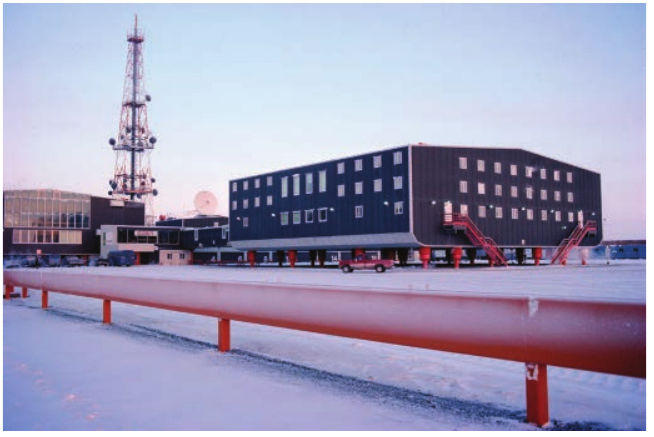
Establishing permanent settlements and developing activities like oil and gas extraction requires major technological advances. The permafrost creates unique problems for construction work and engineering. Many innovations have emerged to overcome the challenges posed by frozen ground.
Note
Although successful, these construction methods prove more expensive than conventional building techniques. This adds significantly to the costs of living in cold regions, and continual maintenance remains necessary.
Construction methods for permafrost
Several specialised building techniques protect the permafrost and prevent subsidence:
Elevated buildings on piles:
- Smaller buildings such as houses can be raised above the ground on piles driven into the permafrost
- The gap below the building allows air to circulate and removes heat that would otherwise be conducted into the ground
- This prevents the permafrost from thawing beneath structures
Aggregate pads:
- Larger structures can be built upon aggregate pads
- These consist of layers of coarse sand and gravel, typically 1-2 metres thick
- The pad substitutes for the insulating effect of vegetation and reduces heat transfer from building to ground
- These pads can also be placed beneath roads, railways and landing strips
Utilidors:
Important
Utilidor
A utilidor is an insulated, elevated above-ground structure that carries water supplies, heating pipes and sewers between buildings.
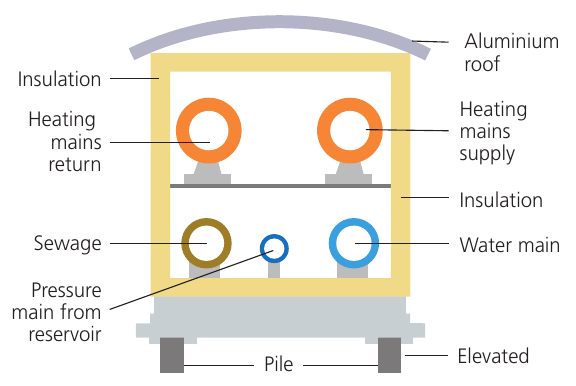
Pipes cannot be buried underground in permafrost regions. Freezing and thawing in upper soil layers would cause damage. Instead, large settlements use utilidors - insulated structures elevated above ground that house:
- Water mains supplying fresh water
- Heating mains (supply and return pipes)
- Sewage pipes
- Pressure mains from reservoirs
The utilidor features an aluminium roof and yellow insulation to protect the pipes. It sits on pile foundations to keep it elevated and maintain permafrost stability below.
Economic activities in different cold environments
Cold environments vary considerably, so economic opportunities differ between regions. People have adapted to occupy and exploit these environments in different ways depending on local conditions and resources.
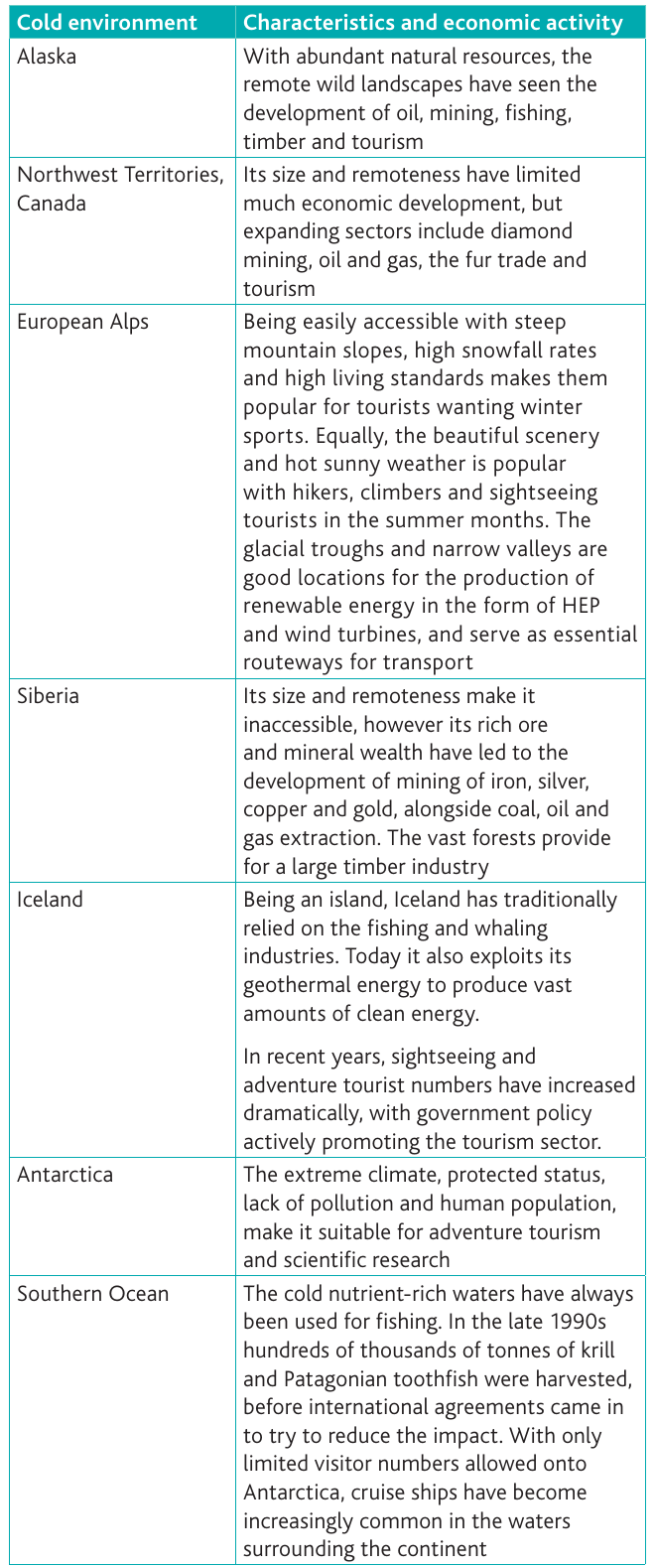
Regional variations in economic activity
Alaska:
- Abundant natural resources drive development
- Remote wilderness areas attract oil development, mining, fishing, timber and tourism industries
- Rich oil reserves have attracted significant investment
Northwest Territories, Canada:
- Size and remoteness limit much economic development
- Expanding sectors include diamond mining, oil and gas extraction, fur trade and tourism
- Harsh conditions restrict development scale
European Alps:
- Easy accessibility with steep mountain slopes and high snowfall rates
- High living standards make the region popular for tourists seeking winter sports
- Beautiful scenery and hot sunny weather attract hikers, climbers and sightseers in summer
- Glacial troughs and narrow valleys provide excellent locations for renewable energy production (hydroelectric power and wind turbines)
- Essential transport routeways crossing the Alps
Siberia:
- Size and remoteness make much of this region inaccessible
- Rich ore and mineral wealth has led to mining development (iron, silver, copper, gold)
- Also produces coal, oil and gas for extraction
- Vast forests provide timber for large-scale industry
Iceland:
- Island nation that traditionally relied on fishing and whaling industries
- Today also exploits geothermal energy to produce vast amounts of clean energy
- Tourism sector growing dramatically with government policy actively promoting sightseeing and adventure tourism
Antarctica:
- Extreme climate, protected status and lack of permanent human population make it suitable for adventure tourism and scientific research
- Controlled access with strict regulations
Southern Ocean:
- Cold, nutrient-rich waters have historically been used for fishing
- Late 1990s saw hundreds of thousands of tonnes of krill and Patagonian toothfish harvested
- International agreements now in place to reduce impact
- Limited visitor numbers allowed onto Antarctica
- Cruise ships increasingly common in surrounding waters
Note
The diversity of economic activities across cold environments reflects both the available resources and the level of accessibility. While some regions like the Alps benefit from tourism and renewable energy, others like Siberia focus on resource extraction. Protected areas like Antarctica prioritize scientific research over commercial exploitation.
Changing human impacts over time
Historical indigenous populations
In North America, the number of Inuit people was always small relative to the vast area in which they lived. Consequently, very little pressure was placed on the environment, which traditionally remained relatively undisturbed.
In northern Europe, the Sami people followed the seasonal movement of reindeer. As long as they lived at low population densities, they understood their environment could sustain them if they managed its use sustainably.
Increasing exploitation from the seventeenth century
From the seventeenth century onwards, outsiders began exploiting tundra resources. Major forms of economic activity developed:
- Sealing
- Whaling
- Trapping for fur
- Mining (particularly for gold)
Mining led to establishing permanent settlements, whereas other activities tended to be temporary or seasonal. These activities brought larger numbers of people than had lived there previously.
Twentieth century intensification
During the twentieth century, tundra regions experienced exploitation on a much larger scale. This created dramatic impacts on both the lifestyle of indigenous people and the physical environment itself.
Environmental damage from development
Many negative human impacts occur when people attempt to establish permanent settlements and infrastructure in tundra regions. Problems arise when vegetation is cleared from ground surface. This reduces insulation and results in summer deepening of the active layer.
Important
Even minor disturbances, such as vehicle tracks, can greatly increase melting. Vegetation re-establishment proves very slow because the growing season is short.
Buildings accelerate this process by spreading heat into the ground. Ground ice thawing leads to development of unnatural landforms.
Important
Thermokarst
Thermokarst is a landscape of topographic depressions characterised by extensive areas of irregular, hummocky ground interspersed with waterlogged hollows.
This ground subsidence damages buildings and causes tilted and fractured older buildings. It also damages roads, railways and airfield runways.
Future challenges from climate change
Cold environments face significant threats from global climate change. These changes will directly impact human populations living in these regions.
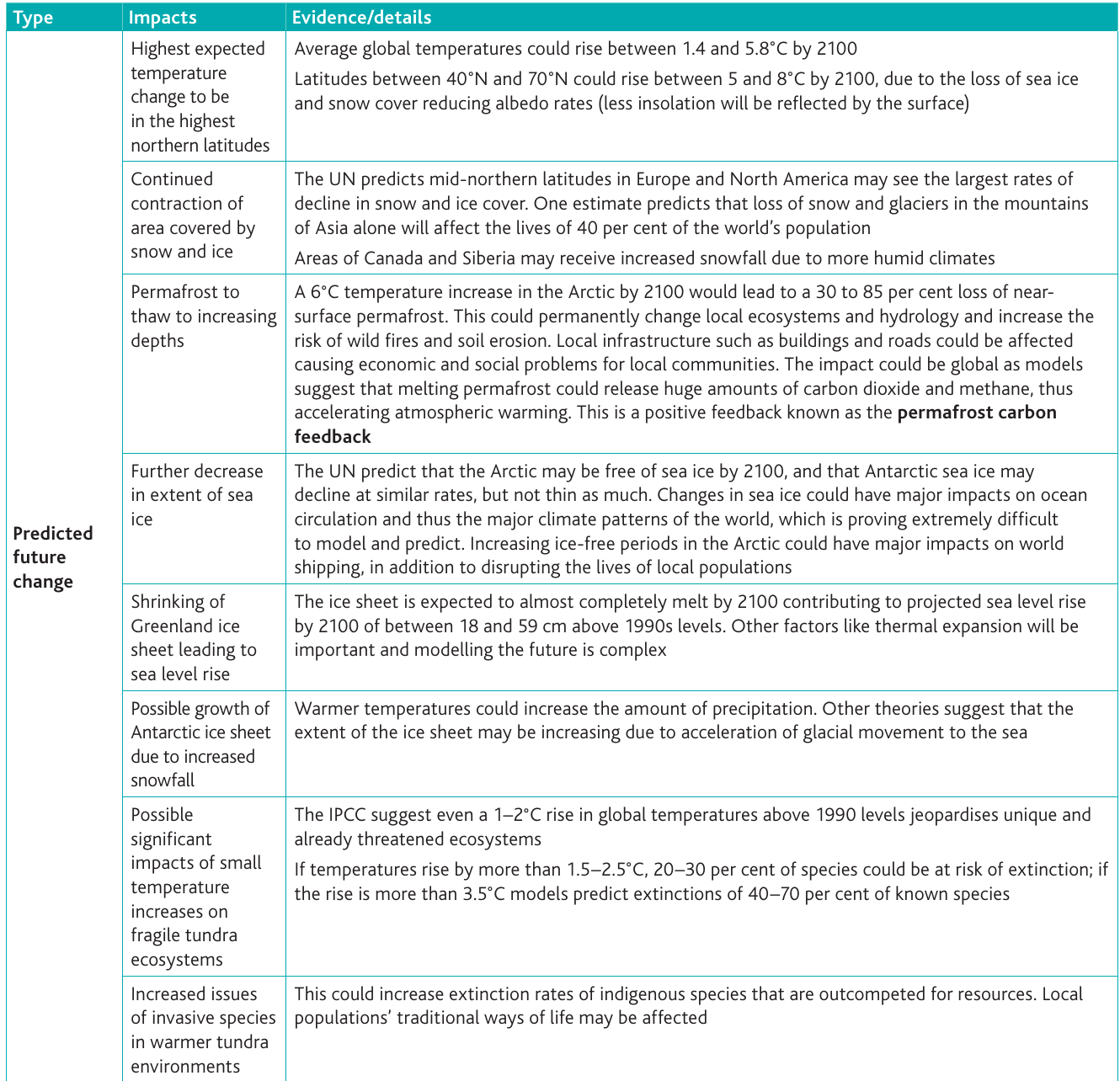
Predicted temperature changes
Climate models predict the highest expected temperature changes will occur in northern latitudes:
- Average global temperatures could rise between 1.4°C and 5.8°C by 2100
- Latitudes between 40°N and 70°N could see increases of 5°C to 8°C by 2100
- This occurs due to loss of sea ice and snow cover, which reduces albedo rates (less insulation is reflected by surfaces)
The United Nations predicts mid-northern latitudes in Europe and North America may experience the largest rates of decline in snow and ice cover. One estimate suggests loss of snow and glaciers in Asian mountains alone will affect 40% of the world's population.
Areas of Canada and Siberia may actually receive increased snowfall due to more humid climates developing.
Permafrost thaw and carbon feedback
A 6°C temperature increase in the Arctic by mid-century would cause a 30% to 85% loss of near-surface permafrost. This could permanently change local ecosystems and hydrology. It would also increase the risk of:
- Wild fires
- Soil erosion
- Damage to local infrastructure such as buildings and roads
- Economic and social problems for local communities
Important
Permafrost carbon feedback
Models suggest melting permafrost could release huge amounts of carbon dioxide and methane, accelerating atmospheric warming. This positive feedback loop is known as the permafrost carbon feedback.
Sea ice decline
The UN predicts the Arctic may be free of sea ice by 2100. Antarctic sea ice may decline at similar rates, though changes in sea ice patterns could have major impacts on ocean circulation. This affects the major climate patterns of the world, which climate scientists find extremely difficult to model and predict.
Increasing ice-free periods in the Arctic could have major impacts on:
- World shipping routes
- Lives of local populations who depend on ice conditions
Ice sheet melting
The Greenland ice sheet is expected to almost completely melt by 2100. This would contribute to projected sea level rise of between 18 cm and 59 cm above 1990s levels. Other factors like thermal expansion will be important in determining future sea levels. This makes modelling the future complex.
Warmer temperatures might increase precipitation amounts. Some theories suggest the extent of the Antarctic ice sheet may actually be increasing due to acceleration of glacial movement to the sea.
Ecosystem impacts
Even a 1-2°C rise in global temperatures above 1990 levels jeopardises unique and already threatened ecosystems:
- If temperatures rise by 1.5-2.5°C, 20-30% of species could be at risk of extinction
- If temperatures increase by more than 3.5°C, models predict extinctions of 40-70% of known species
Important
Additional threats to fragile tundra ecosystems include:
- Invasive species moving into warmer environments - these could outcompete indigenous species for resources
- Local populations' traditional ways of life may be affected
- Extinction rates of indigenous species may increase
Summary
Key Points to Remember:
-
Over 4 million people live within the Arctic Circle, with varying proportions of indigenous and non-indigenous populations across different territories.
-
Traditional indigenous peoples like the Inuit developed sustainable lifestyles with low population densities, taking only needed resources and protecting their environment through cultural practices.
-
Modern construction in permafrost regions requires specialised techniques such as elevated buildings on piles, aggregate pads, and utilidors (elevated insulated structures carrying pipes) to prevent ground thaw and building subsidence.
-
Different cold environments support different economic activities: Alaska has oil and mining, the Alps have tourism and renewable energy, Siberia has mineral extraction, and Iceland has fishing and geothermal energy.
-
Climate change poses severe threats to cold environments and their inhabitants, with predictions of 5-8°C temperature increases by 2100 in northern latitudes, widespread permafrost thaw releasing greenhouse gases (permafrost carbon feedback), and potential extinction of 40-70% of species if temperatures rise more than 3.5°C.