Glacial Systems and Landscapes (AQA A-Level Geography): Revision Notes
📚Revision Notes
Glacial Systems and Landscapes
Introduction to glacial systems
Glacial landscapes constantly change and evolve. While modern processes continue to shape them, these landscapes primarily display features created during past ice ages, particularly from the Pleistocene period. Understanding these environments requires looking at how fundamental geomorphological processes work together to create and modify distinctive landscapes that we can observe today.
Note
Many glacial areas are now recognised as fragile environments facing significant challenges related to biodiversity and sustainability. These regions are particularly vulnerable to environmental changes and require careful management.
Glaciers as open systems
Glaciers operate as natural systems, similar to other physical geography processes you may have studied. By applying a systems approach, we can better understand how glaciers function and change over time.
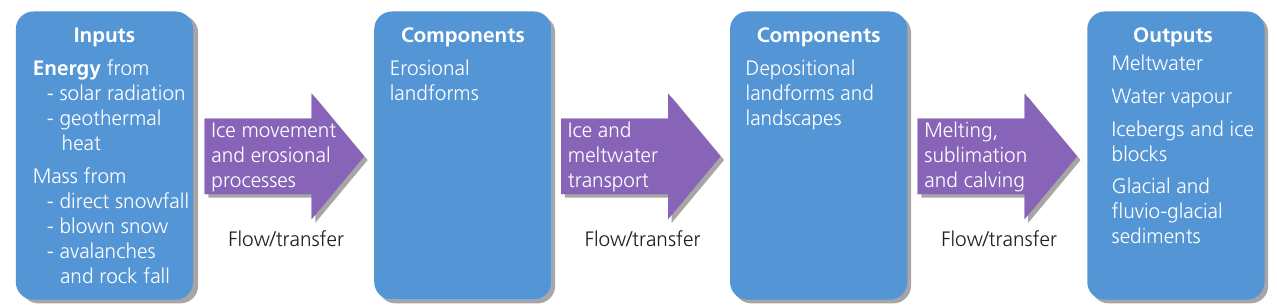
A glacier functions as an open system, which means it has several key components working together:
Inputs - These are the materials and energy entering the system:
- Energy inputs include solar radiation and geothermal heat from beneath the Earth's surface
- Mass inputs include direct snowfall, snow blown by wind, avalanches bringing snow and ice down mountain slopes, and rock fall adding debris to the glacier
Components (or stores) - These are the features within the system:
- Erosional landforms created as the glacier carves into the underlying rock
- Depositional landforms and landscapes formed from material transported by the glacier
Flows and transfers - These are the movements and processes within the system:
- Ice movement through glacial flow
- Erosional processes as the glacier scrapes and plucks rock
- Transport of ice, rock debris and meltwater
- Melting, sublimation (ice turning directly to water vapour), and calving (ice breaking off into water)
Outputs - These are materials leaving the system:
- Meltwater flowing away from the glacier
- Water vapour from sublimation
- Icebergs and ice blocks breaking off from the glacier front
- Glacial and fluvio-glacial sediments deposited beyond the glacier
Note
Remember the four key components of any system: Inputs, Components/Stores, Flows/Transfers, and Outputs. You can use the mnemonic "I Can Flow Out" to help remember these elements.
Dynamic equilibrium and feedback mechanisms
Important
A glacier is in dynamic equilibrium when its inputs and outputs are balanced. When inputs equal outputs, the glacier remains stable in size.
However, this balance can be disrupted. If one element changes - for example, if there is increased ice accumulation from heavy snowfall but no corresponding increase in meltwater output - then the glacier's mass will change. The glacier might advance (grow larger) or retreat (become smaller), and the equilibrium becomes upset. This process of change triggering further changes is called feedback.
Understanding feedback is crucial in glacial systems. When one element changes, it can cause a chain reaction affecting other parts of the system. There are two types of feedback: positive feedback (which amplifies changes) and negative feedback (which dampens changes and restores equilibrium).
The ice-albedo feedback
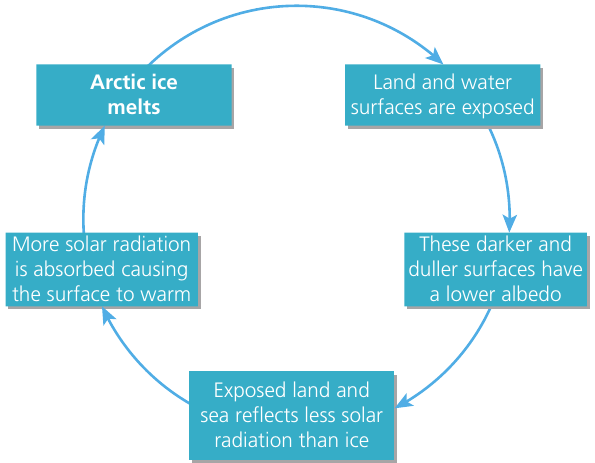
A key example of positive feedback in glacial environments is the ice-albedo feedback mechanism. This is particularly important in understanding how cold environments respond to warming.
Example
Worked Example: The Ice-Albedo Feedback Loop
This positive feedback mechanism demonstrates how initial warming can accelerate ice loss:
Step 1: Arctic ice begins to melt due to warming temperatures
Step 2: As ice melts, it exposes darker land and water surfaces beneath
Step 3: These darker surfaces have a lower albedo (they reflect less sunlight)
Step 4: With lower albedo, these surfaces absorb more solar radiation
Step 5: This absorption causes additional surface warming
Step 6: The warming causes more ice to melt
Step 7: The cycle continues, amplifying the initial warming
This is a positive feedback loop because each stage reinforces the previous change, accelerating the melting process.
This mechanism helps explain why polar regions are particularly sensitive to climate change and why warming in these areas can occur more rapidly than in other parts of the world.
The nature and distribution of cold environments
Defining cold environments
The term 'cold environments' encompasses a diverse range of landscapes, climates and ecosystems. These environments vary considerably in their characteristics. Some cold environments receive substantial precipitation as snow, whilst others receive precipitation levels as low as hot deserts. By definition, all are characterised by cold temperatures, but the degree of cold varies significantly.
Note
The diversity of cold environments is remarkable. Some of the coldest parts of Antarctica experience temperatures below -90°C, with almost no areas of the entire continent ever rising above 0°C. In contrast, some cold environments have considerable seasonal temperature variations, fluctuating around 0°C throughout the year.
This diversity means that cold environments cannot be understood through temperature alone - we must consider precipitation patterns, seasonal variations, and other climatic factors.
Distribution by latitude and altitude
Cold environments are found in different locations worldwide, and their distribution depends primarily on latitude and altitude.
Polar regions are found at the Earth's northern and southern extremes, almost entirely within the Arctic and Antarctic circles, above approximately 66° north and south of the Equator. These represent the coldest environments on Earth and are shaped by their position relative to the sun.
Latitude plays a crucial role because it determines the angle at which solar radiation reaches the Earth's surface. At high latitudes, the sun's rays strike at a low angle, spreading the same amount of energy over a larger surface area. This results in less heating per unit area. Additionally, polar regions experience extreme variations in daylight hours between summer and winter, including periods of 24-hour darkness in winter and 24-hour daylight in summer.
Note
Altitude also creates cold environments. High mountains can have glacial conditions even in tropical latitudes because temperature decreases with elevation. The combination of atmospheric circulation patterns and high altitude means that some mountain regions, such as the South Polar Plateau, are among the coldest locations on Earth.
Polar regions - the Arctic
The polar Arctic region largely consists of the Arctic Ocean, which encircles the North Pole. This ocean is surrounded by some islands and the most northerly extremes of Asia, Europe and North America.
A defining feature of the Arctic is the continuously frozen sea ice that covers the central polar area. This drifting ice pack averages 3 metres in thickness and undergoes significant seasonal changes. In winter, the sea ice doubles in extent, expanding from around 13 to 14 million km². The Arctic area experiences an extremely wide range of climates, though it remains continuously cold throughout the year.
Temperature characteristics:
- Mean annual temperatures range from +4°C to -28°C across different parts of the Arctic
- There are similarly wide-ranging levels of precipitation
- The overall average precipitation is relatively low at only around 100 mm annually
- However, the Atlantic area of the Arctic region receives significantly more precipitation than this average
Note
The Arctic's climate is heavily influenced by the surrounding continents and ocean currents. The presence of land masses affects temperature patterns and precipitation distribution. The relatively low precipitation in many Arctic areas means that despite the cold, some regions are technically cold deserts.
Polar regions - Antarctica
The southern polar region presents a stark contrast to the Arctic in several ways. Antarctica is dominated by the massive frozen wilderness of the ice sheet and surrounding ice shelves, which cover approximately 13 million km². Unlike the Arctic Ocean surrounded by continents, Antarctica is a continent surrounded by the Southern Ocean.
The expanse of uninterrupted ocean surrounding Antarctica creates unique conditions. This vast ocean experiences strong westerly winds, and together with the extreme coldness of the ocean and the large landmass, these factors combine to make Antarctica a considerably colder climate than the Arctic.
Ice and temperature characteristics:
- The continuously cold waters of the Southern Ocean cause sea ice to develop rapidly during winter
- Sea ice extent grows from about 2 million km² in February to approximately 16 million km² by September
- This represents a dramatic seasonal fluctuation far exceeding that of the Arctic
Important
Key Differences Between Arctic and Antarctica:
The fluctuation in sea ice extent is much greater in Antarctica than in the Arctic. This difference is largely due to the influence of the surrounding continents in the north, which limit sea ice expansion. Antarctica experiences a much colder climate overall than the Arctic region.
The interior of Antarctica includes high-altitude mountains and plateaux. The combination of atmospheric circulation patterns and high altitude makes the South Polar Plateau the coldest location on Earth, with mean annual temperatures in some places dropping well below -50°C.
The isolation of Antarctica, surrounded entirely by ocean, means it experiences more uniform and more extreme conditions than the Arctic. The Antarctic ice sheet represents the largest mass of ice on Earth and plays a crucial role in global climate systems.
Remember!
Summary
Key Points to Remember:
-
Glaciers function as open systems with inputs (energy and mass), components (landforms), flows (ice movement and processes), and outputs (meltwater and sediments)
-
Dynamic equilibrium occurs when inputs and outputs balance; disruption to this balance causes the glacier to advance or retreat through feedback mechanisms
-
The ice-albedo feedback is a positive feedback loop where ice melting exposes darker surfaces that absorb more radiation, causing further warming and more melting
-
Cold environments vary widely in characteristics - they're defined by cold temperatures but differ greatly in precipitation, with some receiving snow and others being as dry as hot deserts
-
Polar regions include the Arctic (ocean surrounded by continents, sea ice 3m thick, temperatures +4°C to -28°C) and Antarctica (continent surrounded by ocean, 13 million km² ice sheet, colder than Arctic with greater sea ice variation)