Ice Movement (AQA A-Level Geography): Revision Notes
📚Revision Notes
Ice movement
How glaciers move
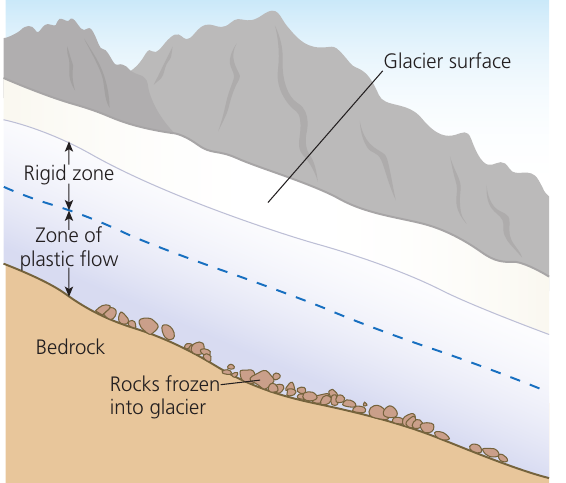
When ice builds up and becomes deeper, gravity causes it to start moving downhill. However, ice doesn't all behave in the same way as it moves. Ice is rigid and strong, but when continuous pressure is applied, it can deform and flow like a plastic material. In contrast, when sudden compression or tension is applied, the ice will crack or shear apart.
This creates two distinct zones within a glacier:
- Upper rigid zone - the ice here is brittle and breaks apart to form crevasses
- Lower plastic zone - here, steady pressure causes the ice to deform and flow. Water produced by pressure and friction with the bedrock enables faster, more fluid movement
Types of ice movement
The technical details of how ice moves are complex, but there are several main types of movement that can be identified.
Internal deformation (creep)
Note
Internal deformation occurs when stress builds up within a glacier, allowing the ice to behave with plasticity and flow.
This process happens when obstacles are encountered or when pressure increases. The ice crystals gradually orientate themselves in the direction of the glacier's movement and slide past each other. Internal deformation and creep are the main features of ice flow in cold polar glaciers. In these frozen environments, without meltwater present, the ice remains frozen to the bedrock beneath.
Rotational flow
Note
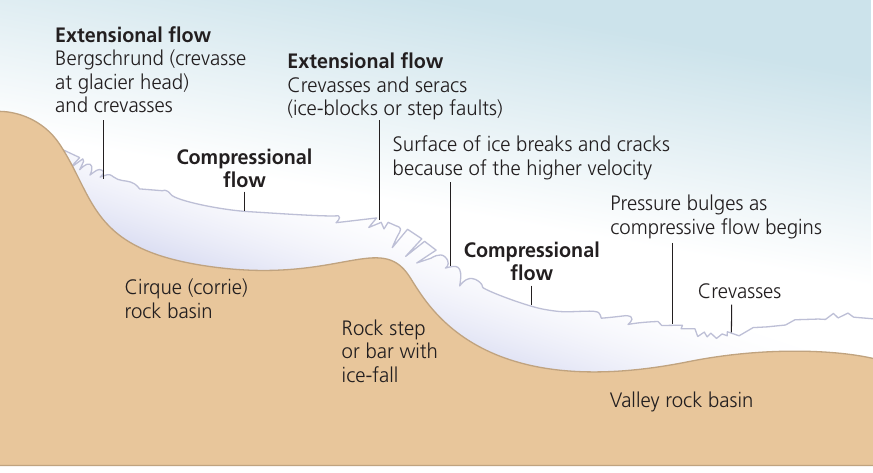
Rotational flow occurs within the corrie (cirque), which is the birthplace of many glaciers.
Here, ice moving downhill can pivot around a central point, producing a rotational movement pattern. This rotation, combined with increased pressure within the rock hollow, causes greater erosion and leads to the corrie floor becoming over-deepened.
Compressional flow
Note
Compressional flow occurs where there is a reduction in the gradient of the valley floor, leading to deceleration and thickening of the ice mass.
At these points of compression, ice erosion reaches its maximum intensity. The slowing and thickening of the ice increases the pressure on the bedrock below, enhancing erosive power.
Extensional flow
Note
Extensional flow occurs when the valley gradient becomes steeper, causing the ice to accelerate and become thinner.
This leads to reduced erosion because the ice thins out. The surface of the ice breaks and cracks due to the higher velocity, forming features called crevasses and seracs (ice blocks or step faults). At the head of the glacier, where the ice pulls away from the back wall, a large crevasse called a bergschrund forms.
Basal sliding (flow/slippage)
Note
Basal sliding occurs because as the glacier moves over the bedrock, there is friction between the ice and the rock surface.
The lower levels of ice experience considerable pressure. This pressure, combined with the friction generated, causes some melting to occur. The resulting meltwater acts as a lubricant, enabling the ice to flow more rapidly over the bedrock surface. This type of movement is particularly important in temperate glaciers where meltwater is more abundant.
Glacial surges
At certain times, glaciers can move forward very suddenly. These rapid movements are known as surges.
Important
Surges occur when an excessive build-up of meltwater under the glacier leads to the ice moving rapidly forward, perhaps as much as 250-300 metres in one day. Such surges represent a significant hazard to people living in the glacial valley below the snout.
Following increased sub-glacial volcanic activity in Iceland over recent years, glaciologists have been able to study these surges more closely and better understand their mechanisms.
Differential rates of flow
Within a glacier itself, there are different rates of movement. The sides and base of the glacier move at a slower rate than the centre surface ice.
This happens because:
- The valley walls create friction that slows the ice at the edges
- The bedrock beneath creates friction that slows the ice at the base
- The centre and surface experience less resistance
As a result, the ice cracks, producing crevasses on the surface. These also occur where extending flow speeds up the movement of the ice, causing the valley widens of the glacier to flow from a valley onto a plain like a piedmont glacier.
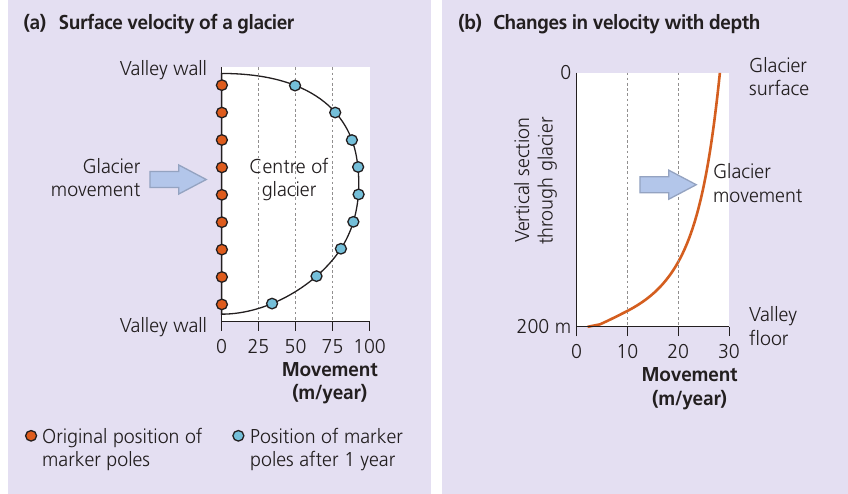
The diagrams above show:
- (a) How surface velocity varies across the glacier width - fastest movement occurs in the centre (up to 100 m/year), whilst the slowest movement occurs at the valley walls where friction is greatest
- (b) How velocity changes with depth through the glacier - movement is fastest at the surface and decreases with depth, reaching minimal movement at the valley floor (200m depth) where friction with the bedrock is greatest
Summary
Key Points to Remember:
- Ice movement is driven by gravity and creates two zones: a rigid upper zone that cracks, and a plastic lower zone that flows
- There are five main types of ice movement: internal deformation (creep), rotational flow, compressional flow, extensional flow, and basal sliding
- Compressional flow occurs where gradients reduce (ice slows and thickens), whilst extensional flow occurs where gradients increase (ice accelerates and thins)
- Glacial surges can cause ice to move 250-300m per day when excessive meltwater builds up beneath the glacier
- Ice moves fastest in the centre and at the surface, but slowest at the edges and base due to friction with the valley walls and bedrock