Impacts of Climate Change (AQA A-Level Geography): Revision Notes
📚Revision Notes
Impacts of Climate Change
Understanding climate change
Climate change is one of the most significant challenges facing our planet today. While Earth's climate has always changed naturally over time, there is strong scientific evidence that human activities are accelerating the rate of warming. This has major implications for glacial systems and cold environments around the world.
Note
Most climate scientists agree that recent decades have seen accelerated warming of global temperatures. The Earth's climate naturally fluctuates through cycles of glacials and inter-glacials, but many argue that the enhanced rate of recent change can only be explained by including human activities in the analysis.
Causes of climate change
Natural causes
Several natural factors can influence Earth's climate:
- Solar activity variations – Changes in the sun's energy output (the solar constant) and sunspot activity
- Earth's orbital changes – Variations in the eccentricity of Earth's orbit and axial tilt affect how much solar radiation reaches the surface
- Meteorite impacts – Can inject large amounts of dust into the atmosphere
- Volcanic activity – Eruptions release dust and gases that can alter atmospheric composition
- Plate movements – Redistribution of land masses affects patterns of heat absorption and reflection
- Changes in ocean circulation – Alters how heat is distributed around the planet
Human causes
Human activities have become increasingly important in driving climate change:
- Atmospheric composition changes – Build-up of greenhouse gases from agriculture, industry, transport and energy production
- Deforestation – Trees act as major carbon stores. When felled, burnt or left to rot, they release carbon back into the atmosphere
- Enhanced greenhouse effect – Human activities have increased concentrations of heat-trapping gases
The greenhouse effect
Important
The Greenhouse Effect
The greenhouse effect is a natural process where certain gases in Earth's atmosphere trap heat, keeping the planet approximately 30°C warmer than it would otherwise be. Without these gases, Earth would be too cold to support life as we know it.
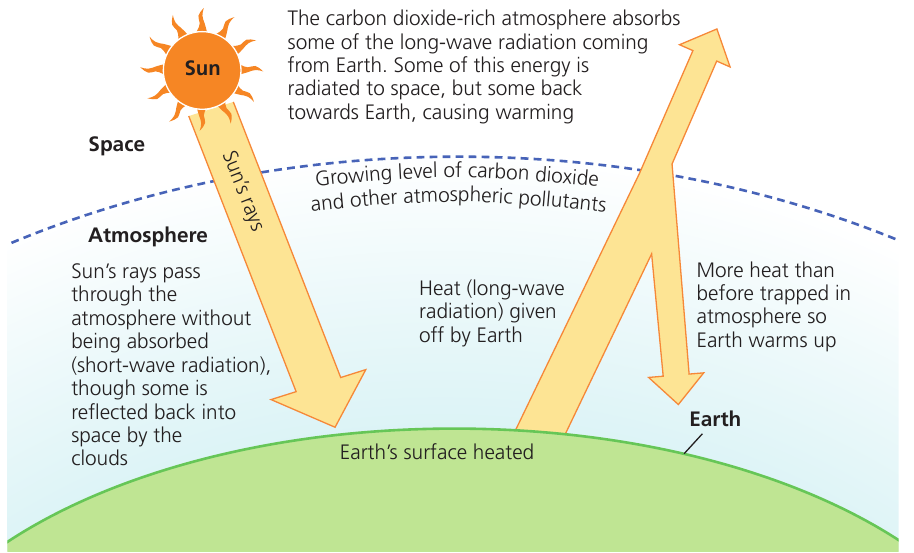
The greenhouse effect works through several steps:
Note
How the Greenhouse Effect Works:
- The sun's rays pass through the atmosphere as short-wave radiation
- Some radiation is reflected back to space by clouds
- Earth's surface absorbs energy and heats up
- The warmed Earth gives off heat as long-wave radiation
- Carbon dioxide and other atmospheric pollutants absorb some of this long-wave radiation
- Some energy escapes to space, but some is radiated back towards Earth
- More heat becomes trapped in the atmosphere, causing warming
Key greenhouse gases
The main gases responsible for trapping heat include:
- Carbon dioxide (CO₂) – The primary greenhouse gas from human activities
- Methane (CH₄) – A powerful heat-trapping gas
- Chlorofluorocarbons (CFCs) – Synthetic compounds previously used in refrigeration
- Nitrous oxide (N₂O) – Released from agricultural and industrial processes
- Ozone (O₃) – Plays a role in atmospheric heat balance
If the natural balance of these gases remains stable and solar radiation stays constant, Earth's temperature remains steady. However, human activity has disrupted this balance.
Sources of greenhouse gases
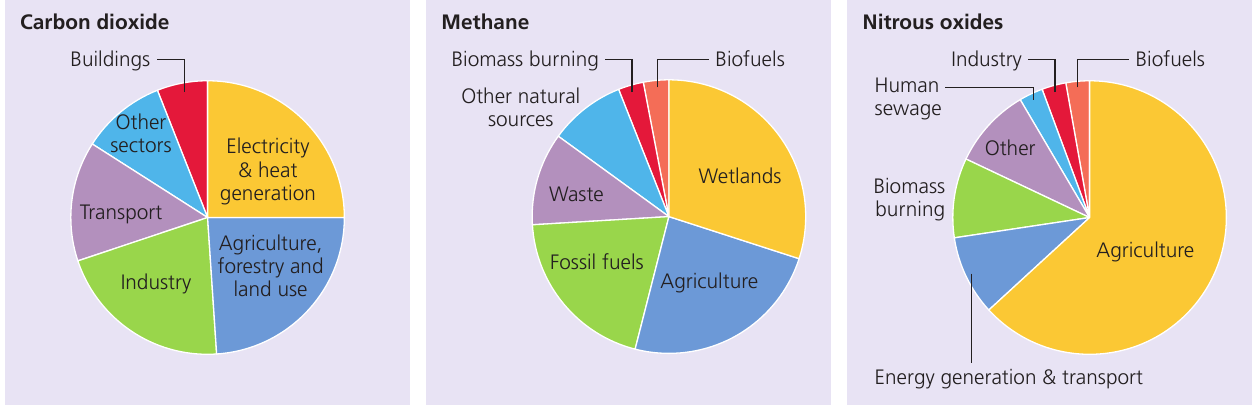
Different greenhouse gases come from various sources:
Carbon dioxide sources:
- Electricity and heat generation (largest contributor)
- Transport
- Industry
- Agriculture, forestry and land use
- Buildings
- Other sectors
Methane sources:
- Wetlands (largest natural source)
- Agriculture
- Fossil fuels
- Waste
- Biomass burning
- Other natural sources
Nitrous oxide sources:
- Agriculture (dominant source)
- Energy generation and transport
- Biomass burning
- Human sewage
- Industry
- Other sources
Evidence of atmospheric change
Historical carbon dioxide trends
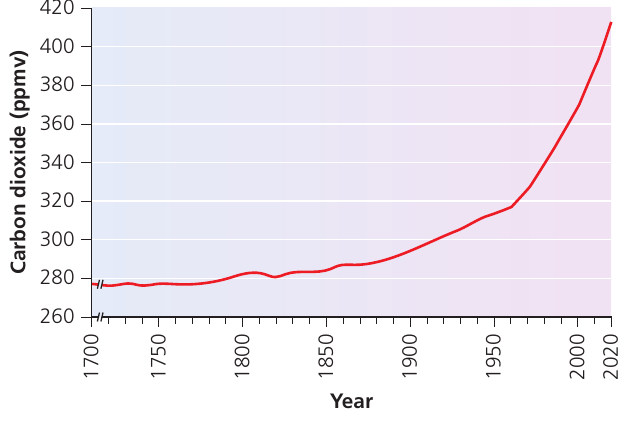
The concentration of atmospheric carbon dioxide has changed dramatically over the past 300 years:
- In the early 1700s, CO₂ levels were around 280 parts per million (ppmv)
- Throughout the 1700s and 1800s, levels remained relatively stable with only gradual increases
- From around 1950 onwards, there was a sharp acceleration in CO₂ concentration
- By 2020, atmospheric CO₂ reached approximately 410 ppmv
Important
This represents an increase of about 20% during the twentieth century alone. The current rate of increase is approximately 2.5 parts per million per year. This rapid rise, combined with increases in other greenhouse gases like methane and nitrous oxides, has disrupted the natural atmospheric balance and led to an enhanced rate of global warming in recent decades.
Observable impacts of climate change
Many climate impacts that scientists predicted 30 or 40 years ago are now happening. Climate change is already affecting cold environments in measurable ways.
Shrinking glaciers and ice loss
Important
Critical Impact on Global Glaciers
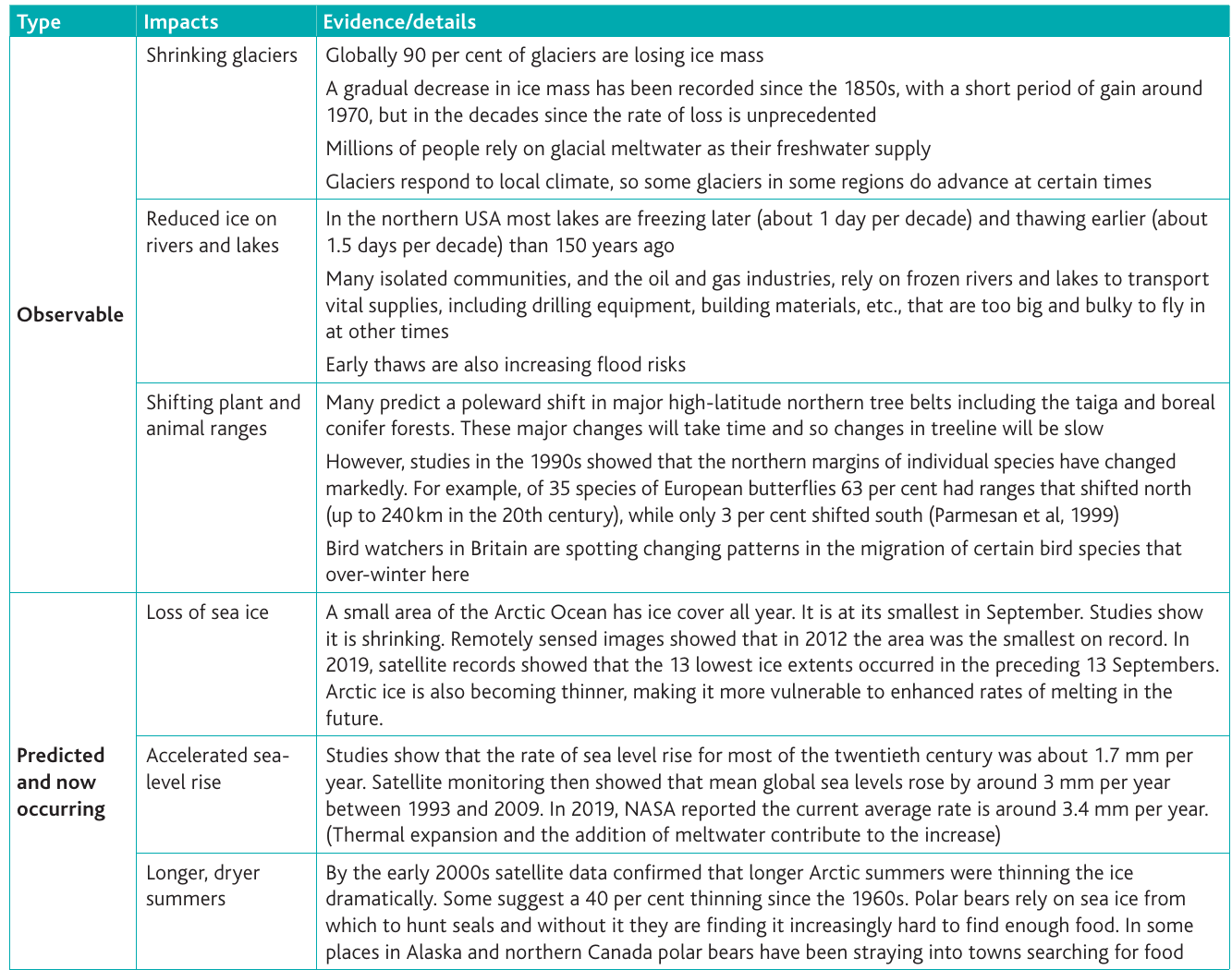
Globally, around 90% of glaciers are losing ice mass. Ice mass has decreased gradually since the 1850s, with a brief period of gain around 1970. In recent decades, the rate of loss has become unprecedented.
- Millions of people depend on glacial meltwater for their freshwater supply
- Glaciers respond to local climate conditions, so some glaciers in certain regions still advance at particular times
Reduced ice on rivers and lakes
Changes in ice coverage on rivers and lakes are becoming increasingly evident:
- In the northern USA, most lakes now freeze about 1 day later per decade
- Lakes are thawing approximately 1.5 days earlier per decade compared to 40 years ago
- Many isolated communities and industries rely on frozen rivers and lakes to transport vital supplies
- Equipment and materials that are too large and bulky to fly in must wait for ice to form
- Earlier thaws are increasing flood risks in some regions
Shifting plant and animal ranges
Note
Scientists predict a poleward shift in major northern tree belts, including taiga and boreal conifer forests. These changes will take considerable time, so alterations in treeline will be gradual.
Example
Observed Species Range Shifts
Studies from the 1990s showed northern margins of individual species have shifted noticeably:
- Research on 35 species of European butterflies revealed that 63% had ranges that moved north (up to 240km in the 20th century), while only 3% shifted south
- Bird watchers in Britain are observing changing migration patterns in certain species that now over-winter in the UK
Loss of Arctic sea ice
A small area of the Arctic Ocean maintains ice cover year-round, reaching its smallest extent in September:
- Remote sensing studies revealed that 2012 had the smallest ice extent on record
- In 2019, satellite records showed the 13 lowest ice extents occurred in the preceding 13 Septembers
- Arctic sea ice is becoming increasingly vulnerable to enhanced melting rates in the future
Predicted and occurring impacts
Some impacts are already happening while others are expected to intensify in the coming decades.
Accelerated sea-level rise
Note
Accelerating Rate of Sea-Level Rise
- Throughout most of the twentieth century, sea levels rose at approximately 1.7 mm per year
- Satellite monitoring between 1993 and 2009 showed mean global sea levels increased by around 3 mm per year
- By 2019, NASA reported the current average rate had risen to approximately 3.4 mm per year
This acceleration is caused by thermal expansion of ocean water and the addition of meltwater from ice sheets and glaciers.
Longer, drier summers
By the early 2000s, satellite data confirmed that Arctic summers were experiencing dramatic thinning of sea ice:
- Some studies suggest a 40% thinning since the 1960s
- Polar bears depend on sea ice to hunt seals
- Without sufficient ice, bears struggle to find adequate food
- In some places in Alaska and northern Canada, polar bears have been observed straying into towns searching for food
Future predicted changes
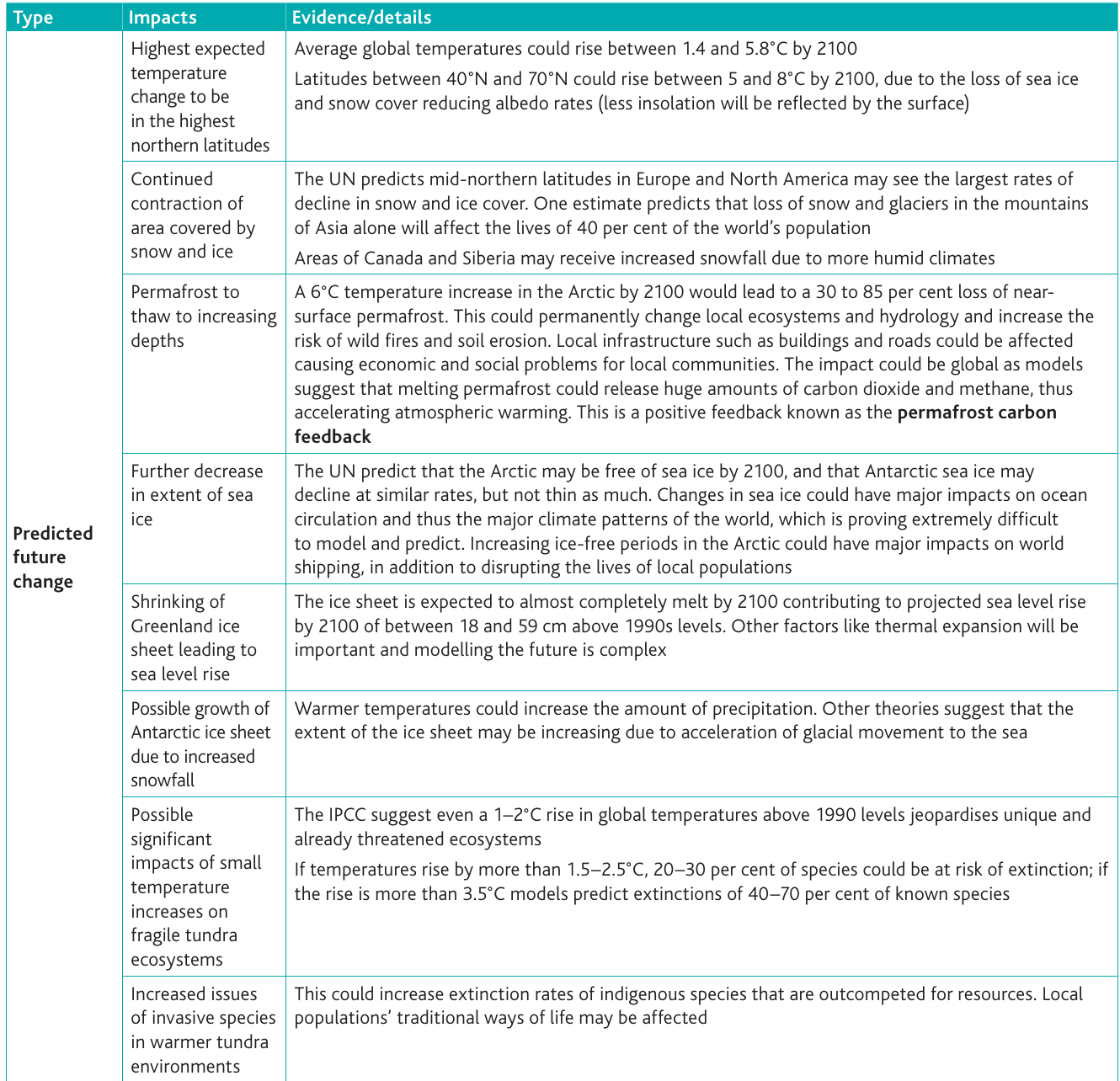
Temperature increases in high latitudes
Important
Severe Warming Predicted for Northern Latitudes
- Average global temperatures could rise between and by 2100
- Northern latitudes are expected to experience the most severe warming, with temperatures potentially rising between and by 2100
- Latitudes between and could see increases of due to loss of sea ice and snow cover
- Reduced snow and ice coverage will lower albedo rates (less solar radiation will be reflected by the surface), causing further warming
Continued contraction of snow and ice
The UN predicts mid-northern latitudes in Europe and North America may experience the largest declines in snow and ice cover:
- One estimate suggests that loss of snow and glaciers in Asian mountains alone will affect 40% of the world's population
- Some areas of Canada and Siberia may actually receive increased snowfall due to more humid climates developing
Permafrost thaw and its consequences
Important
Critical Permafrost Changes and Feedback Effects
A temperature increase in the Arctic by 2100 could lead to a 30-85% loss of near-surface permafrost. The consequences are far-reaching:
- Thawing could permanently alter local ecosystems and hydrology
- Increased risk of wildfires and soil erosion
- Local infrastructure (buildings, roads, pipelines) could be affected, creating economic and social problems
- Permafrost carbon feedback: Models suggest melting permafrost could release enormous amounts of stored carbon dioxide and methane, thus accelerating atmospheric warming even further
Changes in sea ice extent
The UN predicts the Arctic may be free of sea ice by 2100:
- Antarctic sea ice may decline at similar rates, though this is more complex to predict
- Changes in sea ice could have major impacts on ocean circulation
- This affects major climate patterns globally, making future conditions extremely difficult to model and predict
- Increasing ice-free periods in the Arctic could have major impacts on global shipping routes, potentially opening new passages but also disrupting lives of local populations
Melting of major ice sheets
Note
The Greenland ice sheet is expected to almost completely melt by 2100. This could contribute between 18 and 59 cm to projected sea level rise by 2100, compared to 1990s levels. Other factors like thermal expansion add to the total sea level rise. The future is complex and difficult to model precisely.
Antarctic ice sheet changes
Warmer temperatures could increase precipitation levels. Some theories suggest the Antarctic ice sheet may actually be growing due to accelerated glacial movement towards the sea and increased snowfall accumulation.
Impacts on fragile tundra ecosystems
Important
Severe Threats to Biodiversity
The IPCC warns that even a 1-2°C rise in global temperatures above 1990 levels puts unique and threatened ecosystems at risk:
- If temperatures rise by more than , approximately 20-30% of species could face extinction risk
- Temperature increases exceeding could lead to extinctions of 40-70% of known species
- Local indigenous populations' traditional ways of life would be significantly affected
- Extinction rates of indigenous species competing with invasive newcomers could increase
Invasive species in warmer environments
As cold environments warm, species adapted to slightly warmer conditions may move into these regions:
- Native species that have evolved in cold conditions may struggle to compete for resources
- This could disrupt ecosystems and threaten biodiversity
Cold environments as human habitats
Population distribution in cold environments
Despite the harsh characteristics of cold environments, many people live and work in these regions. Over 4 million people live and work within the Arctic Circle, though population size and structure vary considerably across different regions. All Arctic regions experience differences in natural population increase and net migration patterns.
Opportunities and risks
The physical environment of cold regions creates both challenges and opportunities for human occupation and development:
Key challenges include:
- Very low temperatures making outdoor activities and construction difficult
- Short summers resulting in limited growing seasons for agriculture
- Remote locations increasing costs of transportation and supplies
- Harsh conditions requiring specialized equipment and infrastructure
Note
Climate change is altering these conditions, creating new opportunities (such as extended growing seasons or new shipping routes) but also presenting serious risks (infrastructure damage from permafrost thaw, loss of traditional ways of life, ecosystem disruption).
Remember!
Summary
Key Points to Remember:
-
The greenhouse effect is essential for life – without it, Earth would be about 30°C colder, but human activities have enhanced it beyond natural levels.
-
Multiple greenhouse gases contribute to warming – carbon dioxide is the main concern, but methane and nitrous oxides from agriculture, industry and transport also play significant roles.
-
CO₂ levels have risen dramatically – from 280 ppmv in the 1700s to over 410 ppmv today, with most of the increase occurring since 1950.
-
Cold environments are experiencing observable changes now – 90% of glaciers are shrinking, Arctic sea ice is declining, lakes freeze later and thaw earlier, and plant and animal ranges are shifting poleward.
-
Northern latitudes will warm most severely – predicted temperature rises of 5-8°C by 2100 in high latitudes will have cascading effects including permafrost thaw (releasing more greenhouse gases), ecosystem changes, and impacts on human populations and infrastructure.