Plate Tectonics (AQA A-Level Geography): Revision Notes
📚Revision Notes
Plate tectonics
Earth structure
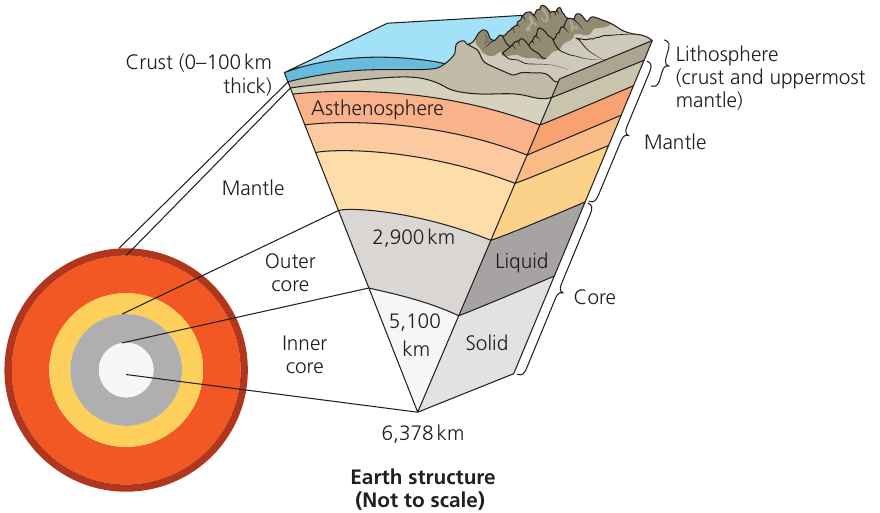
Understanding the internal structure of the Earth is fundamental to grasping how plate tectonics works. The Earth's interior consists of three main components that each have distinct characteristics and play different roles in tectonic processes.
The core
At the very centre of our planet lies the core, which is divided into two distinct parts. The inner core is solid and composed of dense rocks containing iron and nickel. This is surrounded by the outer core, which is extremely hot molten material. Temperatures in the core exceed 5,000°C, making it one of the hottest places in our solar system.
The immense heat within the core comes from two primary sources:
- Primordial heat – this is leftover energy from when the Earth first formed approximately 4.6 billion years ago
- Radiogenic heat – this is continuously produced by the decay of radioactive isotopes, particularly Uranium-238, Thorium-232, and Potassium-40
This heat is crucial because it drives the processes that cause plates to move.
The mantle
Surrounding the core is the mantle, which is the thickest layer of the Earth. This layer is made of molten and semi-molten rock that is rich in iron and magnesium. One mineral commonly found here is peridotite.
The upper portion of the mantle, between approximately 100 and 700 kilometres depth, becomes hotter and more fluid. This specific zone is called the asthenosphere. Above the asthenosphere, the mantle becomes solid and forms part of the lithosphere along with the crust.
Important
The asthenosphere is the part of the Earth's mantle that lies below the lithosphere, at depths between about 100 and 700 kilometres. It is semi-molten and allows the plates above it to move.
The crust
The outermost layer is called the crust. This is where we live and is the thinnest of all the layers. There are two distinct types of crust – continental crust and oceanic crust – and they have quite different characteristics.
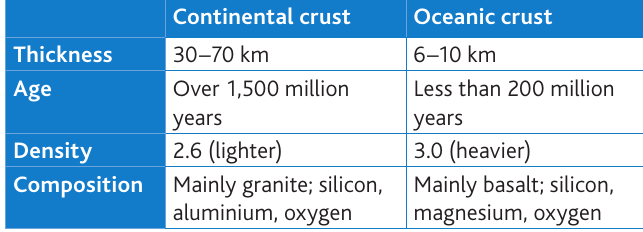
Continental crust is significantly thicker (30-70 km) compared to oceanic crust (6-10 km). It is also much older, with some continental rocks exceeding 1,500 million years, whilst oceanic crust is geologically young at less than 200 million years old.
The density difference is also important: continental crust has a density of 2.6, making it lighter, whilst oceanic crust is denser at 3.0. This density difference affects how the two types of crust behave at plate boundaries.
Note
Continental crust is composed mainly of granite, which contains silicon, aluminium, and oxygen. In contrast, oceanic crust is made of basalt containing silicon, magnesium, and oxygen.
The theory of plate tectonics
The development of plate tectonic theory represents one of the most significant scientific revolutions of the twentieth century. It completely transformed how we understand Earth Science and explains many geological phenomena that were previously mysterious.
Important
Plate tectonic theory states that the Earth's crust is made up of several rigid plates moving relative to one another.
Continental drift
The journey towards our modern understanding began in the 1960s, but the foundations were laid much earlier. In the early twentieth century, a German researcher named Alfred Wegener proposed a revolutionary idea. He collected evidence suggesting that approximately 300 million years ago, all the continents were joined together in one giant supercontinent called Pangaea.
Wegener theorised that Pangaea later split into two smaller continents: Laurasia and Gondwanaland. These then continued to break apart and drift to form the continents we recognise today. He called this concept continental drift.
Evidence for continental drift
When Wegener first proposed his theory, many scientists were sceptical. However, he had gathered compelling evidence from both geological and biological sources.
Geological evidence included:
- The 'jigsaw fit' of South America and west Africa – the coastlines appear to fit together like puzzle pieces
- Ancient glacial deposits found in South America, Antarctica, and India show similar characteristics. These could only have formed if these landmasses were once joined together and then moved
- Structural faults in rocks in Brazil and west Africa match when the two continents are aligned
- Similar rock sequences found in northern Scotland and eastern Canada indicate they were formed under the same conditions in one location
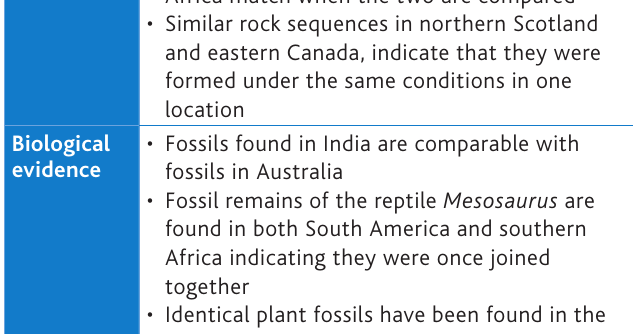
Biological evidence included:
- Fossils discovered in India are comparable with fossils found in Australia, suggesting these lands were once connected
- Fossil remains of the reptile Mesosaurus have been found in both South America and southern Africa. This creature could not have swum across the Atlantic Ocean, indicating these continents were once joined
- Identical plant fossils have been discovered in the coal deposits of both India and Antarctica
Example
Worked Example: Evidence from Mesosaurus Fossils
Observation: Fossil remains of Mesosaurus, a freshwater reptile, have been found in both South America and southern Africa.
Analysis:
- Mesosaurus was a freshwater creature that could not survive in salt water
- The Atlantic Ocean now separates these two continents by thousands of kilometres
- Mesosaurus could not have swum across the Atlantic
Conclusion: The only logical explanation is that South America and Africa were once connected, allowing Mesosaurus to live across both regions before the continents drifted apart.
Crustal evolution
Very little is known about the earliest stages of Earth's crustal development. Much of the geological record has been destroyed as elements of the crust have been recycled over billions of years. The oldest rocks we have found are approximately four billion years old.
Scientists believe that around three billion years ago, there was a significant increase in the growth of continental crust. Rocks from this ancient period can be found in the middle sections of today's large continental plates. This suggests that plate movement has been occurring for an extremely long time, with continents growing and changing over billions of years.
Modern plate tectonic theory
Twenty-first century understanding recognises that the crust and rigid upper mantle together form the lithosphere. This lithosphere is divided into seven large continental and ocean tectonic plates, plus several smaller ones.
Important
A tectonic plate is one of a series of rigid sections of the Earth's crust. They float on the upper mantle and move relative to one another.
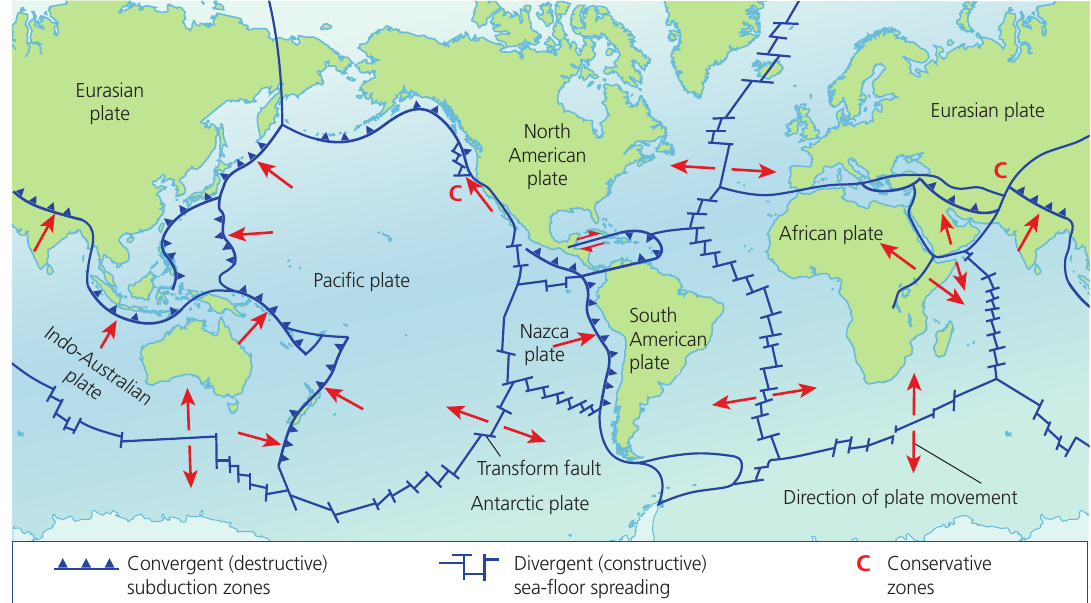
The theory explains that the lithosphere is able to slide over the semi-molten asthenosphere below, and this allows plate movement to occur. The lithospheric plates move across the Earth's surface at speeds typically between five and ten centimetres per year. Although this seems slow, over millions of years these movements result in significant changes to Earth's geography.
Evidence from palaeomagnetism
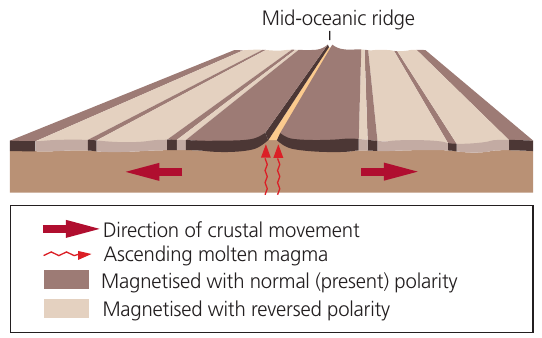
Strong evidence supporting plate tectonics emerged in the 1940s. Scientists discovered and studied the mid-Atlantic ridge, finding a similar feature in the Pacific Ocean. Research into ancient magnetic particles in rocks provided crucial proof.
Important
Palaeomagnetism is a record of the history of the Earth's magnetic field, preserved in magnetic minerals in volcanic rocks.
The study found that:
- The polarity of rock on either side of the mid-Atlantic ridge showed a striped pattern that was mirrored on both sides
- The oceanic crust was slowly moving away from the plate boundary
- The oceanic crust became older with increasing distance from the mid-oceanic ridge (although geologically speaking it is still very young – nowhere older than 200 million years)
Sea-floor spreading
The evidence of magnetic stripes led to an important realisation. If the sea floor is spreading, this means the Earth must be getting bigger. However, this is not the case. To accommodate the new crust being created at mid-oceanic ridges, crust must be destroyed elsewhere.
Evidence was found in huge oceanic trenches where large areas of ocean floor were being pulled downward in a process known as subduction.
Important
Sea-floor spreading is the theory that the ocean floor is moving away from the mid oceanic ridge and across the deep ocean basin, to disappear beneath continents and island arcs.
Plate movement
The forces that drive plate movement are complex, and scientists now believe multiple mechanisms work together rather than a single process being responsible.
Convection currents
Lithospheric plates are massive structures requiring enormous forces to move them. Early theories suggested that convection currents within the mantle were the main driving force. The uneven distribution of temperatures towards the base of the mantle was thought to create convection cells which dragged the lithospheric plates along when the moving mantle reached the surface.
Note
However, this theory has been partly discounted because most of the mantle is not fluid enough to flow in this way. Scientists now believe that convection currents play only a supporting role in the overall mechanism of plate movement.
Current models suggest plates move as part of a gravity-driven system involving two other processes: ridge push and slab pull.
Ridge push (gravitational sliding)
At constructive plate boundaries, less dense, hot magma rises from deep within the Earth and produces an ocean ridge. This ridge stands two to three kilometres above the ocean floor. As newly formed rock cools, it becomes denser.
Gravity acts on this older, denser lithosphere, causing it to slide away from the ridge and down the sloping surface of the semi-molten asthenosphere below. The occurrence of shallow earthquakes at these ridges, resulting from the repeated tearing apart of newly formed crust, provides evidence that there is frictional resistance to this movement.
Some experts prefer to call this process gravitational sliding rather than ridge push.
Slab pull
At destructive (subduction) boundaries, older and colder oceanic plates are denser than the underlying mantle. As the subducting plate is much colder and heavier than the hotter mantle, it sinks into the mantle due to the downward gravitational force acting on it. This pulls the whole oceanic plate down into the mantle.
The force that the sinking edge exerts on the rest of the plate is called slab pull. Currently, although many scientists consider slab pull to be a stronger factor in driving plate movements than ridge push or mantle convection, there is ongoing debate. Each plate moves at its own rate, and the balance of driving and retarding forces must vary from plate to plate. It therefore seems unlikely that any single mechanism is the sole cause of plate motion.
Plate margins
The lithospheric plates interact with one another at their margins (boundaries). It is along these margins that most volcanic and seismic activity occurs. Distinctive landforms are also located at these boundaries. There are three main types of plate margin:
- Constructive (divergent) plate margin
- Destructive (convergent) plate margin
- Conservative (passive) plate margin
Constructive (divergent) plate margins
Important
A constructive plate margin is a plate margin where new crust is generated as the plates pull away from each other. These are found at mid-oceanic ridges.
At constructive plate margins, plates are moving away from one another and new lithosphere is created. Under the oceans, this process has produced an extensive ocean ridge system comprising underwater mountains and volcanoes that stretches for nearly 65,000 kilometres. Over 90 per cent of this mountain range lies at an average depth of 2,500 metres below sea level.
Ocean ridge system
The ocean ridge system has different names depending on location. Examples include the Mid-Atlantic Ridge (MAR), the East-Pacific Rise, the Juan de Fuca Ridge, and the Galapagos Rise. The MAR rises about three kilometres in height above the ocean floor and measures between 1,000 and 1,500 kilometres wide. Along its length, there are numerous transform faults and fractures.
The ridge system forms where tectonic plates are pulling apart. As this happens, pressure is reduced on the hot rock beneath, allowing it to melt and form magma. This magma rises to fill the gap, creating new oceanic crust as it cools and solidifies. The process creates volcanic activity and a characteristic landscape of underwater mountains.
Note
The newly formed volcanic rocks record the Earth's magnetic field at the time of their formation. Because the Earth's magnetic field periodically reverses, the ocean floor displays symmetrical magnetic stripes parallel to the ridge. This pattern provides strong evidence for sea-floor spreading.
Destructive (convergent) plate margins
Important
A destructive plate boundary is a plate margin where crust is destroyed as two plates converge. These are usually associated with island arcs or young fold mountains.
At destructive margins, two plates are moving towards each other. Where this occurs, mountains are formed. Where plates pull apart (at divergent boundaries), continents break apart and oceans form. The continents within the plates, and the ancient hearts of the continents (called cratons), drift with the plates. Over millions of years, these movements cause significant changes to the Earth's geography.
When an oceanic plate meets a continental plate, the denser oceanic plate is forced beneath the lighter continental plate. This process is called subduction. As the oceanic plate descends into the mantle, it melts and can trigger volcanic activity. The area where this occurs is marked by deep ocean trenches.
Conservative (passive) plate margins
Important
A conservative plate margin is a plate margin where two tectonic plates are moving past one another with no addition or destruction of plate material.
At conservative margins, plates slide past each other horizontally. No crust is created or destroyed. However, the friction between the plates as they move can be enormous, causing the plates to become locked together. When the stress eventually overcomes the friction, the plates suddenly jerk past each other, releasing energy as earthquakes. This makes conservative boundaries particularly hazardous.
The most famous example of a conservative margin is the San Andreas Fault in California, where the Pacific Plate and North American Plate slide past each other.
Summary
Key Points to Remember:
- The Earth's structure consists of three main layers: the core (with solid inner and liquid outer parts), the mantle (including the semi-molten asthenosphere), and the crust (either continental or oceanic)
- Plate tectonic theory explains that the lithosphere is broken into rigid plates that float on the asthenosphere and move relative to one another
- Evidence for continental drift includes the jigsaw fit of continents, matching rock sequences and geological structures, and identical fossils found on now-separated landmasses
- Plate movement is driven by a gravity-driven system involving ridge push (gravitational sliding) and slab pull, with convection currents playing a supporting role
- There are three types of plate margins: constructive (divergent) where new crust forms, destructive (convergent) where crust is destroyed, and conservative where plates slide past each other