Responses to Storm Hazards (AQA A-Level Geography): Revision Notes
📚Revision Notes
Responses to Storm Hazards
Responding to tropical storm hazards involves a range of strategies to protect people and property. These responses can be categorised into preparedness, mitigation, prevention attempts, and adaptation. As storm events become more frequent and intense due to climate change, effective response strategies are increasingly vital.
Note
The frequency and intensity of tropical storms are increasing due to climate change, making effective response strategies more critical than ever for protecting vulnerable communities and infrastructure.
Preparedness
Preparedness involves getting ready before a storm strikes. Modern technology has greatly improved our ability to predict and prepare for tropical storms.
Weather prediction and monitoring
Today's data gathering techniques have made tropical storm prediction increasingly sophisticated. Hurricane bureaux, such as the National Hurricane Centre in Florida, USA, play a crucial role in tracking and predicting storms.
These organisations have access to:
- Weather satellites that provide real-time views of storm location, track, size and strength
- Specially adapted aircraft and weather balloons that fly into storms to gather direct measurements
- Powerful supercomputers that analyse data from multiple sources and compare it to historical patterns
By studying all this information, meteorologists can predict the future path and strength of approaching storms. This allows authorities to issue warnings and prepare communities for impact.
Evacuation procedures
Important
Evacuate means to warn people in vulnerable areas and move them to safer locations before a storm arrives.
When predictions show a dangerous storm approaching, people in at-risk areas can be warned to evacuate. However, issuing accurate warnings is essential because:
- Economic costs are substantial - the State of Georgia in the USA estimates that evacuation costs $2.3 million per kilometre of coastline
- False alarms reduce trust - if warnings prove incorrect, people may become complacent and ignore future advice
Note
Because cyclones often follow erratic, unpredictable paths, it's not always possible to give more than 12-18 hours' warning. This creates particular challenges in less developed regions where communication systems are poor and there isn't sufficient time for proper evacuation.
Hurricane preparedness programmes
Some regions have developed comprehensive preparedness programmes. In Florida, for example, 'Project Safeside' is a hurricane awareness programme with precautionary drills used in schools.
Example
Case Example: Bangladesh's Cyclone Preparedness Programme
Bangladesh's cyclone preparedness programme provides an excellent example of coordinated disaster preparation. This initiative, developed by the Bangladesh government, the United Nations, the International Red Cross and the Bangladesh Red Crescent Society, includes:
- Awareness campaigns using public discussions, posters, leaflets, film and theatre to share information about cyclone warning signals
- Early warning systems based on modern weather radar stations that transmit weather updates and identify potentially dangerous storms while they're still at sea
- Construction of storm shelters to reduce storm-related deaths - in 2020, there were 4,000 shelters with plans for 1,400 more
- Replanting mangrove forests in areas just inland from the coast to provide natural protection
- Emergency packs containing dried food and portable stoves so people can survive in storm shelters for extended periods
Results: The success of this programme is dramatic. In 1970, over 200,000 people were killed by a single storm in Bangladesh. In 2019, 2.1 million people were relocated to storm shelters as Storm Bulbul approached. Despite widespread damage, only eight people were killed.
Mitigation
Mitigation focuses on reducing damage to infrastructure and buildings when storms strike.
In the USA, the Federal Emergency Management Agency (FEMA) has developed a handbook with suggestions for reducing damage to infrastructure. Their recommendations include making roads, bridges, public buildings, parks and beaches as resilient as possible to storm impacts.
Protecting homes and buildings
Note
FEMA Recommendations for Homeowners
FEMA has produced factsheets with advice for homeowners on protecting their properties from flood and wind damage:
- Waterproofing all external walls to prevent water penetration
- Securely fixing roofs to the rest of the building structure to prevent them being torn off
- Installing impact-resistant windows and doors to withstand flying debris
- Elevating buildings in flood-prone areas
Insurance
FEMA highly recommends that people take out specialist insurance to cover potential storm damage. This is particularly important because following a cyclone event, aid is available both in the short and long term. However, damage to the economy of the affected area is likely to last for many years.
Note
In the past, poorer regions lost more lives than richer ones, whilst richer regions lost more property of higher monetary value. Globally, fewer lives are now lost to tropical storms, but the difference in the value of property lost (in monetary terms at least) remains significant.
Prevention
Like most other natural hazards, tropical cyclones cannot actually be prevented. Several prevention techniques have been unsuccessfully considered over the past 80 years:
- Seeding clouds with dry ice or silver iodide so the storm loses water over the ocean and has less latent heat energy to release on land
- Cooling the ocean with icebergs to reduce evaporation
- Changing the radiation balance in the storm environment by blowing black soot into the storm
- Exploding the storm apart with hydrogen bombs and blowing it away from land with giant fans
Important
The Impossibility of Storm Prevention
These ideas fail to take into account the sheer size and power of tropical storms. NASA has estimated that during its lifetime, an average Atlantic hurricane can expend as much energy as 10,000 nuclear bombs. Given this immense power, human attempts to prevent or control storms are essentially futile.
Adaptation
With the growing frequency of extreme storm events due to climate change, humans must increasingly adapt both their lifestyle and environment to live with these storms.
Land-use planning
Careful planning can identify areas at greatest risk and limit certain types of development in vulnerable locations. This means:
- Restricting residential development in high-risk coastal zones
- Avoiding building critical infrastructure in flood-prone areas
- Directing population away from the most dangerous locations
Local authorities in the USA have implemented land-use planning strategies to reduce future storm damage. They also maintain plans to reduce evacuation times and facilitate post-disaster redevelopment.
Coastal defences
Building physical barriers helps protect vulnerable coastal areas:
- Sea walls - solid barriers that absorb wave energy and prevent flooding
- Breakwaters - offshore structures that reduce wave height before waves reach the shore
- Flood barriers - gates or barriers that can be closed when flooding threatens
Note
The sea wall built to protect Galveston, Texas, following a deadly storm surge in 1900, was so expensive that it's unlikely to be repeated. Other measures would need to be considered elsewhere.
Retrofitting buildings
Important
Retrofitting means modifying existing structures to make them wind resistant and safer during storm events.
In poorer areas, the need for land often outweighs planning considerations, leading to buildings being constructed in high-risk locations. Retrofitting these buildings becomes essential.
Example
Case Example: Dominica Retrofitting Project (1994)
In 1994 in Dominica (West Indies), some homes were retrofitted by the Organization of American States and the government of Dominica.
Results: The value of this project was demonstrated the following year when all the retrofitted buildings withstood the impact of Hurricane Marilyn whilst surrounding structures suffered severe damage.
Retrofitting involves strengthening buildings to better withstand high winds and flooding, including reinforcing roofs, walls, and foundations.
Case study: Hurricane Michael, northern Florida, USA (2018)
Background and development
Hurricane Michael in October 2018 was the strongest storm to make landfall in the USA since Hurricane Andrew in 1992.
The storm initially developed as a tropical depression in the western Caribbean, between Cuba and Mexico, during the weekend of 6 and 7 October 2018. It had already hit parts of Mexico and Cuba with heavy winds and torrential downpours on the Sunday night and Monday morning.
By 9 October, having become a category 2 storm, it started moving north through the Gulf of Mexico. It made landfall early in the afternoon of 10 October, having briefly been a category 5 storm.
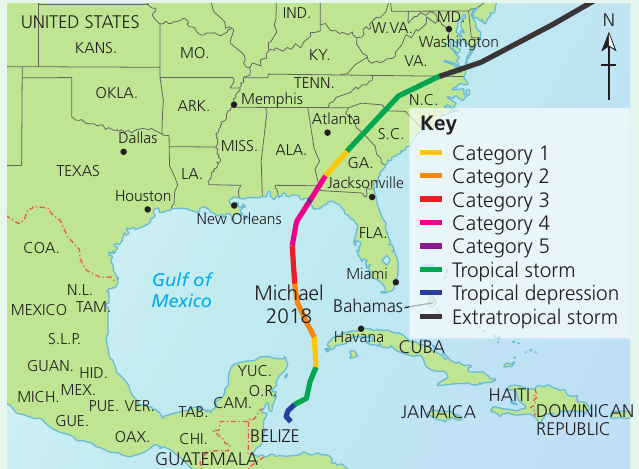
Storm classification
Initially categorised as a category 4 hurricane, a later report published by the National Hurricane Center in Florida confirmed the storm was stronger than that, with winds at landfall estimated to be over 250 kph. Hurricane Michael was one of only four category 5 hurricanes to ever reach land in the USA.
Risk and vulnerability
The storm came ashore on the coast of Florida near Mexico Beach, Bay County, Florida - a small coastal town with a population of 1,000. It then reduced in strength as it headed inland to hit parts of Georgia and North and South Carolina, which were already suffering from the effects of Hurricane Florence earlier that year.
Impacts
Human casualties:
- Wind, storm surge and rain (floods) were directly responsible for 16 deaths across the states of Florida, Virginia, North Carolina and Georgia
- An additional 43 deaths were caused by falls during the storm clean-up, traffic accidents, and medical issues made worse by the hurricane
Property and infrastructure damage:
Hurricane Michael caused a trail of destruction stretching from Florida (particularly the cities of Mexico Bay and Panama City) to Georgia, North Carolina and South Carolina. It caused flash flooding that turned roads into rivers.
Note
Bay County, Florida Damage:
- More than 45,000 structures were damaged
- More than 1,500 were destroyed, including two hospitals with severe damage
- Trees were uprooted and power lines brought down
- Roofs were ripped off and swept into the air
- Homes were ripped open by fallen trees
In the town of Mexico Beach:
- 1,584 of the town's 1,692 buildings were damaged
- More than 800 were destroyed
Economic impacts:
- Power cuts, at their greatest extent, affected nearly 400,000 electricity customers in Florida - about four per cent of the whole state
Summary
Key Points to Remember:
-
Modern technology enables better preparedness - weather satellites, specially adapted aircraft, and supercomputers help predict storm paths and issue evacuation warnings, though cyclones follow erratic paths making precise prediction difficult.
-
Comprehensive preparedness programmes save lives - Bangladesh's Cyclone Preparedness Programme reduced deaths from 200,000 in 1970 to just 8 in 2019 through warning systems, storm shelters, and emergency supplies.
-
Prevention of tropical storms is impossible - the immense energy of storms (equivalent to 10,000 nuclear bombs) makes human intervention futile, so focus must be on preparedness and adaptation.
-
Adaptation is essential for living with storms - strategies include land-use planning, building coastal defences (sea walls, breakwaters), retrofitting existing buildings, and obtaining specialist insurance coverage.
-
Hurricane Michael (2018) demonstrates storm impacts - as one of only four category 5 hurricanes to hit the USA, it caused 59 deaths, damaged 45,000+ structures in Bay County, and affected 400,000 electricity customers in Florida.