Case Study: Causes, Impacts and Implications of Desertification for Local Scale Sustainable Development (AQA A-Level Geography): Revision Notes
📚Revision Notes
Case Study: Causes, impacts and implications of desertification for local scale sustainable development
Introduction
This case study examines how communities in the Touat-Adrar region of Southern Algeria have responded to the challenges of desertification. The region demonstrates how traditional knowledge and sustainable practices can help people adapt to harsh desert conditions.
Aims of the case study
Note
Key Study Objectives:
The case study explores three key areas:
- How growing population numbers can contribute to desertification processes
- The relationships between people and landscapes in areas affected by desertification
- How sustainable solutions enable communities to adapt to and reduce the impacts of desertification
Location
The Touat-Adrar region is located in southern Algeria, within the Northern Sahara Desert. The area is characterised by extreme aridity and limited water resources.
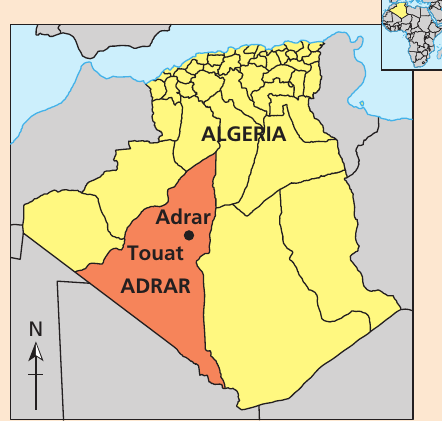
Geographical context
For centuries, communities in this part of the Northern Sahara have developed efficient irrigation systems that make the best use of extremely limited water supplies. These systems have enabled local populations to survive in hostile conditions where water is scarce.
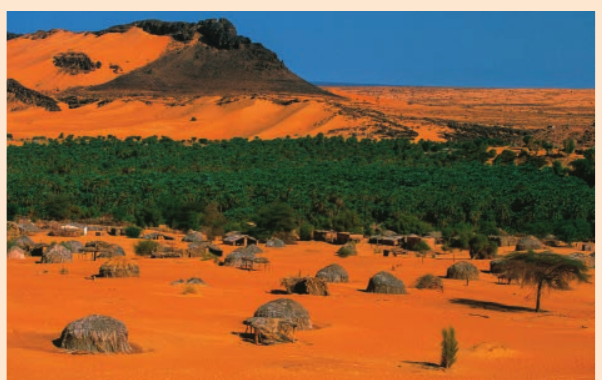
Small settlements have traditionally developed around oases, where groundwater comes close to the surface. These communities have relied on groundwater to sustain themselves and support small-scale agriculture in an otherwise barren landscape.
Important
Oases are areas in desert regions where groundwater supplies enable vegetation to grow and human settlement to exist. They act as vital water sources in arid environments.
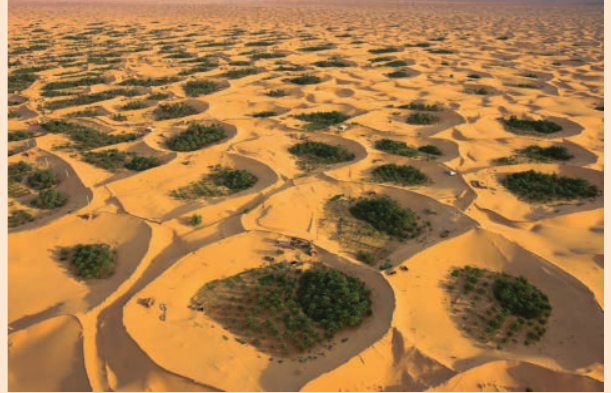
The region receives only an average of 50 mm of rainfall per year, making water conservation absolutely critical for survival.
Causes of desertification in the Touat-Adrar region
In recent decades, the water supplies and soil quality that support these oases have come under serious threat due to several interconnected factors:
Population growth
Algeria's population is expanding rapidly at almost 2% per year. Life expectancy has also increased significantly, reaching 78 years for females and 76 years for males by 2020. This demographic change means more people are competing for the same limited water resources in the desert region.
Note
The combination of high population growth and increased life expectancy creates sustained pressure on limited desert water resources. More people require more water for drinking, agriculture, and daily activities in an already water-scarce environment.
Agricultural intensification and over-cultivation
Farmers have intensified their agricultural practices to feed growing populations. This includes:
- Moving towards monoculture farming of high-yielding modern seed varieties
- Growing cash crops specifically for export markets
- Using chemical fertilisers and modern machinery to boost production
These practices can degrade soil quality and require substantially more water than traditional farming methods.
Modern water extraction
The most critical threat comes from powerful modern water pumps. These pumps extract huge quantities of water directly from underground stores (aquifers). The water is then used for jet irrigation, where most of it evaporates rapidly in the high temperatures before it can be absorbed by crops.
Important
This unsustainable extraction is depleting groundwater supplies that have taken thousands of years to accumulate. Modern pumping methods remove water far faster than natural processes can replenish it.
Traditional response: The foggaras irrigation system
Communities in the region have historically used an ingenious underground irrigation system to adapt to water scarcity and ensure their resilience. This system protects precious water supplies from excessive evaporation.
Important
Foggaras are a series of man-made underground galleries and tunnels that harvest groundwater. They transport water from source to settlement with minimal loss through evaporation.
How the foggaras system works
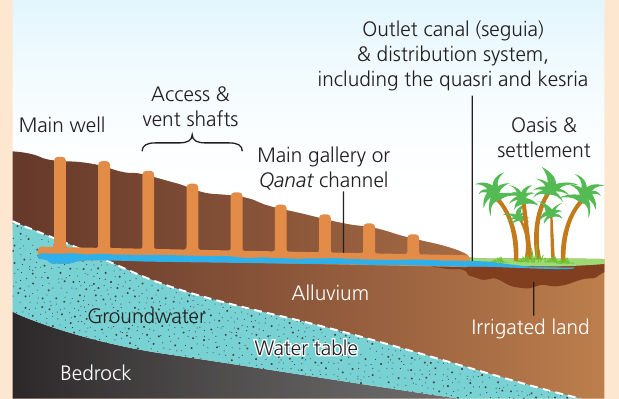
The foggaras system is carefully engineered to work with gravity and the natural landscape:
Note
Key Components of the Foggaras System:
- Main well: Dug approximately 2.5 km upstream from the oasis or village, positioned where the settlement is located on a valley floor or at the foot of a gentle slope
- Underground pipes: Run almost horizontally beneath the surface at a very slight downward incline of about 1-2 mm/m
- Access and vent shafts: Constructed every 20-30 metres along the channel's length to allow maintenance and ventilation
- Outlet canal (sequia): Where water emerges at the oasis and enters a distribution system
The galleries and access wells are constructed from locally quarried stone and palm tree trunks, held together with a cementing mixture of clay and straw. This local sourcing makes the system sustainable and affordable.
Advantages of the foggaras system
The traditional foggaras system offers several important benefits:
- The low gradient means water flows slowly using gravity alone. This prevents erosion from fast-flowing water and eliminates the need for expensive diesel-driven pumps
- Water flowing underground experiences virtually no loss through evaporation, conserving precious water resources
- Using locally sourced building materials provides employment and reduces dependence on imported materials
Water distribution and management
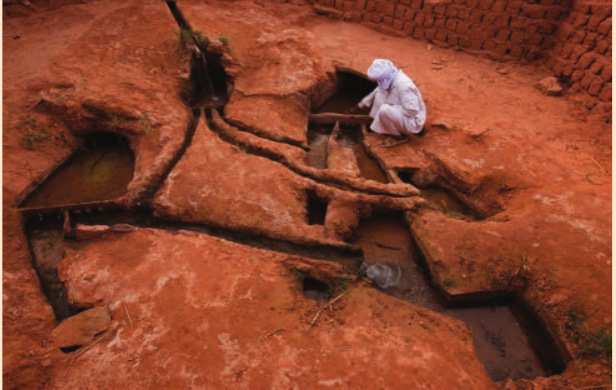
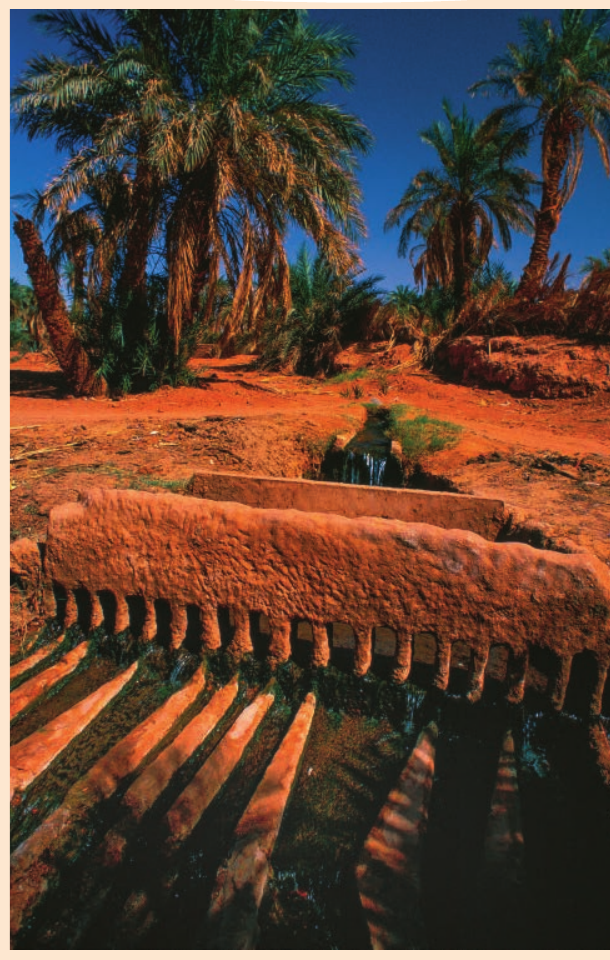
Once water reaches the oasis, it flows into an open-air canal called a sequia. Here it is collected in a small basin or reservoir known as a quasri.
Important
A kesria is a comb-like stone device used to divide water. It splits the flow from the quasri into various irrigation channels, ensuring fair distribution among community members.
Water is distributed fairly among those who hold water rights. The 'water deciders' - community members who understand the system - hold responsibility for distributing water equitably according to established rights.
Recent responses and management strategies
Over the last three decades (particularly following the Arab Spring events in North Africa), research has continued in the region. Since 2017 and 2018, there has been active collaboration between non-governmental organisations (NGOs) from the Mediterranean region and Algeria itself.
Note
NGO Conservation Strategy:
These organisations have developed a strategy to protect the oasis ecosystem. Four oases were selected for conservation activities, including:
- Restoring palm trees to provide shade and prevent soil erosion
- Raising public awareness about preserving the oases
- Rehabilitating and preserving the traditional foggaras irrigation systems
These schemes have successfully rehabilitated traditional irrigation systems known by their traditional name, foggaras.
Implications for sustainable development
The foggaras rehabilitation projects demonstrate several important lessons for sustainable development:
Benefits to local populations
Local communities benefit in multiple ways from these initiatives:
Note
Community Workshops:
Workshops educate people about:
- Saving water resources
- Combating pollution and desertification more generally
- Preserving palm trees
- Rehabilitating existing but currently redundant foggaras
Knowledge transfer: Community members can take skills they learn from their own foggaras projects to other communities in the region, creating a trickle-down effect that spreads sustainable practices.
Challenges and vulnerabilities
Despite these benefits, maintaining the foggaras system presents challenges:
- The system can be dangerous and difficult to maintain. If galleries or wells collapse, repairs are complex
- Modern surveying techniques and equipment may be needed to repair or dig new wells to redirect water
- In oases with electricity access, spare water downstream of the oasis can be gathered and pumped back to the main well at the head of the foggaras. This maintains supply and prevents groundwater depletion
- Studies from 2017 and 2018 revealed that foggaras' simple construction makes them susceptible to damage during rare flood events
Remember!
Summary
Key Takeaways:
- The Touat-Adrar region in Southern Algeria faces desertification caused by population growth, agricultural intensification, and unsustainable modern water pumping
- Traditional foggaras irrigation systems use underground channels to transport water with minimal evaporation loss, demonstrating sustainable adaptation to desert conditions
- Foggaras work by using gravity to move water slowly through underground galleries from source wells to oasis settlements, preventing both erosion and evaporation
- Recent NGO collaboration has successfully rehabilitated traditional foggaras systems, combining traditional knowledge with modern support for sustainable water management
- The case study shows how preserving traditional practices and educating communities can create sustainable solutions to desertification that benefit local populations and can spread to neighbouring areas