Climate, Soil and Vegetation Characteristics (AQA A-Level Geography): Revision Notes
📚Revision Notes
Climate, Soil and Vegetation Characteristics
Understanding aridity in hot deserts
Deserts are classified based on their aridity, which reflects the severe water shortage these environments experience. The classification system uses an aridity index that provides a scientific method for determining how dry an area truly is.
Important
Aridity index
The aridity index is the ratio between precipitation (P) and potential evapotranspiration (PET). It provides a measure of water availability by comparing water input to potential water loss.
Important
Water balance
The water balance compares mean annual precipitation (P) with mean annual potential evapotranspiration (PET). PET represents the amount of water that would be lost from soil through plant transpiration and direct evaporation from the ground.
When precipitation is much lower than potential evapotranspiration, the environment becomes arid. This means that far more water would evaporate and be used by plants than actually falls as rain, creating a significant moisture deficit.
Note
Classification System
Deserts are classified into three categories based on their aridity index values:
- Hyper-arid: AI < 0.05 (extremely dry conditions)
- Arid: 0.05 ≤ AI < 0.20 (very dry conditions)
- Semi-arid: 0.20 < AI < 0.50 (moderately dry conditions)
Together, these arid lands cover approximately 37% of the global land surface.
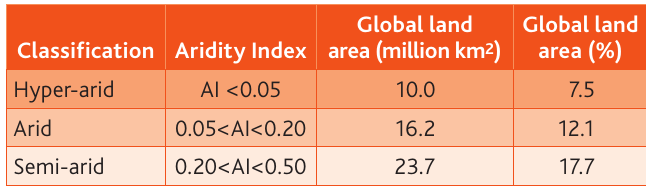
Hot deserts typically receive less than 250mm of precipitation annually, whilst semi-arid regions receive between 250-500mm per year. However, this simple rainfall figure doesn't tell the whole story, which is why the aridity index is more useful - it accounts for how much water could potentially be lost through evaporation and transpiration.
The Sahara Desert has the highest aridity levels, followed by deserts in Arabia, East Africa, Australia and South Africa. The Thar Desert and North American deserts show lower aridity levels, indicating slightly better water availability.
Climate characteristics of hot deserts
Temperature patterns
Hot desert climates are characterised by extreme temperature variations that occur both throughout the year and within a single day. These extremes result from the unique atmospheric conditions found in these regions.
Annual temperature characteristics:
- Daytime temperatures commonly exceed 30°C, with many locations experiencing highs of 45-55°C
- Summer temperatures are consistently very hot across most hot desert regions
- Semi-arid margins experience warm conditions year-round, with hot dry summers and average temperatures around 21-27°C
- Annual temperature ranges increase with distance from the tropics due to greater seasonality
- Desert margins show much larger temperature variations than equatorial arid areas
Diurnal temperature variation:
One of the most distinctive features of hot desert climates is the extreme difference between daytime and night-time temperatures. This diurnal range can exceed 30°C, with some locations experiencing ranges over 40°C.
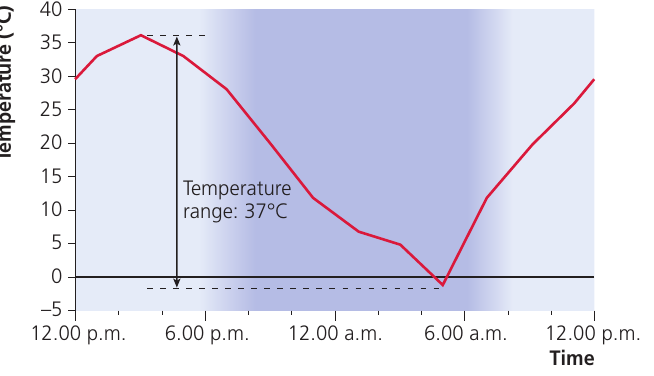
The graph above illustrates a typical 24-hour temperature cycle in a hot desert, showing a temperature range of 37°C. Temperatures peak in the afternoon at around 36°C before dropping rapidly after sunset, reaching near 0°C at dawn.
Example
Understanding Diurnal Range
The diurnal range is calculated by finding the difference between the maximum and minimum temperatures in a 24-hour period.
For example, if a desert location experiences:
- Maximum temperature (afternoon): 36°C
- Minimum temperature (dawn): -1°C
Then the diurnal range = 36°C - (-1°C) = 37°C
This extreme range is characteristic of hot desert environments.
Why do deserts experience such large diurnal ranges?
Note
Two Key Factors
-
Low humidity levels: Hot deserts, particularly those in subtropical latitudes, have extremely low humidity. This means cloud cover is minimal, and clear skies dominate.
-
Clear skies: During the day, cloudless conditions allow large amounts of insolation (incoming solar radiation) to reach the surface, heating it intensely. At night, the absence of clouds means heat escapes rapidly into the atmosphere. Deserts lose twice as much heat at night as more humid latitudes because there are no clouds to trap outgoing radiation.
Night-time temperatures frequently drop below 0°C, with records of around -18°C not being uncommon. This creates challenging conditions for both plants and animals, which must cope with scorching heat by day and freezing temperatures by night.
Precipitation patterns
Rainfall in hot deserts is not only extremely low but also highly unpredictable and variable. This inconsistency makes desert environments particularly challenging for life.
Characteristics of desert rainfall:
- Annual totals are usually well below 250mm
- Some of the driest locations, such as Iquique in the Atacama Desert of Chile, receive almost no rain at all, averaging less than 15mm per year
- The central Sahara receives similarly minimal amounts
- Rainfall often occurs as rare, intense cloudbursts following extended dry periods
- These sudden downpours can deliver the entire annual rainfall total in just a few hours
- The rate of evaporation frequently exceeds the rate of rainfall, meaning much water is lost before it can infiltrate the soil
Important
Cloudburst Events
In desert environments, cloudbursts are sudden, intense rainfall events that can deliver an entire year's rainfall in just a few hours. These rare but powerful storms occur after extended dry periods and can cause flash flooding, as the hard, dry ground cannot absorb water quickly enough.
Regional variations:
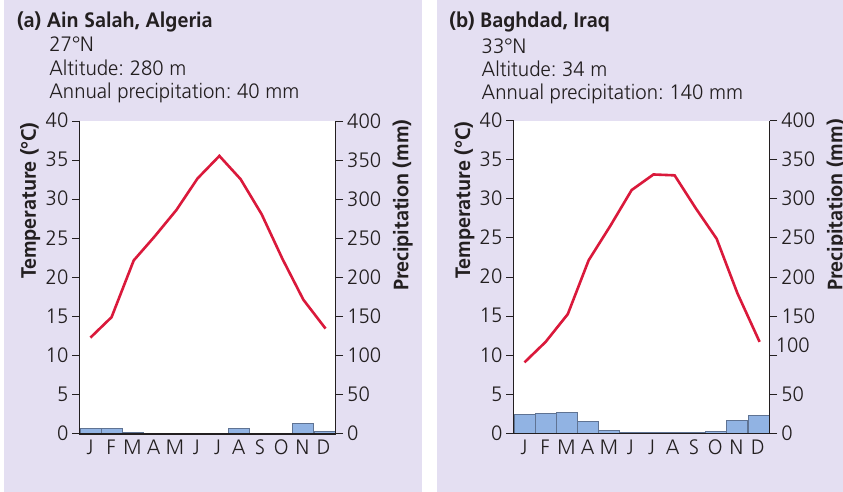
The climate graphs above show two desert locations with different characteristics:
Ain Salah, Algeria (hyper-arid):
- Located at 27°N, altitude 280m
- Annual precipitation: only 40mm
- Temperature peaks around 35°C in summer
- Virtually no rainfall throughout the year
- Represents an extreme desert environment
Baghdad, Iraq (semi-arid):
- Located at 33°N, altitude 34m
- Annual precipitation: 140mm
- Similar temperature pattern to Ain Salah
- Some winter and spring rainfall visible
- Represents a less extreme desert margin
American deserts receive slightly higher rainfall amounts, typically around 280mm annually. Desert margins and semi-arid areas are classified as receiving 250-500mm per year. Whilst this is more than true hot deserts, these regions remain very dry, with rainfall events being unpredictable and often occurring as sudden downpours.
Evapotranspiration:
Note
Due to lower temperatures compared to hot deserts, semi-arid areas lose less moisture through evapotranspiration. In some areas with low night-time temperatures, dew condensation can equal or even exceed the amount of rainfall received, providing an additional water source for plants and animals.
Climate variations across desert types
There is considerable variety in temperature patterns experienced across hot desert areas worldwide, reflecting differences in geographical location and proximity to moderating influences.
Semi-arid region characteristics:
- Warm throughout the year with hot, dry summers
- Average temperatures around 21-27°C
- Temperatures rarely exceed 38°C
- Night-time temperatures remain cool at around 10°C
- Distance from the tropics increases seasonality, creating larger annual temperature ranges
Coastal versus continental deserts:
Note
Oceanic Influence on Temperature
Temperature ranges vary depending on proximity to the ocean. Coastal deserts, such as the Atacama, experience cooler and less extreme temperature ranges than continental interior deserts. The moderating influence of the ocean reduces both maximum daytime temperatures and the diurnal range.
Soil characteristics of hot deserts
Around 17% of the Earth's surface is covered by desert soils. The extent and characteristics of these soils vary considerably across different continents, with Australia having approximately 44% desert soils, Africa 37%, and Eurasia only 15%.
Factors affecting soil development
When soils develop in desert environments, they are typically infertile, with thin soil profiles. Several factors explain the slow rate of soil development and poor soil quality in these regions:
- Lack of moisture: Water is essential for most soil-forming processes, and its scarcity severely limits soil development
- Extremely high temperatures: Intense heat and high evaporation rates mean any moisture present is quickly lost
- Sparse vegetation: With very little plant cover, there is minimal organic material to decompose and enrich the soil
Important
Soil profile
A soil profile is the vertical section of soil showing the different horizontal layers (horizons) from the surface down to the parent material. In deserts, soil profiles tend to be thin and poorly developed.
Desert soil types
The dominant soil order found in hot deserts and their margins is aridisols.
Important
Aridisols
Aridisols are an order of soils that includes infertile alkaline and saline soils characteristic of desert areas. They are distinguished by accumulations of mineral salts (often calcium or sodium compounds) at or near the surface.
Aridisols are typically classified into two main categories:
-
Sierozems (grey desert soils) - found in semi-arid areas receiving around 250mm of rainfall annually
-
Raw mineral soils - found in more arid environments with even less rainfall
Characteristics of aridisols:
- Range from reddish-yellow to grey-brown in colour, depending on the parent material
- Generally very thin profiles, usually less than 100cm deep
- Often have a coarse texture, being rocky or gravelly due to physical weathering
- Tend to be slightly alkaline
- Often unproductive for agriculture
Note
Soil Horizon Structure
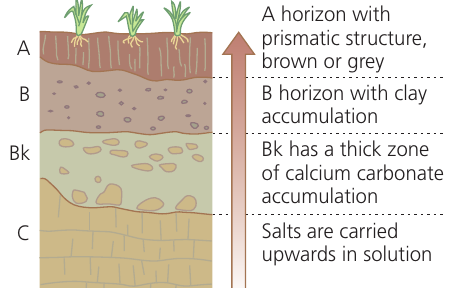
The diagram above shows the typical structure of an aridisol soil profile, with distinct horizons:
- A horizon: Surface layer with prismatic structure, brown or grey colour, containing limited organic material
- B horizon: Subsurface layer where clay accumulates
- Bk horizon: Distinctive zone with thick calcium carbonate accumulation (shown as pale nodules)
- C horizon: Parent material where salts are mobilised and carried upward in solution
Soil processes in desert environments
Capillary movement:
The most significant soil process in desert environments is capillary movement, which differs markedly from processes in more humid environments.
Important
Capillary movement
Capillary movement (or capillary action) is the process where moisture in the soil or subsoil moves upwards through the tiny spaces between soil particles (known as capillaries). This movement occurs when evaporation at the surface draws water upward.
When water exists in the subsoil, capillary action draws dissolved mineral salts (particularly calcium and sodium compounds) upward toward the surface. As this water evaporates in the intense heat, the salts are left behind, accumulating at or near the surface. This process is most effective when evaporation exceeds precipitation - exactly the conditions found in arid environments.
The Bk horizon shown in the soil profile diagram represents this zone of calcium carbonate accumulation, forming what is sometimes called calcrete or caliche. These salt accumulations can form hard crusts at the surface when concentrations become high enough.
Limited leaching:
In contrast to humid environments, desert soils experience very little leaching.
Important
Leaching
Leaching is the downward movement of minerals and nutrients through the soil as water percolates downward. This process removes materials from upper horizons and can deposit them in lower layers.
With minimal rainfall, there is insufficient water percolating through the soil to move minerals downward. This means aridisols have limited variation between different horizons compared to soils in wetter environments. The minerals and nutrients present tend to remain in place rather than being redistributed through the profile.
Note
Contrasting Soil Processes
In desert environments:
- Capillary movement dominates: moisture and salts move UPWARD
- Leaching is minimal: very little downward movement of minerals
- This is the opposite of humid environments where leaching dominates and capillary action is minimal
Physical and chemical weathering:
Raw mineral soils in the most arid areas develop a coarse texture through physical weathering processes. The extreme temperature fluctuations, with intense heating during the day and cooling at night, cause rocks to expand and contract, eventually fracturing them into smaller fragments.
Where water does exist in the subsoil, some chemical weathering can occur. This typically happens in semi-arid areas where groundwater may be present at depth, or where occasional rainfall penetrates into the soil.
Sierozems (grey desert soils):
In semi-arid areas receiving around 250mm of rainfall annually, grey desert soils known as sierozems can develop. The darker colour indicates the presence of some organic material, as these areas typically support 'desert-shrub' vegetation.
These soils are sometimes used for cultivation. With continued irrigation, calcium-rich B horizons can develop beneath the thin A horizon. The irrigation water can lead to accumulations of calcium carbonate or gypsum in the subsurface, giving these deeper layers a lighter colour. These soils remain slightly alkaline and often contain unproductive minerals and nutrients despite having some agricultural potential.
Vegetation characteristics of hot deserts
General characteristics
When people think of deserts, they often imagine completely barren, lifeless landscapes. However, except for the most inhospitable sand sea areas that are constantly mobile, arid and semi-arid regions support a remarkable diversity of plant life.
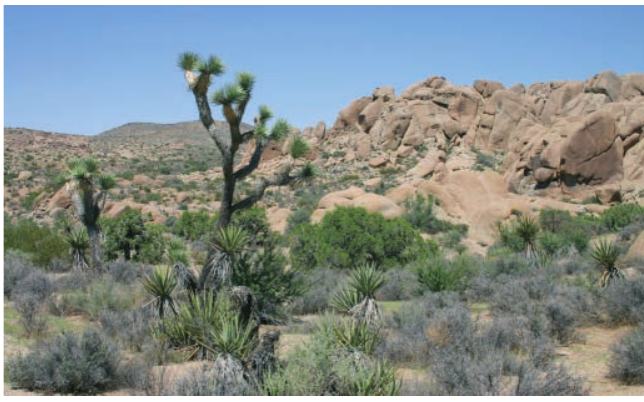
The image above shows typical low-growing desert-shrub vegetation found in arid areas. Plants are usually ground-hugging shrubs or short woody trees, widely spaced across the landscape. This spacing occurs because each plant requires a large area to access sufficient water.
Even in the least hospitable arid environments, vegetation cover remains present, though it is sparse. Net primary productivity (the rate at which plants produce organic matter) ranges from near 0 g/m²/year in the most extreme deserts to 120 g/m²/year in semi-arid areas, depending on temperature and rainfall conditions.
Plant adaptations
The limited water availability, extreme temperatures (both heat and range), and intense constant sunlight have driven desert plants to develop an extraordinary range of physical and behavioural adaptations. These adaptations serve several purposes:
- Maximise use of available water and limit moisture loss
- Store moisture within plant tissues
- Procure water with extensive or deep root systems
- Respond rapidly to sporadic rainfall followed by extended life cycles
Most desert plants are classified as xerophytes - plants adapted to survive in dry conditions.
Important
Xerophytes
Xerophytes are plants that have developed adaptations to survive in environments with very limited water availability. The term comes from Greek words meaning "dry plants."
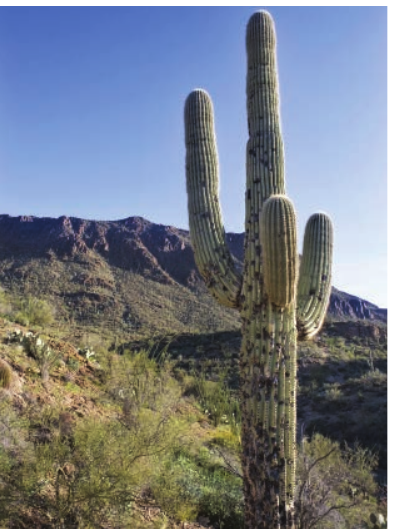
The saguaro cactus shown above exemplifies many classic desert plant adaptations, including succulence, reduced leaves (spines), and an extensive root system.
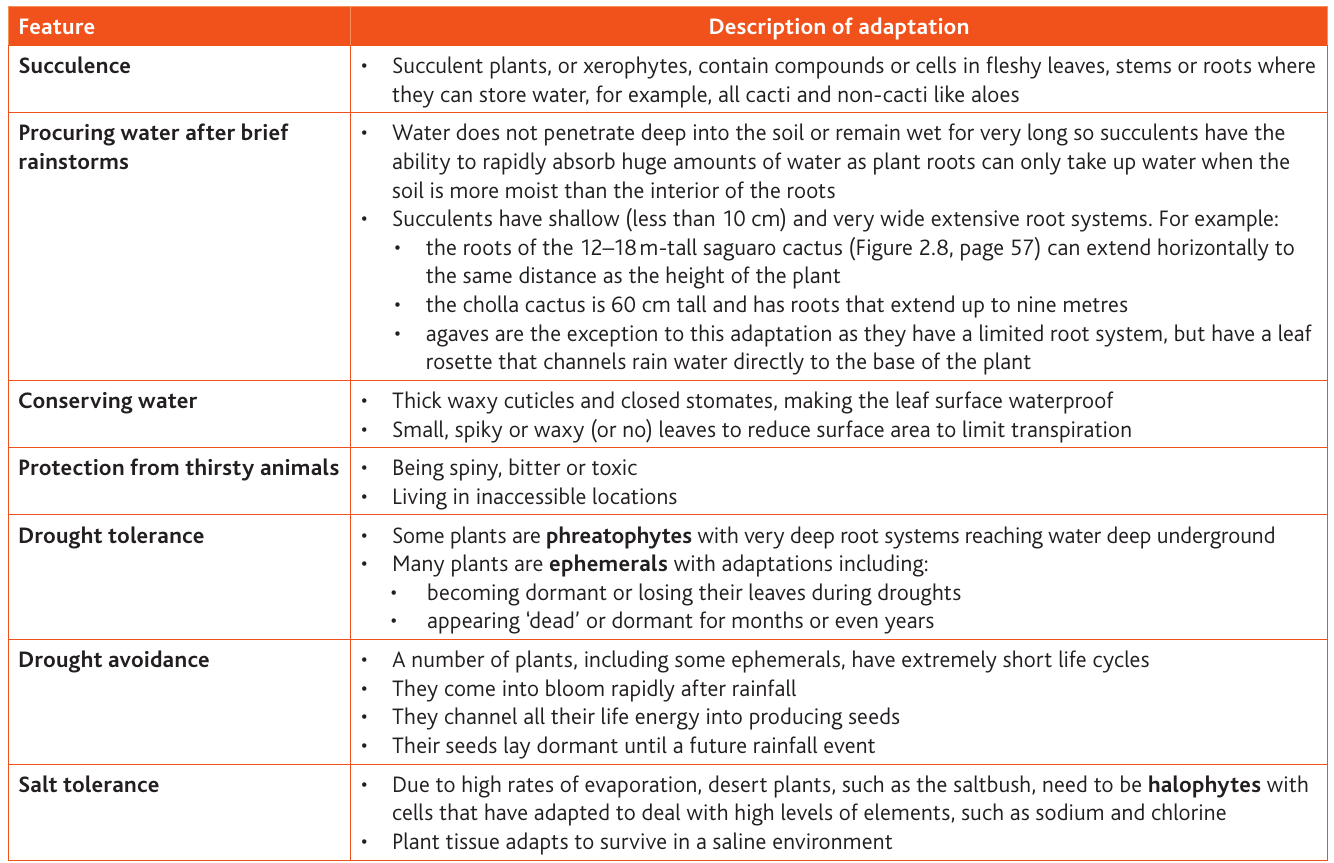
The table above provides a comprehensive overview of desert plant adaptations. Let's explore these in detail:
Succulence:
Note
Water Storage Strategy
Succulent plants (or xerophytes more generally) contain specialised compounds or cells in their fleshy leaves, stems, or roots that enable water storage. Common examples include cacti, agaves, and other non-cacti succulents like aloes.
This adaptation allows plants to absorb and store large quantities of water when it becomes available, then use this reservoir during extended dry periods. The stored water sustains the plant through droughts that might last months or even years.
Procuring water after brief rainstorms:
Water doesn't penetrate deeply into desert soils or remain wet for extended periods, so plants must absorb water rapidly when it becomes available. Succulents have developed the ability to quickly absorb huge amounts of water because plant roots can only take up moisture when the soil is wetter than the interior of the roots.
Root system adaptations include:
- Shallow root systems (less than 10cm deep) that extend horizontally across wide areas. For example, the roots of a 12-18m tall saguaro cactus extend horizontally to the same distance as the plant's height
- The cholla cactus has roots extending up to nine metres from the plant
- Agaves are exceptions, having limited root systems but possessing a leaf rosette structure that channels rainwater directly to the plant's base
Conserving water:
Once water is absorbed, desert plants employ various strategies to minimise water loss:
- Thick, waxy cuticles: These waterproof coatings on leaves and stomata significantly reduce transpiration
- Reduced leaf surface area: Small, spiky, or waxy leaves (or even no leaves at all) limit the surface area through which water can be lost through transpiration
- Many cacti have evolved to eliminate leaves entirely, with photosynthesis occurring in the green stem tissue instead
Protection from thirsty animals:
Note
In water-scarce environments, plants represent valuable water sources for animals. Desert plants have evolved protective features to deter herbivores:
- Being spiny, bitter, or toxic to discourage consumption
- Living in inaccessible locations such as cliff faces or rocky outcrops where animals cannot easily reach them
Drought tolerance:
Some plants have developed remarkable drought tolerance strategies:
Phreatophytes are plants with extremely deep root systems that can access groundwater far underground.
Important
Phreatophytes
Phreatophytes are plants with very deep root systems that reach water sources deep underground, sometimes accessing the water table or underground aquifers.
Ephemerals are plants that have adapted to become dormant or lose their leaves during droughts.
Important
Ephemerals
Ephemerals are plants with adaptations that allow them to become dormant during extended dry periods, appearing 'dead' or dormant for months or even years. They can also lose their leaves during droughts as a water conservation strategy.
Some plants can survive appearing completely dead for extended periods, then rapidly regenerate when water becomes available.
Drought avoidance:
Rather than tolerating drought, some plants avoid it entirely through clever life cycle strategies:
Example
Rapid Life Cycle Strategy
Many ephemeral species employ a drought avoidance strategy:
Step 1: Seeds remain dormant in the soil, sometimes for years, waiting for rainfall
Step 2: When rain arrives, seeds germinate rapidly - often within days
Step 3: Plants grow quickly and come into bloom within weeks
Step 4: All life energy is channelled into producing seeds quickly
Step 5: Seeds are dispersed before the water disappears
Step 6: The cycle begins again - seeds remain dormant until the next rainfall
This strategy allows plants to complete their entire life cycle during brief periods of water availability, avoiding the harsh drought conditions altogether.
Salt tolerance:
Due to high evaporation rates in desert environments, soils often accumulate high concentrations of salts. Plants that can survive in these saline conditions are called halophytes.
Important
Halophytes
Halophytes are plants that have cells adapted to survive in saline (salty) environments. They can tolerate high levels of elements such as sodium and chlorine, with specialised plant tissue that can survive in these harsh chemical conditions.
Examples include saltbush plants, which are commonly found in areas with high soil salinity. Their cellular adaptations allow them to function normally despite salt concentrations that would kill most other plant species.
Summary
Key Points to Remember
-
The aridity index (ratio of P to PET) provides a scientific way to classify desert dryness: hyper-arid (<0.05), arid (0.05-0.20), and semi-arid (0.20-0.50). Together these environments cover 37% of global land area.
-
Desert climates feature extreme temperature variations: daytime temperatures commonly exceed 30°C (reaching 45-55°C in many locations), whilst night-time temperatures can drop below 0°C. This creates diurnal ranges exceeding 30°C, caused by clear skies that allow intense heating by day and rapid heat loss by night.
-
Desert soils (aridisols) are characterised by salt accumulation and thin profiles: Capillary movement draws dissolved salts upward through the soil, leaving accumulations of calcium or sodium compounds at or near the surface when water evaporates. Limited leaching means minerals remain in place rather than moving through the profile.
-
Desert vegetation demonstrates remarkable adaptations including succulence (water storage), extensive or deep root systems (water procurement), reduced leaf surface area and waxy cuticles (water conservation), and varied drought strategies from tolerance to avoidance.
-
Different plant types suit different desert conditions: xerophytes (general drought adaptation), phreatophytes (deep roots accessing groundwater), ephemerals (fast life cycles or dormancy), and halophytes (salt tolerance) each exploit different survival strategies.