Global Distribution (AQA A-Level Geography): Revision Notes
📚Revision Notes
Global distribution
Understanding desert distribution patterns
Deserts are distinctive physical environments found across multiple continents. More than 20% of the Earth's surface is covered by desert regions, making them one of the planet's most extensive landscape types.
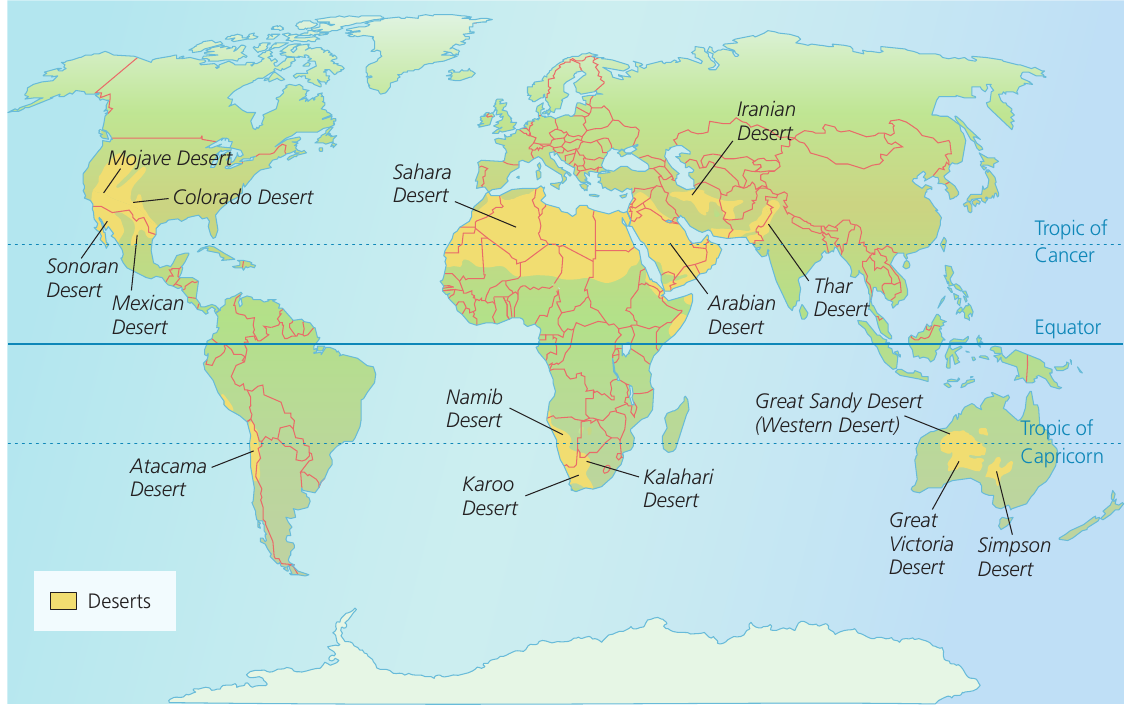
Hot desert environments are not randomly scattered across the globe. Instead, they follow clear geographical patterns. These arid regions typically form in bands that run parallel to the Equator, positioned both north and south of this central line. Most hot deserts are found in mid and low-latitude locations, where specific climatic conditions create extremely dry environments.
Note
The parallel distribution of deserts on either side of the Equator is a result of global atmospheric circulation patterns. This creates two distinct belts of arid environments in both hemispheres, roughly between the Tropic of Cancer and the Tropic of Capricorn.
Global desert locations
Note
Reading the Map
The map above shows the major hot desert regions worldwide. Each colored region represents a distinct desert system, and understanding their distribution helps us recognize the patterns that control where deserts form. Notice how deserts in the northern hemisphere cluster on western continental margins.
Northern hemisphere deserts
In the northern hemisphere, the vast majority of hot desert landscapes are positioned on the western sides of continents. This creates a distinctive distribution pattern across three main regions:
North America
- Mojave Desert
- Sonoran Desert
- Great Basin Desert
- Colorado Desert
- Chihuahuan Desert
- Mexican Desert
These deserts stretch across the southwestern United States and northern Mexico, forming an extensive arid zone.
North Africa
- Sahara Desert (the world's largest hot desert)
- Somali-Ethiopian deserts in the Horn of Africa
The Sahara dominates North Africa, extending from the Atlantic coast to the Red Sea.
Middle East and Asia
- Arabian Desert
- Iranian Desert
- Thar Desert
These deserts form a continuous belt stretching from the Red Sea through the Middle East to Pakistan and India in South Asia.
Important
Northern Hemisphere Pattern
Almost all hot desert landscapes in the northern hemisphere are located towards the west of continents. This is not a coincidence - it's caused by prevailing wind patterns, cold ocean currents along western coasts, and the rain shadow effect of mountain ranges.
Southern hemisphere deserts
Hot desert areas in the southern hemisphere show a more varied distribution pattern across three continents:
South America
- Atacama Desert (one of the world's driest places)
Located along the Pacific coast of South America, the Atacama occupies a narrow strip in Chile and Peru.
Southern Africa
- Namib Desert
- Kalahari Desert
- Karoo Desert
These three deserts span across several southern African countries, creating a substantial arid zone.
Australia
- Great Sandy Desert (also called Western Desert)
- Great Victoria Desert
- Simpson Desert
Australia's interior contains multiple desert regions that together cover a large proportion of the continent.
Key terminology
Important
Arid
The climate of an area that receives less than 250 mm of precipitation per year.
Important
Semi-arid
The climate of an area that receives between 250 and 500 mm of precipitation per year.
Important
Desert
An arid environment receiving very low levels of rainfall.
Important
Aridity index
The ratio between precipitation (P) and potential evapotranspiration (PET). This measure helps classify how dry a region is.
Important
Continentality
The impact of increasing distance from the coast on the climate of an area. Greater continentality typically means more extreme temperature ranges and reduced rainfall.
Important
Water balance
The relationship between the annual precipitation received and the amount of water lost to potential evapotranspiration. In deserts, evapotranspiration greatly exceeds precipitation.
Remember!
Summary
Key Points to Remember:
- Deserts cover more than one-fifth (20%) of the Earth's surface, making them a major global biome
- Hot deserts form in parallel bands north and south of the Equator, primarily in mid and low-latitude zones
- In the northern hemisphere, most hot deserts are located on the western sides of continents
- Major northern hemisphere deserts include the Sahara, Arabian, and North American desert systems
- Southern hemisphere deserts include the Atacama, southern African deserts, and Australian interior deserts
- Arid climates receive less than 250 mm of rain annually, whilst semi-arid regions receive 250-500 mm per year