Change in Magnitude of Water Stores (AQA A-Level Geography): Revision Notes
📚Revision Notes
Change in Magnitude of Water Stores
Introduction
Water on Earth exists in various stores, and the amount of water held in each store changes over time. These changes in magnitude are driven by natural processes that move water between different states and locations. Understanding these stores and the factors that influence them is essential for comprehending the global water cycle and its impact on physical geography.
Types of water stores
Groundwater
Groundwater represents water that exists beneath the Earth's surface. The water table marks the boundary below which all gaps in soil and rock are completely filled with water. This is where the saturated zone begins.
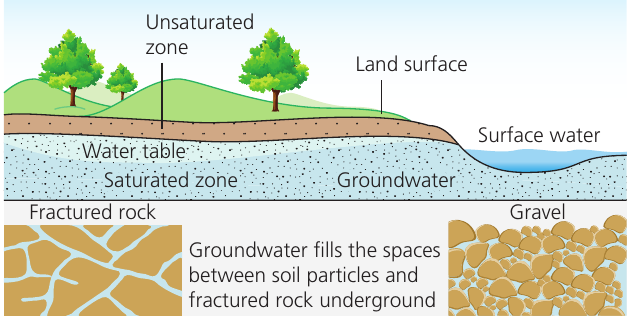
Above the water table lies the unsaturated zone, where soil pore spaces contain both air and water. Below the water table, in the saturated zone, groundwater fills all available spaces between soil particles and within fractured rock. This water moves slowly through underground rocks and eventually flows towards the surface.
Note
Natural discharge of groundwater commonly occurs at springs and seeps, where water emerges from the ground. However, the amount of groundwater is declining in many areas due to intensive extraction for agricultural irrigation, particularly in dry regions where this resource is heavily relied upon.
Important
Saturated refers to the condition when soil pore spaces or fractures in rock become completely filled with water, with no air gaps remaining.
Soil water
Soil water is held within the unsaturated upper weathered layers of the Earth, alongside air. This water store plays a fundamental role in numerous hydrological, biological, and biogeochemical processes. Its importance extends to several areas:
- Weather and climate regulation
- Run-off potential and flood control
- Soil erosion and slope stability
- Reservoir management and geotechnical engineering
- Water quality maintenance
Soil moisture acts as a key variable in controlling the exchange of water and heat energy between the land surface and the atmosphere. This exchange occurs through evaporation and plant transpiration. Consequently, soil moisture has a significant influence on weather pattern development and precipitation production.
Important
Transpiration is the loss of water from vegetation through tiny pores (stomata) on leaf surfaces.
Biological water
Water stored within living organisms and plants is known as biological water. The amount of biological water varies considerably across the globe, depending on vegetation cover and type. Dense rainforests store substantially more water than desert environments. Whilst animals also contain water, their role as a water store is minimal compared to vegetation.
Trees absorb water through their root systems. This water is either transported to and stored within the trunk and branches, or lost through transpiration via stomata in the leaves. When vegetation is destroyed, this water store is lost to the atmosphere, potentially making the climate more desert-like.
Note
Plants are adapted to store water in large quantities through their extensive root systems, using it gradually until the next rainfall. The baobab tree provides an interesting example - it stores water within its structure rather than primarily using it for growth.
The atmosphere
Atmospheric water exists in three distinct states. The most prevalent form is water vapour, which exists as a gas. Water vapour is clear, colourless, and odourless, so we often take its presence for granted. Despite being invisible, atmospheric water vapour plays a crucial role - it absorbs, reflects, and scatters incoming solar radiation, maintaining the atmosphere at a temperature that can sustain life.
The quantity of water vapour that air can hold depends on its temperature. Cold air has a much lower capacity to hold water vapour compared to warm air. This temperature-dependent capacity explains why polar regions tend to be quite dry, whilst tropical areas experience high humidity.
Note
Even a small increase in water vapour levels can lead to an increase in atmospheric temperatures. This creates a positive feedback mechanism: a modest rise in global temperature leads to increased global water vapour levels, which further enhances atmospheric warming.
Cloud represents a visible mass of water droplets or ice crystals suspended in the atmosphere. Cloud formation occurs when air in the lower layers of Earth's atmosphere becomes saturated. This saturation happens through either cooling of the air, an increase in water vapour content, or both processes together. When cloud droplets grow sufficiently large, they eventually fall as rain.
Factors driving changes in water store magnitude
Phase changes and energy transfers
Water exists on Earth in three forms: liquid water, solid ice, and gaseous water vapour. The movement of water between these states involves energy transfers in the form of latent heat. This energy is either absorbed or released depending on the specific process occurring.
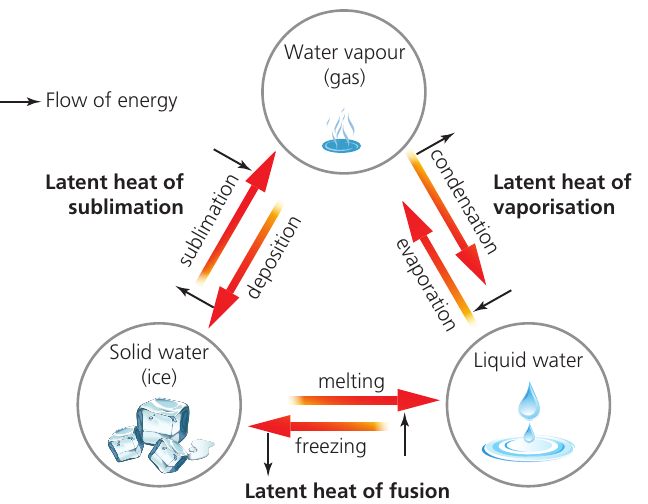
The diagram above illustrates the six main phase changes:
- Melting: solid ice transforms into liquid water (absorbs latent heat of fusion)
- Freezing: liquid water transforms into solid ice (releases latent heat of fusion)
- Evaporation: liquid water transforms into water vapour (absorbs latent heat of vaporisation)
- Condensation: water vapour transforms into liquid water (releases latent heat of vaporisation)
- Sublimation: solid ice transforms directly into water vapour (absorbs latent heat of sublimation)
- Deposition: water vapour transforms directly into solid ice (releases latent heat of sublimation)
Note
These phase changes are particularly important in atmospheric processes such as cloud formation and precipitation. Remember: processes that absorb energy (melting, evaporation, sublimation) cool their surroundings, while processes that release energy (freezing, condensation, deposition) warm their surroundings.
Evaporation
Evaporation occurs when solar radiation energy strikes the surface of water or land, causing liquid water to change state into a gas (water vapour). Several factors influence the rate at which evaporation takes place:
- Amount of solar energy: Greater solar radiation increases evaporation rates
- Availability of water: More evaporation occurs from a pond than from a grassy field
- Humidity of the air: When air is closer to saturation point, evaporation slows down
- Air temperature: Warmer air can hold more water vapour than cold air
Terrestrial plants lose water through transpiration, where water is transported from the roots to the leaves and then released through leaf surface pores. Leaves can also intercept rainfall as it falls, and this intercepted water may evaporate before reaching the soil.
Important
As water evaporates, it utilises energy in the form of latent heat, which cools its surroundings. This cooling effect is why sweating helps regulate body temperature and why evaporative cooling is effective in hot, dry climates.
Condensation
When air cools, its capacity to hold water vapour decreases. If it cools sufficiently, the air becomes saturated and reaches a temperature known as the dew point. At this stage, excess water vapour in the air converts to liquid water through condensation.
Water molecules require a surface to condense upon. These surfaces are called condensation nuclei and can be tiny particles such as smoke, salt, dust, or other materials. Alternatively, condensation can occur on larger surfaces like leaves, grass stems, or windows that fall below the dew point temperature. If the surface temperature drops below freezing, water vapour can sublimate, changing directly from gas to solid in the form of hoar frost.
Important
Condensation is the direct cause of all forms of precipitation. It occurs when the temperature of air is reduced to dew point whilst its volume remains constant.
This happens in two main ways:
- Warm moist air passing over a cold surface - for example, on a clear winter's night when heat radiates out to space and the ground becomes colder, cooling the air in direct contact with it
- Air volume increasing without additional heat (adiabatic cooling) - this occurs when:
- Air is forced to rise over hills (relief or orographic effect)
- Masses of air with different temperatures and densities meet, with less dense warm air rising over denser cold air (frontal effect)
- Localised warm surfaces heat the air above, causing it to expand, become less dense, and rise (convectional effect)
Cryospheric processes
Cryospheric processes are those that affect the total mass of ice at any scale, from local patches of frozen ground to ice sheets and sea ice. These processes include accumulation (the build-up of ice mass) and ablation (the loss of ice mass).
Earth's history has witnessed five major glacial periods. The most recent began approximately 2.58 million years ago and continues today; this is called the Quaternary glaciation. During this period there have been:
- Glacial periods - when the volume of ice on land caused sea level to fall approximately 120 metres lower than present levels. Continental glaciers covered large parts of Europe, North America, and Siberia. This represented a significant interruption in the global hydrological cycle.
- Interglacial periods - when global ablation exceeds accumulation and the hydrological cycle returns to conditions similar to today.
Over the past 740,000 years, there have been eight such glacial cycles.
Note
Permafrost forms when air temperatures remain so low that they freeze any soil and groundwater present. It rarely occurs under ice because temperatures beneath ice sheets are typically not low enough.
Important
Cryospheric processes are those processes that affect the total mass of ice at any scale. They include accumulation (the build-up of ice mass) and ablation (the loss of ice mass).
Drainage basin systems
Understanding drainage basins
A drainage basin (also called a catchment area) represents the area of land that supplies a river with its water. This includes water found on the surface, within the soil, and in near-surface geology. Drainage basins are separated from one another by high land called a watershed.
Note
A useful way to understand drainage basins is to view them as cascading systems. They function as a series of open systems that link together, where the output of one becomes the input of the next.
Key processes in drainage basins
Within a drainage basin, water moves through various processes:
- Infiltration: the downward movement of water from the surface into soil
- Percolation: the downward movement of water within rock under the soil surface; rates vary depending on rock characteristics
- Throughflow: the movement of water downslope through the subsoil under the influence of gravity; particularly effective when underlying impermeable rock prevents further downward movement
- Groundwater flow: the slow movement of water through underlying rocks
- Overland flow: the tendency of water to flow horizontally across land surfaces when rainfall has exceeded the infiltration capacity of the soil and all surface stores are full to overflowing
Additional important concepts include:
- Interception store: precipitation that falls on vegetation surfaces (canopy) or human-made cover and is temporarily stored there. Intercepted water can be evaporated directly to the atmosphere, absorbed into the canopy surfaces, or ultimately transmitted to the ground surface.
- Stemflow: the portion of intercepted precipitation that reaches the ground by flowing down stems, stalks, or tree trunks
- Throughfall: the portion of precipitation that reaches the ground directly through gaps in the vegetation canopy and drips from leaves, twigs, and stems; this occurs when the canopy-surface rainwater storage exceeds its capacity
Important
Run-off is all the water that enters a river channel and eventually flows out of the drainage basin.
Important
Evapotranspiration is the total output of water from the drainage basin directly back into the atmosphere.
Important
Water balance is the balance between inputs (precipitation) and outputs (run-off, evapotranspiration, soil and groundwater storage) in a drainage basin.
Summary
Key Points to Remember:
-
Water stores include groundwater (below water table), soil water (in unsaturated zone), biological water (in living organisms), and atmospheric water (vapour, clouds, ice crystals).
-
Changes in water store magnitude are driven by phase changes involving latent heat - energy is absorbed during melting, evaporation, and sublimation; energy is released during freezing, condensation, and deposition.
-
Evaporation rates depend on solar energy availability, water availability, air humidity, and air temperature. Condensation occurs when air cools to its dew point temperature.
-
Cryospheric processes (accumulation and ablation of ice) have caused major changes in water stores throughout Earth's history, with glacial and interglacial periods significantly affecting sea levels and the hydrological cycle.
-
Drainage basins function as cascading systems with multiple inputs, stores, transfers (infiltration, percolation, throughflow, groundwater flow), and outputs (run-off, evapotranspiration).